
Anxiety affects sleep most painfully when it turns bedtime into a test the body keeps failing. The mind may be exhausted, the room may be dark, the phone may be away, and still the nervous system behaves as if vigilance is required. Then the next day arrives with less emotional margin, more threat sensitivity, and a stronger memory that night is not safe.
That loop is not rare, and it is not explained by weak discipline. In generalized anxiety disorder, up to 90% of people report insomnia symptoms, and a 2025 Stanford Medicine overview notes that people with insomnia are 17 times more likely to have anxiety than the general population.[1][2] An American Academy of Sleep Medicine survey, fielded in May 2024 among 2,006 U.S. adults, found that 68% of Americans reported losing sleep because of anxiety, while fewer than 1 in 5 sought professional help.[3]
Those numbers set the scale. They do not, by themselves, explain the trap. The more useful question is what happens inside the brain and body when ordinary nighttime worry becomes physiological arousal, and why one bad night can make anxiety feel louder the next day.
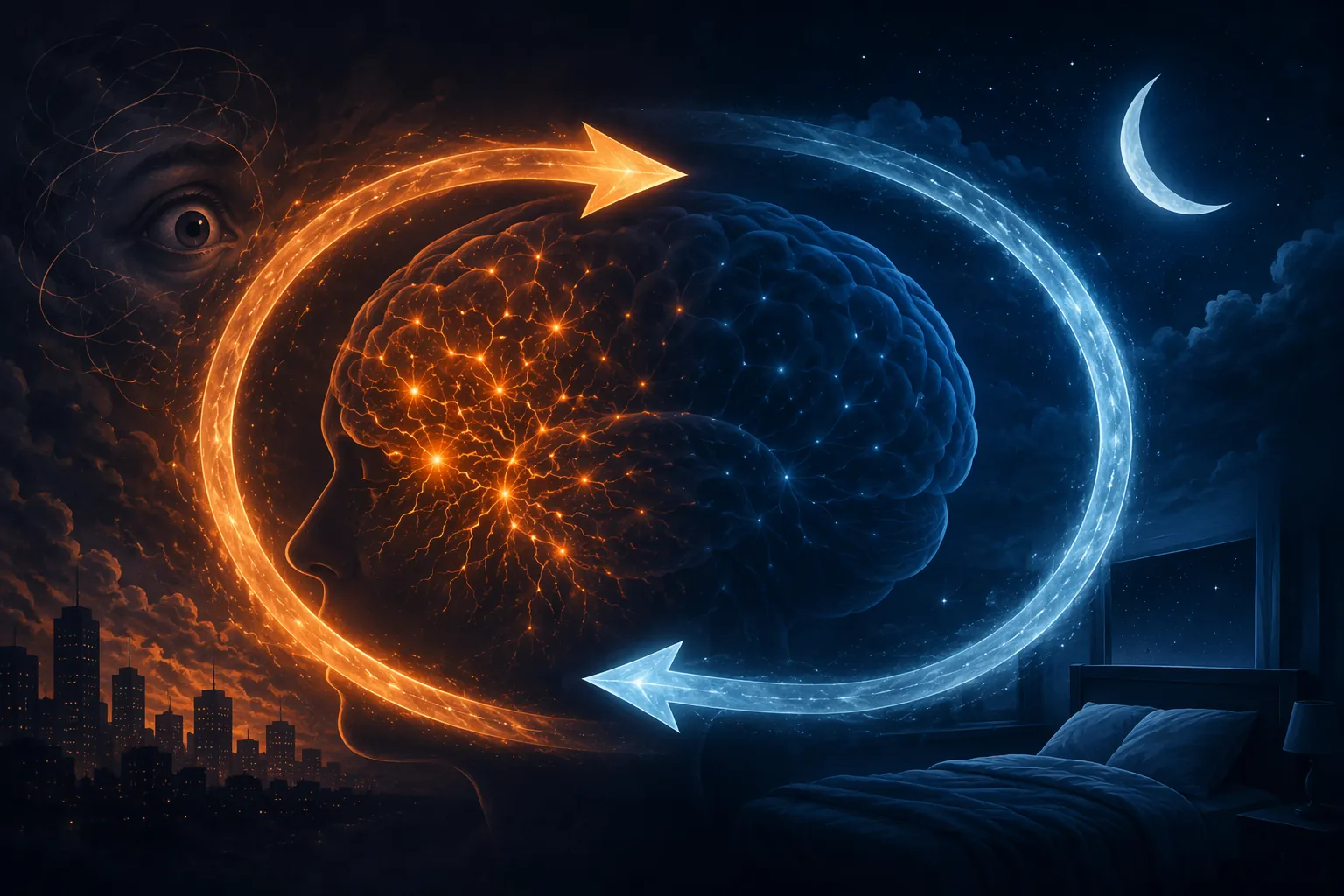
The body can be tired while the threat system stays awake
Sleep begins more easily when the brain can lower threat monitoring. Anxiety does the opposite. It keeps attention scanning, interpretation biased toward danger, and the body prepared to respond. That preparation is not just a thought pattern; it is carried by stress hormones, limbic reactivity, cortical control systems, and inhibitory-excitatory signaling.
Kalmbach and colleagues describe insomnia through hyperarousal and sleep reactivity: some people have a trait-like vulnerability in which stress is especially likely to disturb sleep. Sleep reactivity is estimated to be 29% to 37% heritable, and in the reviewed data, highly reactive insomniacs reported about 65 minutes of sleep latency compared with about 37 minutes among low-reactive insomniacs.[4] That does not mean sleep is genetically fixed. It means some nervous systems are easier to push into nighttime alertness, especially under stress.
This is one reason generic advice can feel insulting when it is offered as the whole answer. A calmer room may help. A consistent schedule may help. But if the stress system is still signaling readiness, the bed can become the place where the body lies still while the brain continues threat rehearsal.
HPA-axis activation keeps the night from feeling biologically neutral
The hypothalamic-pituitary-adrenal axis, often shortened to the HPA axis, is one of the body’s major stress-response systems. When the brain appraises a threat, the HPA axis helps coordinate hormonal readiness, including cortisol activity. In a clean textbook diagram, this is adaptive: detect danger, mobilize, recover. Anxiety-related insomnia is messier because the perceived threat may be unresolved, internal, or future-oriented.
At night, this matters because sleep requires a shift away from mobilization. If the stress system remains active, the person is not merely “thinking too much.” The body is receiving a signal that downshifting may be unsafe. This is why financial worry, health worry, relationship uncertainty, and other unresolved stressors can feel sharper in bed than they did at 4 p.m. The environment has become quiet enough for cognitive arousal to dominate, while the physiology underneath it is still prepared for defense.
This same pathway is visible in other stress-related sleep patterns, such as the way student loan stress can keep people awake at night. The topic changes; the mechanism is familiar. Cognitive threat keeps feeding physiological readiness, and physiological readiness makes the thought feel urgent.
The amygdala gets louder when prefrontal control gets weaker
The amygdala helps detect emotional salience and threat. The prefrontal cortex helps regulate, reinterpret, and down-shift those signals. In both anxiety and insomnia, neuroimaging evidence points to amygdala hyperactivity alongside reduced prefrontal cortical control, which can impair the brain’s ability to down-regulate arousal at bedtime.[4]

This helps explain a specific cruelty of anxiety-driven insomnia: insight often remains intact. A person can know that tomorrow’s meeting is unlikely to ruin their life, that the body is safe in bed, and that checking the clock will not help. But knowing is not the same as down-regulating. If the alarm system is amplified and the regulatory system is underpowered, the thought “I need to sleep now” can itself become another threat cue.
That is also why bedtime anxiety can shift form. One night it is a work problem. Another night it is a health sensation. Another night it is the fear of not sleeping. The content changes, but the underlying circuit may be doing the same basic job: scanning for danger while the rest of the person is trying to surrender consciousness.
GABA and glutamate help decide whether arousal can settle
The sleep-anxiety loop is also chemical. GABA is the brain’s main inhibitory neurotransmitter; glutamate is its main excitatory neurotransmitter. Sleep depends partly on the nervous system’s ability to reduce excitation and permit inhibition. Anxiety pushes in the other direction, making arousal easier to start and harder to quiet.
This does not mean every anxious sleeper has the same neurochemical profile, or that the experience can be reduced to one molecule being too high or too low. The useful point is broader: anxiety and insomnia share systems that regulate arousal. When those systems tilt toward excitation, sleep onset can stretch out, awakenings can feel charged, and returning to sleep can become a second round of threat monitoring.
The pattern a person notices may vary. Some mainly struggle to fall asleep; others fall asleep and then wake repeatedly or too early. If the distinction is unclear, mapping the pattern can help separate sleep-onset insomnia from sleep-maintenance insomnia, as in this guide to identifying insomnia patterns. The mechanism is not identical in every person, but the common theme is that the nervous system has trouble moving from readiness into stable sleep.
Poor sleep feeds anxiety back into the next day
The loop does not end when the alarm goes off. Sleep loss can weaken emotional regulation, increase reactivity, and make the next day’s stressors feel more threatening. Anxiety disrupts sleep, but disrupted sleep also changes the emotional brain that has to handle tomorrow.
REM sleep is especially relevant because it is involved in emotional memory processing. Anxiety can disrupt REM sleep, and disrupted REM may impair emotional memory consolidation in ways that heighten next-day anxiety.[5] This is not a claim that every anxious night causes the same REM disturbance or the same next-day symptoms. It is a mechanism for why the bad night is not simply lost rest; it can alter the emotional conditions under which the next day is lived.
After enough repetitions, the person may begin fearing the night before it starts. The bed is no longer just a bed. It is where the body remembers clock-checking, bargaining, dread, and the embarrassing feeling of being unable to perform the most basic biological task. This is conditioned arousal, and it is one of the reasons anxiety-related insomnia can persist even after the original stressor has faded.
Similar bidirectional patterns appear in other conditions where intrusive thoughts and sleep disruption reinforce each other, including the cycle described in OCD and sleep problems. The important part is not the diagnosis label; it is the learned pairing between nighttime, wakefulness, and threat.
Why staying in bed awake can train the wrong association
The 20-minute stimulus-control idea is often flattened into a rule: if you cannot sleep after about 20 minutes, get out of bed. The mechanism matters more than the stopwatch. Staying in bed awake for long stretches can reinforce a learned association between the bed and arousal, worry, frustration, or monitoring.[4]
In practical terms, the brain is always learning context. If the bed repeatedly becomes the place where a person lies still while rehearsing danger, the bed begins to predict that state. Then the bedroom itself can trigger alertness before any specific worry has fully formed.
Getting out of bed when sleep is not happening is not a moral victory and not a punishment. It is an attempt to protect the bed-sleep association. The goal is to stop giving the nervous system hours of practice pairing the mattress with threat rehearsal. For people whose sleep is fragmented across the night, this can interact with sleep drive as well; sleep-maintenance insomnia often needs a more precise explanation than “you must be stressed.”
A strong association is not the same as proof for everyone
Some studies show very large links between sleep quality and anxiety in specific groups. One 2025 study of Tibetan university students reported an odds ratio of 44.8 for poor sleep quality and anxiety.[6] That is striking, but it should not be treated as a general-population estimate. The sample is specific, including a high-altitude context, so it is better read as contextual support for a sleep-anxiety relationship than as a universal measure of risk.
This caution matters because people with insomnia are often handed overconfident explanations. Anxiety-related sleep disruption is biological, but biology is not a single script. One person may show mainly sleep-onset arousal. Another may wake at 3 a.m. into panic-like alertness. Another may sleep enough hours but lose restorative depth and wake emotionally raw. The shared systems help explain the loop; they do not erase individual variation.
Why sleep hygiene is usually not enough
Sleep hygiene is not useless. Regular timing, light management, caffeine boundaries, and a bedroom that supports sleep can reduce unnecessary friction. The problem is that sleep hygiene is often offered as if anxiety-driven insomnia is mainly a habits problem. Once the bed is conditioned to arousal and the nervous system is biologically reinforced toward threat-readiness, a cleaner routine may not reach the maintaining mechanism.
That is why cognitive behavioral therapy for insomnia, or CBT-I, matters in this discussion. Xue and colleagues describe insomnia as playing a central role in generalized anxiety disorder and note that CBT-I reduces anxiety severity even without directly targeting anxiety.[1] That finding is easy to underestimate. It suggests that treating sleep is not cosmetic symptom management; it can affect one of the systems helping anxiety persist.
CBT-I is not just “relax before bed” with a clinical name. It targets the learned and physiological patterns that keep insomnia alive: time awake in bed, irregular sleep opportunity, catastrophic sleep beliefs, and the mismatch between sleep drive and sleep effort. It is a direct response to the mechanism. If insomnia is helping maintain anxiety, then sleep treatment does not have to wait politely in the background until all anxious thoughts are solved.
This also gives a more humane answer to the person doing everything “right” and still lying awake. The failure may not be in the lavender-free details of the routine. The problem may be that the nervous system has learned night as a threat context, while stress biology, emotional circuitry, and arousal chemistry keep confirming the lesson.
The implication
How anxiety affects sleep is not a simple matter of worry delaying bedtime. Anxiety can activate stress physiology, amplify amygdala threat signaling, weaken prefrontal down-regulation, and tilt arousal systems away from sleep. Poor sleep then feeds back into emotional reactivity, REM-related processing, and conditioned fear of the bed.
That is the reason evidence-based sleep treatment deserves more respect than generic sleep hygiene in anxiety-related insomnia. Sleep disruption is not merely a downstream symptom of anxiety. It can become part of the machinery that keeps anxiety active.
References
- Sleep disturbances in generalized anxiety Disorder: The central role of insomnia. Sleep Medicine. 2025.
- How sleep affects mental health (and vice versa): What the science says. Stanford Medicine. 2025.
- Stress, anxiety and depression: Survey shows mental health conditions disrupt a majority of Americans' sleep. American Academy of Sleep Medicine. 2025.
- Hyperarousal and sleep reactivity in insomnia: current insights. PMC. 2018.
- Anxiety and Sleep: Understanding the Connection for Better Rest. Sleep Foundation.
- Frontiers in Psychology article on poor sleep quality and anxiety among Tibetan university students. Frontiers. 2025.
Comments
Join the discussion with an anonymous comment.