
Mechanism explainer
How declining SIRT1 and NAD+ make your sleep lighter
Age-related declines in the enzymes SIRT1 and NAD+ directly impair circadian rhythm and restorative slow-wave sleep. This article explains the mechanism and reviews early evidence that restoring NAD+ can improve sleep quality in older adults — with important caveats about timing, dosing, and study limitations.
Sleep often changes before people have words for the change. It may still arrive, but it feels thinner. The first half of the night no longer has the same heavy, sealed-off quality. Wake-ups become easier to trigger. Morning comes earlier than desired, and daytime alertness depends more on luck than it used to.
That is why the phrase “how reversing aging enzymes affect sleep quality” needs a careful correction at the start. Enzymes are not being reversed like a clock in a movie. The more precise question is whether restoring or supporting the activity of age-sensitive systems — especially SIRT1 and its required cofactor NAD+ — can improve the timing and depth of sleep.
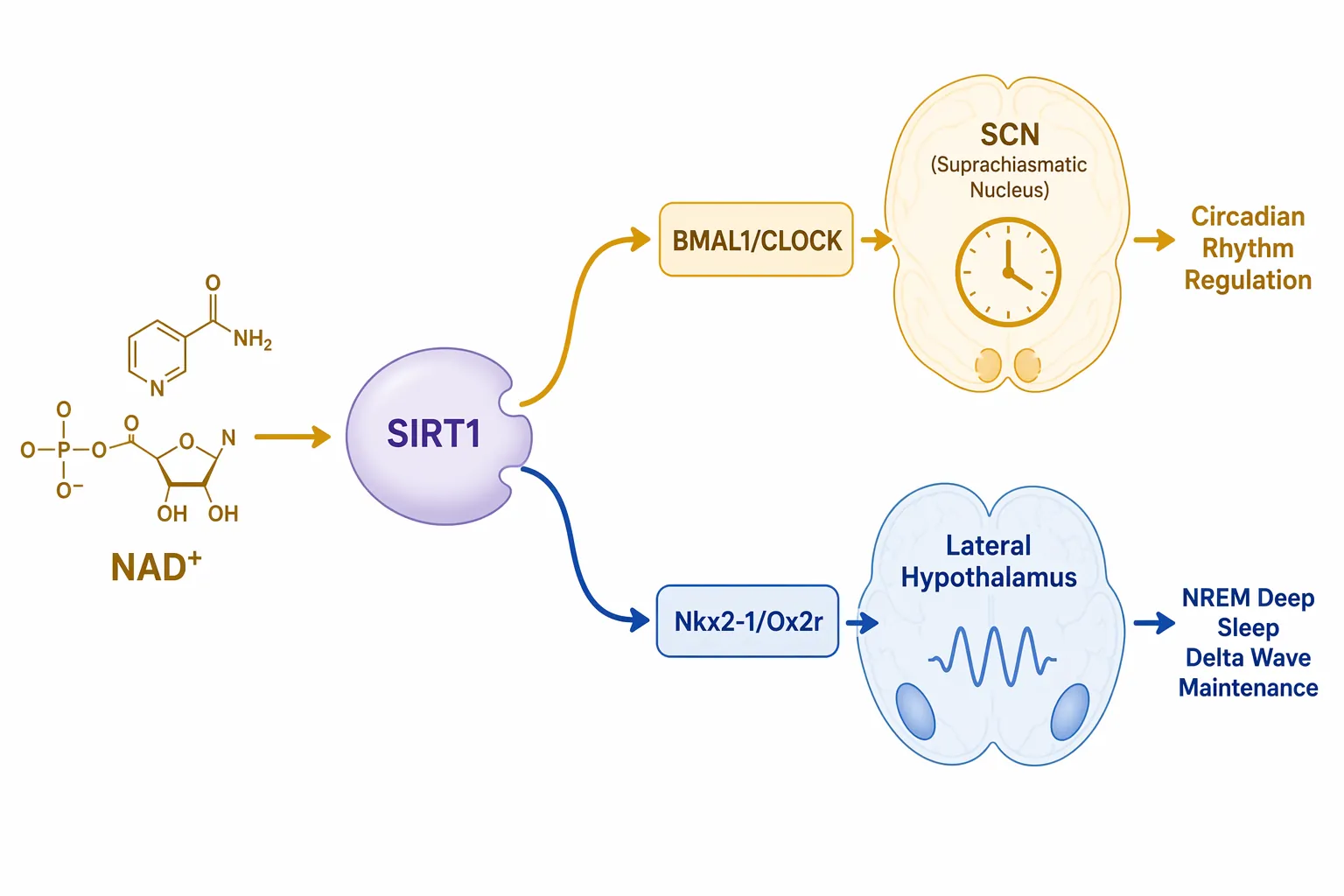
SIRT1 is often discussed in longevity circles, but for sleep it matters because it sits close to two parts of the machinery older adults actually feel: the circadian clock that tells the body when night is, and the NREM slow-wave system that helps sleep feel physically restorative. A review of SIRT1, sleep, and Alzheimer’s disease describes SIRT1 as a regulator of circadian rhythm in the suprachiasmatic nucleus through BMAL1/CLOCK transcription, and as a contributor to NREM delta-wave maintenance through the SIRT1/Nkx2-1/Ox2r pathway in the lateral hypothalamus.[1]
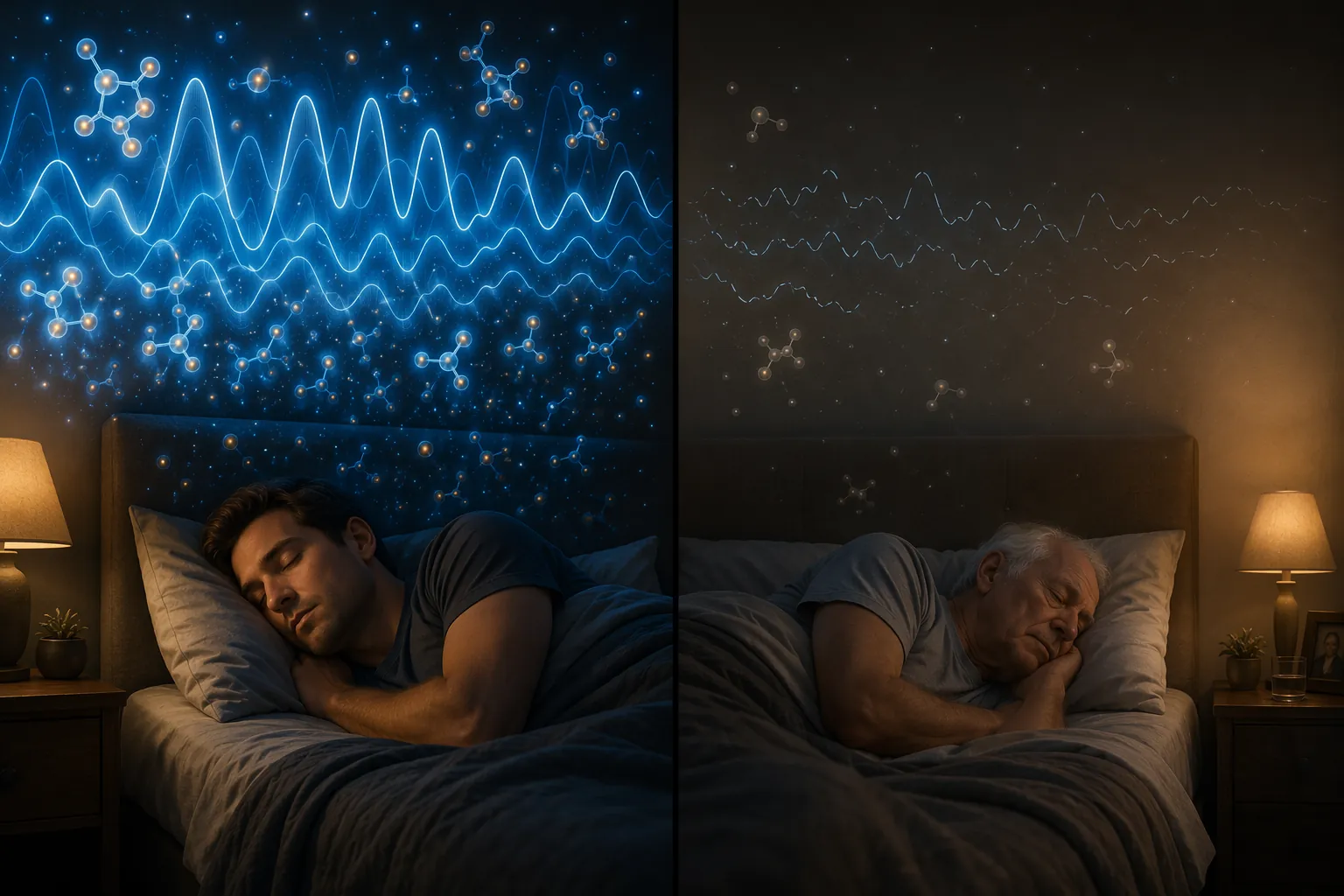
Why lighter sleep is not just a bad habit
Older adults are often handed the same sleep advice younger adults get: dim the lights, keep a schedule, avoid late caffeine, make the bedroom cool. Those habits can matter. But they do not fully explain why a person who used to sleep through thunderstorms now wakes when the heating system clicks on.
Aging sleep is not only a matter of behavior. It is also a matter of signal strength. The circadian system has to send a strong enough “night” signal. The sleep homeostat has to build and discharge enough pressure to support deep NREM sleep. If the molecular systems behind those signals weaken, sleep can become easier to interrupt even when a person is doing many things right.
SIRT1 and NAD+ are not the whole explanation for aging sleep. They are one biologically specific route into the problem. NAD+ is required for SIRT1 activity, and NAD+ levels decline with age in several tissues. When NAD+ availability falls, SIRT1-dependent regulation can weaken. In sleep terms, that raises a plausible mechanism: the clock may become less sharply timed, and deep NREM sleep may lose some of its electrical density.
For practical age-adapted sleep guidance, this mechanism pairs naturally with broader strategies such as consistent light exposure, regular wake time, and daytime activity. If you want that applied layer, see evidence-based sleep tips for healthy aging. The purpose here is narrower: to explain why the biology underneath those strategies may have changed.
The clock pathway: SIRT1 helps the brain keep circadian time
The suprachiasmatic nucleus, or SCN, is the brain’s master circadian clock. It does not merely notice time; it coordinates rhythmic gene expression so the rest of the body can anticipate light, darkness, activity, feeding, and sleep.
Inside that system, BMAL1 and CLOCK are core transcriptional drivers. They help turn circadian genes on and off in a roughly daily rhythm. SIRT1 interacts with this machinery in the SCN, influencing BMAL1/CLOCK-related transcription and thereby helping maintain circadian rhythm regulation.[1]
This matters because many older adults do not simply sleep less; their timing shifts. Sleepiness may arrive earlier in the evening, waking may occur earlier in the morning, and the internal night may feel less stable. A weaker circadian signal can make sleep more vulnerable to noise, temperature, pain, worry, or a bathroom trip. Once awake, the body may not produce a convincing enough “it is still night” message to pull sleep back together.
Animal work strengthens this clock argument. In aged mice, NAD+ restoration has been shown to restore SIRT1 activity, improve BMAL1 binding to chromatin, and recover circadian rhythmicity.[2][3] That does not prove the same intervention will normalize sleep in older humans. It does show that NAD+ and SIRT1 are not vague “anti-aging” decorations; they sit inside a clock mechanism that can be measured.
The deep-sleep pathway: delta power has its own biology
Deep sleep is often reduced to a feeling: “I slept hard” or “I never got under.” In the laboratory, one important marker is delta power during NREM sleep. Delta activity reflects the slow, synchronized brain rhythms associated with the most restorative part of sleep.
The SIRT1 sleep review describes a second pathway that is especially relevant here: SIRT1 helps preserve delta-wave power in NREM sleep through a SIRT1/Nkx2-1/Ox2r pathway in the lateral hypothalamus.[1] The names are technical, but the implication is plain. The depth of sleep is not just a mood, a preference, or a bedtime routine. It is partly maintained by specific hypothalamic signaling.
When people say their sleep became lighter with age, they are often describing the surface of a deeper change: less robust slow-wave activity, more awakenings, and less confidence that sleep pressure will carry them through the night. SIRT1 gives that complaint a physical address. It does not make the whole problem simple, but it makes it less dismissible.
This is also where supplement claims often run too fast. If SIRT1 contributes to deep-sleep regulation, it does not follow that any product advertised as “activating SIRT1” will improve human sleep. A mechanism can make an intervention plausible without making it proven.
The human NMN signal is interesting because timing mattered
The most practically relevant human finding is not a broad claim that NAD+ precursors improve sleep. It is more specific than that. In a 2022 randomized trial summarized in the SIRT1 sleep review, adults aged 65 and older took 250 mg of NMN for 12 weeks. Afternoon NMN significantly improved subjective sleep quality on the Pittsburgh Sleep Quality Index and reduced drowsiness, while morning NMN did not show the same significant effect.[1]
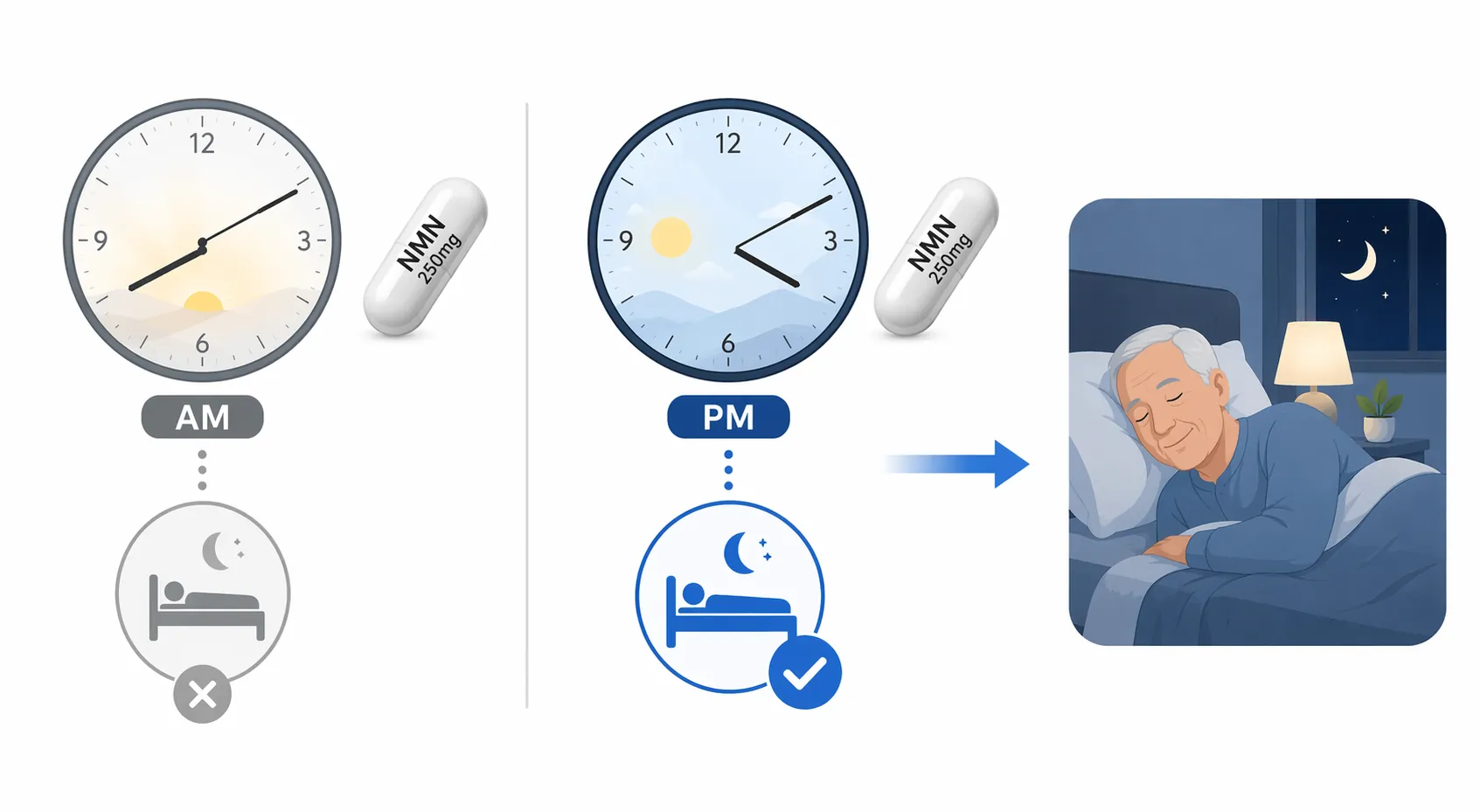
That timing detail deserves more attention than a headline about NMN “helping sleep.” Circadian biology is timing biology. The same molecule can land differently depending on when it enters the system. If an NAD+ precursor changes metabolic or clock-related signaling, morning and afternoon dosing should not be assumed to mean the same thing.
The result is encouraging, but it is not a settled treatment claim. The sleep outcomes were subjective, not polysomnography-confirmed changes in slow-wave sleep, awakenings, or sleep architecture. The study population was limited to Japanese adults aged 65 and older, and the trial lasted 12 weeks.[1] Those details matter because “I feel my sleep is better” is valuable, but it is not the same level of evidence as objective overnight sleep recording or long-term clinical outcomes.
| Evidence | What it suggests | What it does not prove |
|---|---|---|
| Afternoon NMN in adults 65+ | Subjective sleep quality and drowsiness may improve under specific timing conditions | That NMN objectively increases deep sleep or works for all older adults |
| Morning NMN in the same trial context | Timing may strongly influence sleep-related effects | That NMN has no biological effect at other doses, populations, or schedules |
| Mouse NAD+ restoration studies | NAD+ can restore SIRT1 activity and circadian rhythmicity in aged animals | That the same pathway is clinically sufficient in humans |
Why less NREM sleep in an NR mouse study may not mean worse sleep
A 2023 mouse study complicates the usual assumption that more sleep time is always better. Chronic dietary nicotinamide riboside, or NR, supplementation for 6–10 weeks reduced NREM sleep time by 17% and accelerated the discharge rate of homeostatic sleep pressure by more than 4-fold.[4]
Read too quickly, reduced NREM sleep sounds bad. In this study, the authors interpreted the pattern differently: NR appeared to make the discharge of sleep pressure more efficient.[4] In other words, the animals needed less NREM time to dissipate the accumulated pressure for sleep.
That distinction matters for older adults, because “sleep quality” is not identical to “more minutes asleep.” A night can be long and shallow, or shorter and more consolidated. The right question is not whether an intervention simply increases sleep duration. It is whether it improves the relationship between sleep pressure, sleep depth, circadian timing, and next-day function.
The mouse study still has an important limitation. It used C57BL/6J mice carrying a mutation affecting NAD+ metabolism, which may make them more responsive to NR than wild-type mice would be.[4] That makes the study useful for mechanism, not a direct dosing guide for people.
NAD+ restoration connects the clock and the sleep-depth story
The reason NAD+ keeps returning in this discussion is that SIRT1 depends on it. If NAD+ availability falls with age, SIRT1 activity can fall with it. That gives researchers a testable chain: restore NAD+, recover SIRT1 activity, improve clock-gene regulation, and see whether rhythms become more coherent.
In aged mice, NAD+ restoration has been reported to restore SIRT1 activity and BMAL1/chromatin binding, with recovery of circadian rhythmicity.[2][3] This is the strongest mechanistic support for the idea that NAD+ precursors could influence sleep timing rather than merely produce a general metabolic effect.
Still, the leap from restored rhythmicity in aged mice to better sleep in an older person is a leap. Human sleep is shaped by medications, pain, caregiving, retirement schedules, light exposure, alcohol, apnea risk, mood, and social timing. Enzyme activity may be one layer underneath the problem, not the only lever.
That is why this mechanism should not be used to dismiss ordinary timing cues. If anything, it helps explain why older adults may become more dependent on them. When internal rhythmic signaling is less forceful, external anchors — morning light, regular meals, daytime movement, and a stable wake time — can carry more of the load. This is also why generic sleep hygiene can fail when it ignores age-related biology; for that angle, see why sleep hygiene advice often fails older adults.
A small note on melatonin and SIRT1
Melatonin belongs in this discussion, but only briefly. Animal research has shown that melatonin preserved SIRT1 expression in the hippocampus of rats exposed to total sleep deprivation.[1] That suggests a protective relationship between sleep-related hormonal signaling and SIRT1, but it does not prove that melatonin supplements restore SIRT1-dependent sleep architecture in older adults.
The useful takeaway is modest: circadian hormones, NAD+, and SIRT1 appear to interact. The unhelpful takeaway would be to treat every molecule in that loop as interchangeable. Melatonin timing, NAD+ precursor timing, light exposure, and sleep pressure can point in different directions if used carelessly.
What this means if you are considering NMN, NR, or other sleep supplements
Restful Ground is not selling NMN or NR, and the evidence does not justify treating either one as an established sleep medication. The best human signal so far is narrow: 250 mg NMN in the afternoon for 12 weeks improved subjective sleep quality and reduced drowsiness in adults 65 and older, while morning dosing did not show the same significant result.[1]
That finding is worth knowing because it is specific. It is also worth containing. It does not tell us whether higher doses are better, whether NR would behave the same way in older humans, whether the effect lasts for years, or whether objective slow-wave sleep improves. It also does not tell us how these compounds interact with medical conditions or medications.
If your main issue is early waking after retirement, irregular days may be as relevant as molecules; see how retirement affects sleep quality. If you are comparing supplements more broadly, use a problem-specific comparison rather than a longevity ranking; see what is the best sleep supplement.
The calibrated answer
Declining SIRT1 and NAD+ offer a credible biological explanation for why aging sleep can feel lighter, earlier, and less restorative. SIRT1 helps regulate circadian timing through BMAL1/CLOCK activity in the SCN and helps preserve NREM delta power through hypothalamic sleep-depth pathways.[1] NAD+ restoration in aged mice can recover SIRT1 activity, BMAL1/chromatin binding, and circadian rhythmicity.[2][3]
The intervention evidence is promising, but not settled. Afternoon NMN has an early human signal for better subjective sleep quality and less drowsiness in adults 65 and older, while morning dosing did not show the same effect.[1] NR animal work suggests sleep pressure may discharge more efficiently, but that evidence comes from a mouse model with NAD+ metabolism features that may amplify responsiveness.[4]
So the honest answer is neither “normal aging, accept it” nor “take an NAD+ booster and reverse your sleep age.” The biology is real enough to take seriously, especially the timing-dependent NMN result. The proof is not yet strong enough to call NMN, NR, or SIRT1 activation an established treatment for aging sleep.
References
Supports these guides
Spot an error or have clinical feedback?
Because this article covers clinical, medication, or safety information, we use a moderated correction channel instead of open public comments. Let us know if something about “How declining SIRT1 and NAD+ make your sleep lighter” needs a closer look.
Send feedback on this article