
During a hurricane, sleep stops being a wellness goal and becomes part of the safety plan. The point is not to protect a perfect seven- or eight-hour night while alerts, wind, heat, and power failures are changing the situation around you. The point is to preserve enough rest for the people in the house to think clearly, hear warnings, make decisions, drive only if they must, manage children or older relatives, and avoid the kind of exhaustion that turns a bad night into a dangerous one.
That is the practical heart of hurricane preparedness sleep disruption: plan for broken sleep before it happens. Amerisleep’s hurricane sleep guidance frames 3–5 hours of broken sleep as a realistic target during active storm conditions, rather than a normal full night; that figure should be treated as practical preparedness guidance, not a peer-reviewed threshold, but it matches the reality many storm-zone households already know from experience.[1]
| Phase | What Sleep Is For | Main Move |
|---|---|---|
| Before the storm | Bank stability while you still have control | Prepare the sleep space and sleep kit before the house gets loud, hot, or dark |
| During the storm | Keep at least one adult functional | Use shift-sleeping, bedside supplies, and a lower sleep target |
| Immediate aftermath | Bridge from survival mode to repair mode | Restore cooling, safety checks, meals, medication timing, and a predictable sleep window |
| Recovery | Rebuild normal rhythm | Expect improvement in days, with full normalization possibly taking weeks |
Before the Storm: Set Up Sleep While You Still Have Leverage
The last useful window for protecting sleep is not bedtime on the night the storm arrives. It is the day or two before, while batteries can still be found, rooms can still be rearranged, devices can still be charged, and nobody is yet trying to solve everything by flashlight.
Start with a dedicated sleep kit, not a vague promise to “try to rest.” Amerisleep recommends assembling battery-powered white noise, earplugs, an eye mask, portable battery-operated fans, and red-filter flashlights before hurricane season; it notes that earplugs may reduce noise by about 25–30 dB.[1] The exact products matter less than the fact that these items are gathered in one place and reachable from the bed or safe sleeping area.
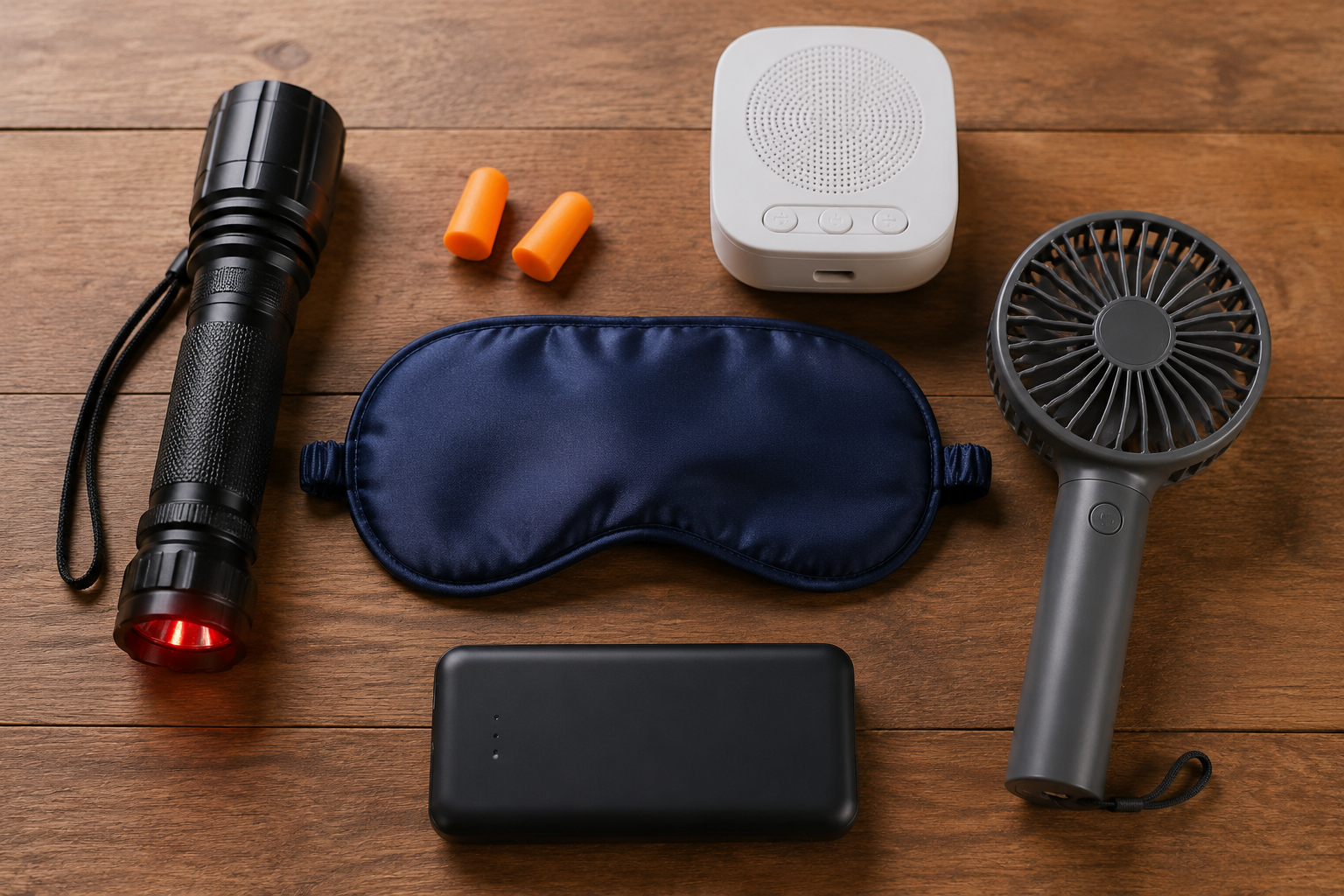
- Put earplugs, eye masks, medications, water, phone chargers, a power bank, and a red-filter flashlight in one container near the planned sleep area.
- Charge phones, weather radios, power banks, fans, and any medical devices before conditions deteriorate.
- Choose the sleep location before nightfall: ideally an interior room away from windows, with enough floor space for the household to rest safely.
- Move blankets, pillows, pet supplies, children’s comfort items, and essential documents before the room is needed.
- Decide who monitors alerts first, who sleeps first, and when the handoff happens.
That last item is easy to skip because it feels premature. It is not. If two adults are available, deciding the first watch before the storm is calmer than negotiating it at 1 a.m. while the roof is rattling and everyone is already tense. The American Sleep Apnea Association’s disaster sleep guidance also points toward sharing alert duty so one person can rest while another stays aware of emergency information.[2]
Treat Noise and Heat as Safety Problems, Not Comfort Problems
Storm sleep usually fails for physical reasons before it fails for motivational ones. Wind noise, pressure changes, house movement, emergency alerts, humidity, and heat all keep the nervous system on guard. Amerisleep states that hurricane wind noise can reach 100+ dB, comparable to a chainsaw; because that claim is not independently tied to a primary acoustics source in the available material, it is best used as a caution rather than a universal measurement.[1]
Heat deserves the same serious treatment. Power outages remove air conditioning and fans, and Amerisleep describes that loss of cooling as interfering with the body’s normal 1–2°F core temperature drop that supports sleep onset.[1] If the forecast suggests a hot, humid night after landfall, a battery fan is not a luxury item. It is part of keeping sleep possible.
Pre-storm anxiety also needs a container. Baylor College of Medicine’s guidance on pre-storm anxiety emphasizes preparation, credible information, and avoiding unhelpful overexposure to storm coverage.[3] That does not mean ignoring the forecast. It means setting times to check official updates, then getting back to concrete tasks instead of letting the whole day become one long alert.
During the Storm: Stop Chasing Normal Sleep
Once the storm is active, the sleep plan changes. The house may be noisy. The room may be too warm. Children may wake up every time the wind surges. Phones may sound warnings. Someone may need to check water intrusion, power loss, or local emergency updates. This is not the night to measure success by sleep efficiency.
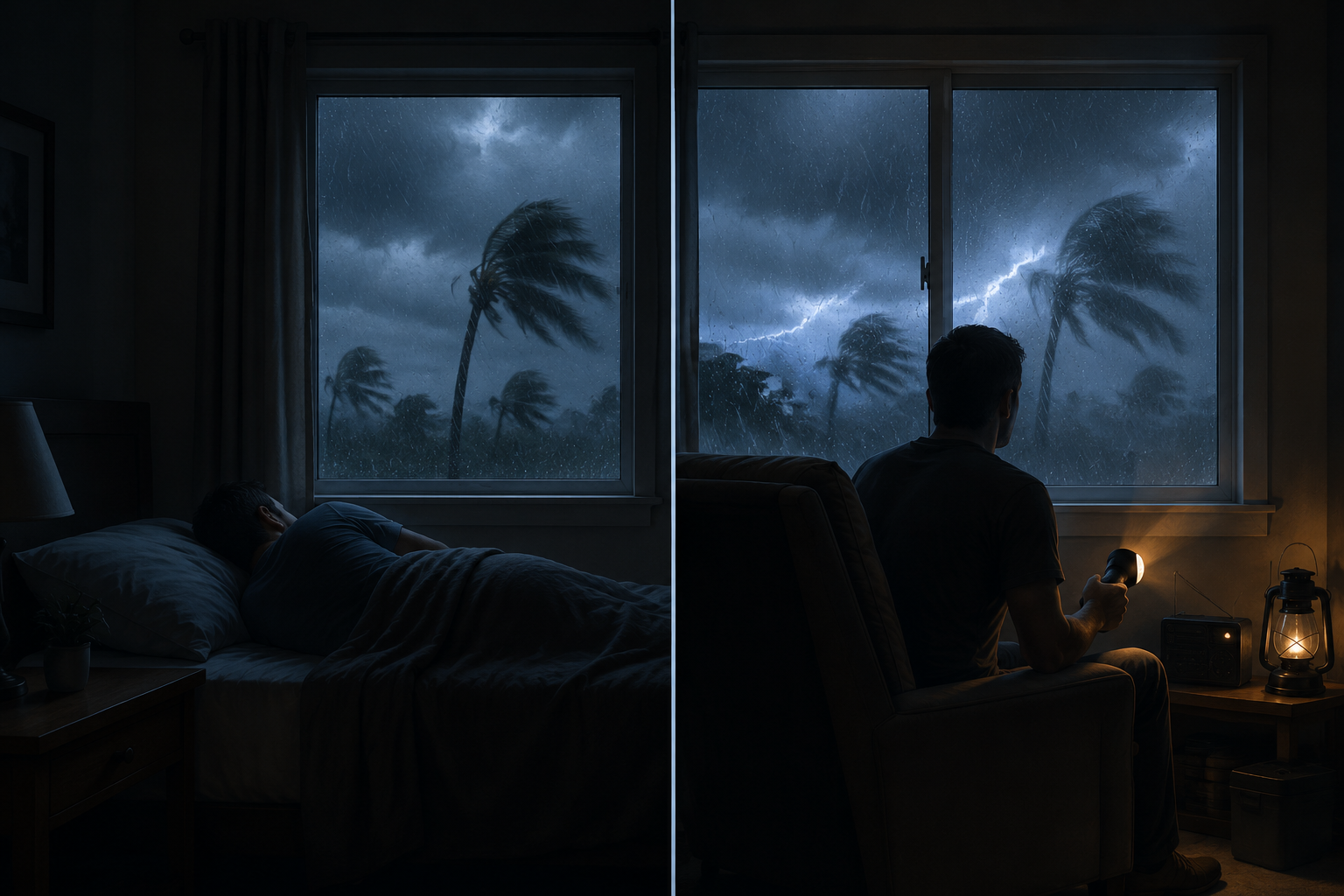
The better model is watch-and-rest. If there is another capable adult in the household, split the night into shifts. One person stays alert enough to monitor warnings and urgent changes; the other uses earplugs, an eye mask, and whatever cooling is available to sleep in fragments. After a planned interval, switch. Disaster sleep guidance from ASAA/Sleephealth.org supports this kind of shared alert strategy during active emergency conditions.[2]
| Household Situation | Workable Sleep Move |
|---|---|
| Two adults are available | Assign watch shifts before midnight if possible; the resting adult uses earplugs and eye mask unless evacuation warnings are expected. |
| One adult is responsible for children or dependents | Sleep in the same safe room with supplies within reach; use alert volume high enough to wake you, but keep nonessential notifications off. |
| A household member uses medical equipment | Prioritize power, backup batteries, cooling, and medication timing before trying to settle everyone. |
| Pets are restless | Keep leashes, carriers, water, and cleanup supplies beside the sleep area so wakeups do not turn into full searches. |
A shift does not need to be elegant. In a hypothetical two-adult household, one adult might take the first part of the night because they handle late evenings better, while the other takes the early-morning hours because they wake more easily. The useful detail is not the exact clock time; it is that nobody is expected to both sleep deeply and remain responsible for every warning.
Keep the nightstand or floor area boringly practical. Water, glasses, medication, shoes, flashlight, phone, power bank, weather radio, and identification should not be across the house. A red-filter light helps because it lets you move and check supplies without blasting the room awake. If children are sleeping nearby, tell them the plan in plain terms: where you are, what sounds they may hear, and what they should do if you wake them.
Broken Sleep Still Counts
The person on rest shift may sleep in pieces: 40 minutes, awake for a branch hitting the house, another hour, awake for an alert, then another short stretch. That is frustrating, but it is not worthless. During active conditions, the goal is not deep recovery. It is enough sleep pressure relief to reduce mistakes.
This is where the 3–5 hour target is useful if handled carefully. Amerisleep presents 3–5 hours of broken sleep as the realistic during-storm range, compared with a normal seven- to eight-hour goal.[1] It should not be treated as a medical guarantee or a badge of toughness. It is a floor to protect if the night is going badly.
- Do not use nonessential phone scrolling as “storm monitoring”; choose official alerts and silence the rest.
- Do not make the alert watcher lie in bed pretending to sleep; sit where warnings can be heard and the resting person can be left alone.
- Do not wait until everyone is exhausted to set roles; make the next handoff visible and simple.
- Do not chase perfect darkness or silence if safety requires light and communication; reduce what you can and accept the rest.
Stress chemistry is also working against sleep. Amerisleep, referencing NIH-described mechanisms, notes that cortisol and adrenaline released during threat perception oppose the parasympathetic activation needed for sleep.[1] That is why “just relax” is poor storm advice. A better instruction is: lower the number of decisions your body has to keep rehearsing. Put supplies in reach. Assign the watch. Decide what alert source counts. Then lie down when it is your turn.
The National Weather Service’s storm anxiety guidance also emphasizes having a plan, using reliable forecast information, and taking storm stress seriously rather than dismissing it.[4] In the middle of the night, those principles become very concrete: one trusted warning channel, one person responsible for hearing it, one resting person allowed to stop checking.
Immediate Aftermath: Do the Minimum That Lets Sleep Return
The first night after the worst of the storm can feel quieter and still be hard to sleep through. Power may be out. The house may be hot. Neighbors may be running generators. Roads may be blocked. Insurance, cleanup, family check-ins, and work messages may start crowding the same brain that just spent a night listening for warnings.
This phase is not full recovery yet. It is the bridge between danger and repair. Start with safety checks, hydration, food, medication timing, and cooling. If the house is safe enough to remain in, rebuild a sleep window even if it is rough. If it is not safe, the sleep plan moves with you: earplugs, eye mask, medications, chargers, and a small light go into the evacuation bag or car, not into a closet.
Do not mistake the end of wind for the end of stress. In a long-term Korean survey of 1,358 disaster victims, 23% reported poor subjective sleep quality and 10.4% reported using sleep medication; the study also found the odds of poor sleep were 2.75 times higher for typhoon victims than earthquake victims.[5] That study is not a U.S. hurricane study, and the setting matters. Still, it is a useful warning that wind-and-water disasters can leave sleep disrupted after the immediate danger passes.
The First 24 to 72 Hours
- Get the safest available cooling in place first: battery fan, shaded room, airflow, or relocation if heat is unsafe.
- Return meals, medications, caffeine, and alcohol to predictable timing as soon as conditions allow.
- Keep storm updates scheduled instead of continuous unless active warnings remain.
- Let the person who handled the longest watch get the first protected recovery block.
- If children are frightened, keep the bedtime explanation short and repeatable rather than replaying the whole event.
Cleanup can wait long enough for one protected sleep block when immediate hazards are handled. A tired adult with a chainsaw, ladder, generator, or flooded electrical area is not more productive because they pushed through.
Recovery: Expect Days of Improvement, Not an Instant Reset
Amerisleep estimates that sleep patterns often begin improving within 3–7 days after the immediate threat passes, while full recovery may take 2–4 weeks depending on damage severity, power restoration, and ongoing stressors.[1] Because that timeline comes from a commercial preparedness article rather than a primary study, it should be used as a planning range, not a promise.
The range is still useful. If the house is intact, the power is back, and the household feels safe, sleep may start settling within a few nights. If there is roof damage, displacement, insurance uncertainty, school disruption, heat exposure, or repeated forecast threats, the body may keep acting as if it is still on watch.
Other disaster research supports taking persistent sleep problems seriously, while also avoiding one-to-one comparisons. AASM reported on a study of 2010 Haiti earthquake survivors in which 94% reported insomnia symptoms after the disaster; two years later, 42% showed clinically significant PTSD and nearly 22% reported depression symptoms.[6] An earthquake in Haiti is not an Atlantic hurricane, but the finding is a sharp reminder that disaster sleep disruption can be tied to longer mental health strain.
Rebuild Rhythm in the Order That Actually Works
Recovery does not start with a perfect bedtime routine. It starts with restoring the conditions that let a routine mean anything: a safe sleep location, tolerable temperature, reduced nighttime monitoring, and enough predictability that the body stops bracing for the next interruption.
- Stabilize the sleep place: clear hazards, reduce noise where possible, cool the room, and keep emergency items nearby until the situation is genuinely normal.
- Stabilize the sleep window: choose a realistic bedtime and wake time, even if sleep is still lighter than usual.
- Stabilize information intake: check recovery updates at set times unless active alerts continue.
- Stabilize responsibilities: rotate cleanup, calls, childcare, and supply runs so the same person is not always sacrificing sleep.
- Watch for persistence: if insomnia, panic at bedtime, nightmares, or heavy daytime impairment continue, treat that as a health issue rather than a character flaw.
The person who stayed up for alerts may not bounce back just because the sky cleared. That role carries a load: listening for danger while everyone else is supposed to rest. Give that person a real recovery window, not just thanks over coffee and a list of chores.
What to Keep Ready for the Next Storm
After the household is safe, restock the sleep kit before memory softens the hard parts. Replace batteries. Put earplugs back where they belong. Note which room stayed coolest, which alert source worked, which charger failed, and whether the shift plan was realistic. That short debrief is more useful than a grand promise that next time everyone will sleep better.
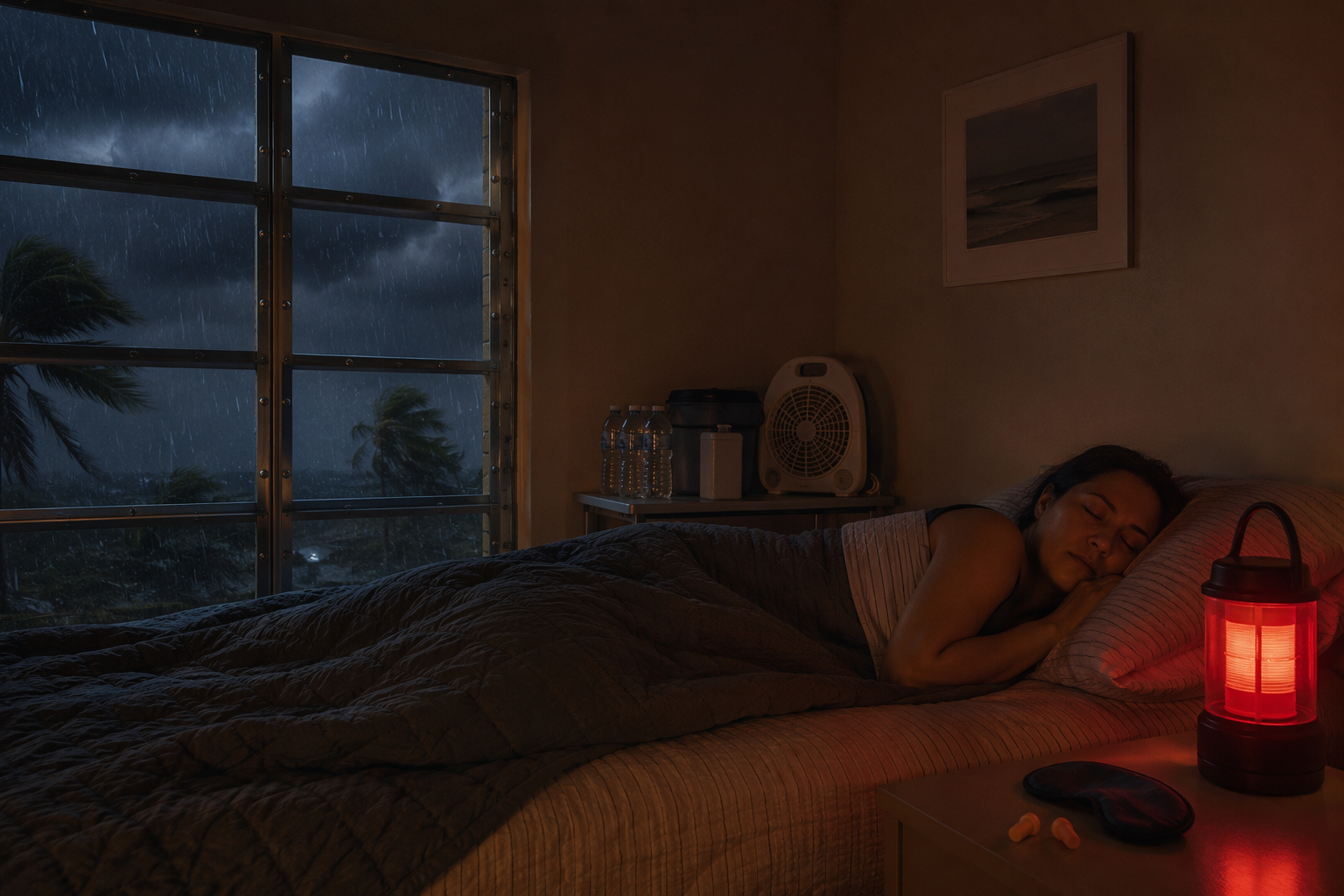
When a hurricane threatens, the sleep plan is simple but not easy: prepare the room before the storm, share alert duty while it is active, protect broken sleep instead of dismissing it, and give recovery time to unfold in stages. First stabilize the night. Then restore the conditions. Then rebuild the rhythm.
References
- Hurricane Preparedness and Sleep — Amerisleep
- How To Manage Your Sleep During And After A Disaster — ASAA/Sleephealth.org
- Navigating pre-storm anxiety — Baylor College of Medicine
- Storm Stress and Anxiety — National Weather Service
- Sleep Problems among Disaster Victims: A Long-Term Survey on the Life Changes of Disaster Victims in Korea — PMC
- Disturbed sleep linked to mental health problems in natural disaster survivors — AASM
Comments
Join the discussion with an anonymous comment.