
The hard part of sleeping during a heat advisory is not that the room feels unpleasant. It is that the room may still be too warm for the body to do the temperature work that normally starts sleep. In the evening, core body temperature is supposed to fall by about 0.5–1°C. That drop is helped by moving heat from the core toward the skin and then out into the surrounding air. When the bedroom stays above roughly 75–77°F, that heat loss gets harder, and sleep onset and sleep stability suffer.[1]
That mechanism matters because it separates useful cooling from merely dramatic cooling. A cold blast of water can feel like a rescue. A fan can feel like the only moving air in the apartment. Sleeping without clothes can feel like the obvious minimalist fix. But the question at 8 p.m. is narrower: does this help heat leave the body over the next hour, or does it interfere with that process while giving a short-lived sensation of relief?
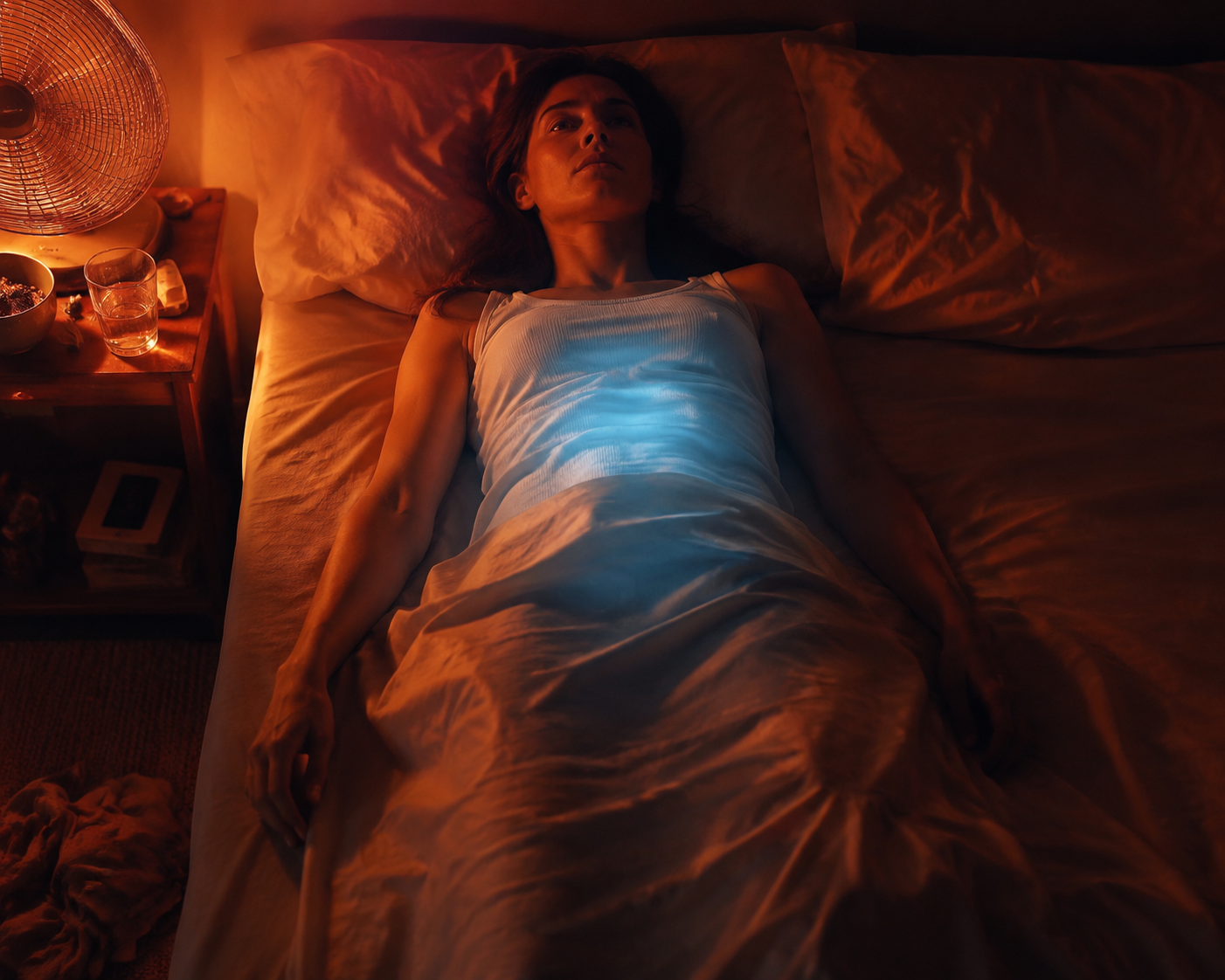
Why a Hot Room Keeps You Awake
Sleep is easier when the bedroom helps the body unload heat. A cooler room does not knock you unconscious by itself; it supports the normal evening shift in heat distribution. Blood flow to the skin increases, heat leaves through the skin surface, sweat can evaporate, and the core temperature drop becomes easier to maintain.
A hot bedroom works against each part of that route. If the air is already warm, the gradient between skin and room shrinks. If the room is humid or still, sweat evaporates less effectively. If the building has stored heat all day, opening the bedroom door at night may simply move warm air from one part of the apartment to another.
Large datasets make the same problem visible at scale. A 2025 Nature Communications study using 23 million sleep records found that each 10°C rise in daily mean temperature was associated with 9.67 minutes less total sleep and a 2.82% decline in deep sleep.[2] A 2025 USC/Keck analysis of more than 12 million nights from 14,232 U.S. adults found a similar heat-sleep pattern, with West Coast residents losing nearly three times more sleep per degree of temperature increase than residents elsewhere in the dataset.[3] The point is not that everyone will lose the same number of minutes tonight. It is that hot-night sleep loss is not just personal fragility or bad attitude.
The practical threshold also shows up in smaller, more directly interpretable findings. The American Heart Association reported in 2025 that sleep efficiency fell 5–10% as nighttime temperature rose from 77°F to 86°F.[4] That is the range many people recognize from an upstairs bedroom, a heat-soaked studio, or a room where the air conditioner cannot catch up before midnight.
The Ranking That Matters Tonight
During a heat advisory, the best sleep advice is not the advice that sounds most refreshing. It is the advice that either prevents indoor heat buildup or helps the body lose heat without adding strain. A broader evidence-ranked sleep tips guide is useful for general sleep hygiene, but heat advisories deserve their own filter: thermoregulation first.
| Priority | Strategy | Why it earns the spot |
|---|---|---|
| Strong first move | Lukewarm shower 1–2 hours before bed | Supports heat movement to the skin without triggering the stronger skin blood-vessel constriction that very cold water can cause. |
| Strong first move | Daytime shading and blocking solar gain | Prevents the room and furnishings from storing heat that will be released back into the bedroom at night. |
| Useful when timed well | Cross-ventilation after outdoor air cools | Exchanges trapped indoor heat for cooler outdoor air when the outside temperature has actually dropped. |
| Conditional | Fan use below dangerous indoor temperatures | Improves evaporation and perceived airflow, but becomes a safety question as indoor temperature rises. |
| Often overrated or risky | Cold showers, unsafe fan use, and sleeping naked in the wrong conditions | Can reduce heat loss, increase heat stress, or impair sweat management despite feeling intuitive. |
1. Take a Lukewarm Shower, Not a Cold One
The European Insomnia Network recommends a lukewarm shower 1–2 hours before bedtime during hot weather.[1] The timing is doing real work here. The goal is not to enter bed dripping and chilled; it is to promote peripheral heat loss before sleep, giving the body time to move heat toward the skin and release it.
A very cold shower can feel better in the first minute and still be the wrong tool for sleep. Cold exposure can narrow blood vessels in the skin, which reduces heat transfer from the core to the surface. That means the skin feels cold while the body may be less efficient at dumping internal heat afterward. The problem is not that cold water is morally wrong or never useful; it is that the sensation of cool skin is not the same as a sustained core temperature drop.
2. Keep Heat Out Before You Try to Remove It
The most boring heat-advisory sleep tactic is often the most useful one: stop the bedroom from becoming a heat battery. Close blinds, curtains, or shades before the strongest sun hits the room. If one side of the home gets afternoon sun, treat that side as the problem wall. The mattress, floor, curtains, and interior walls can hold heat long after the outdoor temperature starts to fall.
This is where sleep preparation starts earlier than bedtime. If the forecast shows a hot night, the useful decision may happen at noon, not at 10:30 p.m. Readers who want to use forecast timing more deliberately can pair this with a weather-based sleep preparation routine.
3. Ventilate Only When the Outside Air Helps
Cross-ventilation is useful when it replaces hotter indoor air with cooler outdoor air. Open windows on opposite sides of the home, or use a fan to move air outward from one window while another opening draws air in. The key condition is simple: wait until the outdoor air is cooler than the indoor air. Opening everything during the hottest part of the day can load the apartment with heat instead of clearing it.
In a badly cooled apartment, this can become a sequence: block sun during the day, check whether outdoor air has dropped after sunset, then ventilate aggressively if it has. If it has not, do not pretend an open window is automatically cooling. It may only be making the room louder, brighter, and hotter.
4. Use a Fan as a Tool, Not a Guarantee
Fans help when they move air across skin and improve sweat evaporation. They also use far less electricity than air conditioning; the European Insomnia Network notes that fans use about 50 times less electricity than AC.[1] For many households, that matters. A fan may be the only affordable way to make a warm room tolerable enough for sleep.
But fan advice has a temperature ceiling. The CDC says fans are effective only when indoor temperature is below 90°F and warns that fans can increase body temperature above that point.[5] The Red Cross uses slightly different wording, saying fans may not prevent heat-related illness when temperatures are in the high 90s.[6] Those are not identical thresholds, but they point in the same direction: at sufficiently high indoor temperatures, blowing hot air across the body is not a harmless sleep hack.
If the room is under 90°F, a fan aimed across the body or toward an exhaust window can be reasonable. If the room is above 90°F, especially if the person is older, medically vulnerable, dehydrated, or unable to cool the room by other means, the fan moves from “sleep comfort” into “heat-stress judgment.” That is the moment to prioritize a cooler location, air-conditioned public space if available, or local heat-advisory guidance over trying to tough out the bedroom.
What Common Cooling Advice Gets Wrong
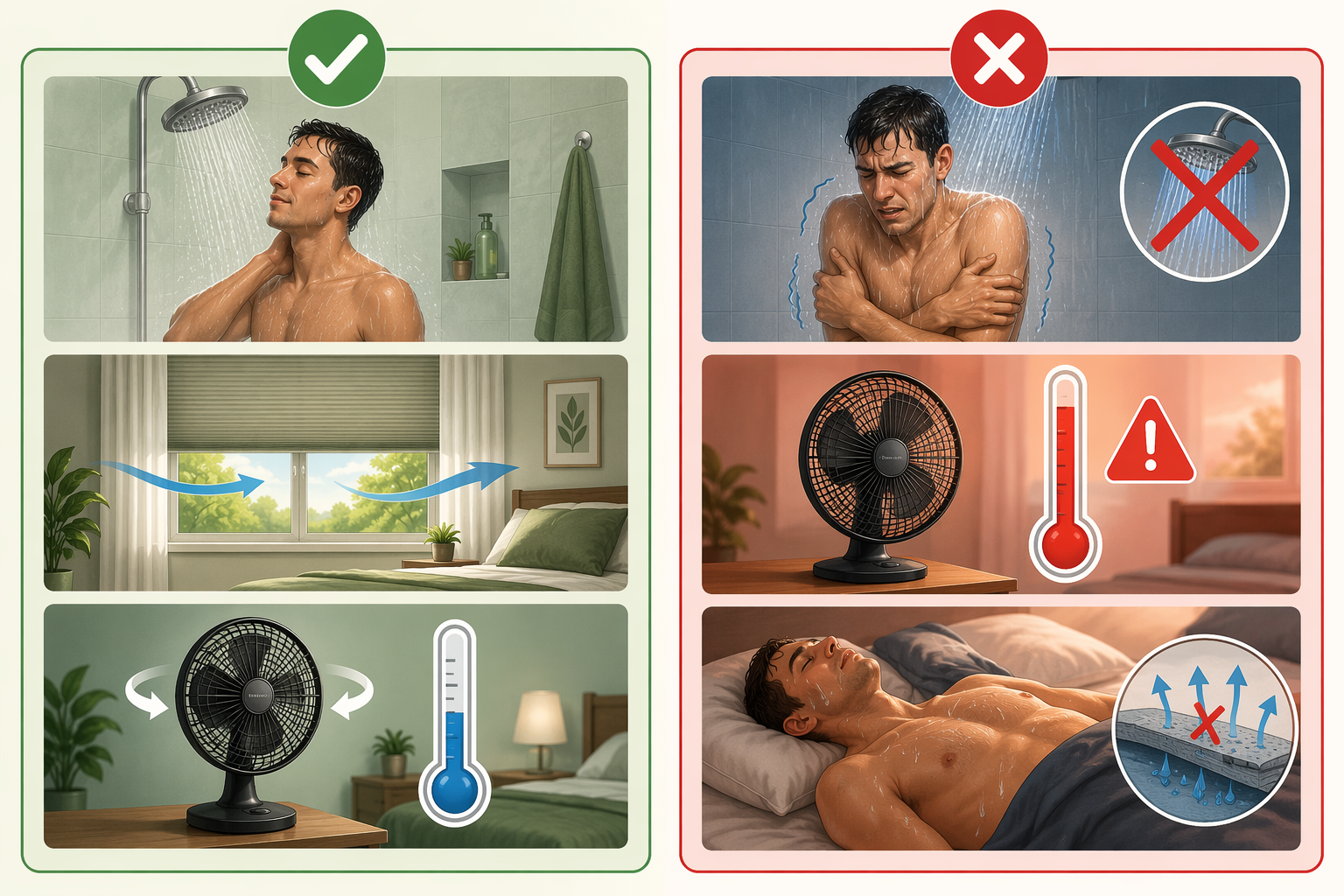
Cold showers are the classic example of a tactic that wins the first sensation and loses the next hour. If the water is cold enough to make the skin vessels constrict, it can reduce the very heat transfer the body needs before sleep. A lukewarm shower feels less heroic, but it fits the physiology better.
Sleeping naked is more conditional than it sounds. Bare skin can help if air is moving, humidity is manageable, and sweat can evaporate. But a light, breathable layer can sometimes manage sweat better than skin against sheets, especially if the bedding traps moisture. The useful test is not whether there is less fabric. It is whether sweat can evaporate and whether the sleep surface stays dry enough to avoid clammy wake-ups.
A fan pointed directly at the body all night can also cut both ways. In a moderately warm room, airflow can help evaporation and comfort. In a very hot room, it can add heat stress. If the air is smoky or polluted during the same advisory period, ventilation decisions need another layer; smoke advisories disrupt sleep through different pathways, including airway irritation and stress, as covered in this smoke-advisory sleep guide.
For a deeper pass through the traps, the companion guide on cooling mistakes that worsen hot-weather sleep is the better place to linger. The short version here is enough for tonight: avoid tactics that make the skin feel cooler while reducing heat loss or increasing heat load.
Why the Same Room Does Not Hit Everyone the Same Way
Population studies are useful because they show that heat-related sleep loss is real, but they do not turn bedroom temperature into a personal prediction. Age, body size, medication use, health conditions, hydration, building design, humidity, and regional acclimatization can all change how much a hot room disrupts one person’s sleep.
The evidence base also has limits. The 2025 Nature Communications study used Chinese Huawei wearable users, which is not the same population as U.S. adults in every respect.[2] The USC/Keck analysis strengthens the case because it uses U.S. Fitbit data and points in the same direction, but it also shows that regional differences matter.[3] A 2024 systematic review in Sleep Medicine Reviews supports the broader conclusion that ambient heat is associated with worse sleep in a warming climate, while still leaving room for differences across settings and populations.[7]
During a heat advisory, the practical rule is to rank choices by mechanism and safety: help heat leave the body, prevent the room from storing more heat, ventilate only when the air exchange is favorable, and treat the fan as conditional rather than automatically safe.
References
- Dealing with sleep problems during heatwaves: practical recommendations from the European Insomnia Network, Journal of Sleep Research, 2023.
- Nature Communications 2025 study on ambient temperature and wearable-measured sleep, Nature Communications, 2025.
- USC/Keck 2025 analysis of temperature and sleep among U.S. adults, USC/Keck, 2025.
- American Heart Association 2025 report on nighttime temperature and sleep efficiency, American Heart Association, 2025.
- Heat and Health Tracker, Centers for Disease Control and Prevention.
- Heat Wave Safety, American Red Cross.
- Ambient heat and human sleep in a warming climate: a systematic review, Sleep Medicine Reviews, 2024.
Comments
Join the discussion with an anonymous comment.