Mechanism explainer
What Anti-Aging Sleep Science Reveals for Women Over 50
Sleep disruption after menopause is more than an annoyance—it's linked to faster biological aging at both the skin and cellular level. This article explains the hormone-driven mechanisms behind this connection and ranks the most evidence-supported interventions so women over 50 can prioritize what truly slows the clock.
The phrase “anti-aging sleep secrets for women over 50” sounds as if it belongs on a supplement label. The better question is less glossy and more useful: after menopause, can worsening sleep plausibly speed up aging biology in ways a woman can see and feel?
There is a reason this question often arrives around the same time as 3 a.m. waking, flatter daytime energy, drier skin, and the uncomfortable sense that recovery takes longer than it used to. In one analysis reported from the Journal of Sleep Research, women’s sleep quality scores dropped sharply after age 51, from a mean Sleep Quality Index of 52.4 to 43.9, while men of the same age did not show the same decline.[1] That does not prove every night of poor sleep is caused by menopause. It does, however, make it harder to dismiss the pattern as vanity, weak discipline, or ordinary aging alone.
The skin evidence points in the same direction, though it needs a steady hand. A small study of 60 Caucasian women found that poor sleepers had twice the intrinsic skin-aging score on the validated SCINEXA scale, 4.4 versus 2.2, and showed 30% slower skin barrier recovery after disruption.[2] That is not a miracle-sleep proof. The study was modest in size and funded by Estée Lauder, so it should not be treated as a universal law. But it is concrete enough to take seriously: sleep quality was associated not just with how tired women felt, but with measurable differences in skin aging and repair.
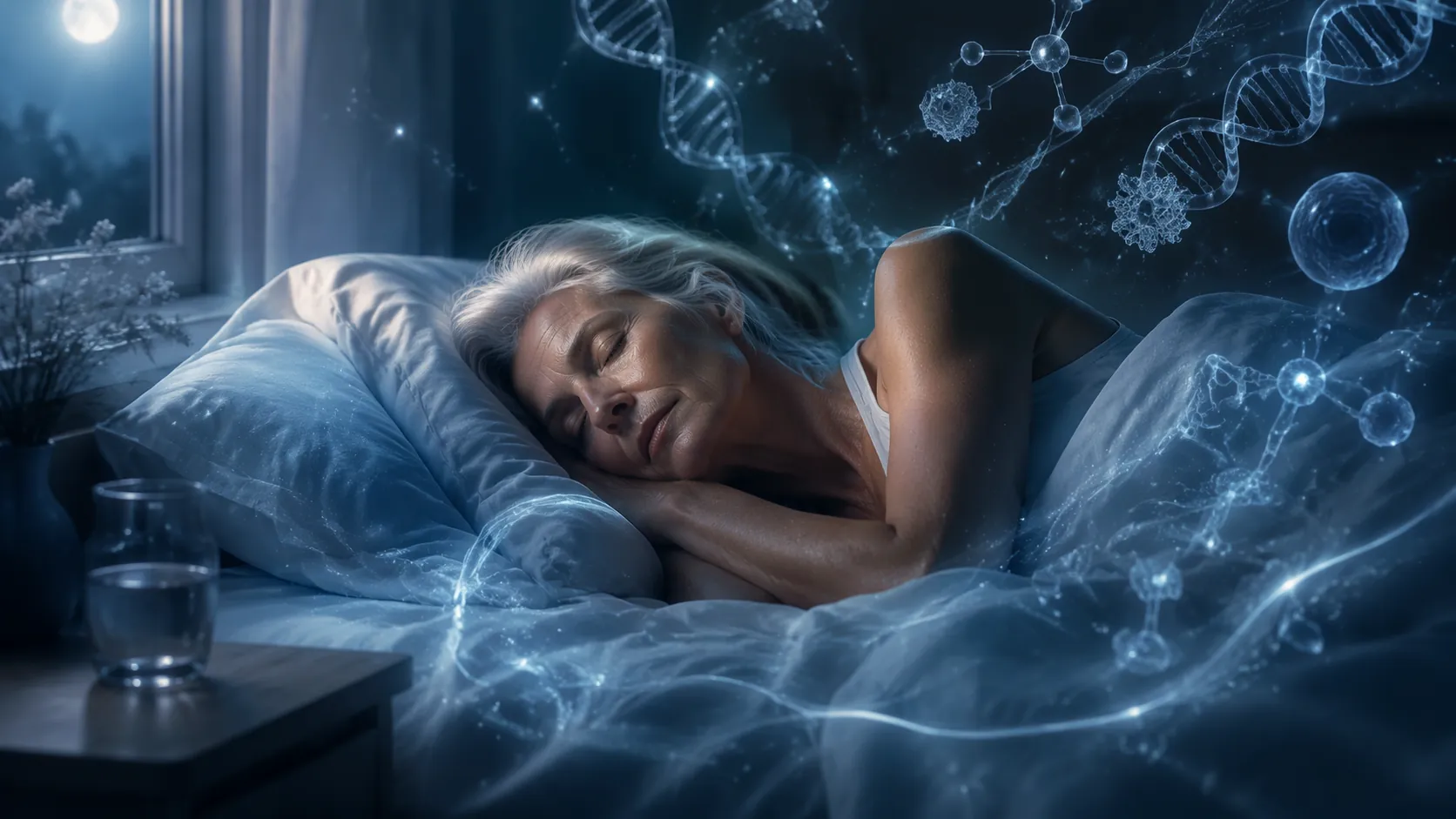
Why Sleep Can Start Aging Differently After 50
Menopause changes sleep through several routes at once. Estrogen and progesterone shifts can affect body temperature regulation, breathing stability, mood, and the timing systems that help sleep stay consolidated. Hot flashes and night sweats can wake a woman directly; anxiety, joint discomfort, and early-morning alertness can keep the wakefulness going after the first interruption. Sleep Foundation’s menopause guidance describes insomnia, sleep-disordered breathing, mood changes, and vasomotor symptoms as common contributors during this life stage.[3]
Long-running menopause research has documented sleep problems across the menopausal transition rather than treating them as a side complaint.[4] Reviews of sleep, melatonin, and menopause describe the transition as a period when hormonal change, circadian signaling, and sleep architecture can all become less stable.[5] The important point is not that hormones explain everything. The important point is that the system holding sleep together becomes easier to disturb.
That matters because sleep is not merely an off switch. During healthy sleep, the brain’s clearance systems are more active, oxidative stress is better managed, immune signaling has a chance to recalibrate, and tissues carry out repair work that is harder to complete during repeated arousals. If sleep becomes short, fragmented, or mistimed night after night, the body spends less time in the conditions that favor repair and more time in stress physiology.

The Mechanism Is Bigger Than Beauty Sleep
Skin is the most visible place to notice poor recovery, but it is not the only place sleep leaves a trace. The more serious anti-aging question is whether bad sleep is associated with cellular aging signals. Buck Institute researchers describe poor sleep as linked with shorter telomeres and accelerated epigenetic aging markers, while consistent 7-to-8-hour sleep patterns are associated with reaching older age free of major disease.[6] Those findings should not be simplified into “sleep reverses aging.” They do support a more careful statement: sleep quality and timing appear connected to biological-aging pathways that matter beyond the mirror.
Telomeres and epigenetic clocks are not symptoms a woman can feel at breakfast. Their value is that they help show why sleep loss can be biologically expensive even before a diagnosis appears. Repeated sleep disruption can increase inflammatory load, worsen metabolic regulation, impair repair rhythms, and weaken the nightly separation between recovery time and daytime demand. After menopause, when circadian rhythm and temperature regulation may already be less forgiving, the same sleep loss can feel as if it lands harder.
This is where the cosmetic language fails. “Anti-aging sleep” is not about waking up poreless. It is about protecting the hours when barrier repair, immune balance, brain clearance, glucose regulation, and cellular maintenance are most likely to occur. Skin changes may be the visible clue. They are not the whole story.
What Deserves Priority
The interventions are not equal. A woman waking for 90 minutes most nights does not need a drawer full of “sleep support” products before anyone has asked whether she has menopausal insomnia, hot flashes, circadian drift, sleep apnea risk, medication effects, or restless legs. The order matters because the strongest tools are not always the most heavily advertised.
| Priority | Best fit | Why it comes here |
|---|---|---|
| CBT-I | Sleep maintenance insomnia, conditioned wakefulness, long nighttime awakenings | Strongest behavioral evidence base and directly targets the insomnia pattern many menopausal women describe |
| Timed light exposure | Early waking, late sleep timing, weak morning alertness, irregular schedules | Acts on the circadian clock rather than treating light as a decorative wellness habit |
| Careful melatonin use | Sleep timing problems or selected older adults with short sleep duration | May modestly improve sleep in some adults, but anti-aging claims remain unproven |
| Hormone therapy evaluation | Sleep disruption driven by hot flashes or night sweats | Can be relevant when vasomotor symptoms are the main sleep disruptor, but is not a universal anti-aging sleep treatment |
CBT-I: the first serious move for persistent insomnia
Cognitive behavioral therapy for insomnia, usually shortened to CBT-I, deserves the highest confidence for chronic insomnia because it changes the sleep system rather than merely sedating it. For women over 50, that often means working with the exact pattern that causes the most distress: falling asleep reasonably well, then waking in the early morning and watching the night become a negotiation.
A good CBT-I program may use sleep restriction, stimulus control, circadian scheduling, cognitive work around nighttime threat scanning, and relapse planning. Sleep restriction is badly named; it is not about depriving the body. It temporarily narrows the sleep window to rebuild sleep drive and reduce time spent awake in bed. For someone whose bed has become the place where she calculates the damage tomorrow will bring, that retraining can be more powerful than another calming routine.
This is also where clinical screening matters. CBT-I is appropriate for insomnia, but untreated sleep apnea, significant restless legs, severe depression, medication side effects, alcohol-related sleep fragmentation, or uncontrolled pain can sabotage the plan. Women after menopause have higher risk for some sleep disorders, including sleep-disordered breathing, and their symptoms are not always the stereotypical loud snoring and daytime sleep attacks described in men.[7]
Timed light exposure: circadian treatment, not bedroom aesthetics
Light is one of the main signals the brain uses to set the sleep-wake clock. For women whose sleep has become fragmented, delayed, advanced, or irregular, the timing of light can either stabilize the system or keep nudging it in the wrong direction.
Morning outdoor light is often the most useful starting point because it anchors daytime alertness and helps the brain distinguish day from night. Evening light, especially bright light close to the face, can push sleep timing later in people who are sensitive to it. The point is not to fear every lamp after sunset. It is to stop treating light as mood decor and start treating it as a biological instruction.
A practical version is simple: get bright outdoor light early in the day when possible, keep wake time consistent, dim the last part of the evening, and avoid using wakeful time in the middle of the night as a second workday under bright screens. For persistent circadian problems, especially very early waking or delayed sleep timing, a clinician trained in behavioral sleep medicine can help adjust timing without guessing.
Melatonin: useful for some sleep problems, not proven age reversal
Melatonin is where the marketing gets slippery. It is a hormone involved in circadian timing, and levels can change with age and menopause-related physiology. It also has antioxidant roles in laboratory and theoretical discussions. That does not make an over-the-counter melatonin gummy a proven human anti-aging treatment.
There is real sleep evidence, but it is modest and specific. A 2022 Harvard randomized trial found that 5 mg melatonin increased total sleep time by more than 15 minutes in adults aged 55 and older.[8] For the woman getting five fragmented hours, 15 extra minutes is not nothing. It is also not the same as repairing the entire menopause-sleep-aging chain.
Dosing should be treated with more care than the supplement aisle suggests. Common sleep-related doses range roughly from 0.3 mg to 5 mg, depending on timing, age, sensitivity, and the problem being targeted. A lower dose taken at the right circadian time may be more rational for a body-clock issue than a higher dose taken randomly at bedtime. More is not automatically more physiologic.
Verywell Health’s 2026 review states the anti-aging claim for melatonin remains theoretical and has not been proven in human research.[9] Product quality is another problem: over-the-counter supplements can vary substantially from the labeled dose, with some products containing several times the stated amount. Melatonin can also interact with medications and health conditions. NSAIDs may lower melatonin levels, and warfarin raises a more serious interaction concern. Anyone taking anticoagulants, seizure medications, sedatives, immune-modulating drugs, or multiple prescriptions should not treat melatonin as harmless because it is sold without a prescription.
Hormone therapy belongs in the conversation when symptoms point there
Hormone therapy is neither a universal sleep cure nor something to ignore when vasomotor symptoms are driving the problem. If hot flashes and night sweats are repeatedly breaking sleep, then evaluating menopause hormone therapy with a qualified clinician can be clinically sensible. Sleep Foundation notes that hot flashes, night sweats, mood changes, and insomnia commonly interact during menopause.[3]
The decision depends on symptom severity, age, time since menopause, personal and family history, cardiovascular and breast cancer risk, clotting risk, uterine status, and treatment preferences. Framing hormone therapy as an “anti-aging sleep secret” does women no favors. Framing it as one possible treatment when vasomotor symptoms are the main sleep disruptor is more honest.
How to Read Your Own Pattern
The most useful next step is not to rank yourself against a perfect sleeper. It is to identify the dominant disruption. A woman who wakes drenched at 2 a.m. needs a different first conversation than a woman who is wide awake at 4:30 a.m. with no hot flash, or a woman who sleeps eight hours but wakes unrefreshed with morning headaches.
- If heat, flushing, and sweating wake you, prioritize evaluation of vasomotor symptoms and menopause-specific treatment options.
- If you wake for long stretches and dread the bed, prioritize CBT-I or a behavioral sleep medicine program.
- If your sleep timing has drifted, prioritize consistent wake time and timed light exposure before experimenting with multiple supplements.
- If you snore, gasp, wake with headaches, have resistant blood pressure, or feel unrefreshed despite enough hours, ask about sleep apnea testing.
- If you use melatonin, treat it as a targeted circadian tool or short-term sleep aid, not as proof that you are slowing aging.
This approach is less glamorous than buying a product called cellular sleep repair. It is also less likely to waste six months. The body does not care whether the intervention sounds sophisticated; it responds to whether the right mechanism is being addressed.
What Better Sleep Can and Cannot Promise
Better sleep after 50 cannot promise age reversal. It cannot guarantee smoother skin, erase menopause, or make biological aging optional. The evidence does not support that kind of certainty.
It does support something more durable: sleep deterioration after menopause is tied to systems involved in repair, inflammation, circadian regulation, skin barrier recovery, and cellular-aging markers. Poor sleepers in the skin study did not simply report feeling worse; they showed higher intrinsic aging scores and slower recovery after barrier disruption.[2] Broader longevity research links sleep patterns with telomeres, epigenetic aging, and disease-free aging.[6]
So the useful version of “anti-aging sleep secrets for women over 50” is not secret at all. Put the strongest interventions first: diagnose the pattern, treat insomnia with CBT-I when insomnia is the pattern, use light as a circadian signal, consider hormone therapy when vasomotor symptoms are breaking sleep, and keep melatonin in its proper place. After 50, better sleep is not merely cosmetic self-care. It is one of the more plausible, evidence-supported levers for protecting several aging-related processes without pretending the clock can be turned backward.
References
- Sleep Quality Deteriorates Faster Among Older Women vs Older Men, Rheumatology Advisor
- Sleep quality may impact skin, AASM Sleep Education
- Menopause and Sleep, Sleep Foundation
- Effects of Sleep Problems During Menopause, SWAN Study
- Sleep, Melatonin, and the Menopausal Transition: What Are the Links?, PMC, 2017
- How a Good Night's Sleep is the Secret to Longevity, Buck Institute
- Menopause and Sleep Disorders, PMC, 2022
- Higher dose of melatonin improved sleep in older adults, Harvard Gazette, 2022
- Can Melatonin Supplements Slow Aging?, Verywell Health, 2026
Supports these guides
Spot an error or have clinical feedback?
Because this article covers clinical, medication, or safety information, we use a moderated correction channel instead of open public comments. Let us know if something about “What Anti-Aging Sleep Science Reveals for Women Over 50” needs a closer look.
Send feedback on this article