
Mechanism explainer
Healthy Sleep Tips for Your 90s
Sleep at 90+ is different from sleep at 65, but it doesn't have to be poor. This article explains the physiological changes, the 7–8 hour cognitive sweet spot from the 90+ Study, and evidence-based strategies that work with—not against—your older body.
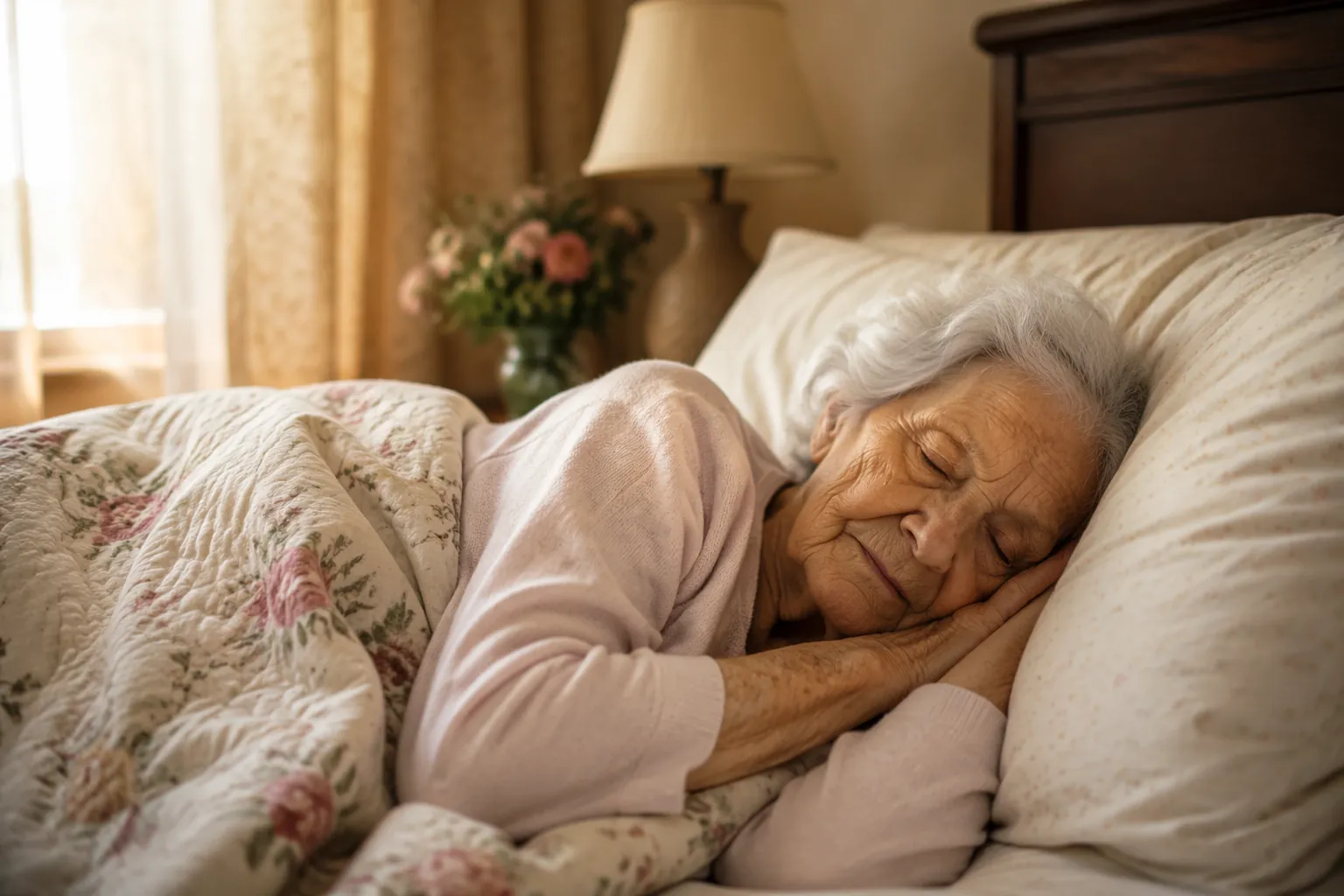
A 92-year-old who falls asleep at 8:30 p.m. and wakes at 4:30 a.m. may look, to the rest of the household, as if something has gone wrong. Sometimes something has. But the timing alone is not proof of bad sleep. Sleep tips for healthy aging at 90 have to start with the body that is actually in the bed: lighter sleep, less slow-wave sleep, more awakenings, lower melatonin output, and a circadian clock that often runs earlier than it did decades before. Reviews of normal aging find that many sleep measures change through adulthood, then tend to plateau after about age 60 in healthy older adults; continued deterioration is often more tied to illness and medications than to age by itself.[1]
That distinction matters. “Normal aging” is too often used as a wastebasket, especially once someone is in the ninth or tenth decade. If a person over 90 is sleeping less deeply, waking earlier, and taking a midday nap, physiology may explain part of it. It does not excuse ignoring pain, breathing trouble, urinary symptoms, depression, medication effects, or a sudden drift into sleeping most of the day.
The more interesting evidence is not defeatist. In the Chinese Longitudinal Healthy Longevity Survey, which included 15,638 adults and 2,794 people aged 100 or older, centenarians were about 70% more likely to report good sleep quality than adults aged 65 to 79 after adjustment for health and socioeconomic factors. Their average total sleep time, including naps, was about 7.5 hours.[2] The data are self-reported and come from a Chinese cohort, so they should not be treated as a perfect map for every U.S. household. Still, they are a useful corrective: very old age does not automatically mean very bad sleep.
The 7-to-8-Hour Finding Deserves Careful Attention
For people over 90, the most useful cognitive signal comes from the 90+ Study, a long-running University of California, Irvine research program focused on the oldest-old population.[3] In a 2018 analysis by Sabeti and colleagues, 144 adults over 90 had sleep duration compared with memory, global cognition, executive function, and hippocampal volume. The reference group was not the familiar seven-to-nine-hour adult recommendation. In this age-specific sample, people sleeping 7 to 8 hours performed better cognitively than those sleeping longer than 8 hours.[4]
The long-sleep finding was not small enough to wave away. Adults over 90 who reported sleeping more than 8 hours had significantly poorer memory, global cognition, and executive function compared with those sleeping 7 to 8 hours. The association remained after adjustment for age, sex, education, depression, and sleep medication use. Among participants with dementia, 91% were long sleepers.[4]
Those adjustment variables are not a statistical footnote. Depression can lengthen time in bed. Sleep medications can change both nighttime sleep and next-day testing. Education affects cognitive test performance. Age and sex distributions matter in a study of people who have already reached extraordinary old age. Adjusting for these factors does not make the result causal, but it does make the signal harder to dismiss as only a demographic artifact.
The same restraint has to apply in the other direction. This was a cross-sectional analysis, not a trial in which some 93-year-olds were assigned to sleep longer and others shorter. It cannot prove that sleeping more than 8 hours causes cognitive decline. Long sleep may be a marker of illness, frailty, neurodegenerative change, medication burden, depression, reduced daytime activity, or another process already underway. The study also notes that the responder group was cognitively healthier than non-responders, which can affect how broadly the findings apply.[4]
A later 90+ Study paper looking at self-reported sleep and dementia risk also belongs in this cautious category: it helps keep attention on sleep as a clinically meaningful signal in this age group, without turning sleep duration into a simple lever that controls dementia risk.[5]
| If sleep looks like this at 90+ | Treat it as | A safer first response |
|---|---|---|
| Asleep early, awake early, steady daytime function | Often compatible with an advanced circadian phase | Adjust expectations before trying to force a late-night schedule |
| About 7 to 8 total hours, including naps, with stable cognition and mood | Close to the strongest age-specific cognitive signal | Protect consistency rather than chasing younger sleep patterns |
| More than 8 hours regularly, especially if new or paired with confusion | A reason to look for illness, medication effects, depression, frailty, or cognitive change | Ask a clinician to review the change instead of simply adding a sleep aid |
| Fragmented nights with bathroom trips, pain, breathing symptoms, or falls | Not just “old age” | Address the specific disruptor and the safety risk |
Work With the Earlier Clock, Not Against It
The suprachiasmatic nucleus, the brain’s central circadian pacemaker, changes with age. The result is often a phase advance: sleepiness arrives earlier, and morning wake time moves earlier too. The shift is commonly described as roughly an hour earlier, though the household impact can feel larger when the rest of the family lives on a later clock.[1]
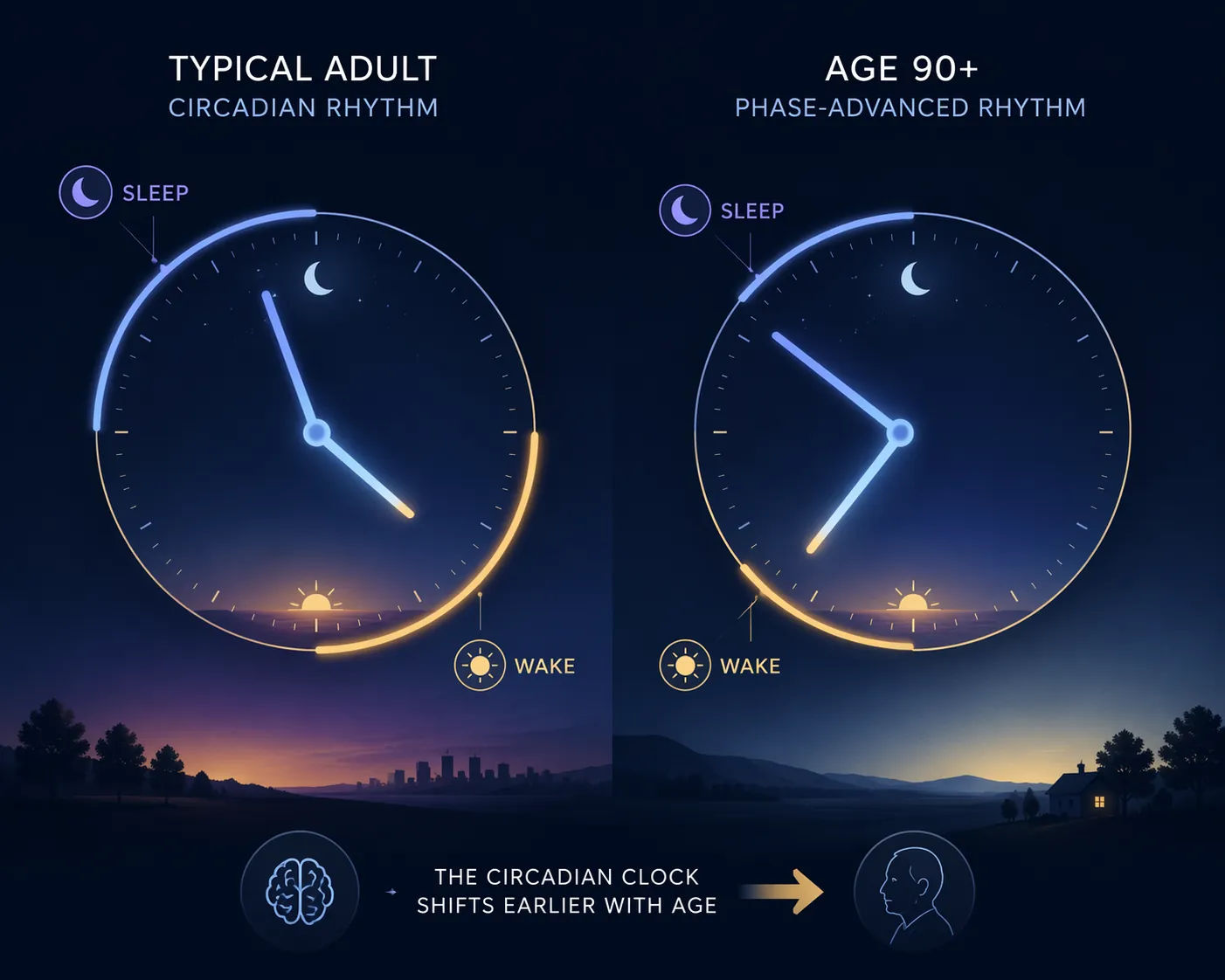
For a 90-year-old, the question is not “How do we make this person sleep like they did at 55?” It is “Is the sleep window sufficient, stable, and safe?” If an earlier bedtime produces a consistent 7 to 8 total hours and the person is alert enough for meals, conversation, walking, therapy, hobbies, or family routines, there may be nothing heroic to fix.
When the wake time is too early for safety or caregiving, timing matters. Bright light very early in the morning can reinforce an early rhythm. Light after the intended wake time, daytime exposure near windows or outdoors when safe, regular meals, and predictable evening dimming can help stabilize the clock. Pushing bedtime later by willpower alone often backfires: the person becomes overtired, falls asleep in a chair, wakes confused, or loses the first part of the night when sleep pressure is strongest.
Count Naps as Sleep, Not as a Moral Failure
Generic sleep hygiene often tells older adults to avoid naps. At 90, that advice can be too blunt. The centenarian data included naps in the average total sleep estimate of about 7.5 hours, and midday rest may fit the rhythm of a very old body, especially in cultures and households where daytime rest is normal.[2]
The better question is what the nap is doing to the whole 24-hour pattern. A short, early afternoon nap that helps someone stay engaged through dinner is different from repeated long daytime sleep episodes after a medication change. A nap after a poor night is different from a new daily pattern in which a parent sleeps through meals, skips walking, and then lies awake for hours overnight.
- Track total sleep across 24 hours for several days, including chair sleep and naps.
- Keep naps earlier in the day when possible, so they do not steal the first part of nighttime sleep.
- Treat a new need for long daytime sleep as a symptom worth reviewing, not as laziness or inevitable aging.
- Use daytime activity, meals, light, and social contact as rhythm anchors, not as a campaign to exhaust the person.
Be More Suspicious of Sleep Aids Than of an Early Bedtime
At 90+, a “harmless” nighttime pill can become a morning fall, a confused bathroom trip, or a day lost to grogginess. The American Geriatrics Society Beers Criteria warn against several medication classes commonly used for sleep or sedation in older adults, including benzodiazepines, nonbenzodiazepine hypnotics, and drugs with strong anticholinergic effects, because of risks such as cognitive impairment, delirium, falls, fractures, and motor vehicle crashes in older adults.[6]
The Beers Criteria are written for adults 65 and older, not exclusively for nonagenarians. That makes them a floor, not a ceiling, for caution. Frailty, kidney function, liver function, balance, nighttime urination, vision, and the number of other medications all change the risk calculation. A person over 90 who is already waking to use the bathroom does not need a drug that makes the route to the toilet more dangerous.
Melatonin and over-the-counter products deserve the same practical scrutiny. The issue is not whether a product sounds natural. The issue is whether it causes morning sleepiness, worsens confusion, interacts with other drugs, masks a medical problem, or encourages the household to medicate a schedule that is actually a stable early circadian phase.
When a Sleep Change Needs a Medical Review
The safest sleep work at 90 often begins outside the bedroom. A sudden change in sleep can be the first visible sign that pain is undertreated, a urinary problem has worsened, breathing is disrupted, depression has deepened, infection is developing, cognition has shifted, or a medication is no longer being tolerated.
- Ask for review if sleep suddenly becomes much longer, especially beyond 8 hours with new daytime confusion or withdrawal.
- Bring a medication list, including nighttime pain medicines, bladder medicines, antihistamines, anxiety medicines, sleep products, and supplements.
- Describe the timing: bedtime, wake time, naps, bathroom trips, falls, nightmares, breathing pauses, pain flares, and morning grogginess.
- Do not judge sleep only by the caregiver’s preferred schedule; judge it by safety, function, cognition, mood, and total sleep.
This is where a simple diary is more useful than a dramatic conclusion. Three to seven days of notes can show whether the person is sleeping 7.5 hours in an early but stable pattern, or spending 11 hours in bed with fragmented sleep and a heavy sedating medication on board. The plan changes depending on which pattern is real.
The Basic Sleep Advice Changes Shape After 90
Caffeine, bedroom comfort, and routine still matter, but they are not the center of the story. At 90, “keep a routine” may mean coordinating meals, caregiver shifts, bathroom access, hearing aids, eyeglasses, walkers, lighting, and pain control. “Make the bedroom comfortable” may mean preventing overheating, reducing fall hazards, keeping a clear path to the bathroom, and using night lighting that is bright enough for safety without turning the room into morning.
The caffeine question also becomes less abstract. If a person drinks coffee at breakfast and sleeps well, there may be no reason to remove one of the day’s pleasures. If tea at 4 p.m. is followed by a restless first half of the night, the timing is worth changing. The test is not purity. The test is whether the change improves nighttime sleep without shrinking daytime life.
A useful 90+ sleep plan is usually modest: protect a consistent sleep window, use light and meals to mark the day, count naps honestly, review medications, treat medical disruptors, and avoid turning every early wake-up into a crisis.
Why Sleep Still Belongs in Healthy Aging
Broader longevity research gives sleep its place, though it should not drown out the over-90 evidence. Buck Institute writing in February 2026 connected poor sleep with shorter telomeres and accelerated epigenetic aging, mechanisms that help explain why sleep remains biologically important across the lifespan.[7] Mayo Clinic Press summarized data from 172,321 adults in which adequate sleep was associated with about 5 years longer life expectancy in men and about 2 years in women.[8]
Those findings are supportive context, not a prescription for a 94-year-old to chase a wellness ideal. The most relevant evidence for this age group is narrower and more useful: many very old adults can report good sleep, healthy aging does not require sleep to keep declining after 60, and the strongest 90+ cognitive signal points to roughly 7 to 8 total hours rather than very long sleep.
Poor sleep after 90 deserves attention, not resignation. So does excessive sleep, especially when it is new. But the target is not to make a nonagenarian sleep like a younger adult. The target is stable, sufficient, safe sleep that fits the older circadian system, avoids unnecessary medication harm, and leaves enough wakeful life for eating, moving, thinking, and being with other people.
References
- Sleep in Normal Aging, PMC, 2018.
- Sleeping Well at 100 Years of Age, American Academy of Sleep Medicine.
- The 90+ Study, UCI MIND.
- Sleep, hippocampal volume, and cognition in adults over 90, PMC, 2018.
- Self-reported sleep in relation to risk of dementia at age 90+, Taylor & Francis Online, 2022.
- American Geriatrics Society 2023 updated AGS Beers Criteria for potentially inappropriate medication use in older adults, Journal of the American Geriatrics Society, 2023.
- How a Good Night's Sleep is the Secret to Longevity, Buck Institute, February 2026.
- Sleep and longevity, Mayo Clinic Press.
Supports these guides
Spot an error or have clinical feedback?
Because this article covers clinical, medication, or safety information, we use a moderated correction channel instead of open public comments. Let us know if something about “Healthy Sleep Tips for Your 90s” needs a closer look.
Send feedback on this article