
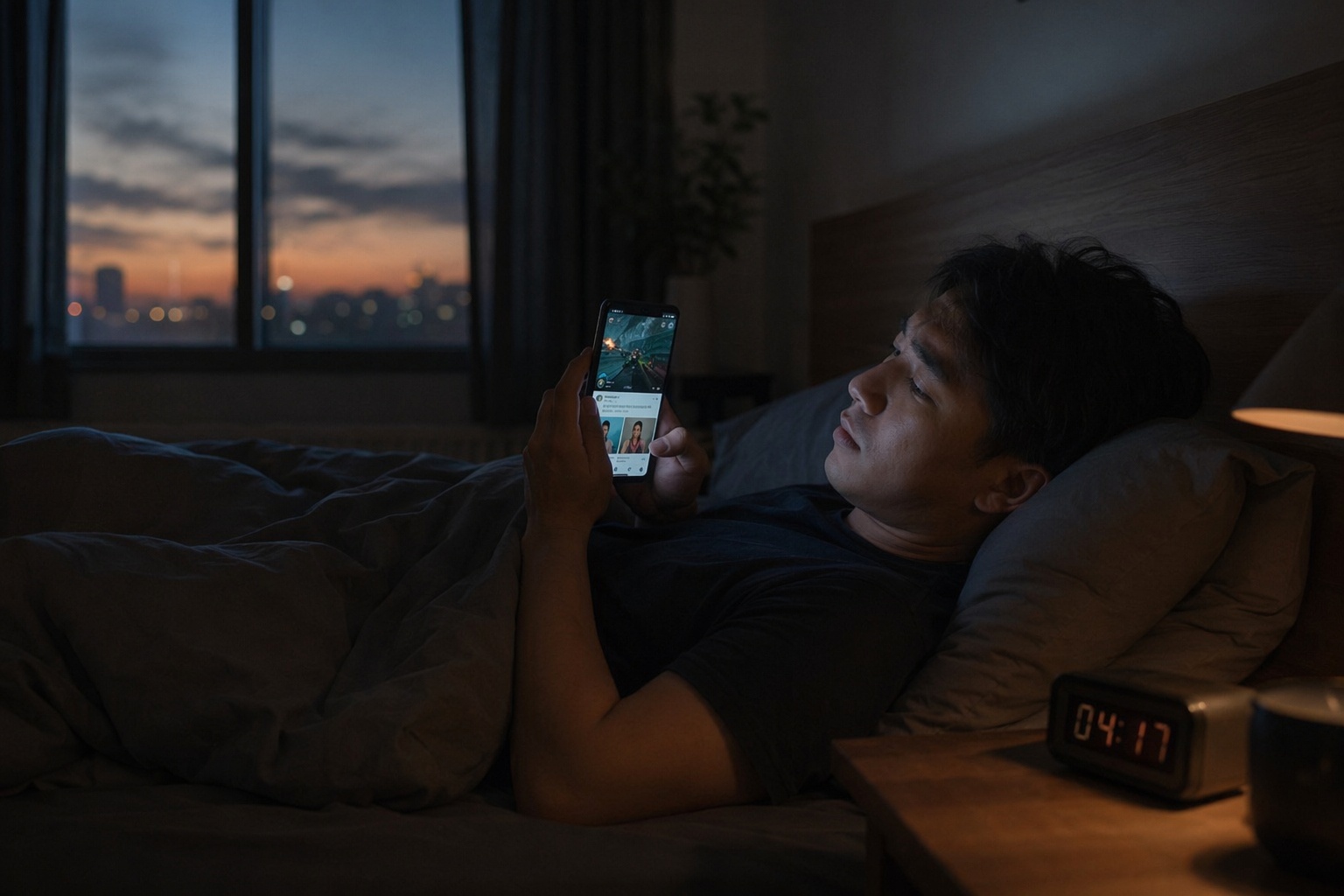
If you turned on night mode, bought blue-light glasses, stopped using the bright white setting on your phone, and still find yourself awake after midnight, the problem is probably not that you failed at managing screens. It is more likely that the popular explanation was too small.
Blue light can affect circadian timing. That part is real. But the size of the effect from ordinary screen light has been stretched far beyond what the best evidence can comfortably carry. A 2024 systematic review of 11 experimental studies found that screen light delayed sleep by about 9 minutes at worst.[1] That is not nothing, especially for someone already running on too little sleep, but it is not the same as saying a phone screen is wrecking the night by itself.
The light comparison is even more clarifying. A phone may deliver roughly 50 to 80 lux of blue light. An overcast outdoor day is around 10,000 lux, and direct sunlight can reach about 100,000 lux.[2] The biology of light still matters, but the bedroom phone is not in the same category as the daytime sky.
A 2026 network analysis of 9,443 adults makes the same correction from a different angle. In that study, blue-light exposure had the strongest direct association with sleep problems, at r=0.31, but the association between general screen time and sleep problems dropped from r=0.42 to r=0.03 after other factors were controlled.[3] Because the analysis is observational, it cannot prove what caused what. Still, it points away from the idea that “screen time” is one simple exposure with one simple effect.
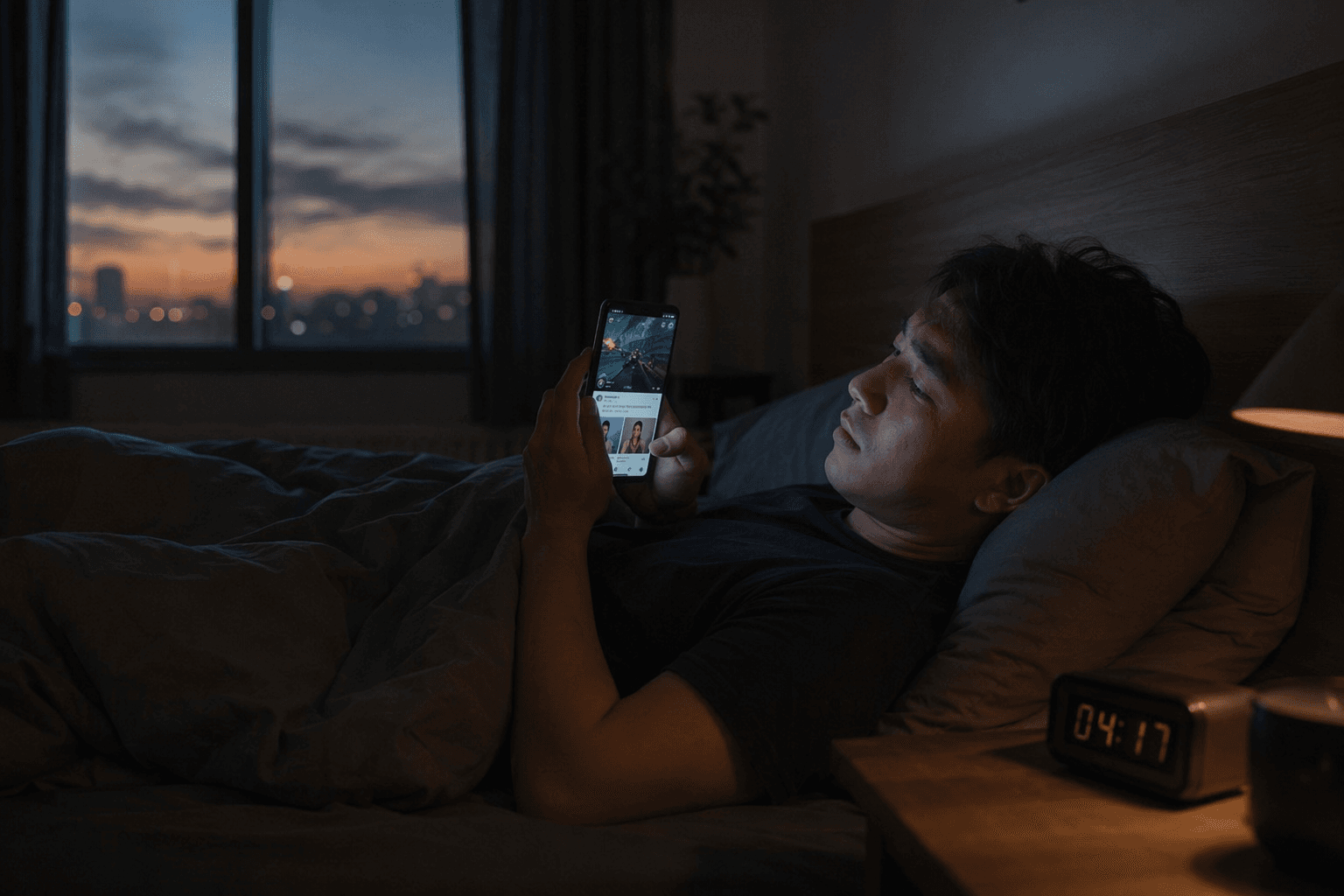
Screen light is not the same as screen use
The useful question is not whether screens affect sleep. They often do. The useful question is which part of the screen experience is doing the work.
A phone used for a quiet audiobook with the screen off is not the same exposure as a phone used for a conflict-heavy message thread. A tablet used to read a familiar novel is not the same as a tablet used for an intense game. The screen may be physically similar, but the nervous system is not receiving the same assignment.
That distinction matters because the blue-light story has become convenient. It gives people a product to buy, a setting to change, and a rule to follow. Those may help at the margin. They do not explain why one person can fall asleep after reading on a device while another lies awake replaying a social exchange that happened through the same glass rectangle.
The more honest model has three parts: what the content does to your brain, how much sleep time the device displaces, and how much daytime light your circadian system received before evening ever arrived.
The first culprit: content that keeps the brain on duty
Cognitive and emotional arousal is the least tidy part of sleep and technology because it depends on the person, the content, and the timing. It is also where many real nights fall apart.
Sleep is not just a switch controlled by darkness. It is also a state the brain has to be willing to enter. A stressful message asks for interpretation. A news feed asks for threat scanning. A game asks for rapid decisions, reward tracking, and one more attempt. Social media can ask for comparison, vigilance, or repair. None of that becomes harmless because the display is amber.
This is why two people can report opposite experiences with the same device. One person reads a predictable chapter and gets sleepy. Another checks work chat, sees a vague message from a supervisor, and spends the next hour preparing for a conversation that has not happened. The device did not merely shine light into the eyes; it delivered a task to the mind.
Research summarized in the BBC Future review points to this broader problem, including arousing content such as thriller novels, horror games, and socially anxious online experiences.[2] The important point is not that every exciting story or game is forbidden at night. It is that “screen” is too blunt a category. Content that raises alertness, emotion, competition, or social evaluation can keep the sleep system waiting even when the light exposure is modest.
For many adults, the most useful bedtime technology change is therefore not a color filter. It is a content filter. The last half hour before sleep is a poor place for unresolved social material, competitive play, work triage, or feeds designed to keep refreshing. If a device stays in the evening routine, the question becomes: does this use lower the temperature of the room mentally, or does it bring another room full of people into bed?
What to change before you change the device
- Move socially charged messages earlier, especially anything likely to require interpretation, repair, or restraint.
- Separate relaxing digital content from algorithmic feeds that keep offering new decisions.
- Treat games, news, work platforms, and conflict-heavy group chats as alerting activities, not neutral screen time.
- If anxious thoughts continue after the phone is down, use a dedicated wind-down technique rather than blaming the display alone.
For readers who recognize the pattern of being tired but mentally activated, broader strategies for falling asleep may matter more than another display setting. The issue is no longer just exposure; it is the transition from engagement to sleep.
The second culprit: the bedtime that disappears while you are still awake
Time displacement is less glamorous than blue light, but it explains a large share of ordinary screen-related sleep loss. The phone harms sleep by occupying the time sleep would have used.
This does not require addiction language or moral panic. A person plans to check one thing at 10:20 p.m. The next clear decision point arrives at 11:05 p.m. Nothing dramatic happened. Sleep simply lost 45 minutes before it had a chance to begin.
This is also where “I use night mode” can become misleading reassurance. Night mode may reduce one kind of light exposure, but it does not return the minutes spent scrolling, watching, shopping, replying, or comparing. If the wake-up time stays fixed, those minutes usually come out of sleep duration.
| If the problem is... | The practical boundary is... |
|---|---|
| You keep choosing one more item | Set a stopping point before the most engaging app opens |
| You lose track of time | Use an external cue, such as an alarm across the room, not an in-app reminder |
| You start work or social repair at bedtime | Create an earlier review window so the bed is not the first quiet moment |
| You use the phone because the evening has no landing routine | Replace the final screen segment with a repeatable low-effort cue |
The boundary does not have to be severe to be useful. A hard “no screens after 9” rule may work for some people and fail completely for others. What matters is whether the rule protects the actual sleep opportunity. A 10-minute calming use that ends on time is different from a “relaxing” scroll that keeps moving the target.
The third culprit: a dim day makes the evening brighter to your body
The least familiar part of this problem happens long before bedtime. If the day is spent mostly indoors, under relatively low artificial light, the circadian system may receive a weak daytime signal. Then evening light, including ordinary household and screen light, can matter more than it would after a bright day.
This is where the lux comparison becomes more than a trivia point. A phone at roughly 50 to 80 lux looks important when the rest of the day has been dim. It looks very different after the eyes and brain have received outdoor daylight, where even an overcast day can reach about 10,000 lux.[2]
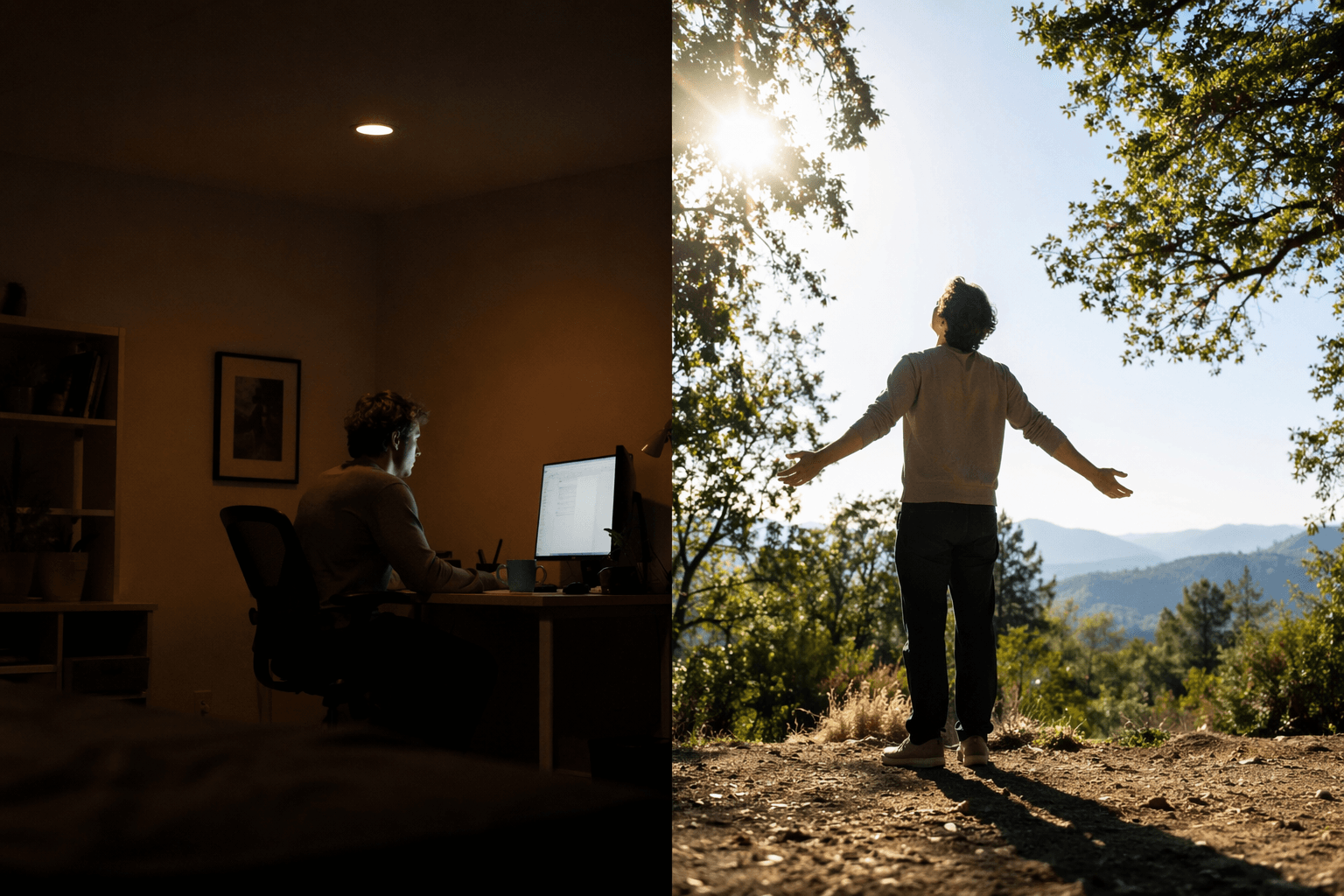
A useful circadian day has contrast. Brightness rises after waking, stays meaningfully brighter during the active part of the day, then falls in the evening. Many modern days flatten that pattern: indoor light during the morning, indoor light during work, indoor light during errands, indoor light during dinner, then a phone in bed. The phone becomes the most visible villain because it is the last object in the story, not necessarily because it is the largest biological signal.
This is also why the strongest practical move is often not a stricter evening gadget rule. It is morning outdoor light. A 30-minute morning walk, when possible, gives the circadian system a clearer daytime anchor and may reduce sensitivity to evening light.[2] The timing matters: morning light helps set the day’s clock, while a dim morning leaves the system with less contrast to work from.
For someone with a delayed sleep schedule, very late bedtimes, or a suspected circadian rhythm disorder, light timing can be more delicate and may need clinical guidance. But for many adults, the everyday correction is simple: stop treating the bedroom as the only place sleep is made. The day is part of the night.
Blue-light glasses and night mode are small tools, not the treatment plan
Blue-light glasses, warm display settings, and dimmed screens are not useless. They can reduce a specific light input, and for some people that is worthwhile. The mistake is treating them as if they address all the ways technology changes sleep.
A warmer screen does not make a work email emotionally neutral. Glasses do not stop an autoplay queue. A dim phone in a dark room can still deliver a social threat, a shopping decision, a gambling-like reward loop, or the familiar relief of not having to be alone with tomorrow’s obligations yet.
The public has good reason to be confused. Sleep technology is now part of ordinary sleep culture, from wearable trackers to smart mattresses to apps that promise insight or control. A 2026 ResMed global survey of 30,000 adults found that 21% named screen use before bed as a top sleep barrier, while wearable tracking use had doubled to 39%.[4] Straits Research projected the sleep tech market at $26.57 billion in 2026, rising to $74.75 billion by 2034.[5]
That does not make sleep technology inherently bad. The American Academy of Sleep Medicine describes technology as capable of both helping and hurting sleep, depending on how it is used.[6] A tracker can help someone notice irregular timing. A meditation app can support a wind-down routine. A smart alarm may make mornings less abrupt. But a device that measures sleep is not the same as a life that protects it.
What to do if screens are part of your real life
The goal is not to perform a perfect analog evening. The goal is to reduce the parts of technology use most likely to keep the sleep system alert, late, and poorly anchored.
- Get outdoor light early. When your schedule and mobility allow, a morning walk of about 30 minutes is a stronger circadian move than obsessing over a tiny screen-light adjustment at night.
- Choose low-arousal content late. Familiar, finite, emotionally neutral material is less likely to keep the brain working than feeds, conflict, games, news, or work messages.
- Put a boundary around the stopping point. Decide when the device use ends before the most engaging app opens.
- Make the evening dimmer without making it the whole strategy. Lower brightness, use warm settings, and avoid complete darkness with a bright device close to the face.
- Watch the pattern, not one night. If sleep remains difficult even after reasonable screen changes, the screen habit may be one piece of a broader insomnia or schedule problem.
This is where habit-building matters. A morning-light routine or a device stopping point works best when it is repeatable enough to survive normal evenings, not just the evenings when motivation is high. If sleep timing is inconsistent, it may also help to think in terms of overall sleep health rather than one isolated bedtime rule.
Blue light is not imaginary. It is just too small a story for the way most screen-related sleep problems actually happen. The more useful question is what the device is asking your brain to do, how much sleep time it is taking, and whether your day gave your body enough light to know when night should begin.
References
- Sleep and screen media in adults: A systematic review. Sleep Medicine Reviews. 2024.
- The blue light from your phone isn't ruining your sleep. BBC Future. April 2026.
- Network analysis of blue light exposure, screen time, and sleep problems. CNS Neuroscience & Therapeutics. 2026.
- 2026 Global Sleep Survey. ResMed. 2026.
- Sleep Tech Market. Straits Research. 2026.
- How technology is helping — and hurting — your sleep. Sleep Education, American Academy of Sleep Medicine.
Comments
Join the discussion with an anonymous comment.