
Most adults have heard the sleep advice so often that it starts to sound like the whole subject: get enough hours. For many people, that means aiming for the familiar 7-to-9-hour range and hoping the rest of the story takes care of itself. The problem is not that duration is useless. It is that duration can be true and still incomplete.
Sleep health asks a better question: not only how long you slept, but how your sleep-wake pattern is functioning across your actual life. Daniel Buysse’s 2014 framework defined sleep health as “a multidimensional pattern of sleep-wakefulness, adapted to individual, social, and environmental demands, that promotes physical and mental well-being.” That definition matters because it moves sleep out of a narrow disease-or-no-disease box and into a positive framework for judging whether sleep is doing its job.[1]
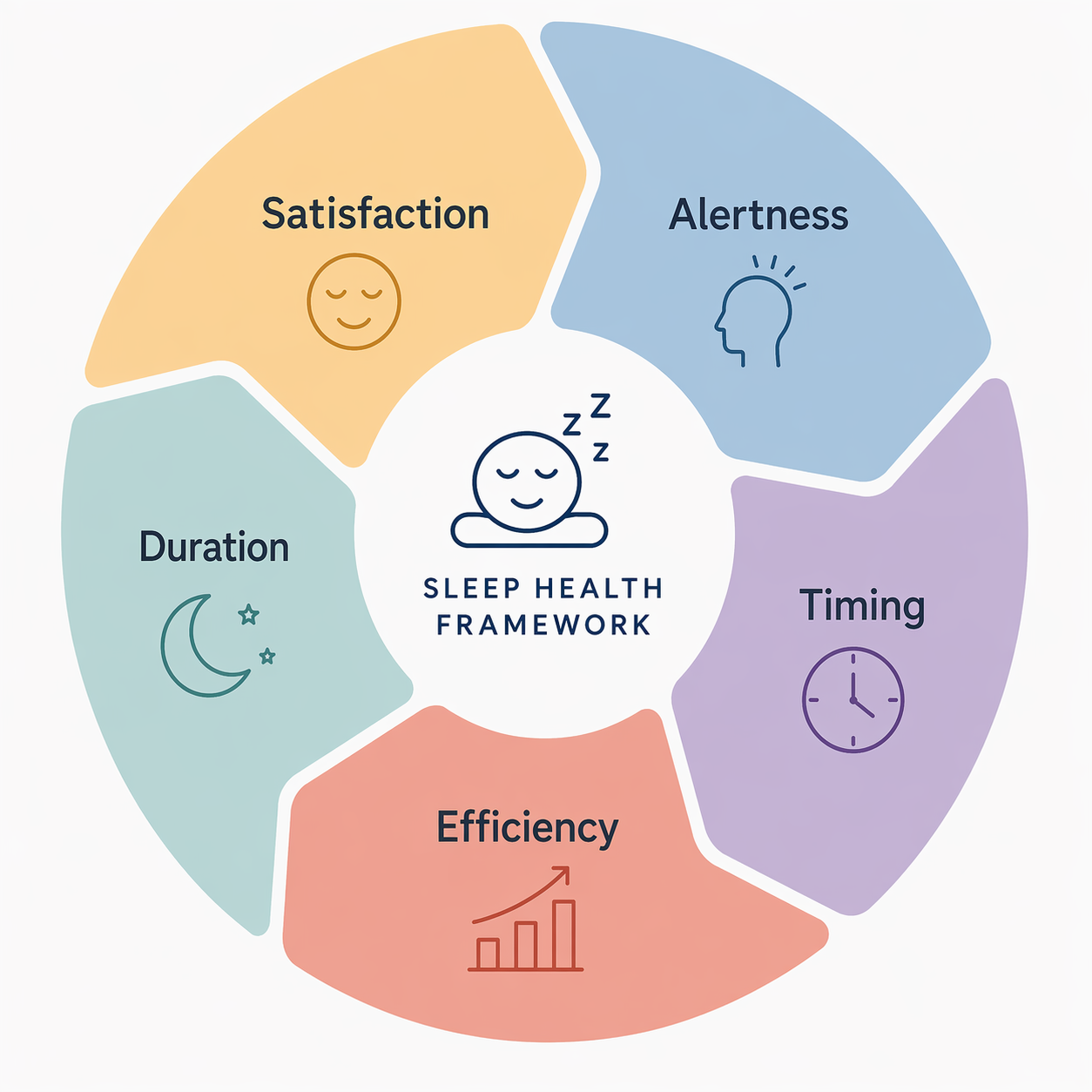
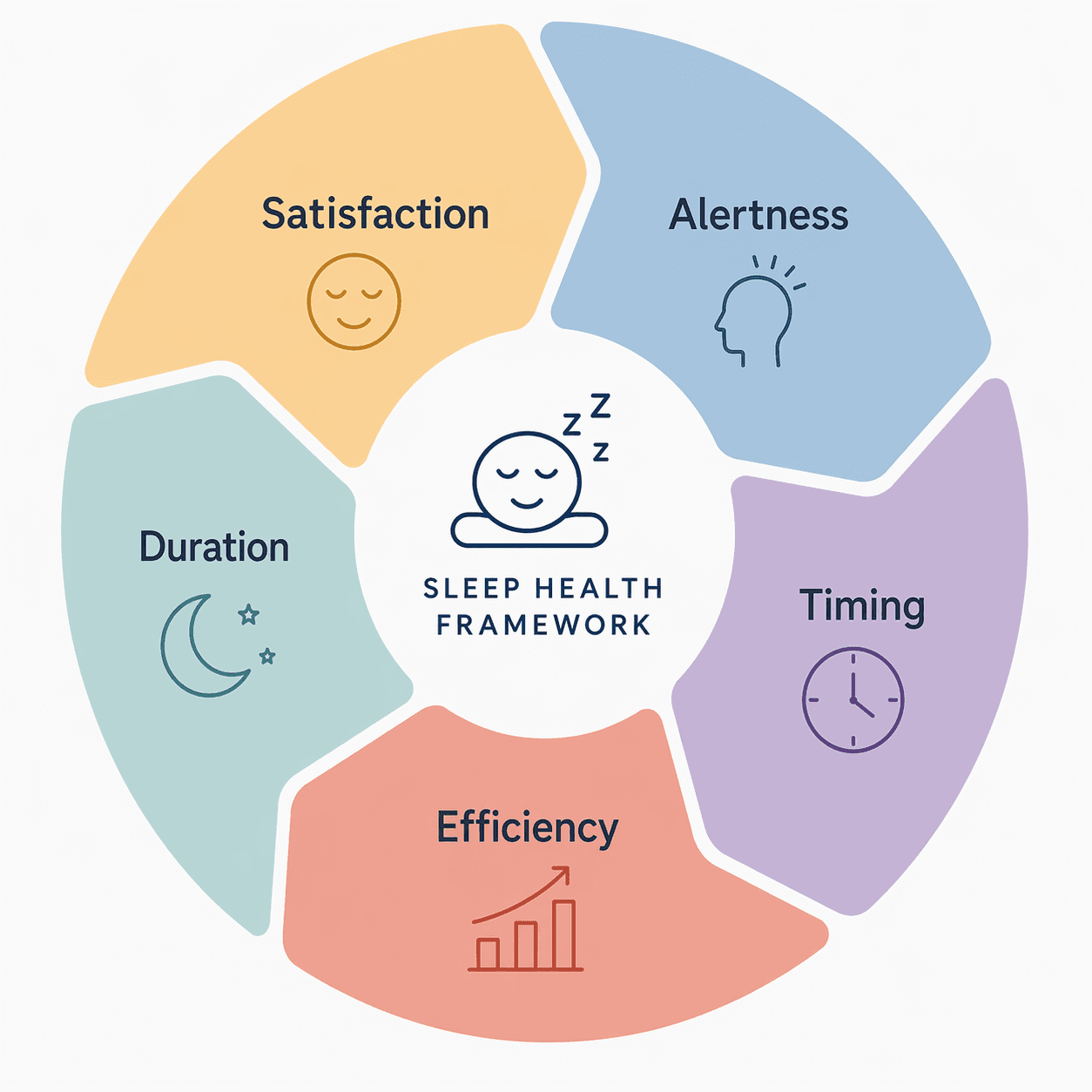
The practical version of that framework is SATED: Satisfaction, Alertness, Timing, Efficiency, and Duration. It gives names to complaints that otherwise get flattened into “bad sleep,” especially for people who are technically spending enough time in bed but still wake unrefreshed, drag through the day, or feel thrown off by an irregular schedule.[1]
Sleep Health Is a Pattern, Not a Scorecard
The useful turn in the SATED model is that it treats sleep as a pattern of functioning. A person can have acceptable duration and poor timing. Another can have short sleep during a demanding week but still have high satisfaction and daytime alertness. Someone else may sleep long, wake dull, and need evaluation for a condition that is fragmenting sleep without fully waking them.
That is why sleep health is not the same thing as sleep hygiene. Sleep hygiene refers to behaviors and environmental practices that may support sleep: light exposure, caffeine timing, bedroom conditions, wind-down routines, and similar levers. Sleep health is the larger outcome those practices are trying to support.
It is also not identical to sleep quality. In everyday speech, “sleep quality” often means how good sleep felt. In SATED, that subjective judgment belongs mostly to Satisfaction. It is important, but it is only one dimension. A person can feel satisfied while keeping highly irregular timing, or feel dissatisfied despite a tracker reporting efficient sleep. Both patterns deserve more precision than a single quality label can provide.
The Five SATED Dimensions
The five dimensions are simple enough to remember, but they are not interchangeable. Each points to a different way sleep can support—or fail to support—physical, cognitive, and emotional functioning.[1]
| Dimension | What it notices | The question it helps answer |
|---|---|---|
| Satisfaction | How you judge your sleep overall | Do you feel your sleep is good enough for your life? |
| Alertness | How awake and functional you feel during the day | Is sleep supporting daytime attention, energy, and functioning? |
| Timing | When sleep occurs across the 24-hour day | Is your sleep-wake schedule reasonably aligned with your body and obligations? |
| Efficiency | How much time in bed is actually spent sleeping | Is your sleep consolidated, or are you spending long stretches awake in bed? |
| Duration | How much total sleep you get | Is the amount of sleep sufficient for your needs? |
Satisfaction: the complaint that should not be brushed aside
Satisfaction is the subjective dimension: whether you are content with your sleep. It can sound soft compared with minutes, stages, or wearable data, but dismissing it is a mistake. The person living in the body is noticing something the spreadsheet may not capture: dread before bed, a sense of never feeling restored, frustration after repeated awakenings, or a mismatch between a device score and lived experience.
This is where many adults lose trust in sleep advice. They did the obvious thing—blocked out enough time—and still feel wrong. SATED gives that experience a place without pretending that dissatisfaction alone proves a specific diagnosis. It says: this is a legitimate dimension to examine, and it may point toward insomnia, pain, mood symptoms, hormonal transition, breathing disruption, environmental disturbance, or a subjective-objective mismatch.
When dissatisfaction persists, the next step is not usually another generic tip list. It is narrowing the pattern. Difficulty falling asleep or returning to sleep may point toward an insomnia and CBT-I pathway. A mismatch between how you slept and what a tracker reports may fit the subjective-objective sleep gap. Night sweats and awakenings in midlife may belong in a perimenopause sleep disruption conversation instead of a generic “try harder” routine.
Alertness: the daytime evidence
Alertness asks whether sleep is carrying over into waking life. That includes sleepiness, attention, mental sharpness, and the ability to stay awake when the day requires it. It is the dimension that catches the adult who says, “I was in bed for eight hours, so why am I useless at 2 p.m.?”
Low alertness can reflect too little sleep, but it can also reflect fragmented sleep, circadian misalignment, medications, mental health strain, sleep apnea, or another medical issue. SATED does not diagnose those causes. It prevents the premature conclusion that duration settled the matter.
This is also where safety and functioning enter. Daytime sleepiness can affect driving, work, caregiving, learning, and mood regulation. A sleep pattern that looks adequate at night but repeatedly fails in the day is not fully healthy in the SATED sense.
Timing: when sleep happens
Timing is the sleep-wake schedule across the 24-hour day. It includes regularity, alignment with circadian rhythms, and the social realities that shape sleep: work shifts, caregiving, school schedules, commuting, light exposure, and household noise.
This dimension is easy to over-prescribe, so it is worth staying close to the definition. Sleep health is adapted to individual, social, and environmental demands.[1] That does not mean every schedule is equally easy on the body. It means the useful question is not whether everyone sleeps at the same clock time, but whether a person’s timing is consistent and workable enough to support daytime functioning.
Timing often explains why two people with the same duration can feel different. One sleeps seven hours on a fairly stable schedule. The other gets seven hours, but the sleep window jumps from weekday early mornings to weekend late mornings. The total is similar; the pattern is not.
Efficiency: time in bed is not the same as time asleep
Efficiency looks at how much of the time spent in bed is actually spent sleeping. It brings attention to long sleep latency, extended awakenings, and the habit of stretching the sleep opportunity so widely that the bed becomes a place for waiting, scrolling, worrying, or monitoring.
A low-efficiency pattern can be especially demoralizing because the person may be “doing the responsible thing” by going to bed early, only to spend more of the night awake. That is one reason insomnia treatment often focuses not only on relaxation but also on the relationship between bed, wakefulness, and sleep pressure.
Efficiency can also be disturbed by conditions that interrupt sleep without the person fully understanding why. Loud snoring, witnessed pauses in breathing, gasping, or morning headaches belong in a sleep apnea pathway rather than a simple bedroom-routine discussion.
Duration: still important, no longer alone
Duration remains the most familiar sleep metric because it is visible, memorable, and easy to communicate. Public-health guidance needs numbers people can remember. If someone is routinely sleeping far less than they need, no framework should talk them out of noticing that.
But duration is one dimension. It does not tell you whether sleep was satisfying, whether you were alert the next day, whether sleep timing was stable, or whether the night was consolidated. Treating it as the whole diagnosis is how someone can “pass” the hour test and still miss the actual weak point.
Why the Dimensions Matter Separately
The SATED framework was not introduced as a branding exercise for better habits. Buysse’s paper argued that sleep health should be studied as a positive, multidimensional construct and reviewed evidence linking dimensions of sleep to health outcomes.[1] In 2025, the American Heart Association adopted a multidimensional sleep-health framing in a scientific statement on cardiometabolic health, giving the idea contemporary clinical and public-health weight beyond the older habit of treating sleep mostly as duration.[2]
The cardiometabolic stakes are important, but the lesson is broader: different sleep dimensions can carry different information. Duration may relate to one risk pattern, timing to another, and satisfaction or alertness to still another. That does not mean a reader should rank the dimensions in a universal order. It means the weak dimension in your pattern may not be the one public advice talks about most.
The available AHA materials should be read with appropriate caution here. Because access to the full 2025 statement may require authentication, the safest claim is the narrower one: the AHA has recognized multidimensional sleep health as relevant to cardiometabolic health, not that any single SATED score mechanically predicts an individual’s future disease risk.[2]
That caution is not a weakness of the framework. It is part of using it correctly. SATED is most useful as a map for assessment: it tells you where to look before you decide what problem you are trying to solve.

Awareness Has Not Solved the Sleep Problem
People do not need much persuading that sleep matters. Resmed’s 2026 Global Sleep Survey reported that 84% of respondents recognized that sleep extends lifespan, yet more than half said they get good sleep no more than four nights per week.[3]
That gap is familiar in sleep science: belief is not the same as a usable framework. Knowing sleep matters does not tell someone whether their problem is timing, efficiency, alertness, satisfaction, duration, or a condition that disrupts several dimensions at once.
National Sleep Foundation materials from 2025 have also been reported as showing a substantial share of U.S. adults with poor Sleep Health Index grades, but the primary PDF was not directly available for verification. That makes the general point reasonable—many adults remain sleep-strained despite broad awareness—but the exact NSF figure should be verified against the primary report before being treated as a primary statistic.
A Practical Way to Read Your Own Sleep Pattern
The brief SATED questionnaire turns the framework into a self-assessment prompt. It is not a diagnosis, and it should not be used to overrule symptoms that need medical attention. Its value is that it slows down the reflex to ask only, “How many hours did I get?”[1]
| SATED dimension | Ask yourself |
|---|---|
| Satisfaction | Am I generally satisfied with my sleep, or do I feel frustrated, unrefreshed, or worried about it? |
| Alertness | Do I feel awake enough during the day for work, driving, caregiving, learning, and ordinary responsibilities? |
| Timing | Does my sleep happen on a reasonably consistent schedule that fits my body and life demands? |
| Efficiency | When I give myself time in bed, do I spend most of it asleep, or am I often awake for long stretches? |
| Duration | Am I getting enough total sleep for my needs, not just enough time reserved on the calendar? |
The point is not to produce a perfect-looking profile. It is to identify the dimension that is actually limiting your sleep health right now.
- If Satisfaction is low, look for persistent distress, insomnia patterns, pain, mood symptoms, hormonal disruption, or a mismatch between subjective experience and device data.
- If Alertness is low, pay attention to daytime sleepiness, concentration problems, drowsy driving risk, and signs that sleep is not restoring waking function.
- If Timing is the weak point, examine schedule drift, light exposure, shift work, social jet lag, and whether your sleep window is realistic for your life.
- If Efficiency is poor, notice long awakenings, long time to fall asleep, time spent awake in bed, and whether a clinical insomnia pathway is more appropriate than another routine tweak.
- If Duration is short, the first issue may simply be insufficient sleep opportunity, but it still belongs beside the other dimensions rather than above them.
Some patterns point back to ordinary supports: a steadier schedule, a darker and quieter bedroom, or a more consistent wind-down routine. A sleep environment guide may help when the main disturbance is light, noise, temperature, or bedding. Other patterns deserve escalation, especially when sleepiness is dangerous, insomnia is persistent, breathing symptoms appear, or sleep disruption clusters with a medical transition or condition.
The Correction Sleep Advice Needed
Duration is still useful. It is just not the whole measure of sleep health. The better question is whether your sleep pattern is satisfying, alerting, well-timed, efficient, and sufficient for the life you are actually living.
For one person, the limiting dimension will be duration. For another, it will be timing. For another, it will be the uneasy gap between sleeping long enough and still feeling unwell. SATED does not make sleep simple; it makes the problem more accurately named.
References
- Sleep Health: Can We Define It? Does It Matter? Sleep, 2014.
- Multidimensional Sleep Health: Definitions and Implications for Cardiometabolic Health: A Scientific Statement From the American Heart Association American Heart Association, 2025.
- Resmed 2026 Global Sleep Survey Resmed, 2026.
Comments
Join the discussion with an anonymous comment.