
Mechanism explainer
What Cholesterol Guidelines Miss About Sleep in Perimenopause
Sleep loss in perimenopause can distort your cholesterol readings in ways standard lipid guidelines don't consider, leading to potentially misleading risk assessments. This article explains the hormone-sleep-cholesterol connection and what it means for your next lipid panel.
A cholesterol result can feel unusually personal when it arrives after months of 3 a.m. wake-ups, night sweats, and the kind of sleep that technically happened but did not restore anything. The obvious question is whether the lab and the sleep are connected. In perimenopause, the most honest answer is not clean enough for a checkbox: sleep disruption may be part of the cardiovascular context, but it is not a do-it-yourself explanation for an LDL-C number.
That distinction matters because the question behind how cholesterol guidelines affect sleep in perimenopause is usually not about sleep advice. It is about interpretation. If a lipid panel is read as a static snapshot while hormones, sleep duration, vasomotor symptoms, activity, and metabolic regulation are all shifting, the number may be technically accurate and still clinically incomplete.
The lipid panel is precise; the body around it is moving
LDL-C, total cholesterol, HDL-C, and triglycerides are not interchangeable signals. A higher LDL-C result does not mean the same thing as a higher triglyceride result, and neither one automatically answers whether a statin is indicated. Guidelines are useful exactly because they stop the conversation from becoming vague. They give clinicians shared thresholds, risk categories, and treatment pathways.
But perimenopause makes the circumstances around the measurement harder to ignore. The same person may be sleeping five fragmented hours, having more frequent hot flashes, exercising less because she is exhausted, and moving through a hormonal transition that changes lipid metabolism. A fasting lipid panel does not show any of that. It shows the result.
The mistake is to jump from that limitation to the comforting idea that insomnia “caused” the cholesterol result and therefore the number can be discounted. The evidence does not support that. The more useful point is narrower: sleep status can change the biological and clinical context in which a lipid result is interpreted, and current cholesterol decision frameworks do not give perimenopausal women a specific adjustment for that context.
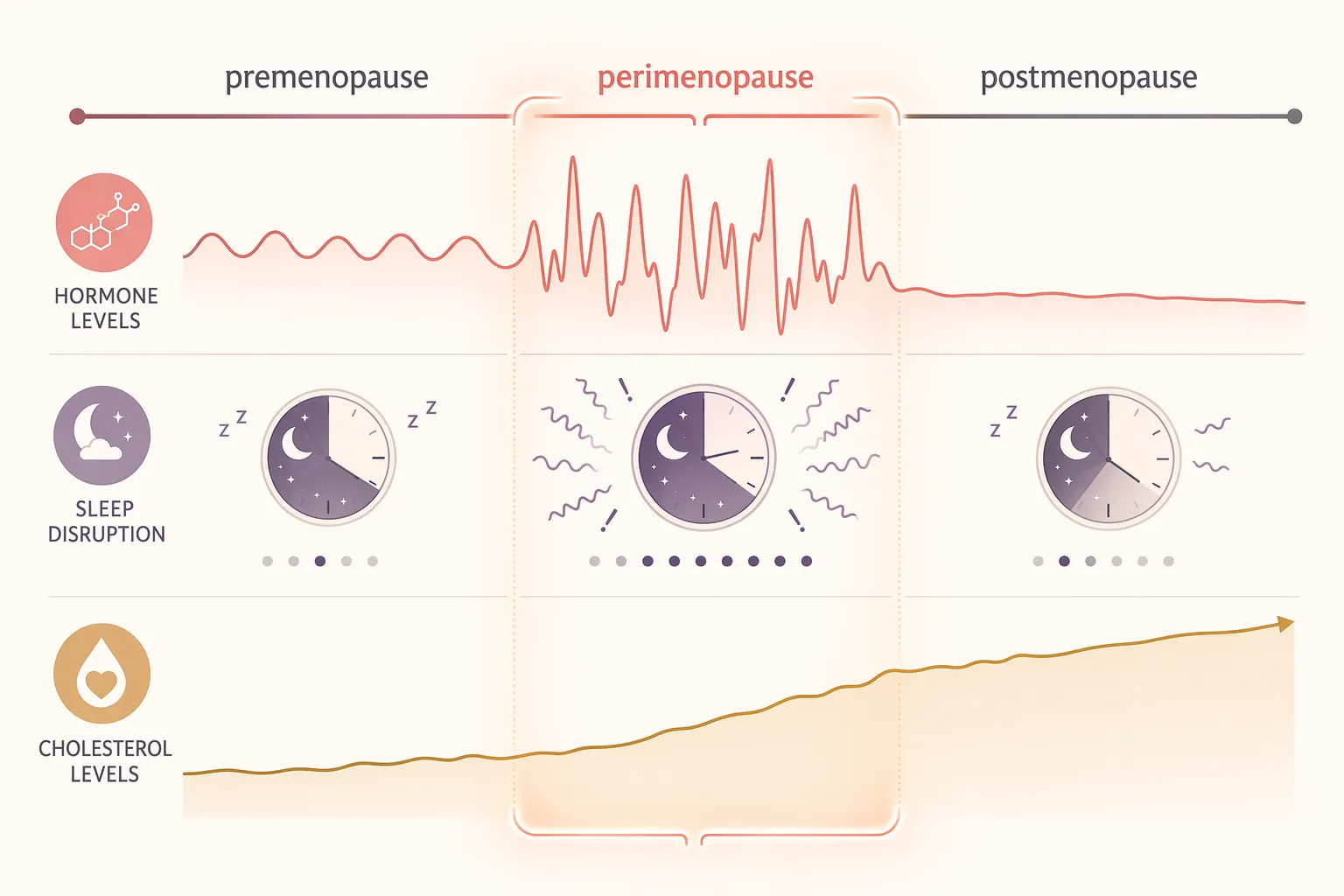
The paradox: sleep restriction lowered LDL-C before menopause, not after
The most disruptive evidence here comes from a pooled analysis of two randomized controlled trials by Barragan and colleagues. In the study, women underwent six weeks of sleep restriction, with sleep reduced by 90 minutes per night. Among premenopausal women, that restriction reduced total cholesterol and LDL-C. Among postmenopausal women, the same effect did not appear. [1]
That finding is awkward in the best way. It does not say that sleep deprivation is good for cholesterol. It does not say that a woman with perimenopausal insomnia should expect LDL-C to fall. It says that menopausal status changed the lipid response to experimentally restricted sleep. The same sleep challenge did not behave the same way across reproductive stages.
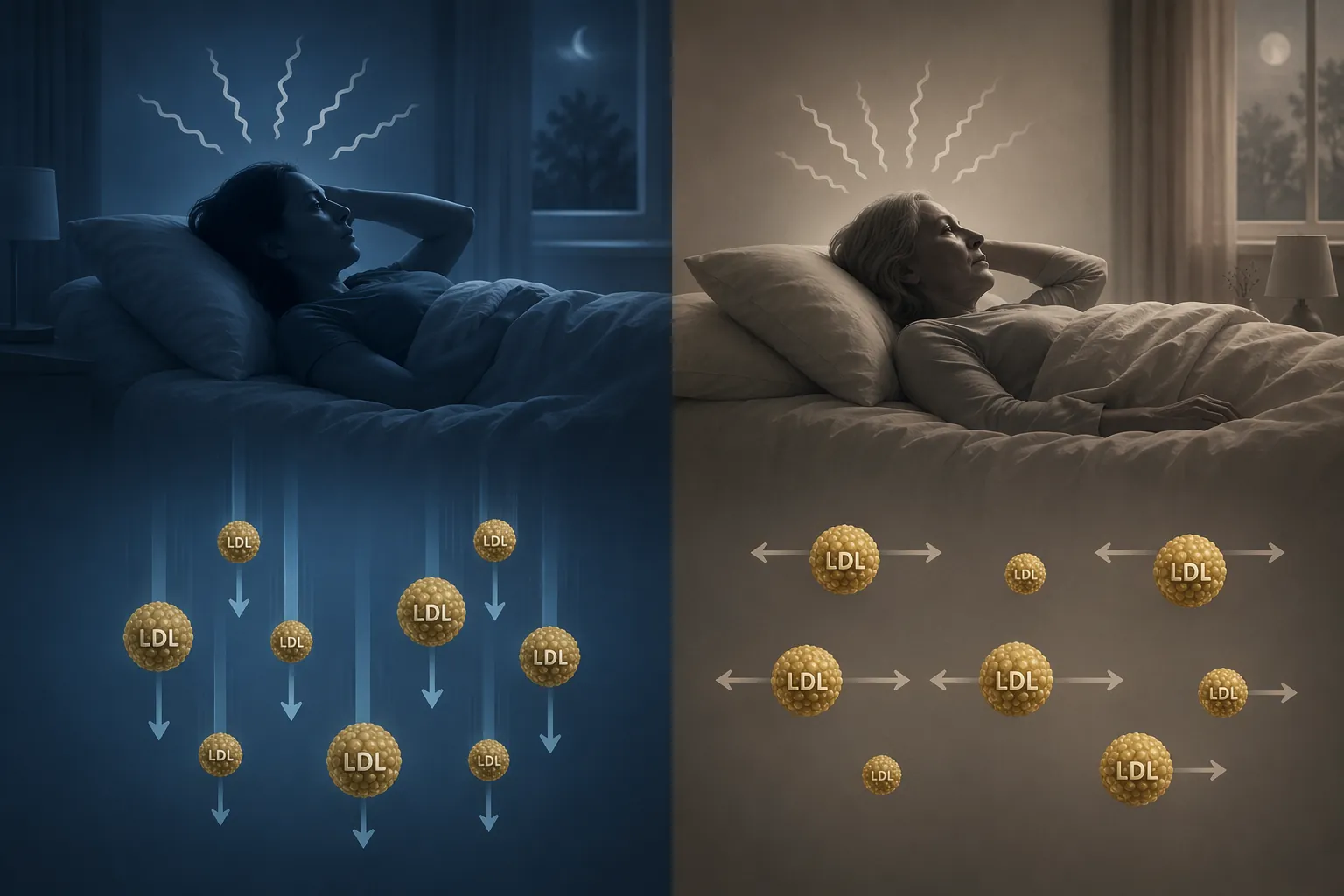
Perimenopause sits between those categories, which is exactly why it is clinically inconvenient. It is not simply “premenopause with worse sleep,” and it is not yet a stable postmenopausal state. Ovarian hormone patterns are changing, sleep is often becoming more fragmented, and lipid values may be rising for reasons that are not reducible to one bad habit or one bad week.
The Barragan study also has boundaries. It tested a controlled six-week protocol, not years of irregular sleep, hot flashes, stress, caregiving, rotating work, alcohol changes, or untreated sleep apnea. Its value is not that it gives a correction factor for your next LDL-C. Its value is that it makes a simple interpretation harder to defend: sleep loss does not appear to interact with lipid biology in one uniform way across female reproductive aging.
Why perimenopause is the wrong time for a context-free reading
During the menopause transition, cholesterol commonly rises. The American Heart Association’s 2020 scientific statement describes increases of roughly 10% to 15%, or about 10 to 20 mg/dL, during this period. [2]
At the same time, sleep problems are not a fringe symptom. A 2025 narrative review summarized that sleep problems affect about 40% to 60% of perimenopausal women and are linked with adverse cardiometabolic changes. [3]
Those two facts do not prove that poor sleep is responsible for a higher cholesterol result. They do make it unreasonable to treat sleep as irrelevant background noise. If a patient’s LDL-C is rising during the same period that her sleep has become chronically disrupted, the practical question is whether the clinician should interpret risk while also asking what has changed in the nights preceding and surrounding the lab.
Longer-term observational data add weight to that concern. In the SWAN cohort, Thurston and colleagues identified four sleep trajectories across the menopause transition; women with persistently high insomnia had higher cardiovascular disease risk even after adjustment for vasomotor symptoms and depression. [4]
That still is not the same as proving that treating insomnia will lower LDL-C. It is a stronger reason to stop treating insomnia as merely a quality-of-life complaint when cardiovascular risk is being discussed. A woman who is awake for hours most nights is not bringing the same physiological context to a lipid panel as someone sleeping reliably through the night.
Triglycerides complicate the picture rather than simplifying it
The sleep-lipid relationship also depends on which lipid measure is being discussed. In a 2026 analysis of Korean National Health and Nutrition Examination Survey data including 10,115 women, Jung and Cho found that both short sleep duration, defined as less than six hours, and long sleep duration, defined as at least eight hours, were associated with higher odds of hypertriglyceridemia in postmenopausal women, with odds ratios of 1.35 and 1.36 respectively. The same pattern was not found in premenopausal women. [5]
This is not the Barragan finding repeated in a different dataset. It concerns triglycerides, not LDL-C; it is observational, not experimental; and it used self-reported sleep duration in Korean women aged 40 to 64, which limits how directly it can be carried into a U.S. clinic visit. But it points in the same general direction: menopausal status changes the sleep-lipid conversation.
Activity matters too. Du and colleagues reported an additive association between sleep problems and physical inactivity with dyslipidemia risk in women aged 45 to 55. [6]
That finding is especially relevant because perimenopausal sleep loss often changes the next day. A person who wakes repeatedly may skip a morning walk, choose more convenient food, or lose the bandwidth to keep routines stable. The lipid panel cannot tell whether sleep disruption changed behavior, biology, or both.
Where current cholesterol guidance is useful, and where it is silent
There is a difference between a flawed guideline and a guideline being asked to answer a question it was not built to answer. The 2018 ACC/AHA multisociety cholesterol guideline gives clinicians a structure for assessing ASCVD risk, discussing statin therapy, and considering risk-enhancing factors. It does not incorporate sleep quality as a modifier for lipid interpretation or statin decisions in perimenopausal women. [7]
That silence should not be inflated into an accusation that every standard lipid assessment is unfair. Age, blood pressure, diabetes, smoking, LDL-C, and other established risk factors still matter. A high LDL-C result still counts. A very high LDL-C result should not be waved away because sleep has been bad.
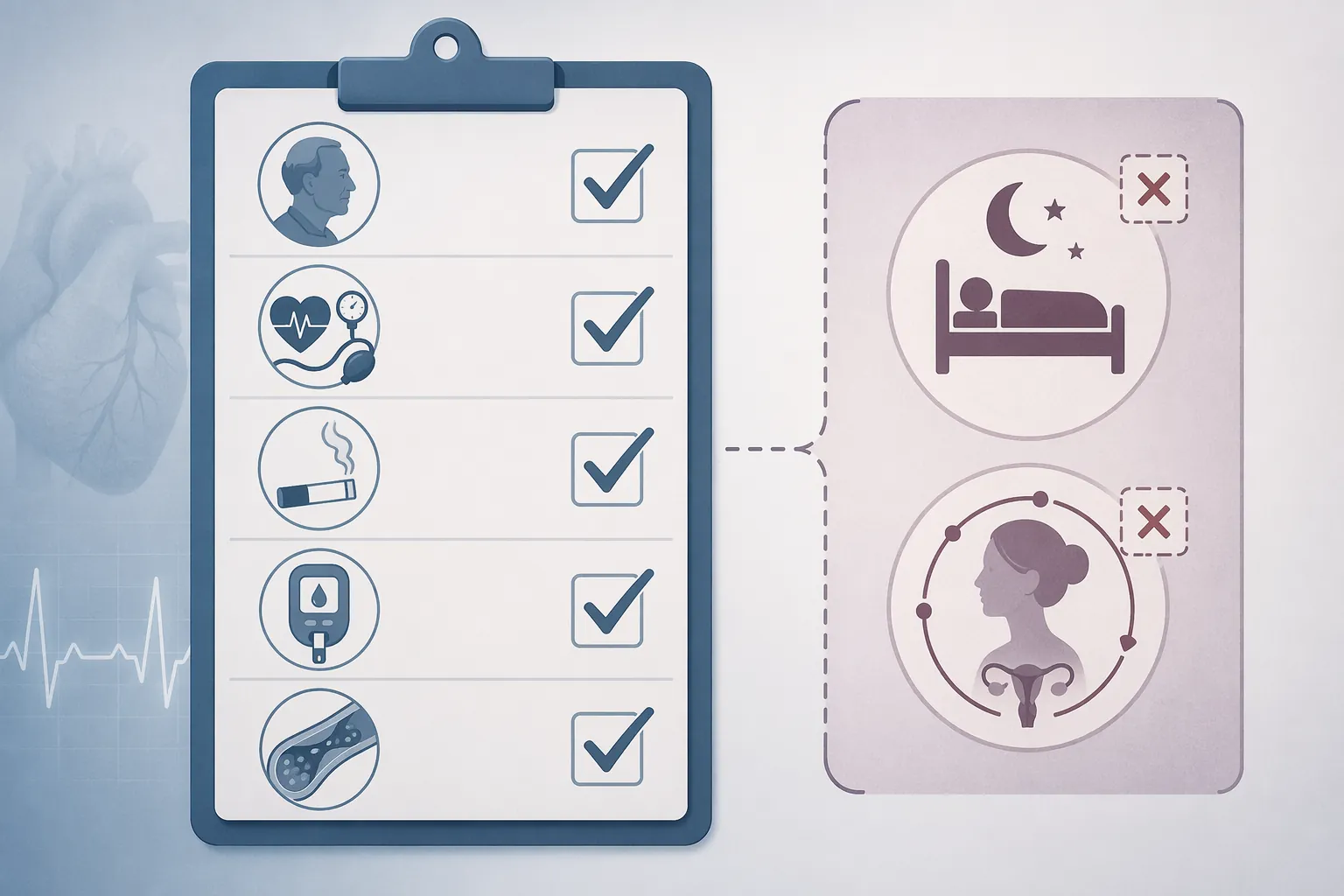
The gap is more specific. The AHA’s Life’s Essential 8 added sleep health as a formal cardiovascular health metric in 2022, while lipid-treatment pathways have not translated that recognition into a perimenopause-specific way to interpret cholesterol results. A clinician may ask about sleep because they are thorough. The guideline itself does not require sleep status to be integrated into the cholesterol decision in this life stage.
| What the lipid result can tell you | What it cannot tell you by itself |
|---|---|
| Your measured LDL-C, HDL-C, total cholesterol, and triglycerides at the time of testing | Whether disrupted sleep raised, lowered, or did not affect those values |
| Whether your result crosses a guideline threshold or contributes to estimated ASCVD risk | Whether that threshold captures the full perimenopause context |
| Whether repeat testing or treatment discussion may be appropriate | Whether improving sleep will normalize cholesterol |
| Whether other risk factors should be reviewed | Whether insomnia is harmless because it is not built into the lipid algorithm |
What to bring into the next cholesterol conversation
The most useful move before the next lipid panel is not to argue that the number should be adjusted downward because sleep has been poor. There is no validated perimenopause sleep correction for LDL-C. The useful move is to make sleep visible as part of the clinical picture.
- Note your usual sleep duration, including whether it is short because you cannot fall asleep, because you wake repeatedly, or because your schedule does not allow enough time in bed.
- Describe insomnia severity in practical terms: how often it happens, how long you are awake, and whether it has persisted for weeks or months.
- Mention vasomotor symptoms, especially night sweats or hot flashes that wake you.
- Bring up changes in activity, weight, alcohol, food pattern, medications, thyroid status, blood pressure, glucose, and family history rather than isolating sleep as the only explanation.
- Ask whether repeat testing makes sense, especially if the result was unexpected or occurred during an unusually disrupted stretch.
The wording matters. “Could my insomnia have caused this?” often corners the conversation into yes or no. A better clinical question is: “Given that I’m in perimenopause and my sleep has changed substantially, should we consider sleep duration, insomnia, vasomotor symptoms, activity, and menopausal stage when interpreting this lipid panel and deciding what to do next?”
If the sleep side of the problem needs its own plan, start with evidence-based insomnia options rather than assuming cholesterol will improve as a reward for sleeping better. The practical next step is a sleep-focused one: review perimenopause insomnia treatments ranked by evidence and use that to decide what belongs in a separate sleep discussion with a clinician.
Better sleep is worth pursuing because sleep is part of cardiovascular health and because insomnia is miserable on its own terms. It should not be sold as a guaranteed cholesterol treatment. The more accurate question to bring into care is not “Does my cholesterol count?” It does. The better question is: “Are we interpreting this cholesterol result in the body and sleep state I’m actually in?”
References
- Barragan et al. pooled analysis of sleep restriction and lipid profiles in premenopausal and postmenopausal women. Journal of the American Heart Association. 2023.
- Menopause Transition and Cardiovascular Disease Risk: Implications for Timing of Early Prevention: A Scientific Statement From the American Heart Association. American Heart Association. 2020.
- Women’s Health: Sleep and Cardiometabolic Health, a Narrative Review. 2025.
- Menopausal Vasomotor Symptoms, Sleep, and Cardiovascular Disease Risk in the Study of Women’s Health Across the Nation. Circulation. 2024.
- Association between sleep duration and hypertriglyceridemia among Korean women according to menopausal status. 2026.
- Association of sleep problems and physical inactivity with dyslipidaemia in women aged 45–55 years. BMJ Open. 2022.
- 2018 AHA/ACC/AACVPR/AAPA/ABC/ACPM/ADA/AGS/APhA/ASPC/NLA/PCNA Guideline on the Management of Blood Cholesterol. American College of Cardiology/American Heart Association. 2018.
Supports these guides
Spot an error or have clinical feedback?
Because this article covers clinical, medication, or safety information, we use a moderated correction channel instead of open public comments. Let us know if something about “What Cholesterol Guidelines Miss About Sleep in Perimenopause” needs a closer look.
Send feedback on this article