
Mechanism explainer
How Sperm Whales Sleep in Vertical Formation
Sperm whales achieve their iconic vertical sleep posture through a recently discovered bubble-buoyancy control system that counteracts their buoyant heads. Learn how these marine mammals manage to nap while upright and what their bizarre sleep patterns reveal about the limits of mammalian rest.
The famous sperm-whale sleeping pose looks as if it should not work. Several enormous animals hang upright in the water column, heads near the light, tails below, bodies nearly motionless. They are not lying on the seafloor. They are not resting at the surface like logs. They are suspended, as though someone solved a balance problem and then walked away.
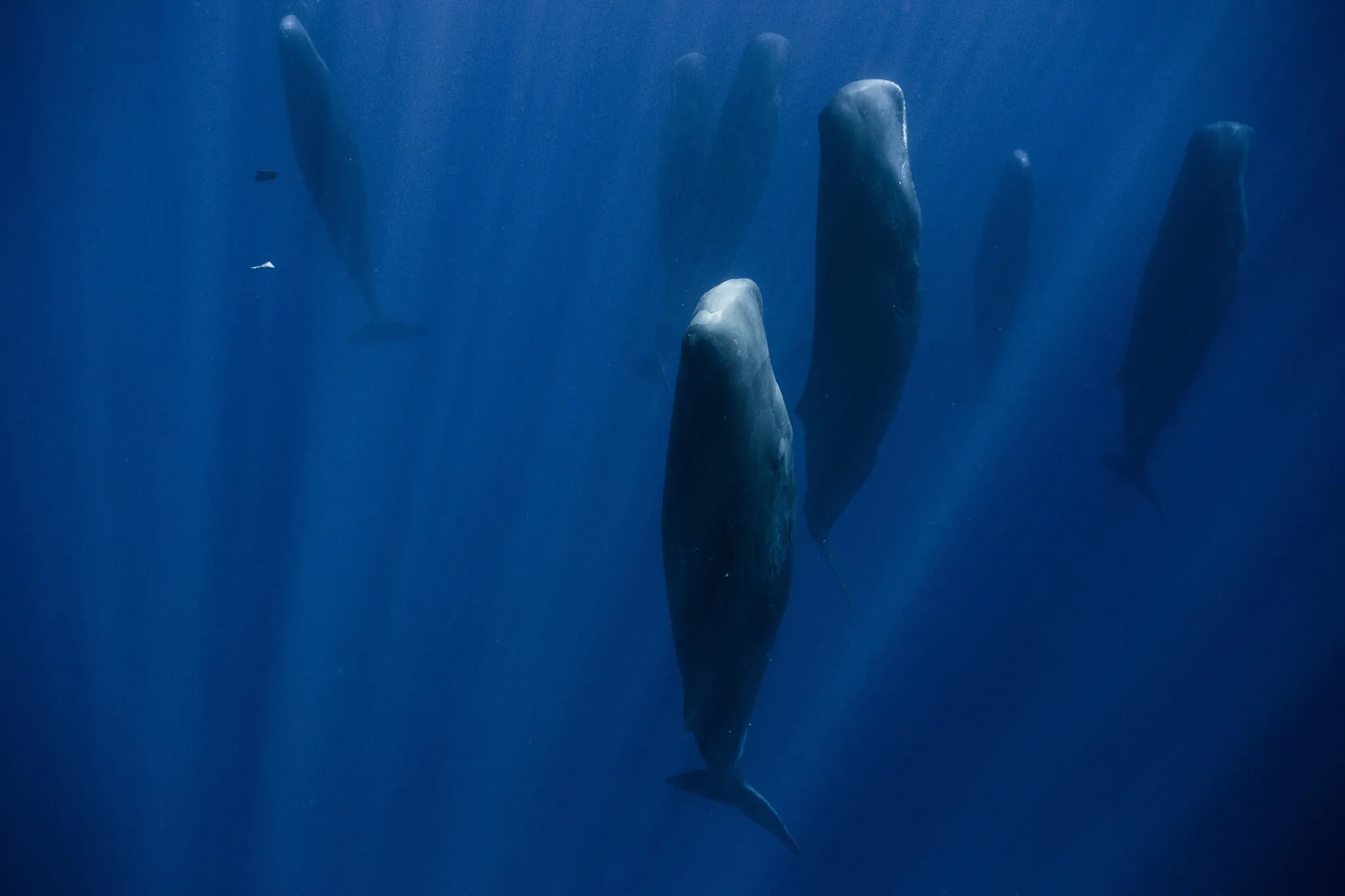
The hard part is the head. A sperm whale’s massive forehead contains the spermaceti organ, an oil-and-wax-filled structure that helps make the front of the animal positively buoyant. Put that buoyant head above a heavy body, remove active swimming, and the posture becomes a mechanical question before it becomes a sleep question: why does the whale not bob upward, roll, or sink away?
A 2026 field study gives the clearest answer so far. Freymond, Burslem, and Miller tagged 42 sperm whales around Norway’s Lofoten Islands with sound-and-movement recorders and found that resting whales release gas bubbles in patterns consistent with buoyancy control. During near-surface naps, the whales released bubbles about 11 times per nap; during ascents from deeper than 200 meters, they released only 3 to 4 times. A simulation in the same study found that releasing bubbles could reduce positive buoyancy enough to help the whale hold a resting depth instead of floating upward.[1]
The Bubble System Behind the Vertical Posture
The useful detail in the 2026 work is not simply that whales blow bubbles. Many marine mammals release air for reasons that have nothing to do with sleep. The interesting part is the timing: bubbles appeared during resting sequences, and the number of releases changed with the whale’s depth history. That makes the bubbles look less like incidental exhalation and more like a control system.
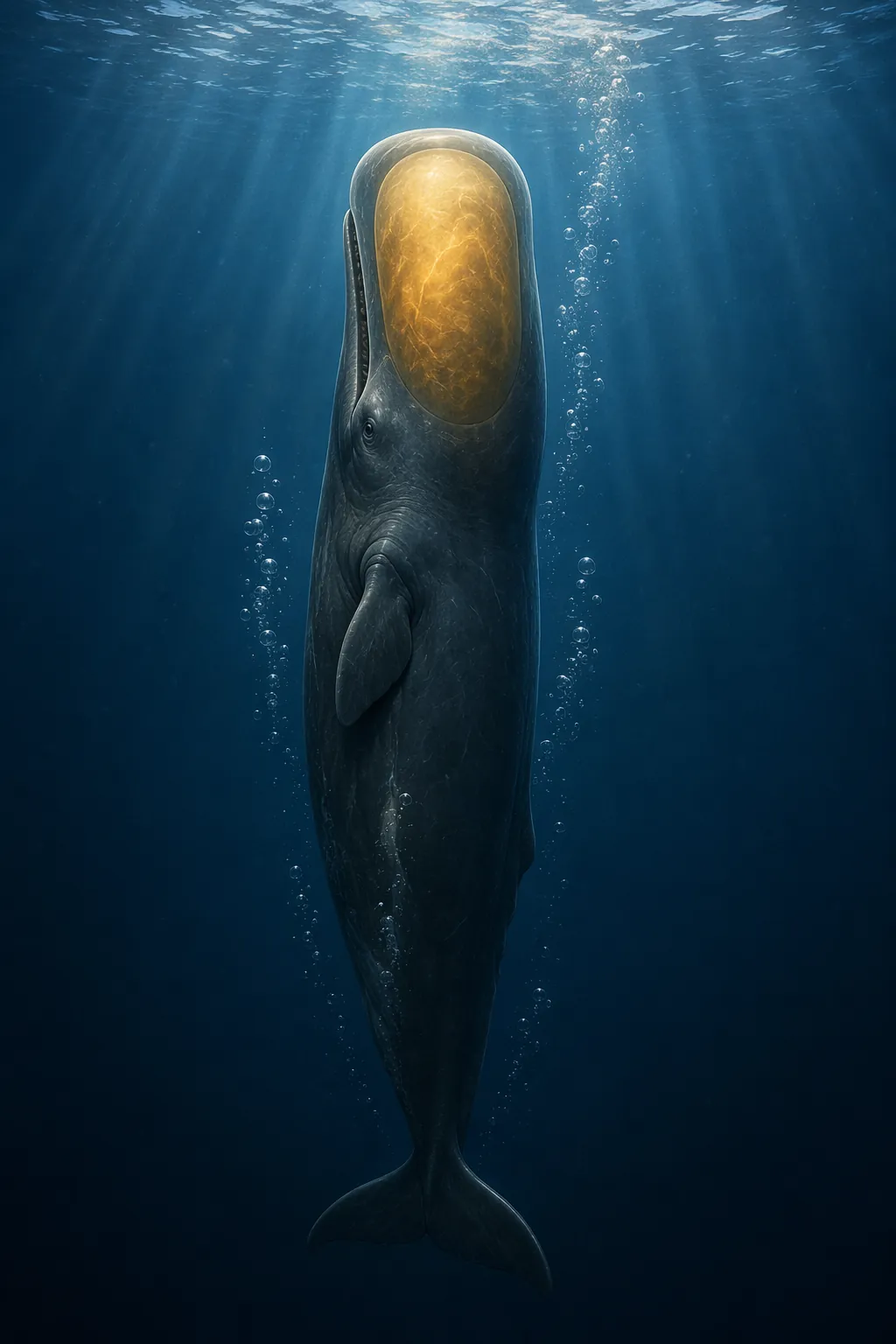
The researchers described three resting modes. In one, a whale slowly sank tail-first by about 8 meters. In another, it tipped into a head-first dive, then the buoyant head helped reverse the movement. In the third, the whale ascended after a deep dive from more than 200 meters. Those modes matter because they put the same animal in different buoyancy situations. A whale that has just come from depth is not managing the same gas state as a whale already napping near the surface.[1]
| Resting mode | What the whale is doing | Why bubbles matter |
|---|---|---|
| Slow tail-first sink | The whale drifts downward by about 8 meters while upright. | Bubble release may help adjust buoyancy while the animal remains nearly motionless. |
| Head-first dive and reversal | The whale begins to move head-first, then the buoyant head helps reverse the direction. | The posture shows how strongly the head affects the animal’s resting mechanics. |
| Ascent from deeper than 200 meters | The whale rises after a deeper dive and releases fewer bubbles than during near-surface naps. | The different bubble count suggests the system responds to depth and gas conditions rather than following a fixed ritual. |
Near the surface, a large air-bearing animal with a buoyant head has a problem of excess lift. Releasing gas reduces that lift. The 2026 simulation did not need to prove what the whale was experiencing; it only had to ask whether the proposed adjustment was physically large enough to matter. The answer was yes: bubble release could offset enough positive buoyancy to stabilize a resting whale at depth.[1]
That is why the new finding changes the old vertical-whale image. The posture is not just an odd silhouette. It is an active compromise between body shape, stored gas, gravity, seawater, and minimal movement. The animal appears still, but the stillness is being maintained.
Staying Upright Is Easier to Show Than Sleeping
The bubble mechanism answers one version of how sperm whales sleep in vertical formation: it explains how an upright resting whale can avoid simply floating out of position. It does not, by itself, prove what is happening in the brain.
The most cited sleep-time estimate comes from an earlier tagging study. In 2008, Miller and colleagues tagged 59 sperm whales, collected 562 hours of recording-tag data, and found that the whales spent 7.1% of their time in a stereotyped vertical drift-dive posture. The bouts lasted about 10 to 15 minutes and occurred mostly between 6 p.m. and midnight.[2]
That 7.1% figure is startling because it places sperm whales near the extreme low end of mammalian rest. It is also easy to overstate. The number measures time in a particular drift-dive posture, not EEG-confirmed sleep. The whales may sleep during that posture; they may also get additional sleep during slow swimming or surface logging. The tag record is powerful behavioral evidence, but it is not a direct readout of sleeping brain state.[2]
This is the awkward place where the physics becomes more solid than the sleep label. The whale can be tagged. Its pitch, depth, movement, and sounds can be recorded. Its bubbles can be counted. But a wild sperm whale is not going to cooperate with a conventional laboratory sleep setup. Without EEG data, “vertical drift” remains a proxy for sleep rather than sleep itself.
If They Are Asleep, the Control Is Remarkably Fine
The 2026 finding becomes especially interesting if the drift posture is sleep. Bubble release is not a crude event like collapsing into rest. It is a repeated adjustment, and the count differs between near-surface naps and ascents after deeper dives. If whales are truly asleep while doing this, then some form of fine positioning control persists during sleep.[1]
That possibility does not require imagining a whale half-awake in a human sense. Sleep in aquatic mammals already resists tidy categories. Dolphins, for example, have EEG-confirmed unihemispheric slow-wave sleep in captivity: one brain hemisphere shows slow-wave sleep while the other remains more alert. By contrast, no EEG data has confirmed sleep in wild sperm whales, and reviews of aquatic mammal sleep treat unihemispheric sleep as the cetacean pattern actually demonstrated by EEG.[3]
Sperm whales may be doing something different during vertical resting bouts, but the evidence is behavioral. The strongest visual clue comes from a Chile encounter in which vertically resting sperm whales did not respond to a slowly approaching vessel until one was accidentally bumped; reports of the event noted closed eyes and a lack of response before contact. It is a vivid scene because unresponsiveness is one of the behaviors people intuitively associate with sleep. It is still not the same as measuring both hemispheres asleep.[3]
The distinction is not pedantic. If a whale is in unihemispheric sleep, it may retain one-sided vigilance while resting. If it is in bihemispheric sleep, both hemispheres may be offline in a way no cetacean has yet had confirmed by EEG. A vertical, unresponsive whale with closed eyes pushes toward the second interpretation, but it cannot finish the argument on its own.
What the Vertical Formation Really Shows
The safest answer is a double one. Sperm whales most likely maintain their vertical sleep posture by releasing gas bubbles that counteract the positive buoyancy of the spermaceti-filled head. That mechanism is now supported by field tags and simulation, with different bubble-release patterns in near-surface naps and deeper ascents.[1]
Whether every vertical drift-dive should be called true sleep in the neurological sense is still unresolved. The 2008 tag data showed a strikingly small amount of time in the posture most associated with sleep, but posture is not brain state. The Chile encounter makes the sleep interpretation feel compelling, yet no one has collected EEG data from wild sleeping sperm whales.[2][3]
That uncertainty is part of why the behavior matters. Sperm whales expose sleep at its least bedroom-like: brief, vertical, buoyancy-managed, and inferred from traces left in water rather than wires on a scalp. The animal does not stop being strange once the mechanism becomes visible. It becomes stranger in the better way: mechanically intelligible, biologically unfinished.
References
- Freymond, Burslem & Miller sperm whale bubble-buoyancy study, Journal of Experimental Biology, July 23, 2026.
- Stereotypical resting behavior of the sperm whale, Current Biology, 2008.
- Sleep in Aquatic Mammals, PMC/NIH, 2019.
Supports these guides
Spot an error or have clinical feedback?
Because this article covers clinical, medication, or safety information, we use a moderated correction channel instead of open public comments. Let us know if something about “How Sperm Whales Sleep in Vertical Formation” needs a closer look.
Send feedback on this article