
Mechanism explainer
Does Meal Timing in Time-Restricted Eating Affect Sleep?
The timing of the eating window within time-restricted eating protocols matters more for sleep outcomes than the fasting duration itself. This article reviews evidence on early versus late TRE, showing distinct effects on sleep duration, efficiency, and latency, and highlights who is most likely to benefit or experience trade-offs.
If you are considering time-restricted eating for sleep, the useful question is not simply whether a 16-hour fast is “good” or “bad.” It is whether your eating window ends at 3 PM, at 8 PM, or with a more modest buffer before bed. Those are different sleep experiments. The evidence so far points to a restrained answer: fasting duration alone is not the sleep-relevant variable; the placement of the eating window appears to matter more.
That matters because claims about time-restricted eating and sleep benefits can make the field sound cleaner than it is. In one 14-week randomized trial secondary analysis among adherent adults with obesity, early time-restricted eating from 7 AM to 3 PM was linked with about 0.5 hours less self-reported sleep and about 7 minutes longer sleep onset latency.[1] In a separate 12-week randomized trial using a later 12 PM to 8 PM window, objective sleep efficiency measured by Oura ring fell by 2.7%.[2] Neither finding proves that every early or late eating window harms sleep. They do show why “TRE improves sleep” is too blunt.
TRE is not one sleep intervention
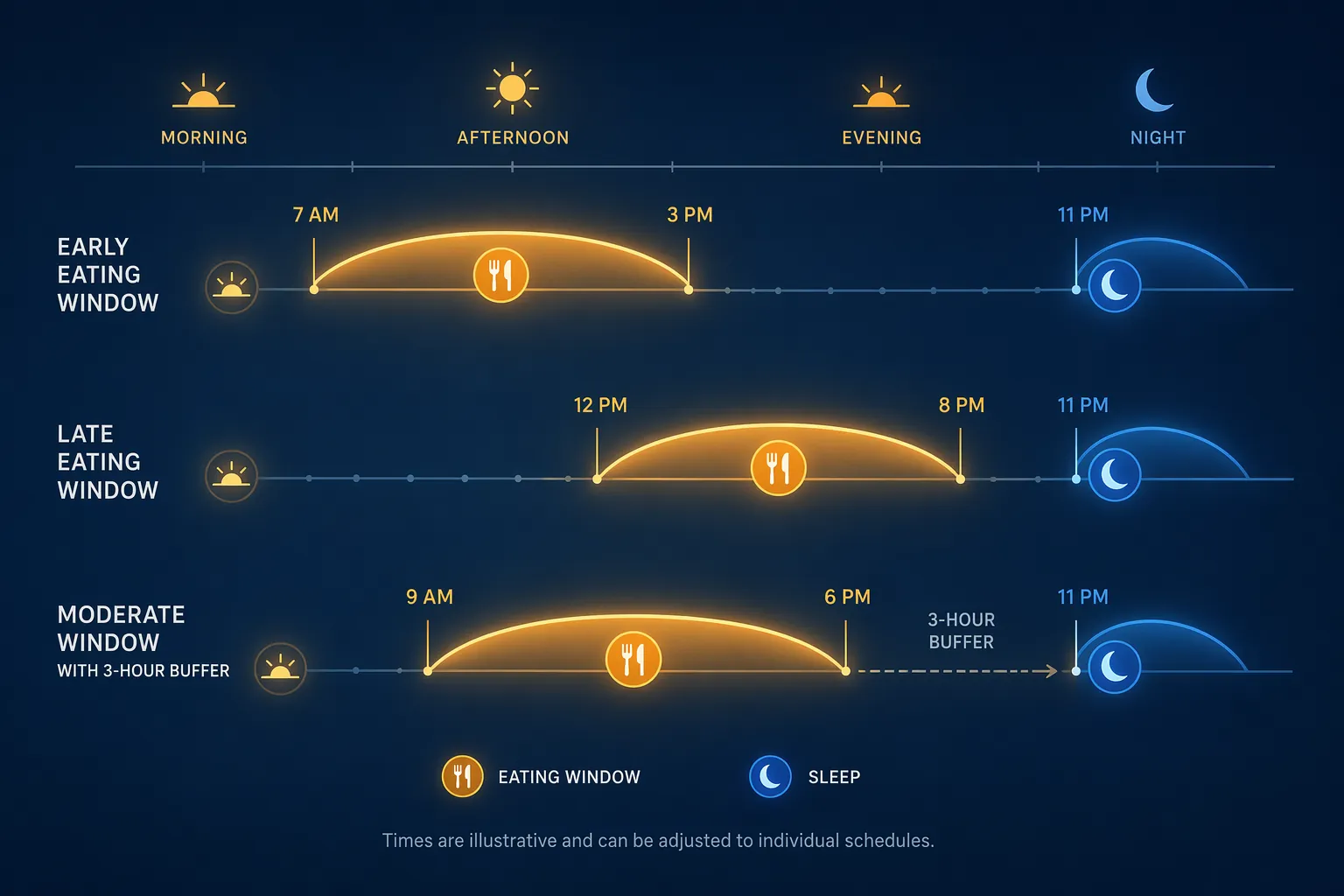
Two people can both say they are doing “16:8” and have very different nights. One person may eat breakfast early and stop midafternoon. Another may skip breakfast, eat lunch at noon, and finish dinner at 8 PM. A third may not follow a strict fasting label at all but may consistently stop eating three or more hours before bed. From a sleep perspective, those distinctions are not cosmetic.
| Pattern | Typical timing | Why sleep may respond differently |
|---|---|---|
| Early TRE | About 7 AM–3 PM | Long gap before bedtime; stronger circadian rationale, but may create evening hunger or social strain |
| Late TRE | About 12 PM–8 PM | Easier for many work and dinner schedules, but eating may sit closer to bedtime |
| Moderate bedtime buffer | Last calories at least 3 hours before bed | Less extreme; targets the period when digestion, reflux, glucose handling, and sleep initiation can collide |
The early window is often treated as the most biologically elegant version because it keeps most calories in the daylight portion of the day. That logic is plausible. It is not the same as showing better sleep in every trial. The late window may be easier to live with, but it can move calories into the evening, when many people are trying to wind down. The moderate buffer is less dramatic, and for sleep it may be the most defensible place to start: not because it has solved every question, but because it avoids the two extremes that have produced measurable trade-offs.
Early eating windows: circadian logic, real sleep trade-offs
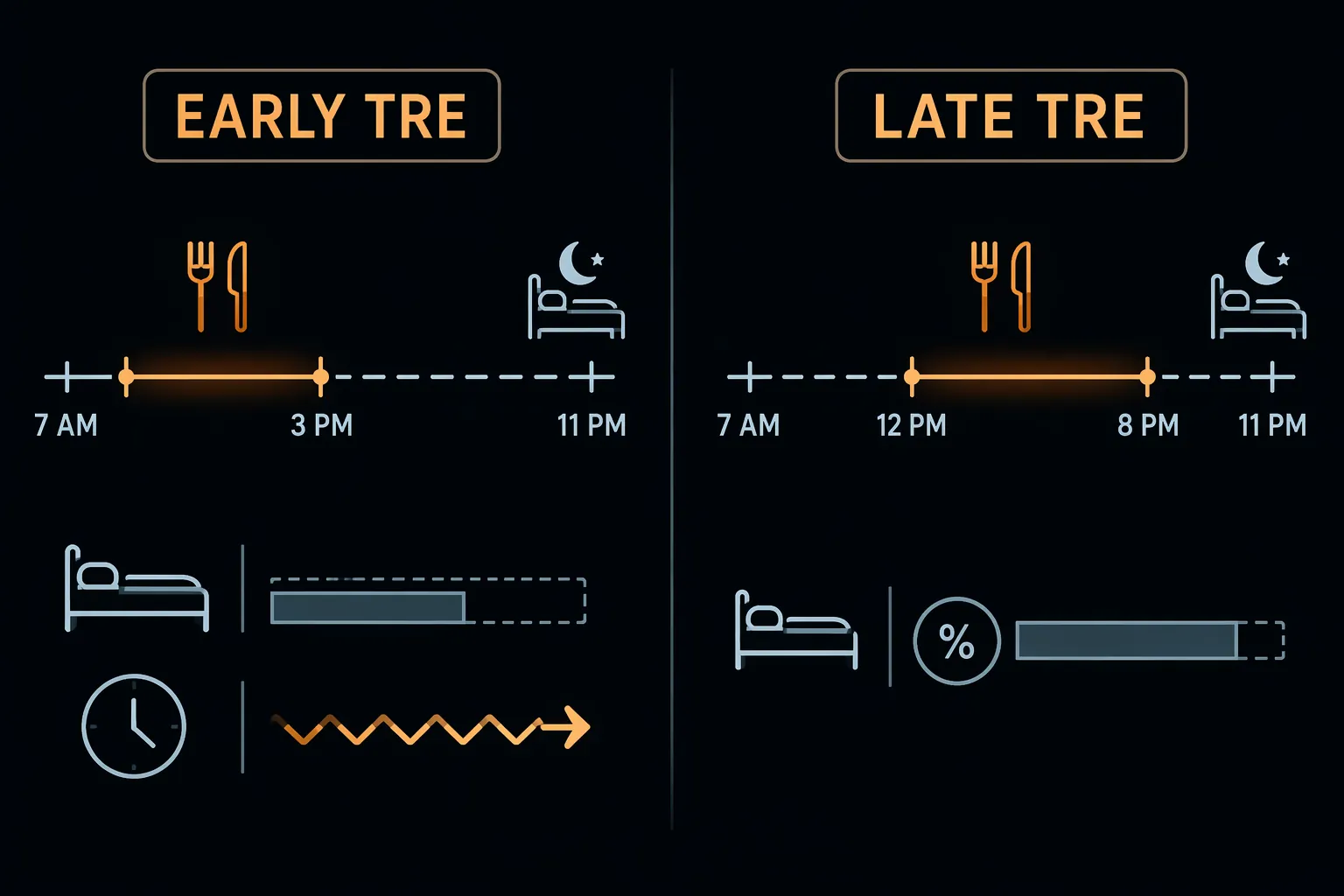
Early time-restricted eating is attractive on paper. A 7 AM to 3 PM eating window leaves a long interval before bedtime, avoids late-night meals, and lines up food intake with the part of the day when alertness and metabolic handling are usually stronger. But in the Steger et al. secondary analysis, the sleep signal was not a straightforward improvement. Among adherent completers with obesity in a 14-week randomized trial, early TRE was associated with shorter self-reported sleep duration and longer self-reported sleep onset latency.[1]
The caveat matters. This was a secondary analysis, and the sleep findings came from adherent completers rather than serving as the main intention-to-treat sleep outcome. That lowers confidence compared with a trial designed primarily to test sleep. Still, it is a useful warning against letting circadian enthusiasm overrule the actual sleep measures. If a person stops eating at 3 PM but then lies awake hungry, wakes earlier than intended, or finds the schedule impossible around family dinner, the protocol has not become sleep-friendly just because it looks circadian.
There is also a practical issue that rarely gets enough room in wellness advice: a 3 PM cutoff can be socially and physiologically demanding. People with late work hours, caregiving responsibilities, evening exercise, medication schedules, hot flashes, or a long-standing family dinner routine may not experience early TRE as a gentle circadian nudge. They may experience it as an evening stressor. Sleep does not usually improve when the intervention creates a nightly negotiation with hunger and household life.
Late eating windows: easier to follow, not automatically easier on sleep
A noon to 8 PM window fits modern life better. It preserves dinner, avoids breakfast for people who are not hungry in the morning, and is easier to explain than a midafternoon kitchen closing time. But the sleep data do not let it off the hook. In Lowe et al.’s 12-week randomized trial of late TRE, participants assigned to the 12 PM to 8 PM eating window had a 2.7% reduction in objective sleep efficiency measured by an Oura ring.[2]
Sleep efficiency is the percentage of time in bed actually spent asleep. A 2.7% drop is not the same as catastrophic insomnia, and an Oura ring is not polysomnography. It is still a sleep-relevant finding. A person can get into bed at the same time, spend the same number of hours there, and come away with less consolidated sleep if the night contains more wakefulness. That is a different outcome than shorter total sleep time, and it is one reason TRE studies should not be collapsed into a single “better” or “worse” sleep verdict.
Late TRE may be especially vulnerable when dinner is heavy, spicy, alcohol-containing, or pushed close to bedtime. The trial result does not isolate every one of those evening behaviors. It does, however, fit a practical sleep rule that is more modest than “eat as early as possible”: do not make digestion compete with sleep onset if you can avoid it.
Sleep duration, efficiency, latency, awakenings: the outcome matters
A sleep benefit can mean several different things. One study may measure how long people sleep. Another may measure how efficiently they sleep while in bed. Another may ask whether they feel disturbed or rested. Those are related, but they are not interchangeable.
| Sleep outcome | What it asks | What the TRE evidence suggests so far |
|---|---|---|
| Sleep duration | How much sleep occurred | Early 7 AM–3 PM TRE was associated with about 0.5 hours less self-reported sleep in adherent adults with obesity.[1] |
| Sleep onset latency | How long it took to fall asleep | Early TRE was associated with about 7 minutes longer sleep onset latency in the same secondary analysis.[1] |
| Sleep efficiency | How much time in bed was spent asleep | Late 12 PM–8 PM TRE reduced Oura-measured sleep efficiency by 2.7% in a 12-week randomized trial.[2] |
| Subjective sleep disturbance | Whether sleep felt disrupted | A 14:10 TRE protocol reduced self-reported sleep disturbances in 24-hour shift workers.[3] |
| Objective architecture and awakenings | Light sleep, deep sleep, latency, awakenings, and total sleep time by wearable | A 7-day 16:8 TRE study in healthy adults found no significant changes on Withings ScanWatch measures.[5] |
This distinction is not academic. If early TRE shortens sleep duration but avoids late meals, that is a trade-off. If late TRE preserves dinner but reduces sleep efficiency, that is another trade-off. If a shift worker reports fewer sleep disturbances after a structured eating window, that may matter clinically even if the measurement is self-reported. The sleep question is not “Did TRE work?” It is “Which part of sleep moved, in which direction, and for whom?”
Who may benefit, and who may trade one problem for another
Shift workers with circadian disruption
Shift workers are one group where a structured eating window may plausibly help sleep, not because TRE is magical, but because the baseline problem is often circadian chaos. In Manoogian et al.’s study of 24-hour shift workers, a 14:10 TRE protocol using a 10-hour eating window reduced self-reported sleep disturbances.[3] That is encouraging, and the self-reported nature of the outcome should stay attached to the claim.
The implication is not that every night-shift worker should copy a daytime eating schedule. A workable eating window for shift work has to account for commute timing, breaks, safety-sensitive work, overnight hunger, and whether the person is trying to sleep during the day. In this group, regularity may be as important as early timing.
People with obesity or OSAHS
For adults with obesity, the evidence is mixed rather than neatly positive. The early TRE secondary analysis found shorter sleep duration and longer latency among adherent completers.[1] A different preliminary trial in obese patients with obstructive sleep apnea-hypopnea syndrome, or OSAHS, used an 8-hour 10 AM to 6 PM eating window and reported improved sleep latency, sleep duration, and sleep efficiency at 12 weeks.[4]
That OSAHS finding is worth noticing, but not overselling. The trial had 58% post-hoc power, so the result should be treated as preliminary rather than definitive.[4] It also does not mean TRE treats sleep apnea itself. OSAHS is a breathing disorder during sleep, and people with suspected or diagnosed sleep apnea still need appropriate clinical evaluation and treatment. Meal timing may become part of a broader plan; it should not be asked to replace airway care.
Healthy adults who already sleep well
If sleep is already solid, there may be less room for TRE to improve it. Strüven et al. followed healthy adults through 7 days of 16:8 TRE using Withings ScanWatch data and found no significant changes in total sleep time, light sleep, deep sleep, sleep latency, or awakenings.[5] A week is short, and smartwatch technology has limits. Still, the finding is consistent with a plain clinical expectation: if baseline sleep is already healthy, a timing rule may not produce a dramatic sleep gain.
Perimenopause, pregnancy, ADHD, and older adulthood
This is where the evidence becomes thinner than many readers need it to be. The studies above do not specifically answer what happens in perimenopausal women, pregnant people, or adults with ADHD. That absence should not be softened into “more research is needed” and then forgotten. These are groups where sleep timing, appetite, temperature regulation, medication timing, nausea, impulsivity, blood sugar swings, and caregiving schedules may all affect whether a fasting window is tolerable.
Older adults also deserve caution, even when they are not excluded from every discussion of TRE. Aging often brings earlier circadian timing, lighter sleep, medications that need food, and greater consequences from under-eating or overnight dizziness. A very early eating window may suit some older adults beautifully. For others, it may worsen evening hunger or reduce total intake. The current sleep literature is not strong enough to turn one timing rule into a blanket recommendation for older adults.
The mechanism is plausible, but it does not settle the question
Food timing can act as a secondary zeitgeber, a time cue that helps synchronize body clocks outside the brain’s central light-driven clock.[6] That is the most interesting biological argument for meal timing and sleep. Light remains the dominant circadian cue, but food can send timing information to metabolic tissues. Eating late, irregularly, or across too many hours of the day may blur those signals.
There are also metabolic reasons researchers care about the fasting interval. Anton et al. describe a “metabolic switch” after roughly 12 hours without food, when the body shifts away from readily available glucose toward greater use of fat-derived ketones, with related discussion of cellular repair pathways.[7] This mechanism helps explain why TRE attracts interest beyond weight loss. It does not prove that a 16-hour fast will improve sleep, and it certainly does not prove that ending food at 3 PM is better for every sleeper than ending at 6 PM.
Early TRE may influence circadian physiology in measurable ways. In Jamshed et al.’s study, early time-restricted feeding significantly reduced evening cortisol levels, suggesting an effect on circadian rhythm markers.[8] That is a meaningful mechanistic clue. It is also exactly where interpretation needs discipline: lower evening cortisol is not the same outcome as longer sleep, better sleep efficiency, or fewer awakenings.
The mechanism makes timing worth studying. The trials decide how much confidence to place in a sleep claim. Right now, those trials point away from one universal TRE sleep benefit and toward a more conditional pattern: eating too close to bed can be a problem, but pushing the window very early can create its own sleep costs.
What the broader trial literature can and cannot say
The most sobering check comes from Bohlman et al.’s 2024 systematic review of randomized controlled trials on TRE and sleep. Across 6 RCTs lasting 8 to 14 weeks, only 1 found a significant improvement in subjective sleep quality, and TRE did not typically worsen sleep parameters.[9] That is neither a ringing endorsement nor a warning label. It is a small, short-term evidence base.
Short duration matters. An eating window that feels fine for 8 weeks may not be socially sustainable for 8 months. A protocol that improves sleep during a structured study may become harder during travel, holidays, caregiving, grief, night shifts, or a perimenopausal stretch of 3 AM awakenings. The current RCT literature cannot answer long-term sleep effects with much confidence.
Measurement also matters. Wearables can be useful for patterns, especially when they collect repeated nights of data, but they are not the same as polysomnography. Self-reported sleep disturbance is not worthless; it is often the thing patients are actually living with. But a self-report improvement, an Oura sleep-efficiency change, and a lab-measured sleep-stage change should not be treated as the same kind of evidence.
A practical sleep-first timing principle
For sleep, the most defensible takeaway is not “fast longer” or “eat as early as possible.” It is more specific: avoid eating close to bedtime, and treat very early or very late eating windows as trade-offs rather than universal upgrades.
For many adults, that means starting with the least disruptive version: keep dinner earlier when possible, leave at least a few hours between the last calories and bed, and watch what happens to sleep onset, awakenings, and morning alertness over several weeks. If a strict 7 AM to 3 PM window shortens sleep or makes evenings miserable, the circadian argument is not enough to rescue it. If a 12 PM to 8 PM window preserves social life but pushes dinner near bedtime and sleep becomes more fragmented, the convenience has a cost.
The unanswered questions are not minor. We still do not have direct sleep evidence for TRE in perimenopause, pregnancy, or ADHD adults, and the long-term sleep effects of different eating-window placements remain uncertain. Until those gaps narrow, meal timing should be treated as a sleep lever that may help some people and inconvenience others—not as a clean promise attached to a fasting duration.
References
- Early time-restricted eating affects weight, metabolic health, mood, and sleep in adherent completers: a secondary analysis, PMC, 2023.
- Effects of Time-Restricted Eating on Weight Loss and Other Metabolic Parameters in Women and Men With Overweight and Obesity, JAMA Internal Medicine, 2020.
- Feasibility of time-restricted eating and impacts on cardiometabolic health in 24-h shift workers: the Healthy Heroes randomized control trial, Cell Metabolism, 2022.
- 8-h time-restricted eating in obese OSAHS patients, Frontiers in Nutrition, 2026.
- Impact of intermittent fasting on sleep physiology: A prospective observational study using smartwatch technology, PMC, 2025.
- Circadian Rhythm Fasting, Sleep Foundation.
- Flipping the Metabolic Switch: Understanding and Applying the Health Benefits of Fasting, PMC, 2018.
- Early Time-Restricted Feeding Improves 24-Hour Glucose Levels and Affects Markers of the Circadian Clock, Aging, and Autophagy in Humans, Nutrients, 2019.
- The effects of time-restricted eating on sleep: a systematic review, PMC, 2024.
Supports these guides
Spot an error or have clinical feedback?
Because this article covers clinical, medication, or safety information, we use a moderated correction channel instead of open public comments. Let us know if something about “Does Meal Timing in Time-Restricted Eating Affect Sleep?” needs a closer look.
Send feedback on this article