
Mechanism explainer
How permanent daylight saving time affects sleep, state by state
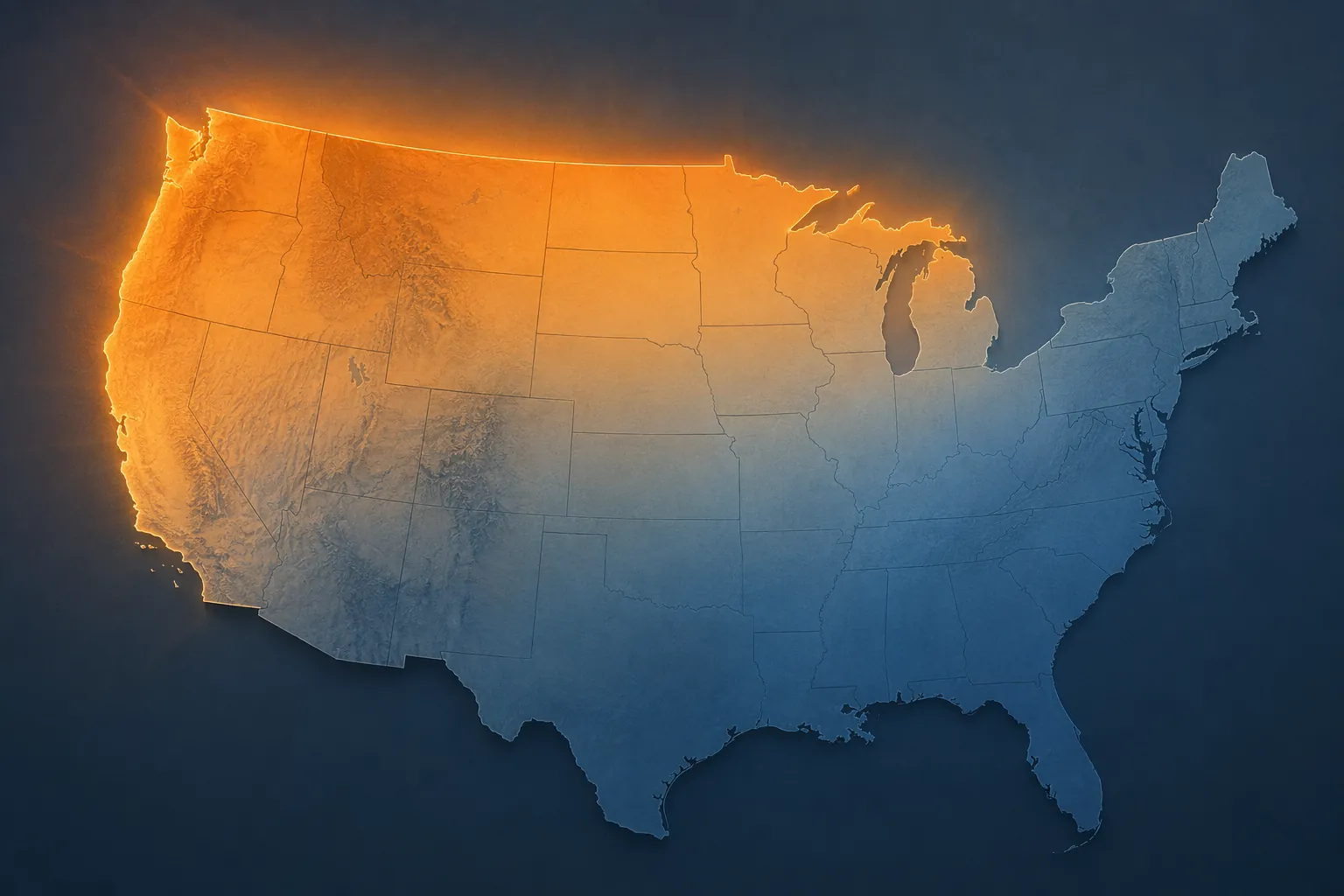
Maps how permanent daylight saving time would disrupt sleep differently across US counties based on latitude, time-zone position, and baseline sleep health. Reveals which regions face the worst circadian burden and why.
The sleep question behind permanent daylight saving time is not simply whether Americans would get more evening light. It is what kind of morning your county would inherit in December and January. A parent in Juneau, a commuter in Indianapolis, a student in New York City, and a retiree in Miami would all be living under the same federal clock rule, but not under the same biological conditions.
That is why a state-by-state answer has to start at county scale. In a 2025 PNAS county-level model, Jamie M. Weed and Jamie M. Zeitzer compared permanent daylight saving time with permanent standard time across U.S. counties and found that the sleep burden depends heavily on where a place sits north-south and east-west inside its time zone, not just on which state it belongs to.[1]
The winter sunrise examples make the divide visible. Under permanent daylight saving time, TIME’s July 2026 projections put Juneau’s winter sunrise at about 11 a.m., Indianapolis at about 9:06 a.m., New York City at about 8:20 a.m., and Miami at about 8:10 a.m.[2] Those are not small lifestyle differences. They decide whether a fixed school start, job shift, clinic appointment, or caregiving routine begins after dawn, before dawn, or in what the body still reads as night.
The three clocks that decide your state’s risk
Permanent daylight saving time moves the legal clock later relative to the sun all year. Whether that is mildly annoying or biologically punishing depends on three overlapping clocks: the seasonal sun at your latitude, your position within the time zone, and the existing sleep health of the population living there.
| Driver | What it changes under permanent DST | Who feels it most |
|---|---|---|
| Latitude | Northern places get later winter sunrises because winter daylight is already short. | Alaska, northern-tier states, and northern counties within large states |
| East-west position inside the time zone | Western-edge places already run later than solar time; permanent DST adds another hour of mismatch. | Counties near the western edge of Eastern, Central, Mountain, or Pacific time |
| Baseline sleep health | Communities with more short sleep have less room for additional circadian strain. | States and regions already reporting poorer sleep duration, including parts of the South and Appalachia |
These drivers do not line up neatly with state borders. A state can contain both relatively protected eastern counties and high-burden western counties. A southern state may avoid the most extreme winter sunrise problem but still carry a serious public-health concern if short sleep is already common.
Latitude: the northern winter-morning penalty
Latitude is the bluntest part of the map. The farther north a place is, the shorter its winter daylight window becomes. Permanent daylight saving time does not create that darkness, but it moves more of it into the social morning. The evening looks friendlier on the clock; the morning becomes the price.
That is why Alaska is not just a more dramatic version of Florida. In Juneau, a roughly 11 a.m. winter sunrise under permanent daylight saving time would put much of the school and workday before natural morning light arrives.[2] Miami’s projected roughly 8:10 a.m. sunrise is still later than many people would like, but it is not the same exposure problem.[2]
Northern states also have less margin for early schedules. A teenager with a fixed school start, a hospital worker on a day shift, or a caregiver trying to wake a household cannot simply wait for dawn. In those settings, the clock rule is not an aesthetic preference about sunsets. It determines whether morning obligations repeatedly occur before the strongest natural signal for waking has appeared.
The western edge of a time zone already lives late
The quieter geographic mechanism is east-west position. Two counties can share a time zone, but the county farther west sees the sun later by clock time. Permanent daylight saving time pushes both later, yet the western county starts from a worse solar-time mismatch.
The PNAS model gives this mechanism weight. Weed and Zeitzer found that western position within a time zone was associated with greater circadian shifting, with ρ=0.420 for intermediate chronotypes and ρ=0.798 for late chronotypes.[1] That is not a claim that every western-edge resident becomes sick because of the clock. It is a modeled relationship between geography and circadian burden, and it is exactly the kind of relationship that gets erased when the debate is framed only as a national preference poll.
Indianapolis is a useful anchor because it shows how a place can sit far enough west in its time zone for sunrise to become a daily winter problem. TIME projected an Indianapolis sunrise of about 9:06 a.m. under permanent daylight saving time.[2] For many people, that means commuting, opening classrooms, and starting shifts before sunrise for a substantial part of winter.
Baseline sleep health changes how much strain a state can absorb
Solar timing is not the whole public-health story. A southern or eastern-edge state may avoid the most brutal winter sunrise times, but that does not automatically make it low-risk. If a population already has high short-sleep prevalence, any policy that makes morning alignment harder lands on less resilient ground.
CDC National Center for Health Statistics state-level data show meaningful geographic differences in short sleep duration among U.S. adults, with parts of the South and Appalachia standing out in baseline sleep-health disparities.[3] That matters because permanent daylight saving time would be added to existing work schedules, school start times, commute patterns, caregiving demands, and chronic-disease burdens rather than applied to a blank map.
This is where the state-by-state answer becomes less tidy. A northern western-edge county may face the darkest winter mornings. A southern county with less severe solar timing may still deserve attention if short sleep is already common and residents have little control over schedules. Geography sets the exposure; social conditions decide who can adapt.
Permanent DST versus permanent standard time: what the county model actually found
The strongest evidence in this debate does not come from asking whether people like summer evenings. It comes from comparing how clock rules line up with human circadian timing. In the PNAS model, 82.3% of U.S. counties had lower circadian burden under permanent standard time than under permanent daylight saving time for intermediate chronotypes.[1]
The same study modeled health outcomes as estimates, not as observed results from a national experiment. Permanent daylight saving time was estimated to reduce obesity by about 0.51%, or 1.7 million cases, and stroke by 0.07%, or 220,000 cases; the authors described that as roughly two-thirds of the modeled benefit of permanent standard time.[1] In plain terms: ending the twice-yearly clock change may help, but the model suggests standard time is the healthier permanent option for more counties.
Medical societies have reached a similar policy judgment. The American Academy of Sleep Medicine says permanent standard time is the optimal choice for health and safety and notes that social jetlag is worse in the western-most parts of time zones; the position is supported by the American Medical Association, the National Sleep Foundation, and the Society for Research on Biological Rhythms.[4] For a broader comparison of the two permanent-clock options, see Permanent DST vs standard time: which is better for sleep?.
There is an important caveat. The Stanford model used idealized light-exposure assumptions, including a 10 p.m. to 7 a.m. sleep schedule, a 9 a.m. to 5 p.m. work schedule, and some outdoor time; the authors also noted that people spend less than 5% of the day outside even in California.[1] If real life delivers less morning light than the model assumes, indoor living could make the practical circadian problem worse, not better.
What the map means by region
Northern states and Alaska
High-latitude places face the clearest sunrise penalty. Alaska is the extreme case, but northern counties across the continental U.S. also lose morning light earlier and recover it later through winter. In these places, permanent daylight saving time would push more ordinary morning life into darkness: bus stops, first-period classes, early medical shifts, factory starts, and winter commutes.
The policy burden is not distributed evenly even inside these states. A northern county on the western side of a time zone can carry both penalties at once: short winter daylight and a late solar noon. Those are the counties where permanent daylight saving time most clearly turns the time-zone map into a health map.
Western edges of time zones
The western-edge penalty is easy to miss because it often cuts through familiar regional categories. Parts of Indiana, western Michigan, western Kentucky, western Tennessee, the western side of Central Time, and western counties in Mountain or Pacific Time can live later than their official clock suggests. Permanent daylight saving time would add a legal hour to a mismatch they already feel.
This is why a state average can be misleading. A capital city, a rural western county, and an eastern metro area may not share the same sunrise experience. If the state-level conversation treats them as interchangeable, the people with the darkest mornings become politically invisible.
Southern and eastern-edge states
Southern and eastern-edge places generally avoid the most severe winter sunrise delays. Miami’s projected winter sunrise of about 8:10 a.m. under permanent daylight saving time is late, but it is far from Juneau’s roughly 11 a.m. projection and earlier than Indianapolis’s roughly 9:06 a.m. projection.[2] New York City’s projected roughly 8:20 a.m. sunrise also shows how an eastern-edge location can have a milder solar-time penalty than a western-edge city in the same broad national debate.[2]
Milder sunrise timing should not be mistaken for no concern. In places where short sleep is already common, a smaller circadian push can still matter. That is especially true for workers with early shifts, children with fixed school starts, caregivers, and older adults whose schedules are constrained by transportation, medication timing, or household responsibilities.
Chronotype decides who gets hit first
County geography is the exposure; chronotype is the body’s starting point. The PNAS model separated chronotypes and found that late chronotypes showed a stronger association between western time-zone position and circadian shifting than intermediate chronotypes, with ρ=0.798 for late chronotypes compared with ρ=0.420 for intermediate chronotypes.[1]
That helps explain why adolescents and evening-type adults often suffer more when early obligations meet delayed morning light. It does not prove that every late chronotype in a western county will have a specific medical outcome. It does mean that the same sunrise time can be more disruptive for one body than another. For readers trying to place themselves in that range, Restful Ground’s chronotype guide is a useful companion to the map.
The research is thinner for specific life-stage and clinical groups. There is not enough peer-reviewed evidence here to make precise claims about permanent daylight saving time effects in perimenopause, pregnancy, ADHD, or other groups beyond the broader principle that less flexible bodies and less flexible schedules have fewer ways to compensate. For children and school timing specifically, see what the Sunshine Protection Act means for children’s sleep and why permanent daylight saving time harms student sleep.
The politics are current, but not settled
As of July 28, 2026, the Sunshine Protection Act remains a moving target. The House passed a permanent daylight saving time bill in July 2026, but Senate action was still uncertain; The Hill also reported that 19 states had permanent daylight saving time laws contingent on federal approval, while Arizona and Hawaii already remain exempt from daylight saving time on permanent standard time.[5]
The 1974 U.S. experiment with permanent daylight saving time is the cautionary memory here. Public support fell from 79% to 42% after one winter, with dark mornings becoming a central complaint, especially in northern and western areas.[2] The lesson is not that people never like evening light. Many do. The lesson is that winter mornings test public tolerance in a way summer sunsets do not.
How to read your own state
If permanent daylight saving time becomes law, the fairest way to judge your state is not to ask only whether the state is north or south. Ask how your county sits on all three axes.
- Start with latitude: farther north means later winter sunrise and a higher chance that school, work, and caregiving begin before dawn.
- Then check east-west position inside the time zone: western-edge counties are more likely to experience permanent DST as an added solar-time mismatch.
- Then consider baseline sleep health: states with higher short-sleep prevalence may have less room for another circadian stressor.
- Finally, look at who has schedule control: students, shift workers, caregivers, and many older adults cannot simply move their mornings later.
That reading produces a more honest answer than a simple list of winners and losers. Northern states and western time-zone edges face the heaviest circadian burden. Southern and eastern-edge states generally face milder sunrise timing, but existing short-sleep disparities can still make the policy consequential. Permanent daylight saving time would create a geographic sleep divide, and the people most exposed are often the ones with the least control over the clock.
References
- Weed and Zeitzer county-level circadian burden model, PNAS, 2025, https://www.pnas.org/doi/10.1073/pnas.2508293122
- What Permanent Daylight Saving Time Would Look Like Across the U.S., TIME, July 15, 2026, https://time.com/article/2026/07/15/daylight-saving-time-permanent-congress-bill-sunrise-sunset/
- CDC NCHS Data Brief 2024, CDC National Center for Health Statistics, 2024, https://www.cdc.gov/nchs/products/databriefs/db559.htm
- Permanent standard time is the optimal choice for health and safety, American Academy of Sleep Medicine, https://aasm.org/advocacy/position-statements/permanent-standard-time-is-the-optimal-choice-for-health-and-safety/
- If permanent daylight saving time bill passes, would your state be impacted?, The Hill, July 2026, https://thehill.com/policy/energy-environment/5965438-if-permanent-daylight-saving-time-bill-passes-would-your-state-be-impacted/
Supports these guides
Spot an error or have clinical feedback?
Because this article covers clinical, medication, or safety information, we use a moderated correction channel instead of open public comments. Let us know if something about “How permanent daylight saving time affects sleep, state by state” needs a closer look.
Send feedback on this article