
Mechanism explainer
How Toxic Cabin Air Triggers Fatigue and Poor Sleep
If you experience crushing fatigue and unrefreshing sleep after flying, contaminated cabin air may be the cause. This article explains how organophosphate compounds from engine oil disrupt sleep through a neurotoxic mechanism distinct from jet lag, and what the evidence says for aircrew and passengers.
The confusing part is not that you felt tired after a flight. Most people do. The confusing part is when the fatigue feels disproportionate, your thinking stays slow, and sleep does not repair anything. You get home, lie down, and still cycle through insomnia, shallow sleep, early waking, or a heavy unrefreshed feeling that does not match ordinary travel tiredness.
That pattern is often waved away as jet lag. Sometimes it is. Circadian timing, cabin noise, dry air, stress, dehydration, and cabin altitude can all disturb sleep after flying. But contaminated cabin air raises a different question: organophosphate compounds from engine oil can enter the cabin and act on the central nervous system through organophosphorus-induced chronic neurotoxicity, or OPICN. In that model, fatigue and poor sleep are not just consequences of travel; they are part of a neurotoxic symptom pattern involving insomnia, cognitive dysfunction, poor concentration, memory problems, and unrefreshing sleep.[1]

Jet lag changes timing; OPICN may change the nervous system’s ability to recover
Jet lag is mainly a timing problem. Your internal clock is out of phase with the local light-dark schedule, so sleep arrives at the wrong time, wakefulness arrives when you want to sleep, and digestion, temperature, alertness, and mood can feel displaced. It is miserable, but the mechanism is familiar: the circadian system is misaligned.
The contaminated-air hypothesis is different. Modern aircraft commonly use bleed air: compressed air drawn from the engine or auxiliary power unit and then supplied to the cabin. If engine oil or hydraulic fluid contaminants enter that air stream, passengers and crew may inhale compounds that were never meant to be part of the breathing environment. The organophosphate compounds of greatest concern in this literature include tricresyl phosphate, or TCP, isomers from engine oil.[1]
| Post-flight pattern | More consistent with ordinary travel disruption | More concerning for a contaminated-air mechanism |
|---|---|---|
| Timing | Sleepiness follows time-zone change, night flying, or a missed sleep opportunity | Symptoms appear after a fume or smell event, or recur after particular aircraft exposures |
| Main sleep complaint | Sleep is mistimed but gradually normalizes with light exposure and schedule adjustment | Sleep is poor, fragmented, or unrefreshing even when there is adequate opportunity to sleep |
| Daytime symptoms | Tiredness, irritability, appetite changes, circadian grogginess | Crushing fatigue, cognitive fog, poor concentration, memory issues, headache, sensory or neurological symptoms |
| Expected duration | Often tracks the number of time zones crossed and the recovery of the sleep schedule | Reported in aircrew studies as lasting days to weeks, weeks to months, or becoming chronic after fume events[1] |
That comparison matters because the body can be exhausted for more than one reason. A person can have jet lag and a cabin-air exposure. A flight attendant can have chronic circadian disruption and repeated low-level exposure. A passenger can have anxiety, dehydration, sleep apnea, and a fume event on the same trip. The clinical task is not to pick the most dramatic explanation; it is to stop calling every post-flight collapse “just tiredness” when the symptom pattern is broader than sleep loss.
The OPICN pathway, in plain language
Most people who have heard of organophosphate poisoning think of acute cholinergic toxicity: sweating, salivation, diarrhea, pinpoint pupils, breathing problems, seizures, and a medical emergency. That is not the main pattern being discussed in persistent cabin-air illness. OPICN is described as a non-cholinergic form of organophosphate-related neurotoxicity. In other words, the problem is not limited to the short-lived enzyme-inhibition picture clinicians are taught to look for in high-dose poisoning.[1]
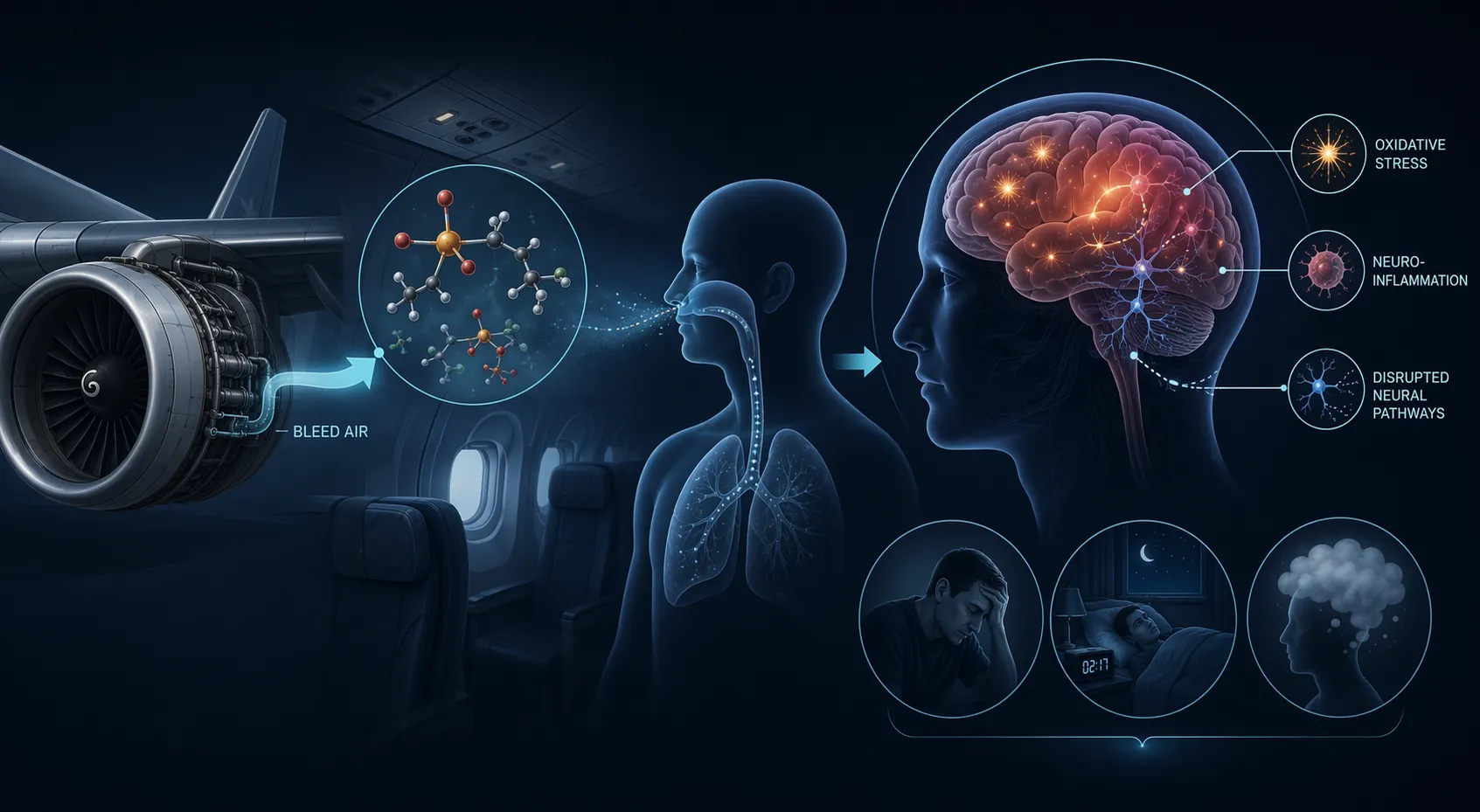
The proposed pathway begins with oil-derived organophosphate compounds entering bleed air. Once inhaled, these compounds may affect the central nervous system through mechanisms such as oxidative stress, neuroinflammation, and disruption of axonal transport — the cellular movement system neurons rely on to maintain long nerve fibers. These are not abstract biochemical decorations. They are plausible ways to get from an inhaled contaminant to symptoms a person can actually feel: fatigue, insomnia, poor concentration, memory deficits, and sleep that does not restore normal function.[1]
This is the part that often gets lost when the discussion is flattened into “toxic air” versus “no toxic air.” The sleep complaint is not simply that a person cannot fall asleep after travel. The more specific complaint is that the nervous system seems unable to downshift and recover: wired fatigue, shallow sleep, mental fog on waking, and a sense that the body has not repaired overnight. OPICN gives that pattern a biological shape without requiring the person to have had a classic acute poisoning crisis.
What has actually been found in cabin air
The exposure pathway is not speculative in the broad sense. Cabin air monitoring studies cited in the 2023 review found TCP isomers in 23% to 100% of sampled flights, with higher concentrations during taxi-out, takeoff, climb, descent, and landing. Those are also the flight phases when passengers and crew may notice odors, haze, or feeling suddenly unwell, although odor is not a reliable exposure meter.[1]
Oil fume events can also involve very high ultrafine particle concentrations. The review reports concentrations reaching 2.8 × 10⁶ particles/cm³ during oil fume events, more than 500 times the cited average for indoor offices of 5,000 particles/cm³.[1]
The cumulative-exposure question is especially relevant for aircrew because low-level oil leakage is described as a feature of current engine and auxiliary power unit air supply systems, not only a rare failure state. The same review estimated TCP internalized dose over a career ranging from 0.062 mg to 339 mg depending on the measurement method used.[1]
That does not make every cabin a dangerous cabin, and it does not mean an occasional passenger has the same exposure profile as a pilot or flight attendant. It does mean the mechanism should not be dismissed simply because a flight did not involve visible smoke or an emergency diversion.
The strongest human signal comes from aircrew
The evidence is not evenly distributed across everyone who flies. It is strongest in aircrew, for the obvious reason: repeated exposure, repeated reporting opportunities, and occupational consequences when symptoms persist.
Across aircrew studies summarized in the 2023 review, fatigue appears repeatedly as a reported symptom; the review notes fatigue in at least 15 separate studies. Sleep disorders are also included as both acute and chronic symptoms in the 2023 International Fume Events Task Force medical protocol.[1]
The duration data are harder to wave away. Surveys of aircrew after fume events found that 20% to 77% reported sensory and neurological symptoms; 44% of pilots reported symptoms lasting days to weeks, 32% reported symptoms lasting weeks to months, and 13% experienced chronic ill health resulting in permanent loss of flight status.[1]
For a sleep-focused reader, the International Crew Health Survey is particularly striking. It reported chronic fatigue syndrome in 7% of aircrew compared with a 0.3% population baseline, and depression in 22% compared with a 10% population baseline.[1]
Those figures do not prove that contaminated air caused every case of fatigue or depression. Aircrew also work irregular hours, cross time zones, sleep in hotels, and often have limited recovery control. But the scale of the fatigue signal belongs in the conversation, especially when it appears alongside documented fume events, neurological symptoms, and a biologically plausible OPICN pathway.
The acute-on-chronic pattern: a pilot case that makes the sleep piece visible
Single case reports cannot tell us how common a condition is. Their value is different: they show timing, symptom clustering, and recovery in a level of detail that surveys cannot. A 2023 case report followed a pilot with fatigue, cognitive impairment, and vision deficits after exposure events. The pilot appeared to make a full recovery after the initial event, then worsened after re-exposure; symptoms persisted for more than 3 years.[2]
The sleep detail is clinically important. In the case report, poor sleep worsened the pilot’s ongoing cognitive and fatigue symptoms.[2] That is a familiar loop in sleep medicine: disrupted sleep lowers resilience, impaired cognition makes daily functioning harder, stress rises, and the next night’s sleep becomes more fragile. But in this case the loop was not floating in isolation. It was embedded in an exposure history and a neurological symptom pattern.
This is where “just rest” becomes an inadequate response. If a nervous system has been pushed into a state of persistent neuroinflammatory or oxidative stress, sleep may still be essential for recovery, but sleep alone may not be easy to obtain or sufficient to end the illness quickly. The pilot case does not prove that every post-flight insomnia episode is toxicant-driven. It does show why an acute exposure superimposed on prior exposure can look very different from a bad night after a long-haul flight.
Newer cognitive data add weight, but not certainty
A 2025 study found that pilots’ cognitive performance significantly differed from the general population and resembled patterns reported in organophosphate-exposed groups.[3] That matters because fatigue after toxicant exposure is rarely just sleepiness. People describe losing words, rereading the same line, misplacing objects, missing steps, or feeling as if their attention has been padded with cotton.
Still, cognitive performance data should be read for what they can and cannot do. They can strengthen convergence between exposure, symptom reports, and mechanism. They cannot, by themselves, assign causality to a specific flight, aircraft, or contaminant dose for an individual person.
Why a normal cholinesterase test may not settle the question
People looking for medical confirmation often ask about cholinesterase testing. It is a reasonable question, but the test is a poor fit for many cabin-air complaints. Cholinesterase testing has a narrow useful window of roughly 4 to 48 hours after exposure and is insensitive at low doses.[1]
That limitation matters because OPICN is not the same as acute high-dose cholinergic poisoning. A normal test days later does not necessarily answer whether a person experienced a lower-level or mixed exposure that triggered persistent neurological symptoms. It also does not prove that contaminated cabin air was the cause. It simply means the usual acute-poisoning test may not be the right tool for the chronic symptom pattern being described.
Where the uncertainty begins
Aerotoxic syndrome is discussed in peer-reviewed literature and legal contexts, but it is not currently an ICD-recognized diagnosis.[1] That is not a small detail. Diagnostic recognition affects coding, surveillance, compensation, clinician familiarity, and how seriously patients are taken when they report a pattern that does not fit routine post-travel fatigue.
Aviation industry groups dispute the causal link for chronic low-level exposure, pointing to the lack of real-time air monitoring sensors and methodological limits in epidemiological studies.[1] Some of that caution is scientifically legitimate. Exposure reconstruction is difficult when the air was not measured at the moment symptoms began. Retrospective symptom surveys can be affected by recall and selection bias. Aircrew also have multiple occupational sleep risks that can produce fatigue without any toxicant exposure.
But uncertainty should not be used as a solvent that dissolves the whole problem. When an exposure pathway exists, relevant compounds have been measured, a plausible CNS mechanism has been described, and aircrew repeatedly report fatigue, sleep disturbance, and cognitive symptoms after fume events, the responsible conclusion is not “nothing to see here.” It is that the evidence is strongest for repeated occupational exposure and more limited for occasional passengers.
For passengers: possible is not the same as proven
If you fly a few times a year, the aircrew data should not be pasted onto your life as if your exposure history were the same. A fume event could plausibly trigger symptoms in a passenger, and some passengers may be more vulnerable because of health status, pregnancy, age, medication use, or a nervous system that is already easily destabilized. But the best evidence base still comes from people exposed repeatedly at work.
For an occasional flyer, the practical question is pattern recognition. Did symptoms begin during or soon after a flight with a noticeable odor, haze, or sudden cluster of symptoms among others? Did the fatigue feel neurological — heavy, foggy, unrefreshing — rather than simply sleepy? Did sleep remain abnormal after the time-zone adjustment should have settled? Did cognitive symptoms, headache, dizziness, sensory changes, or memory problems appear alongside insomnia or unrefreshing sleep?
Those answers cannot diagnose you. They can help you decide whether to document the event, seek medical care, and avoid prematurely accepting “jet lag” as the whole explanation.
Other sleep disruptors still belong in the differential
A contaminated-air mechanism does not erase the ordinary physiology of flying. Cabin altitude can be equivalent to about 8,000 feet, which can lower oxygen saturation in susceptible people. Noise fragments sleep. Dry cabin air and dehydration can worsen headaches and airway irritation. Anxiety can keep the arousal system activated. Time-zone travel can disrupt circadian rhythm even when the cabin air is perfectly ordinary.[1]
Undiagnosed sleep disorders also matter. Sleep apnea, for example, is often missed in women and can present as fatigue, insomnia, mood change, morning headache, and cognitive fog rather than obvious sleepiness. Perimenopause can make temperature regulation and nighttime awakenings worse. Pregnancy can intensify breathing, reflux, and positional sleep problems. Older adults may have less physiological reserve after a disrupted night. ADHD can make post-flight cognitive fog especially hard to separate from baseline attention variability.
Those contexts do not make symptoms imaginary. They make interpretation harder. A person whose sleep system is already fragile may notice a smaller insult more dramatically, whether that insult is circadian disruption, cabin hypoxia, medication timing, a fume event, or several of these at once.
What to track if fatigue and poor sleep follow a flight
Documentation is not a cure, but it can protect the signal from being blurred by time. If symptoms are severe, persistent, or neurological, write down the details while they are still fresh.
- Flight details: date, route, aircraft if known, seat area, and flight phase when symptoms began.
- Exposure clues: unusual smell, visible haze, smoke, oil-like odor, reports from crew or other passengers, or sudden symptoms during taxi, takeoff, climb, descent, or landing.
- Sleep pattern: insomnia, repeated waking, unusually vivid or fragmented sleep, early waking, or sleep that feels nonrestorative despite enough time in bed.
- Neurological symptoms: concentration problems, memory lapses, dizziness, headache, visual changes, tingling, weakness, tremor, or unusual sensory symptoms.
- Duration: whether symptoms resolve within a day, last days to weeks, persist for weeks to months, or recur after later flights.
- Competing explanations: time-zone change, missed sleep before travel, alcohol, sedatives, new medications, infection symptoms, altitude sensitivity, anxiety, or known sleep disorders.
For aircrew, repeated episodes deserve particular attention because the evidence base is occupational. A single bad recovery after one trip is different from a pattern of fume-associated symptoms, progressive fatigue, cognitive change, and sleep that stops responding to normal recovery days.
The calibrated answer
Contaminated cabin air can plausibly trigger persistent fatigue, insomnia, cognitive fog, and unrefreshing sleep through OPICN, a non-cholinergic organophosphate-related pathway involving central nervous system effects such as oxidative stress, neuroinflammation, and disrupted axonal transport.[1]
The case is strongest for aircrew and repeated exposure: surveys show persistent symptoms after fume events, chronic fatigue appears far above population baseline in crew data, and case and cognitive-performance studies add converging evidence without settling every causal question.[1][2][3]
For infrequent passengers, the mechanism is possible but less proven. If your post-flight fatigue feels crushing, neurological, and nonrestorative rather than like ordinary travel tiredness, contaminated cabin air belongs on the list of possibilities — alongside jet lag, cabin altitude, sleep deprivation, anxiety, dehydration, infection, medication effects, and undiagnosed sleep disorders.
References
- Health consequences of exposure to aircraft contaminated air and fume events: a narrative review and medical protocol for the investigation of exposed aircrew and passengers, Environmental Health, 2023.
- Aerotoxic Syndrome: A Case Report, International Journal of Environmental Research and Public Health, 2023.
- Cognitive performance of pilots exposed to contaminated cabin air, 2025.
Supports these guides
Spot an error or have clinical feedback?
Because this article covers clinical, medication, or safety information, we use a moderated correction channel instead of open public comments. Let us know if something about “How Toxic Cabin Air Triggers Fatigue and Poor Sleep” needs a closer look.
Send feedback on this article