
Mechanism explainer
How atmospheric rivers disrupt your sleep and what to do about it
Atmospheric rivers disrupt sleep through four distinct physiological pathways—barometric pressure drops, temperature dysregulation, sensory overload, and storm anxiety—each supported by peer-reviewed evidence. Learn what is happening in your body during a storm and which evidence-backed countermeasures can help.
No study has yet put sleepers inside an atmospheric river, measured the whole storm as one exposure, and told us exactly how much sleep the event cost them. That caveat matters. It keeps us from pretending that every 2 a.m. wake-up during a West Coast storm has one neat cause.
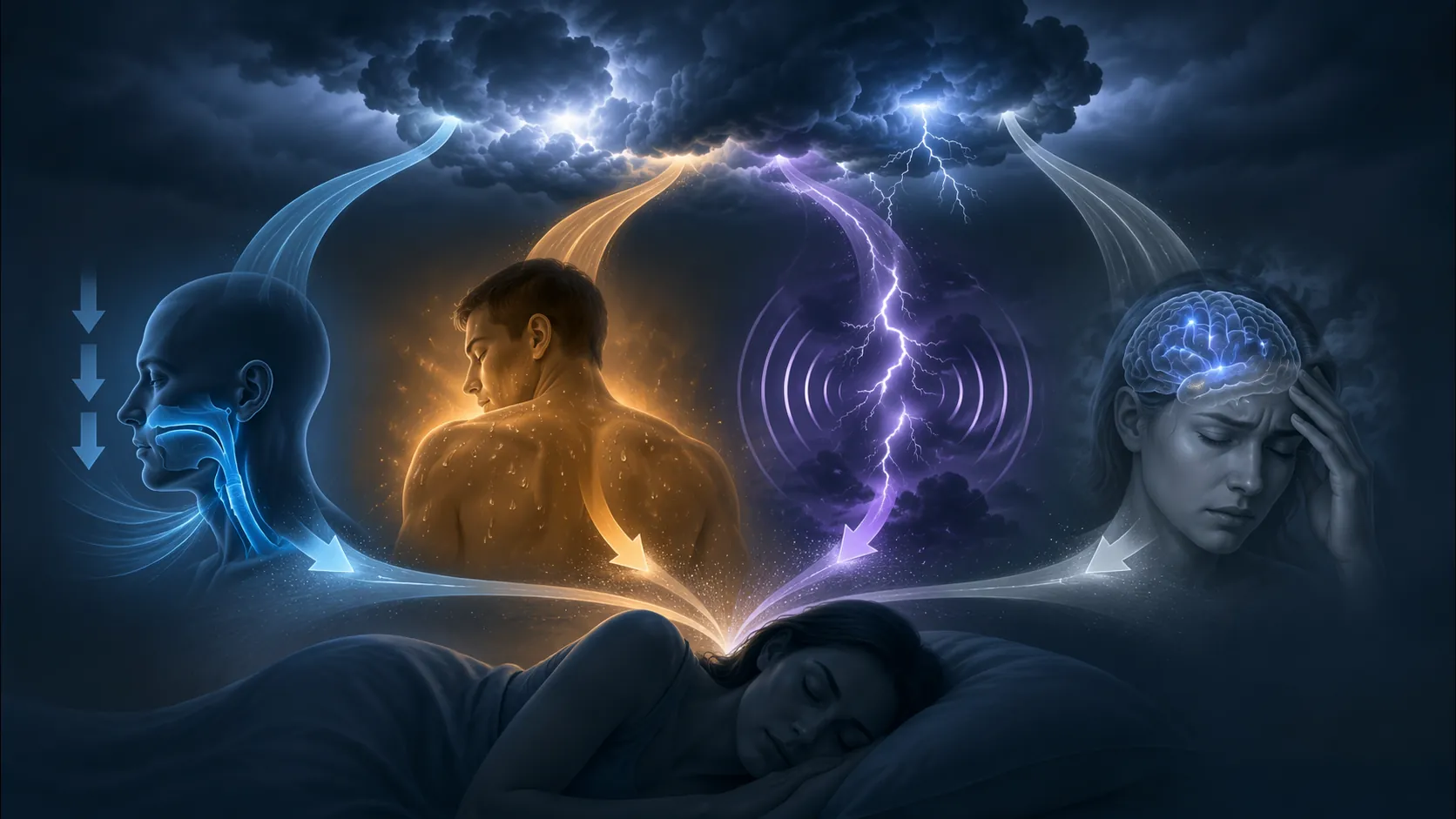
Still, the question of how extreme weather like an atmospheric river affects sleep is answerable in a useful way. Atmospheric rivers bring several sleep-disrupting inputs at once: falling barometric pressure, warm humid air, noise and light, and the anticipatory stress of watching water rise or power flicker. Those inputs act on different body systems, so the right response depends on which pathway is most active for you.
A Storm Can Make an Existing Airway Problem More Obvious
The strongest sleep-specific evidence starts with air pressure, not with fear or noise. In a Seattle sleep-lab study of 537 patients, researchers matched overnight polysomnography data with barometric pressure measurements. They found that the obstructive apnea index increased by 0.3 events per hour for each 1-millibar decrease in mean nightly barometric pressure. Nights in the lowest pressure quartile averaged 23.9 obstructive apnea events per hour, compared with 17.1 in the highest pressure quartile, and the association was statistically significant at p = 0.01.[1]
That is not a vague “stormy nights feel worse” finding. It points to obstructive events specifically, which matters because obstructive sleep apnea is a mechanical problem: the airway narrows or collapses during sleep, breathing pauses or becomes restricted, oxygen may dip, and the brain has to pull the sleeper out of deeper sleep to reopen the airway.
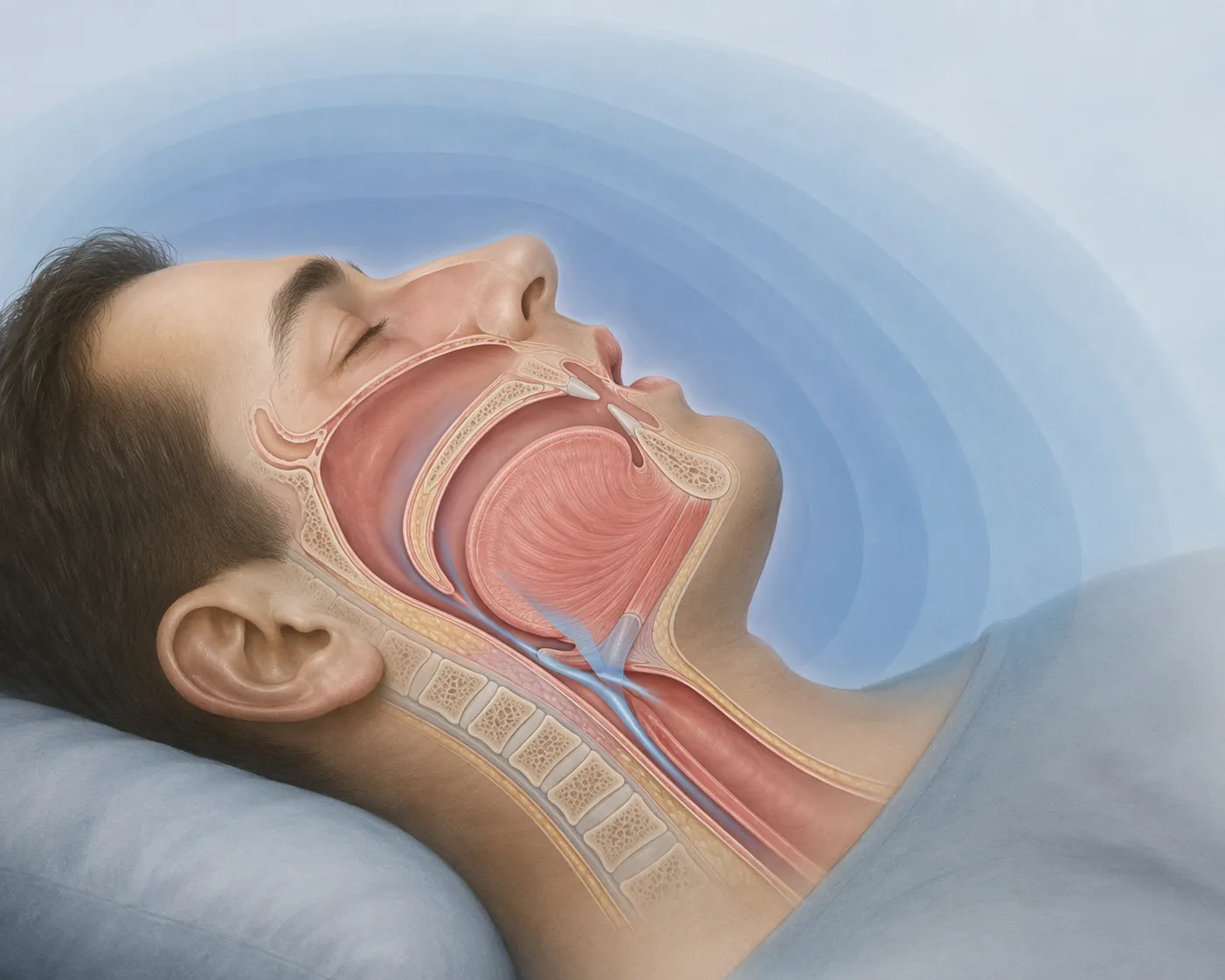
This does not prove that every atmospheric river worsens apnea for every person. The study was done in Seattle at about 200 feet of elevation, so it should not be stretched to mountain passes, inland basins, or every coastal microclimate. It also studied people referred for sleep testing, not the whole population.[1] But for someone who already has a vulnerable airway, a pressure drop is a plausible added load on a system that was already close to failing during sleep.
That distinction is important for perimenopausal women and older adults, because sleep apnea is often missed when the story sounds like insomnia, stress, night sweats, or “I just wake up a lot.” If storm nights bring gasping, dry mouth, morning headaches, unusually heavy fatigue, or a bed partner notices breathing pauses, it is worth reading more about sleep apnea symptoms in women or the overlap between sleep apnea and perimenopause. A bad storm night should not become a diagnosis by itself, but repeated storm-related breathing symptoms are a pattern worth taking to a clinician.
What to Do if This Sounds Like You
- Use prescribed CPAP, oral appliance, or positional therapy consistently during storm windows rather than treating those nights as exceptions.
- Avoid extra alcohol or sedatives before bed unless your clinician has specifically advised otherwise; both can worsen airway collapsibility for some sleepers.
- If you wake choking, gasping, or with a racing heart during multiple storms, write down the pattern instead of dismissing it as poor sleep hygiene.
- Ask about sleep apnea evaluation if storm nights expose symptoms that also appear, more quietly, on ordinary nights.
Warm, Humid Air Can Work Against the Body’s Nightly Cooling Process
Atmospheric rivers are not just wet storms. They are warm, moisture-laden plumes, and that matters because sleep onset is tied to thermoregulation. In the evening, the body normally sheds heat through the skin, core temperature drifts downward, and that cooling helps support the transition into sleep. A bedroom that stays warm and humid makes that heat loss harder.
A USC Keck School of Medicine study published in December 2025 analyzed 14,232 U.S. adults and found an average loss of 2.63 minutes of sleep for every 10°C increase in nighttime temperature. The same report found that West Coast populations lost nearly three times as much sleep as other regions, and projected 8.5 to 24 hours of sleep lost per person per year by 2099 under high-emissions scenarios.[2]
The scale of that finding should be read carefully. A few minutes per 10°C is not a promise that one warm storm night will steal hours from one particular person. It is a population signal. But it lines up with the lived problem of a room that refuses to cool, damp bedding, clammy skin, and repeated blanket-on, blanket-off decisions that keep the nervous system involved when it should be handing control over to sleep.
This pathway can hit especially hard when another life-stage sleep disruptor is already present. Perimenopausal hot flashes, late pregnancy discomfort, postpartum night wakings, and some chronic conditions can all narrow the margin. The storm does not have to be the only cause; it only has to remove the last bit of thermal comfort the sleeper was relying on.
Cooling Strategies That Match the Mechanism
- Start cooling the bedroom before the heaviest rain arrives if power outages are possible; pre-cooling buys time.
- Use breathable layers rather than one heavy comforter so you can adjust without fully waking yourself.
- Reduce indoor humidity when safe and practical, especially in bedrooms that trap damp air.
- Keep a dry shirt, towel, or pillowcase nearby if night sweats or damp bedding commonly wake you.
- Borrow heat-wave tactics when the storm is warm: the same thermoregulation logic behind sleeping during a heat dome can apply to a muggy atmospheric-river night.
Noise and Light Keep Reopening the Door to Wakefulness
Rain noise is not always soothing. A steady low sound may fade into the background, but pounding rain, shifting wind gusts, thunder, branches against siding, and sudden alerts are different inputs. They carry novelty and possible threat. The sleeping brain keeps monitoring the environment, and abrupt sound or light can pull it toward lighter sleep or full waking.
Lightning has its own route in. Even through closed eyelids, a bright flash can register as a sudden change in the room. If it is followed by thunder, the pairing teaches the nervous system to wait for the next jolt. The result may not be one dramatic awakening; it may be a night of shallow sleep, brief arousals, and the sense that you were never fully off duty.
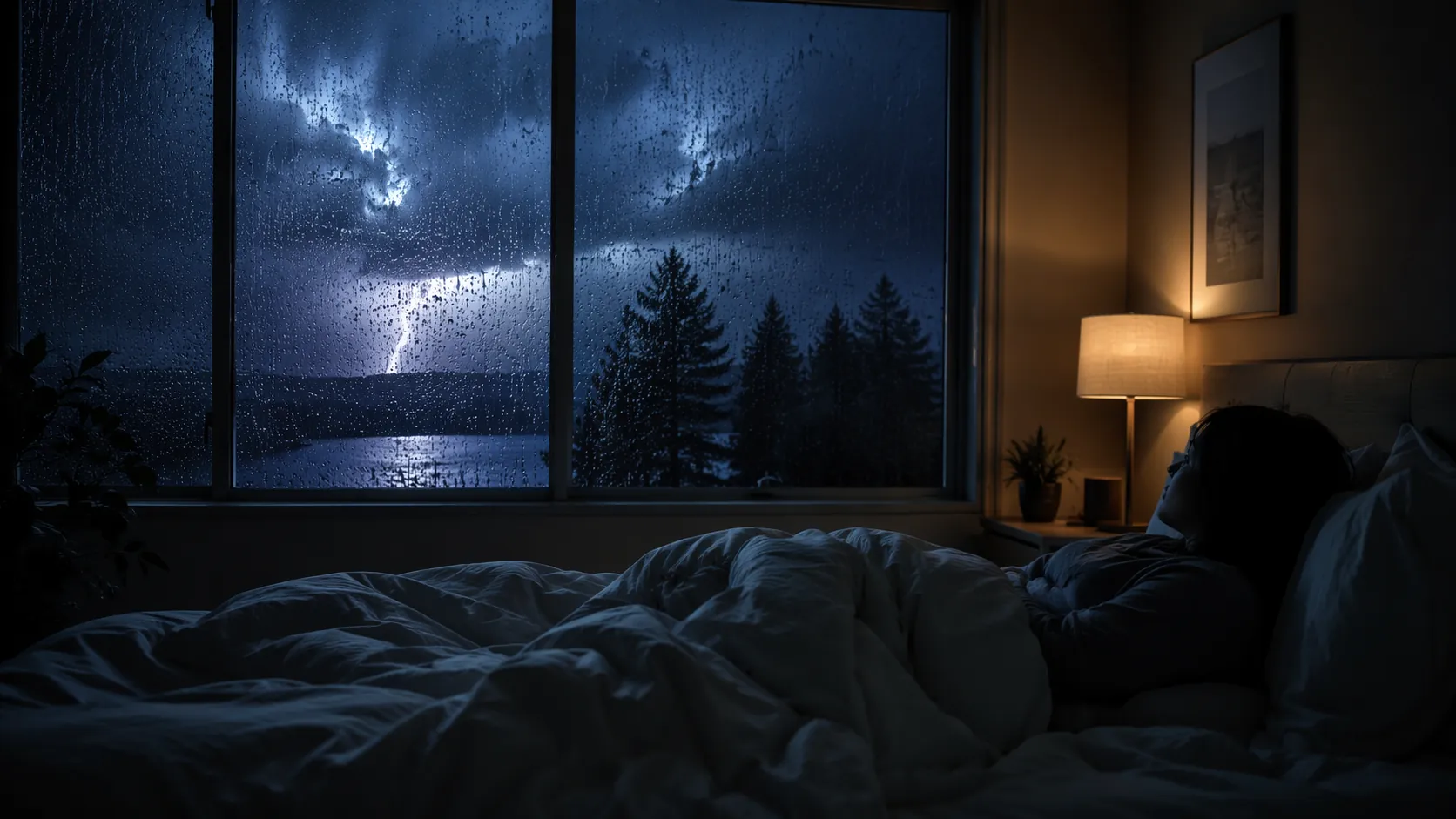
The countermeasure is not to create perfect silence. That is rarely possible during a coastal storm, and chasing it can make the brain listen harder. The more realistic goal is to reduce contrast: fewer sharp peaks, fewer flashes, fewer reasons to check whether the house is okay.
- Use consistent background sound, such as a fan, white noise, brown noise, or an app, to soften sudden rain and wind changes.
- Charge devices outside the bed if emergency alerts are enabled, so you can hear necessary warnings without turning every buzz into a scrolling session.
- Use blackout curtains or an eye mask if lightning flashes wake you.
- Move sleep away from the loudest wall or window when possible, especially in rooms exposed to wind-driven rain.
Storm Anxiety Starts Before Bed
For many people, the sleep problem begins before the first gust hits the window. It starts with radar loops, school closure messages, flood maps, outage memories, and the mental checklist of pets, medications, sump pumps, trees, roads, and relatives. That is not ordinary bedtime worry wearing a raincoat. It is anticipatory arousal, and it keeps the body oriented toward action.
A Ball State University survey from 2014, with roughly 300 respondents across 43 states, reported that about 10% of Americans experience severe weather phobia involving sleep loss and helplessness. In the same survey, 72% reported anxiety during storms and 60.8% said they changed their schedules because of severe weather.[3] Those figures should not be treated as a perfectly precise national map, given the sample size, but they do show that storm-related anxiety is not a fringe experience.
Baylor College of Medicine’s clinical guidance on pre-storm anxiety also identifies sleep changes as a key symptom.[4] After flooding, mental health effects can persist well beyond the storm itself: a 2020 systematic review and meta-analysis of UK flood populations found 19.8% anxiety prevalence and 30.4% PTSD prevalence within 12 months.[5] That evidence comes from flood aftermath, not from U.S. atmospheric-river nights specifically, so it should be applied cautiously. Still, it helps explain why a person with prior flooding, evacuation, caregiving responsibility, or limited mobility may feel their body shift into vigilance long before bedtime.
The practical target is to move necessary preparation earlier and make the night less decision-heavy. Anxiety often worsens when the brain believes it must keep checking because no plan exists.
- Set one weather-check cutoff and one exception, such as an official emergency alert, rather than refreshing forecasts from bed.
- Write the storm plan before evening: devices charged, medications located, pets accounted for, flashlights placed, and evacuation threshold named.
- For caregivers, decide who is responsible for overnight alerts so every adult is not half-awake all night.
- Use a short downshift routine after preparation: dim lights, warm shower if it helps, slow breathing, or a familiar low-stimulation activity.
- Pregnant and postpartum readers who cannot tell whether the issue is normal exhaustion, anxiety, or insomnia may find it useful to compare patterns with postpartum insomnia guidance.
Match the Fix to the Pathway
The same storm can disturb four different sleepers for four different reasons. One person is waking because their airway is unstable. Another is too warm and damp to drop into sleep. Another is startled awake by irregular sound and light. Another is lying still while the mind rehearses what happens if the creek rises.
| If the storm night feels like this | Most likely pathway to examine first | Most useful first response |
|---|---|---|
| Gasping, choking, dry mouth, morning headache, bed partner notices pauses | Sleep-disordered breathing | Use prescribed therapy and discuss possible OSA evaluation |
| Clammy skin, sweating, damp bedding, room will not cool | Thermoregulatory interference | Pre-cool, dehumidify when possible, and use breathable layers |
| Repeated jolts from thunder, rain bursts, wind, alerts, or lightning | Sensory overstimulation | Reduce contrast with steady sound, darkness, and device boundaries |
| Forecast checking, evacuation rehearsal, helplessness, inability to disengage | Pre-storm hyperarousal | Move preparation earlier and set a clear alert plan |
This is also where “sleep hygiene” advice can become unfair. A person with untreated apnea, perimenopausal night sweats, a flood history, or a caregiving role is not failing because rain exposed the weak point in their sleep system. If repeated storms produce repeated bad nights, the pattern deserves attention. For midlife women trying to separate insomnia, apnea, and restless sleep, the distinction is covered more directly in perimenopause insomnia, sleep apnea, and related sleep disruption.
Atmospheric rivers can plausibly disturb sleep through several measurable channels at once. The practical response is not one magic storm-sleep fix. It is to identify the channel that is loudest in your body, protect the vulnerable sleep system you already have, and treat repeated storm-related sleep disruption as information rather than a personal failure.
References
- The Impact of Barometric Pressure on Obstructive Sleep Apnea, Journal of Clinical Sleep Medicine, 2010.
- Study links rising temperatures to reduced sleep in U.S. adults, Keck School of Medicine of USC, December 2025.
- One in 10 suffer severe weather phobia, Ball State University, 2014.
- Navigating pre-storm anxiety, Baylor College of Medicine.
- The impact of flooding on mental health: a systematic mapping review, 2020.
Supports these guides
Spot an error or have clinical feedback?
Because this article covers clinical, medication, or safety information, we use a moderated correction channel instead of open public comments. Let us know if something about “How atmospheric rivers disrupt your sleep and what to do about it” needs a closer look.
Send feedback on this article