
Mechanism explainer
How Cabin Air Quality Disrupts Sleep on Flights
Poor sleep on flights isn't just about cramped seats and noise — cabin pressurization creates hypobaric hypoxia that fragments deep sleep and REM, even in healthy adults. A 2022 DLR study and 2024 Thorax trial show measurable oxygen desaturation during sleep, worsened by alcohol and low humidity, with disproportionate effects on older adults, pregnant travelers, and those with sleep apnea.
When travelers talk about cabin air quality and sleep on flights, they often mean two very different things at once. One is comfort: a narrow seat, a dry mouth, engine noise, aisle traffic, meal service lights. The other is physiology: the aircraft cabin is a controlled altitude environment, and sleep changes how the body handles that environment.
That distinction matters. A healthy adult can usually sit awake in a pressurized cabin without much drama. But sleep is not wakefulness with closed eyes. Ventilation patterns change, arousal thresholds change, and oxygen saturation can fall in a way that is mostly invisible to the passenger until the result arrives as shallow sleep, repeated awakenings, or that familiar post-flight sense that the night never really became sleep.
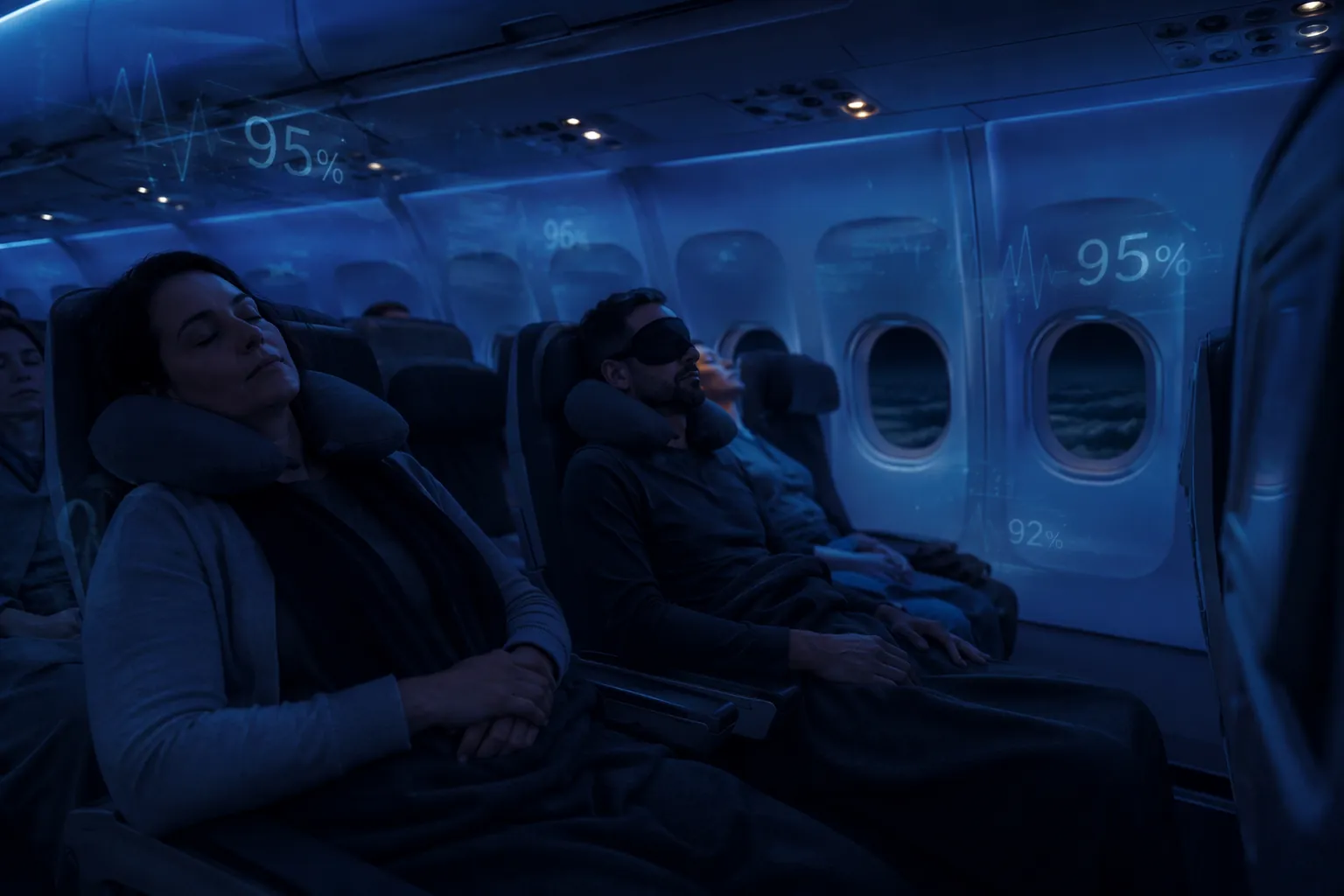
The cabin is tolerable while awake. Sleep is the stress test.
Commercial aircraft cabins are pressurized, but not to sea-level pressure. The usual cabin-altitude range is closer to the equivalent of several thousand feet above sea level, commonly discussed around 6,000 to 8,000 feet. That is an engineering compromise: enough pressure for safe, efficient flight, not the pressure your bedroom provides.
The most useful sleep evidence here is not a complaint survey and not a travel-hack experiment. It is a controlled altitude-chamber study from the German Aerospace Center, published in 2022, that measured healthy adults aged 18 to 40 with polysomnography under flight-level pressure conditions. The point was not whether they liked the room. The point was what happened to oxygen saturation and sleep architecture when they slept under simulated cabin altitude.
The contrast between waking and sleeping is the part that should stop the usual “planes are uncomfortable” explanation from swallowing the whole story. During sleep under flight conditions, mean oxygen saturation fell to 88.1%, and participants spent 74.5% of sleep time below 90%, a commonly used clinical threshold for hypoxia. During wakefulness under the same pressure conditions, only 13.2% of time was spent below 90% oxygen saturation.[1]
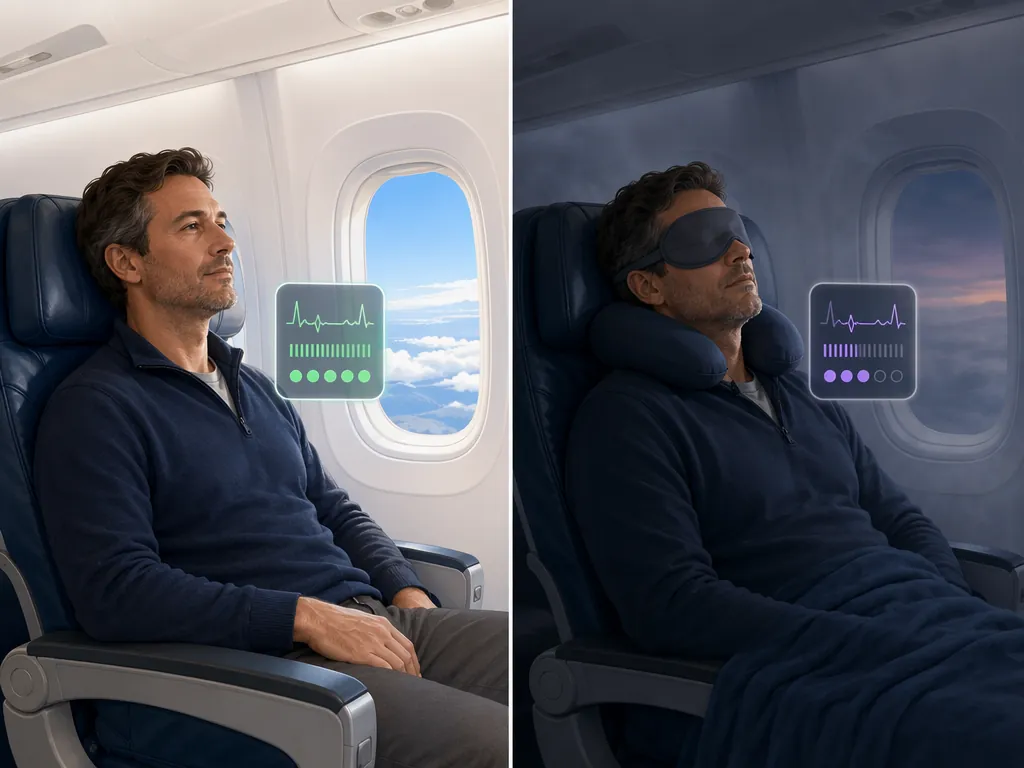
That is not a small comfort effect dressed up as biology. It says the same cabin pressure can be mostly tolerated while awake and become oxygen-limiting during sleep. If you are awake, you can unconsciously adjust posture, breathe a little differently, move, cough, sip water, or respond to discomfort. Once asleep, the body is trying to maintain sleep while also managing lower oxygen availability. Those two jobs are not always compatible.
Sleep efficiency fell as well. In the DLR study, sleep efficiency dropped from 85.7% under normal conditions to 73.2% under flight-level hypobaric conditions. Across the four-hour sleep opportunity, deep sleep, or N3, was reduced by about 17.6 minutes, and REM sleep by about 20.1 minutes.[1]
Those lost minutes matter because N3 and REM are not decorative sleep stages. N3 is the high-pressure recovery phase people often mean when they say they slept “deeply.” REM is tied to memory, emotion processing, and the later-night architecture of sleep. A four-hour airplane sleep window is already short. When hypoxia cuts into N3 and REM inside that window, the passenger can accumulate time with eyes closed without getting the normal distribution of sleep stages.
This is why the phrase “I slept, but I don’t feel like I slept” is so common after overnight flights. A wearable may even record several hours of sleep. But if the cabin environment has pushed oxygen saturation down and fragmented the stages that make sleep restorative, duration alone will overstate what the body actually received.
Alcohol makes the cabin-altitude problem harder to ignore
In-flight alcohol is usually discussed as a behavioral choice: it relaxes you, it dehydrates you, it might help you doze, it might make you groggy. The more important question is what alcohol does when it is added to sleep at cabin altitude.
A 2024 randomized crossover trial in Thorax tested alcohol and hypobaric hypoxia in sleeping adults. The study included 23 participants in the sleep-lab condition and 17 in the altitude-chamber condition. When alcohol was combined with cabin-altitude hypoxia, oxygen saturation fell to around 85%, heart rate rose to 88 beats per minute, and deep sleep dropped below 50 minutes.[2]
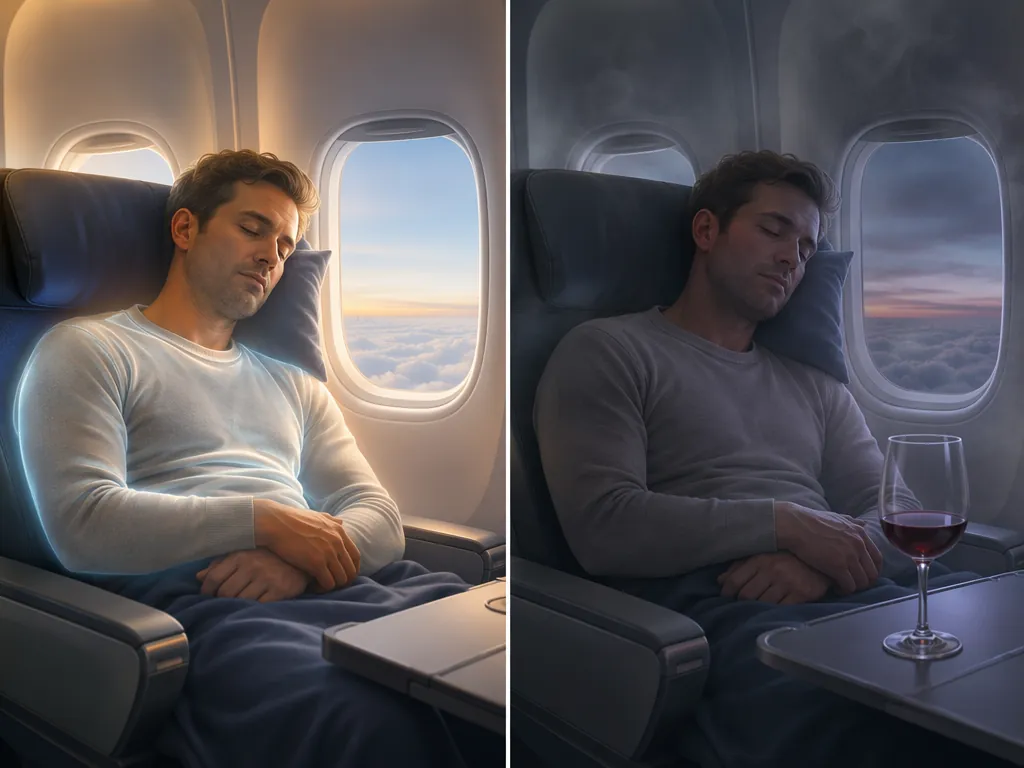
The warning is strong, but it should be kept in its proper shape. This was not a giant population study, and the sample was modest. Participants slept supine, which resembles lie-flat sleep more than an upright economy seat. The chamber is a controlled simulation, not a real aircraft with boarding stress, turbulence, seatmates, announcements, and posture constraints.
Those caveats do not make the result irrelevant. They make it more specific. In a controlled setting, alcohol did not simply make people “sleepier.” It worsened the oxygen and cardiovascular profile during sleep at simulated cabin altitude. If the goal is consolidated sleep, a drink that helps initiate drowsiness can still degrade the physiology needed to sustain restorative sleep.
That distinction is especially easy to miss on overnight flights. Alcohol can shorten the uncomfortable transition into sleep while making the later sleep less stable. The passenger experiences the first effect consciously and the second effect mostly after the fact, as early waking, dry mouth, headache, or a strangely unrefreshed arrival.
Dry cabin air is real, but it is not the main oxygen story
Low humidity is one of the few cabin-air complaints passengers can feel immediately. The eyes sting. The throat dries. The nose feels raw. A technical aviation-humidification source describes typical aircraft cabin humidity as roughly 5% to 12%, compared with normal indoor relative humidity around 30% to 60%.[3]
That dryness can compound poor sleep by irritating mucosal surfaces and making people drink, wake, swallow, or mouth-breathe more often. It can also make a mild congestion problem feel larger. But it should not be inflated into the central explanation for the oxygen findings. The DLR result is about hypobaric hypoxia: lower pressure and lower oxygen partial pressure under flight conditions, with a sleep-specific fall in oxygen saturation. Dryness is an added burden, not the main mechanism measured in the sleep study.
This is also where “cabin air quality” needs more precision. The phrase often points people toward rare fume events, filtration debates, odors, or the vague feeling that aircraft air is stale. Those issues are not the same as sleep under reduced cabin pressure. For sleep, the quieter pressure-and-oxygen problem has better direct evidence than many of the more dramatic cabin-air narratives.
Why some passengers should care more than others
The DLR study is powerful because it showed sleep-specific hypoxia in healthy young adults. It is also limited for exactly that reason. It did not directly test older adults, pregnant travelers, people with obstructive sleep apnea, or passengers with cardiac or pulmonary disease. So the careful conclusion is not that the DLR numbers automatically apply to every vulnerable group. The careful conclusion is that if healthy young adults desaturate during sleep at simulated cabin altitude, people who start closer to the edge deserve more caution.
There is separate evidence that cabin altitude can produce measurable hypoxic responses even in healthy adults. In a 2007 New England Journal of Medicine study of aircraft-cabin altitude and passenger discomfort, exposure to an equivalent altitude of 2,438 meters produced measurable hypoxic responses in healthy participants.[4]
Risk does not distribute evenly. An FAA report identified age over 50, cardiac disease, and low baseline oxygen saturation as risk factors for hypoxia at cabin altitude.[5] Those factors do not prove a particular passenger will sleep badly on a particular flight, but they change the starting point. Someone whose oxygen saturation is already lower at baseline has less margin when sleep and cabin altitude both push in the wrong direction.
Obstructive sleep apnea belongs in this conversation for the same reason. OSA already involves repeated breathing interruptions and oxygen dips during sleep. Add cabin altitude, alcohol, sedatives, or sleeping supine, and the concern is not simply whether the seat is comfortable enough. It is whether the sleep period is adding avoidable oxygen stress. Travelers who use CPAP should plan around power access, device settings, airline rules, and medical guidance rather than treating the flight as a normal night with worse legroom.
Pregnant travelers are another group where restraint matters. The DLR trial did not study pregnancy, so it cannot be used to claim measured fetal or maternal sleep effects. But pregnancy changes respiratory physiology and raises the stakes of sustained oxygen dips. For pregnant passengers with anemia, cardiopulmonary disease, sleep apnea symptoms, high-risk pregnancy factors, or long overnight itineraries, this is a medical-planning issue, not a neck-pillow issue.
Flight crews sleeping on board face a different version of the same problem. Their sleep is not vacation recovery; it is operational recovery. Crew-rest compartments may reduce some environmental disturbances, but they do not remove the basic cabin-pressure environment. A quieter bunk can help sleep opportunity. It does not automatically erase hypobaric sleep physiology.
Lower cabin altitude is promising engineering, not proof of better sleep
Aircraft design can change the pressure environment. Industry comparisons often note that the Boeing 787 is pressurized to around 6,000 feet rather than the more traditional figure near 8,000 feet, and some private-jet claims go lower still, such as the Gulfstream G700 figure of 2,840 feet cited in aviation marketing material.[6]
Those differences are interesting. They are also not the same as independent sleep-outcome evidence. A lower cabin altitude should, mechanistically, reduce hypoxic pressure on the sleeper. But unless a study measures polysomnography, oxygen saturation, sleep stages, awakenings, and the relevant passenger population, it should not be sold as a proven sleep solution.
The same skepticism applies to comfort claims more broadly. Better seats, darker cabins, quieter engines, and improved humidity may all help. They lower the environmental load around sleep. They do not answer the specific question of whether the passenger maintained oxygen saturation and preserved N3 and REM under flight pressure.
What this changes about sleeping on a plane
The usual advice is not useless. Choose a seat that lets your body settle. Reduce light. Reduce noise. Avoid unnecessary screen glare. Use an eye mask if it helps. Keep your airway as comfortable as possible. These steps remove some of the obvious insults to sleep.
They just do not fully explain why a traveler can do all of that correctly and still wake up feeling physiologically cheated. The cabin may have allowed enough oxygen for comfortable wakefulness while failing to support stable sleep in the same way a bedroom does. That is the central lesson from the chamber data: the problem appears most clearly when the passenger is asleep.
The most practical interpretation is modest. Avoid making the oxygen problem worse. Be cautious with alcohol before or during attempted in-flight sleep. Treat dehydration and nasal dryness as compounding discomforts. If you have sleep apnea, low baseline oxygen saturation, cardiac or pulmonary disease, pregnancy-related risk factors, or repeated severe symptoms after flights, discuss flight sleep with a clinician rather than relying on generic travel tips.
Poor sleep on flights is not merely a failure of discipline, accessories, or seat selection. Cabin pressurization creates a sleep-specific oxygen problem that can reduce deep sleep and REM even in healthy adults. Alcohol, dryness, and baseline vulnerability can make the same cabin feel much more punishing. If you wake from a flight feeling as if the night never consolidated, the aircraft may not have just annoyed your sleep. It may have reduced the physiological conditions required to build it.
References
- Sleep-Induced Hypoxia under Flight Conditions, Nature and Science of Sleep / German Aerospace Center, 2022.
- Combined effects of alcohol and hypobaric hypoxia on sleep, oxygen saturation and heart rate: a randomised crossover trial, Thorax, 2024.
- Aircraft Humidification, CTT.se.
- Effect of Aircraft-Cabin Altitude on Passenger Discomfort, New England Journal of Medicine, 2007.
- Health Effects of Aircraft Cabin Pressure in Older and Vulnerable Passengers, Federal Aviation Administration, 2011.
- Private Jet Cabin Altitude, Wing Aviation.
Supports these guides
Spot an error or have clinical feedback?
Because this article covers clinical, medication, or safety information, we use a moderated correction channel instead of open public comments. Let us know if something about “How Cabin Air Quality Disrupts Sleep on Flights” needs a closer look.
Send feedback on this article