
Alcohol Before Bed Ruins Sleep Quality in Perimenopause
Perimenopause amplifies alcohol's sleep-disrupting effects through three converging mechanisms: slowed alcohol metabolism due to estrogen decline, worsened night sweats from alcohol's thermogenic effect, and compounded sleep fragmentation on top of perimenopause's own sleep disruption. Understand why the 2–3 a.m. wake-up happens and what this means for your sleep.
The pattern is maddening because it starts so innocently. One glass of wine with dinner, maybe another small pour while the house gets quiet. You fall asleep faster than usual, which makes the drink feel like it helped. Then somewhere around 2 or 3 a.m., you are awake: hot, damp at the neck or chest, mouth dry, heart a little busy, sheet kicked off, mind suddenly sharp enough to inventory every bad decision you have ever made.
So, does alcohol before bed ruin sleep quality in perimenopause? For many women, yes — not because midlife suddenly requires moral perfection, and not because every bad night has one tidy cause. Alcohol before bed is especially likely to damage sleep quality in perimenopause because it lands on a sleep system already made more vulnerable by changing estrogen, unstable temperature regulation, and more fragmented sleep architecture.
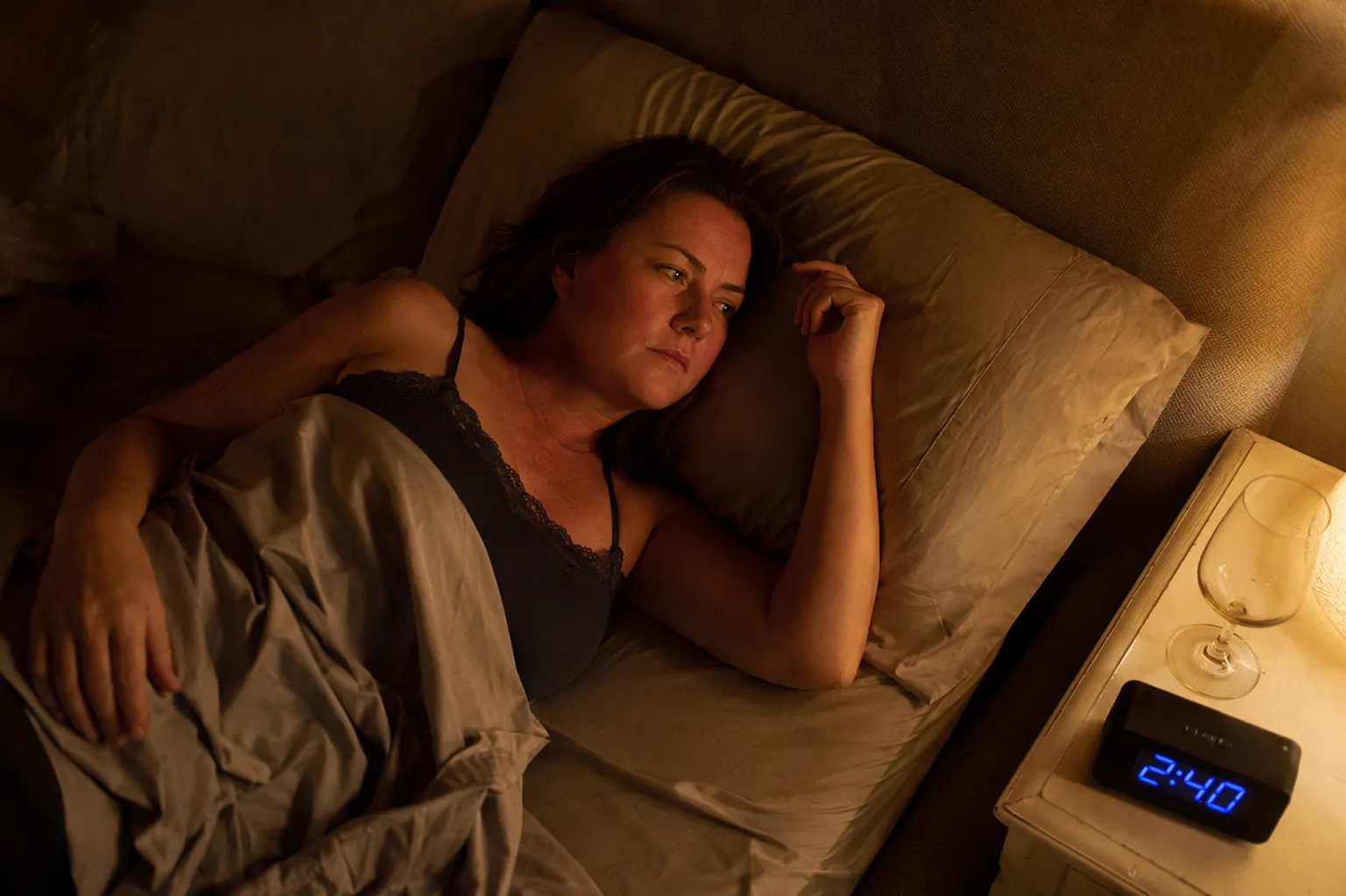
The most useful way to understand the 2–3 a.m. wake-up is not to treat it as a mystery of willpower. It is a collision of timing, heat, and sleep-stage disruption. University Hospitals describes menopause-related changes in alcohol metabolism, including the role of declining estrogen and less efficient liver processing with age, which can leave alcohol relevant deeper into the night than it used to be.[1] General sleep medicine sources are consistent on the other side of the pattern: alcohol can feel sedating early, then contribute to lighter, more disrupted sleep as the night progresses, with effects on REM and deep sleep.[2][3]
The same drink is reaching a different sleep system
At 38, a glass of wine may have been metabolized and mostly out of the way before your sleep became fragile. At 47, the same glass may be competing with a body that is already cycling through hormonal volatility, lighter sleep, and a more reactive temperature-control system. That does not mean alcohol has become a toxin in some new, dramatic sense. It means the margin for error has narrowed.
Alcohol’s first trick is the one that keeps people using it as a sleep aid: it can reduce the time it takes to fall asleep. Cleveland Clinic’s explanation of alcohol and sleep describes that early sedating effect, followed later by more fragmented and less restorative sleep.[2] The Sleep Foundation similarly notes that alcohol can suppress REM sleep and interfere with normal sleep architecture, especially when consumed close to bedtime.[3]
That distinction matters. Falling asleep is not the same as sleeping well. A drink may help with the first door into sleep while making the second half of the night more breakable. In perimenopause, that second half is often exactly where the trouble already lives.
If you want the broader version of this topic, the companion guide on how alcohol disrupts sleep in perimenopause covers the larger alcohol-sleep pattern. Here, the important question is narrower: why does one ordinary evening drink now have such a suspiciously specific middle-of-the-night consequence?
Why the 2–3 a.m. wake-up makes physiological sense
The timing is not exact enough to be a diagnostic clock. No single prospective study proves that alcohol causes perimenopausal women, specifically, to wake at 2:40 a.m. But the window makes sense when you put the pieces together.
Alcohol does not simply make you sleepy and disappear. As your body metabolizes it, blood alcohol levels fall. Sleep specialists commonly describe the later-night problem as a rebound into lighter, more disrupted sleep after the early sedating phase.[2][3] If a drink is taken in the evening, that falling-alcohol window can overlap with the middle of the night — the exact period when many perimenopausal women are already more likely to wake.
Perimenopause can make that overlap more noticeable because alcohol may not clear in quite the same way. University Hospitals links menopause-related alcohol sensitivity to declining estrogen and changes in liver efficiency, while also acknowledging the age-related component.[1] The responsible interpretation is not that estrogen alone explains every changed reaction to alcohol. It is that hormonal change and aging both appear to shift the body’s handling of alcohol, and that shift can matter during sleep.
Picture a simple, hypothetical evening: a drink that once felt functionally finished by bedtime now remains biologically active later into the night. As its sedating effect wears down, your nervous system does not stay in the same smooth sleep groove. Sleep becomes easier to puncture. If perimenopause has already made your sleep lighter, warmer, and more discontinuous, the same amount of alcohol can produce a bigger interruption than it used to.
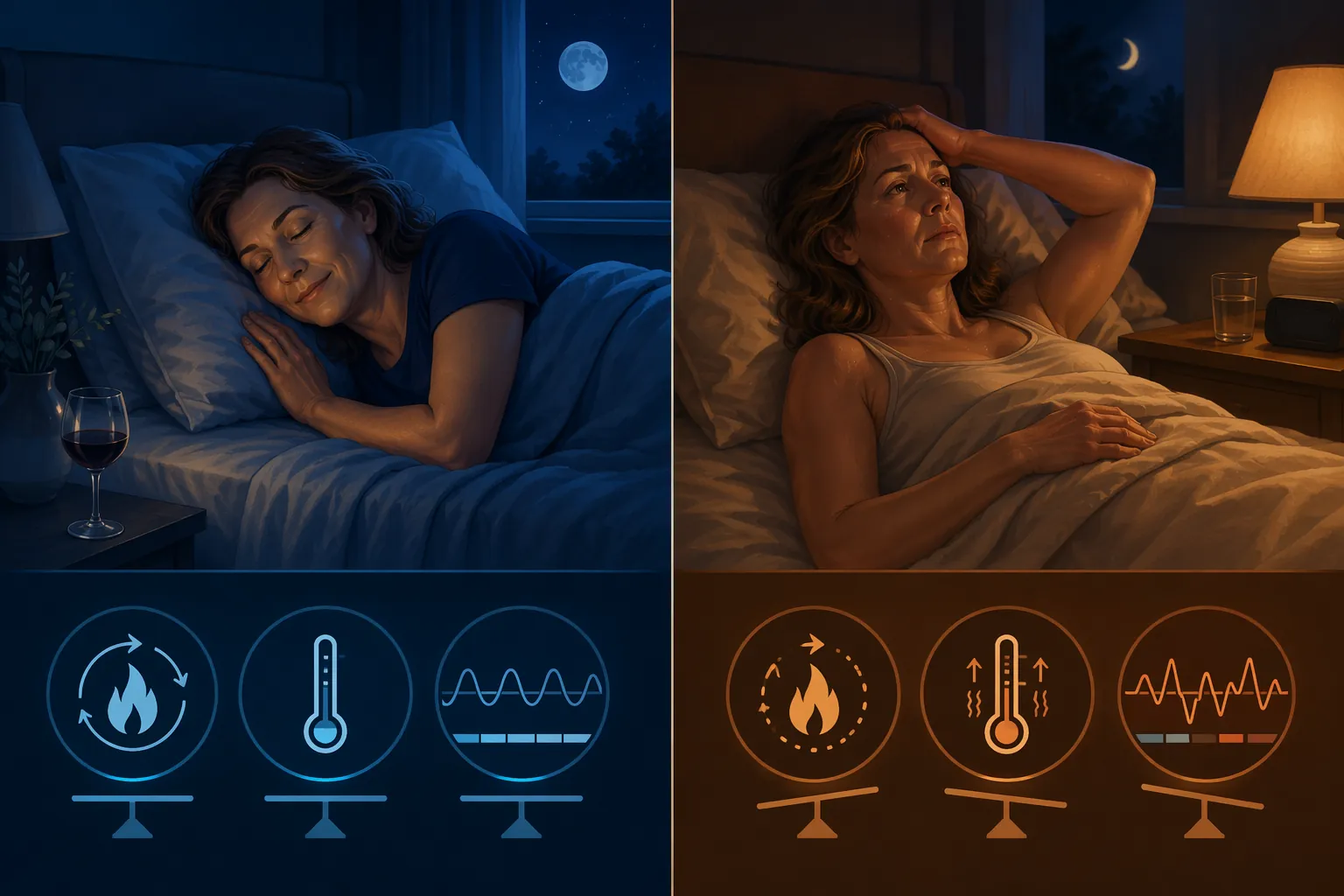
Heat is often the alarm, not a side note
The hottest part of the alcohol-perimenopause story is not metaphorical. Mayo Clinic’s menopause guidance warns that alcohol can worsen hot flashes and night sweats, and Dr. Juliana Kling specifically discusses the combination of alcohol, menopause, metabolism, and sleep risk.[4] The reason this feels so recognizable is that alcohol’s effects are pushing on a system that is already touchy.
During perimenopause, fluctuating and declining estrogen can destabilize the hypothalamic temperature-control system. The body’s comfort zone narrows. Small internal or external heat shifts that used to pass unnoticed can now trigger a vasomotor response: heat rising, flushing, sweating, then a chill or an irritated wake-up after the sweat cools.
Alcohol adds pressure from two directions. It can dilate blood vessels, which can make the body feel warmer, and it can contribute to thermogenic effects that raise the likelihood of heat and sweating. Mayo Clinic describes night sweats as a common menopause-related issue and notes that alcohol can intensify these symptoms; vasomotor symptoms, including hot flashes and night sweats, affect roughly 80% of perimenopausal women.[4]
That is why the advice to “just skip the wine” often lands badly even when it is directionally correct. The woman waking up drenched after one drink is not necessarily weaker than she was ten years ago. She may be living in a body whose temperature-control threshold has changed. Alcohol is not inventing the entire problem; it is adding heat load, vasodilation, and sleep-stage disruption to a body already primed for night sweats.
This also explains why the wake-up can feel physical before it feels psychological. You may notice the damp shirt, the hot face, the pounding awareness of your pulse, or the need to throw off the sheet before you have any coherent thought. For more practical help with the heat side of the problem, the guides on sleeping with perimenopause night sweats in extreme heat and sleeping in a heat wave without AC during perimenopause are better next stops than generic sleep hygiene lists.
Alcohol is disrupting sleep that may already be discontinuous
The third mechanism is less dramatic than a night sweat, but it may be the one you feel the next day. Perimenopause is already associated with more sleep discontinuity. In the SWAN Study, about 56% of perimenopausal women reported sleep discontinuity, compared with about 32% of premenopausal women.[5] A 2023 meta-analysis reported a 51.6% prevalence of sleep disorders during menopause, underscoring that sleep disruption around this life stage is common rather than rare.[6]
Those numbers do not mean every bad night is hormonal. They do explain why alcohol can feel newly disproportionate. If your baseline sleep has become easier to interrupt, then a substance that lightens sleep, suppresses REM, and interferes with deep sleep does not have to do all the damage by itself. It only has to push an already unstable pattern a little further.
REM and deep sleep are not decorative stages. They are part of why sleep feels restorative instead of merely unconscious. Sleep Foundation summarizes alcohol’s tendency to reduce REM sleep and alter sleep architecture, while Cleveland Clinic describes the familiar split effect: sedation early, poorer sleep later.[2][3] In perimenopause, when awakenings may already be more frequent, that architecture matters.
Melatonin may add another layer. A review on sleep, melatonin, and the menopausal transition describes age- and menopause-related changes in melatonin and circadian regulation.[7] Alcohol can suppress what remains of normal sleep signaling, so the night may lose both structure and stability at once: less consolidated sleep, more arousals, and a morning that feels unfairly bad for the amount you technically lay in bed.
This is also where cumulative disruption starts to matter. One bad night after a drink is annoying. Repeated nights of lighter, hotter, more fragmented sleep can become a larger recovery problem, especially when layered onto work, caregiving, exercise, and stress. If that is the pattern you are tracking, the article on perimenopause sleep loss and biological age goes further into the consequences of chronic sleep disruption.
When alcohol is not the only suspect
Alcohol before bed is a strong suspect when the pattern is consistent: easier sleep onset, then a hot or restless middle-of-the-night awakening after drinking. But it should not be forced to explain everything. Perimenopause can bring insomnia, vasomotor symptoms, mood changes, and circadian shifts even without alcohol. Other sleep disorders can also become more visible in midlife.
If awakenings are accompanied by loud snoring, gasping, morning headaches, high blood pressure, or heavy daytime sleepiness, alcohol may be worsening the night while sleep apnea is doing part of the work. The guide on sleep apnea versus perimenopause is a more useful differential than assuming every 3 a.m. wake-up is hormonal.
What the evidence can say — and what it cannot
The honest evidence picture is convergent, not perfect. There is not a large randomized trial that assigns perimenopausal women to bedtime alcohol or abstinence and then measures detailed sleep-stage outcomes across the night. The case is built from overlapping lines of evidence: general alcohol-sleep physiology, menopause-related sleep epidemiology, menopause-clinician observations, and plausible mechanisms around metabolism and thermoregulation.
That limits the claim, but it does not make the claim weak. We can say that alcohol is known to sedate early and disrupt later sleep; perimenopause is associated with more fragmented sleep; menopause-related changes can alter alcohol metabolism; and alcohol can worsen hot flashes and night sweats.[1][2][3][4][5] What we should not say is that one study has proven the exact 2–3 a.m. pattern in all perimenopausal women.
The metabolism piece also deserves restraint. Estrogen decline and aging-related liver changes are difficult to fully separate. A woman’s body composition, medications, drinking pattern, meal timing, stress load, and baseline sleep disorders can all change how alcohol feels at night. The useful conclusion is not that estrogen alone made wine a sleep problem. It is that the perimenopausal body often has fewer buffers against alcohol’s known sleep-disrupting effects.
What this means for bedtime drinking
If sleep quality is the priority, alcohol close to bedtime is a poor bargain in perimenopause. It may make the first part of the night easier while making the part you care about most — consolidated, cool, restorative sleep — more fragile. The cost is often paid later, when blood alcohol levels are falling, temperature regulation is more reactive, and REM or deep sleep has already been disturbed.
The practical test does not require self-punishment. Watch what happens on nights when alcohol is earlier, smaller, or absent compared with nights when it is closer to bed. The pattern may not be perfectly clean, because perimenopause rarely offers clean experiments. But if the hot 2–3 a.m. awakening repeatedly follows evening alcohol, your body is giving you useful information, not evidence that you have lost discipline.
The same drink can now carry a different sleep cost because the underlying sleep system has changed. That is the central point. Alcohol before bed does not have to be judged in the abstract to be judged clearly for this situation: in perimenopause, it is particularly likely to ruin sleep quality by slowing the night’s recovery from alcohol, intensifying heat instability, and worsening sleep fragmentation that may already be underway.
References
- Does Menopause Change the Way You Metabolize Alcohol? — University Hospitals
- How Does Alcohol Affect Sleep? — Cleveland Clinic
- Alcohol and Sleep — Sleep Foundation
- Mayo Clinic Minute: Why alcohol and menopause can be a dangerous mix — Mayo Clinic
- Effects of Sleep Problems During Menopause — SWAN Study
- Global prevalence of sleep disorders during menopause: a meta-analysis — PMC, 2023
- Sleep, Melatonin, and the Menopausal Transition — PMC, 2017
Safety & eligibility read
Cross-check against other interventionsExplore the mechanism
Next step
Spot an error or have clinical feedback?
Because this article covers clinical, medication, or safety information, we use a moderated correction channel instead of open public comments. Let us know if something about “Alcohol Before Bed Ruins Sleep Quality in Perimenopause” needs a closer look.
Send feedback on this article