
Which 12-Hour Pain Reliever Works Best for Perimenopause Sleep?
Not every OTC pain reliever can cover a full night's sleep, and perimenopause changes the safety math. This guide explains why naproxen is the only 12-hour option and what to watch for with PM products and your health.
If you need one OTC pain reliever to last through a sleep window, the short answer is naproxen sodium. It is the only common OTC pain reliever in this comparison labeled for up to 12 hours of pain relief; ibuprofen and acetaminophen are not built around the same overnight interval.[1][2]
The longer answer is whether naproxen is safe for your body, your stomach, your kidneys, your blood pressure history, your medication list, and your actual sleep problem. Perimenopause makes that question more specific. A woman waking with hip pain at 3 a.m. is not just choosing between brand names; she is choosing between duration, drug class, sleep-aid ingredients, and the possibility that repeated nighttime pain is part of a hormonal transition that deserves more than another box from the pharmacy shelf.

The Overnight Duration Comparison
The pharmacy aisle gets easier when the first filter is duration, not marketing language. For 12 hour pain relief for sleep in perimenopause, the only OTC analgesic in this group labeled around that full-night window is naproxen sodium. Aleve’s labeling says one caplet, tablet, or gelcap can be taken every 8 to 12 hours while symptoms last, with the first dose allowing two pills within the first hour if needed, and with daily maximums on the label.[1][2]
| OTC option | Typical labeled dosing interval | What that means for sleep |
|---|---|---|
| Naproxen sodium, such as Aleve | Up to 12 hours | The only option here designed to cover a full sleep window without middle-of-the-night redosing. |
| Ibuprofen, such as Advil | Up to 8 hours | May cover part of the night, but it is not a 12-hour pain reliever. |
| Acetaminophen, such as Tylenol | Every 4 to 6 hours | Often too short for an uninterrupted full night if pain returns. |
| PM products | Depends on the pain reliever base | The sleep-aid ingredient may make you drowsy, but it does not automatically extend the pain-relief interval. |
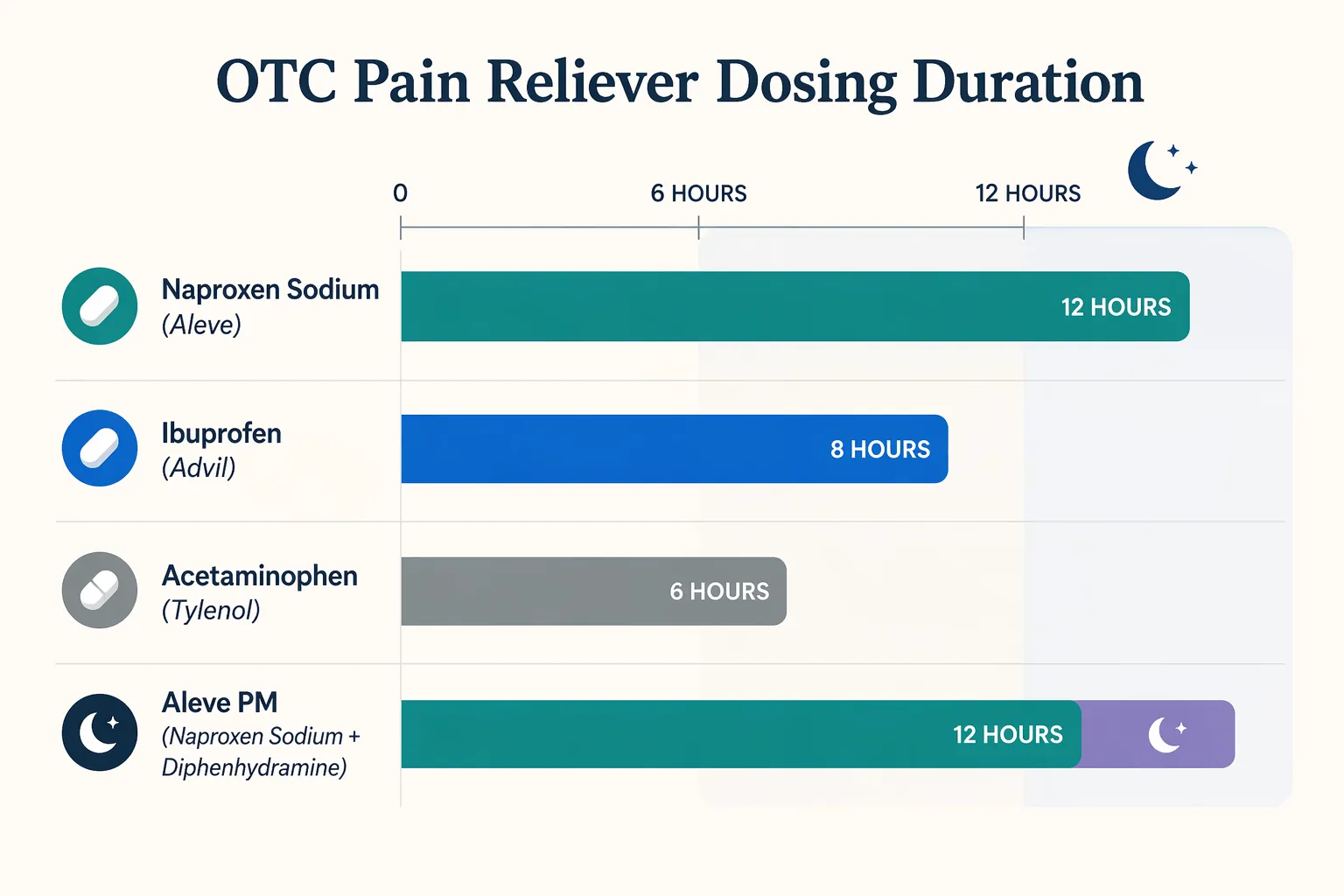
That last row is where many tired people get misled. “PM” usually means a pain reliever plus a sedating antihistamine. It does not mean every PM product gives 12 hours of pain relief. Aleve PM is different because its pain-reliever base is naproxen sodium, but its sleep-aid ingredient is still a separate drug with its own tradeoffs.[3][4]
Why Perimenopause Pain Often Shows Up at Night
Joint and muscle pain during perimenopause is common enough that it should not be waved away as “just getting older.” Harvard Health describes musculoskeletal syndrome of menopause as a cluster that can include joint pain, muscle loss, tendon and ligament issues, and bone changes, and reports that musculoskeletal pain affects about 70% of women around the time of menopause, with nearly one-quarter describing symptoms as debilitating.[5]
The mechanism is not mysterious, though it is often under-discussed. Estrogen receptors are present in joints, tendons, ligaments, and bone, and declining estrogen may affect joint lubrication, inflammatory signaling, connective tissue, and pain sensitivity.[5][6] When that shift arrives alongside lighter sleep, night sweats, mood changes, or early-morning waking, a mild ache that was tolerable at 4 p.m. can become the thing that breaks the night.
Sleep disruption itself is also a core perimenopause symptom, not a side plot. Sleep Foundation describes perimenopause as a time when hot flashes, night sweats, mood symptoms, and changing hormone levels can disrupt sleep.[7] Nurofen UK cites estimates that 28% to 63% of perimenopausal women experience sleep disturbance, with pain and night sweats among the drivers.[8]
When Naproxen’s 12 Hours Actually Matters
Naproxen’s advantage is clearest when the problem is pain duration: you can fall asleep, but pain in a hip, shoulder, hand, back, or knee wakes you before morning. In that situation, a longer-labeled dosing interval can matter because the medication is matched to the sleep window rather than to a shorter daytime dosing rhythm.
That does not make naproxen the automatic best choice for every perimenopausal woman. It is a nonsteroidal anti-inflammatory drug, or NSAID. NSAIDs can irritate the stomach, increase bleeding risk, affect kidney function, and raise cardiovascular concerns, especially with higher doses, longer use, older age, certain health conditions, or interacting medications.[9][10]
Naproxen is sometimes discussed as having a possibly more favorable cardiovascular profile than some other NSAIDs, but that is not the same as being cardiovascularly harmless. The practical question is not whether naproxen “wins” against ibuprofen in the abstract. It is whether you are a reasonable NSAID candidate at all, and whether the expected benefit is occasional overnight pain control or a new nightly medication habit.
That distinction matters in midlife. Perimenopause is when blood pressure, cholesterol, reflux, migraine patterns, kidney concerns, and medication lists may also be changing. If you already have a history of stomach ulcers or bleeding, kidney disease, uncontrolled high blood pressure, heart disease, blood thinners, steroid use, heavy alcohol use, or regular use of other NSAIDs, the “12-hour” claim is not the deciding fact. It is a reason to ask a clinician or pharmacist before using naproxen, especially repeatedly.
The PM Box Adds a Second Decision
Aleve PM combines 220 mg naproxen sodium with 25 mg diphenhydramine HCl.[3] Bayer described its 2014 launch as the first OTC PM pain reliever combining a sleep aid with the 12-hour pain-relieving strength of Aleve.[4] That is a useful label fact, but it should be read literally: naproxen is doing the longer pain-relief work; diphenhydramine is the sedating antihistamine.
Diphenhydramine can make people sleepy. It can also cause next-day grogginess, dry mouth, constipation, urinary retention, and cognitive fog in some users. It is an anticholinergic medication, and cumulative anticholinergic burden is a recognized concern in medication safety. The American Geriatrics Society Beers Criteria flags first-generation antihistamines such as diphenhydramine as potentially inappropriate for adults 65 and older because of anticholinergic effects and related risks.[11]
A woman in her 40s or early 50s is not in the same risk category as an adult over 65. Occasional use of a diphenhydramine-containing PM product is a different decision from taking it every night because pain and wakefulness have become routine. The problem is not that one PM dose is automatically dangerous; it is that “occasional” can quietly become “most nights,” and then the sleep-aid ingredient deserves as much scrutiny as the pain reliever.
The next morning is often where the truth shows up. If a PM product helps you fall asleep but leaves you constipated, foggy, unable to urinate comfortably, more reflux-prone, or dulled at work, it has solved only part of the night. If you are already using other medications with sedating or anticholinergic effects, the combined burden is another reason to ask a pharmacist before stacking products.
Plain Naproxen Versus Aleve PM
If the main issue is pain waking you up, plain naproxen may be the cleaner experiment than a combination PM product, assuming naproxen is safe for you and you follow the label. It tests the actual theory: does longer pain relief keep the pain from breaking sleep?
Aleve PM fits a narrower situation: pain and difficulty falling asleep are both present, and you want occasional short-term help that includes a sedating antihistamine. It is less well matched to someone whose main trouble is repeated 3 a.m. waking from perimenopause symptoms, night sweats, anxiety surges, or pain that is frequent enough to need medication most nights.
There is also an evidence boundary worth keeping clean. The 12-hour naproxen label is general OTC pain-relief labeling, not proof from trials specifically in perimenopausal women with hormone-related body aches. Likewise, Aleve PM’s composition and launch claims tell us what is in the product and how it was positioned; they do not prove that a perimenopausal sleeper should use it regularly.[3][4]
When Acetaminophen or Ibuprofen May Still Be the Better Fit
A shorter duration does not automatically make a medication inferior. Acetaminophen is not an NSAID, so it may be considered when NSAIDs are a poor fit because of stomach, kidney, cardiovascular, or bleeding concerns. Its tradeoff is that it does not have the same anti-inflammatory action and is usually labeled for a shorter interval, so it may not cover a full night for pain that predictably returns.
Ibuprofen may help inflammatory aches for some people, but it is still an NSAID and it is not the 12-hour option in this comparison. For someone who wakes after the medication wears off, switching from ibuprofen to another short-window approach may not fix the timing problem. For someone with NSAID cautions, switching from ibuprofen to naproxen may not fix the safety problem.
The label should also stop one common mistake: do not combine NSAIDs casually. Taking ibuprofen and naproxen in the same night is not a stronger sleep plan; it increases NSAID exposure. If you are alternating or combining pain relievers because nothing is lasting, that is a clinical conversation, not a personal willpower test.
The Hormonal Driver Should Not Be Ignored
OTC pain relievers can be useful, especially for an occasional bad night. They do not address why a woman who used to sleep through the night is now waking with aching joints, night sweats, lighter sleep, or a nervous-system jolt before dawn.
Menopause hormone therapy, or MHT, is one route to discuss with a clinician because it addresses declining estrogen rather than only blocking pain after it appears. Sleep Foundation notes that hormone therapy can reduce hot flashes and night sweats for some people and may improve sleep when vasomotor symptoms are driving disruption.[7] Harvard Health and Hone Health also describe hormone therapy as one option that may help musculoskeletal symptoms related to menopause, though individual risks, contraindications, and access vary.[5][6]
That does not make MHT a simple substitute for naproxen, and it does not mean every woman with perimenopause pain should or can use hormones. It does mean that repeated nighttime pain medication should not be the only plan if the pain is arriving with other perimenopause signals.
A Practical Way to Choose Tonight
Start with the actual sleep failure. If pain is the main reason you wake, and you are a good NSAID candidate, naproxen is the OTC option that matches the 12-hour sleep-window problem. If sleep onset is the main issue and pain is minor, a PM pain product may be treating the wrong target. If both pain and insomnia are present, decide whether you truly need a sedating antihistamine or whether pain control plus non-drug insomnia strategies would be safer for repeated use.
- Choose plain naproxen only if NSAIDs are safe for you, you can follow the dosing label, and the goal is occasional overnight pain relief.
- Be cautious with Aleve PM or other PM products if you are sensitive to next-day sedation, constipation, urinary symptoms, dry mouth, confusion, or medication stacking.
- Do not let the word “PM” obscure the pain-relief duration; check whether the pain reliever is naproxen, ibuprofen, or acetaminophen.
- Avoid turning any OTC pain reliever or antihistamine sleep aid into a nightly workaround without medical guidance.
The clinician-check threshold is straightforward: if pain is frequent enough to require regular nighttime medication, if you have gastric, kidney, cardiovascular, medication-interaction, cognitive, constipation, or urinary concerns, or if sleep disruption persists alongside hot flashes, night sweats, mood changes, or cycle changes, the next step is not another PM box. It is a conversation about safer pain control and menopause-directed treatment.
References
- The Aleve Difference, Aleve.com
- Aleve label, DailyMed, NIH
- Aleve PM FAQ, Aleve.com
- Bayer HealthCare Announces the Launch of Aleve PM, the First and Only OTC PM Pain Reliever with a Sleep Aid Plus the 12-Hour Pain Relieving Strength of Aleve, PRNewswire, 2014
- Musculoskeletal syndrome of menopause: When menopause makes you ache all over, Harvard Health
- Perimenopause Body Aches & How to Stop Them, Hone Health
- Perimenopause and Sleep: Causes and Solutions to Disruptions, Sleep Foundation
- Menopause Pain & Night Sweats: How To Sleep Better, Nurofen UK
- Naproxen for Women 40-50, Ubie Health
- Treatment Options for Menopausal Symptoms, Banner Health
- American Geriatrics Society 2023 updated AGS Beers Criteria for potentially inappropriate medication use in older adults, Journal of the American Geriatrics Society, 2023
Explore the mechanism
Next step
Spot an error or have clinical feedback?
Because this article covers clinical, medication, or safety information, we use a moderated correction channel instead of open public comments. Let us know if something about “Which 12-Hour Pain Reliever Works Best for Perimenopause Sleep?” needs a closer look.
Send feedback on this article