
Binge Netflix on Weekends Without Perimenopause Sleep Disruption
Learn why perimenopause makes weekend Netflix binges more disruptive to sleep and get a targeted protocol—including a cool-down buffer, room temperature management, and morning bright-light recovery—to enjoy your shows without sacrificing sleep quality.
The frustrating part is not that a weekend Netflix binge is new. It is that the same two or three hours that used to feel harmless can now leave you waking at 3 a.m., kicking off covers, replaying the final scene, or moving through Monday as if you borrowed sleep from a lender with terrible terms.
That change is not a character flaw, and the show is not automatically the villain. Weekend watching can be decompression, couple time, the one shared story your group chat is still following, or the only leisure block that survives work, caregiving, and everyone else’s needs. The useful question is narrower: how to avoid sleep disruption from a weekend Netflix binge in perimenopause without pretending leisure has to be surgically removed from your life.
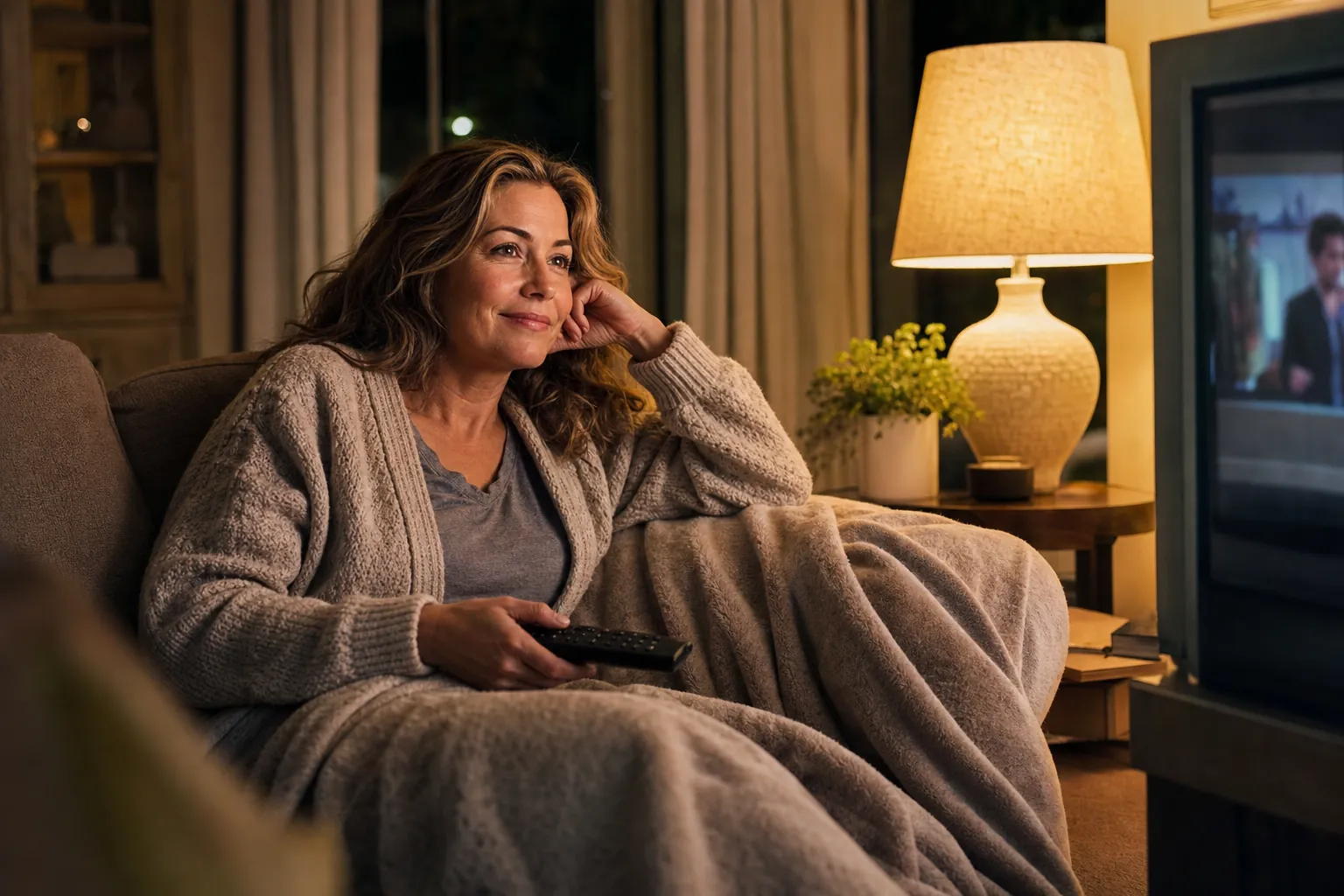
The short answer: keep the show, but stop treating your perimenopausal sleep system as if it still has the same buffer it had at 35. The main problem is usually not one screen across the room. It is late-night stimulation landing on sleep that is already more vulnerable to wake-ups, temperature swings, and weaker sleep-onset signaling.
Why the same binge costs more now
Perimenopause often changes the starting point. In the Apple Women’s Health Study, about 47–56% of perimenopausal participants reported sleep disturbances, and wake-after-sleep-onset, or WASO, rose by an average of 7% in the 18 months before the final menstrual period in a sample of 338 participants.[1] WASO matters because it describes exactly the kind of night many women complain about: not always trouble falling asleep, but more time awake after sleep has begun.
So when a late episode leaves your mind running, it is not landing on a calm, stable system. It is landing on sleep architecture that may already be easier to fragment. Add a warm bedroom, a hot flash, one emotionally loaded cliffhanger, or a delayed bedtime, and the result can feel disproportionate to the behavior.
The behavior itself is also ordinary. In a study of binge viewing and sleep, the average binge session lasted 3 hours and 8 minutes, and 52% of viewers reported watching three to four episodes in one sitting.[2] That does not mean the pattern is sleep-neutral. It means the starting point should not be moral panic. A weekend binge is a common leisure pattern; perimenopause changes how much recovery room your body has afterward.
The bigger issue is what your brain keeps doing after the credits
The most useful binge-watching sleep finding is not a blue-light finding. In Exelmans and Van den Bulck’s study, binge viewers had 98% higher odds of poor sleep quality, and the relationship was fully mediated by cognitive pre-sleep arousal.[2] In plain language: the problem was not simply that people looked at a screen. It was that the content kept the mind activated.
Serial TV is built to travel with you after the screen goes dark. A cliffhanger asks the brain to keep predicting. A betrayal scene keeps emotion online. A dense plot asks for memory work: who knows what, who lied, what happens next. If you watch until the moment you expect sleep to take over, you are asking your nervous system to make a hard pivot with no runway.
Perimenopause can make that pivot less forgiving. Melatonin levels begin declining during the menopausal transition, reducing one of the body’s natural signals for sleep onset.[3] That does not mean melatonin is the whole story, or that every woman needs a supplement. It does mean the evening sleep signal may be less robust, so late cognitive activation has less opposition than it used to.
Blue light still deserves nuance, not dismissal. Research summarized by The New York Times reported that TV viewed from more than 9 feet away had no measurable melatonin suppression, while an iPad at full brightness for 1 hour caused no change and 2 or more hours at full brightness produced a small suppression.[4] A television across the room is not the same exposure as a bright tablet near your face. Still, if perimenopause has already softened your melatonin signal, it is sensible to avoid adding prolonged, close-range, full-brightness screen exposure to the end of the night.
A weekend protocol that preserves the pleasure
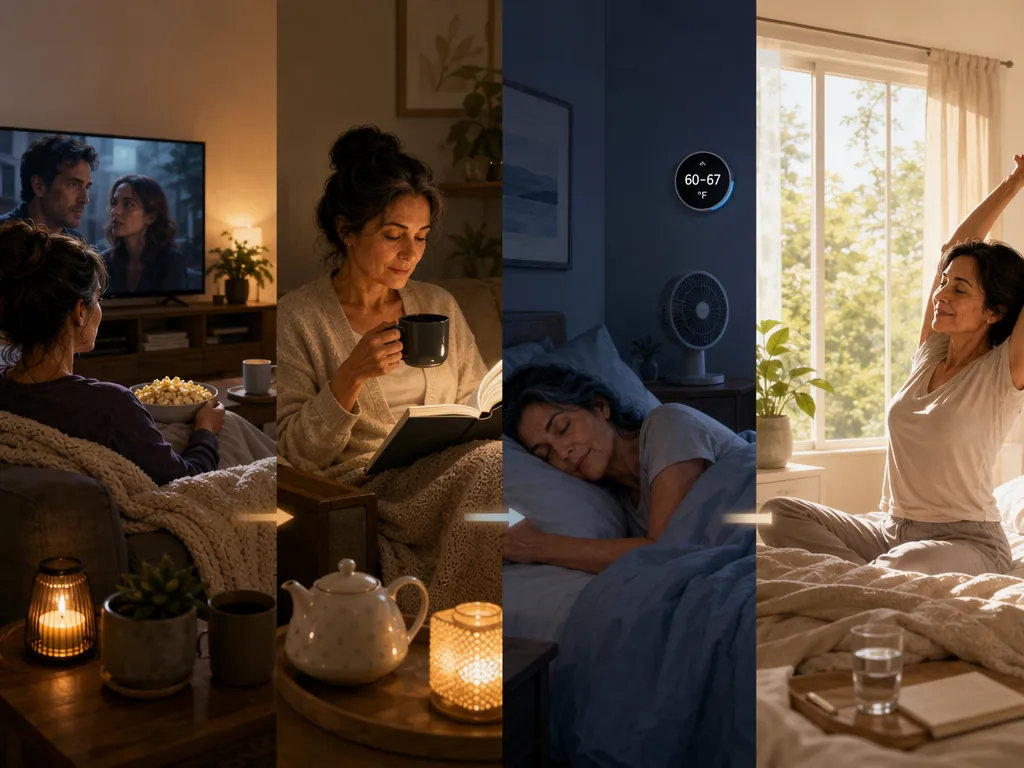
The protocol is not “no screens after dinner.” It is a way to keep the enjoyable part of the ritual while protecting the pieces of sleep that perimenopause commonly stresses: the wind-down, the bedroom temperature zone, and the next morning’s circadian signal.
| When | What to do | Why it matters in perimenopause |
|---|---|---|
| Before pressing play | Decide the final episode before the first episode starts. | Decision fatigue is lower before the cliffhanger has you negotiating with yourself. |
| During the binge | Keep the TV at a distance; avoid switching to a bright phone or tablet in bed. | Cognitive arousal is the main concern, but close, bright light can still add pressure. |
| Last episode | End 45–60 minutes before your intended sleep time. | The brain needs a runway between narrative stimulation and sleep onset. |
| Cool-down buffer | Choose a low-arousal transition that does not create a new plot to solve. | Perimenopausal sleep is often easier to fragment, so the transition has to be genuinely quiet. |
| Bedroom setup | Aim for a cool room in the 60–67°F range. | Temperature management helps reduce vasomotor-event-triggered awakenings. |
| Next morning | Get bright morning light, especially after a disrupted night. | Light helps re-anchor circadian timing after a delayed or fragmented weekend night. |
Choose the stopping point before the show starts
The weakest time to decide whether you are done is 11:42 p.m., after an episode ends with someone opening a door they should not open. Decide earlier: “We stop after episode three,” or “We stop at 10:15 even if the episode has eight minutes left.” If stopping mid-episode sounds impossible, choose a show length that lets the episode end with enough time left for the buffer.
This is not about being strict for the sake of being strict. It is about moving the decision to the part of the evening when your prefrontal cortex is still available and the streaming platform has not started its countdown.
Protect a real 45–60 minute cool-down buffer
A buffer is not the time between turning off the TV and scrolling in bed. It is the time between the last emotionally engaging scene and the point where you ask your body to sleep. For many perimenopausal women, 45–60 minutes is a more realistic target than a token five-minute pause, especially after suspense, conflict, horror, true crime, or a finale.
Good transition activities are mildly pleasant and cognitively unambitious: loading the dishwasher without starting a household project, taking a warm shower early enough that you are not overheating in bed, stretching lightly, listening to familiar music, reading something that does not introduce a new plot, or making tomorrow’s coffee setup. The activity should give the mind somewhere to land without asking it to solve, compare, react, or keep up.
If a cliffhanger is unavoidable, add a small mental off-ramp. Write one sentence on paper: “Next episode: she confronts him about the call.” That sounds almost too simple, but it gives the brain a parking place. You are not trying to erase interest in the story. You are reducing the need to rehearse it in bed.
Do not move the binge into bed
If you watch on a television from the couch, keep it there. The risk changes when the final episode migrates to a tablet or phone inches from your face under the covers. That move combines a stronger light exposure, a weaker boundary between watching and sleeping, and often a later stopping point because no one has to get up.
This is one of the few screen rules worth defending firmly: bed is not the overflow location for the last episode. If you want the show, enjoy the show. Then make a physical transition away from it.
Cool the room for the sleep you actually have now
Temperature advice can sound bland until hot flashes or night sweats start breaking sleep open. For perimenopausal women, the Sleep Foundation recommends a bedroom temperature of 60–67°F to reduce the likelihood of awakenings triggered by vasomotor events.[5] This is not generic coziness advice. It is a direct response to one of the ways perimenopause can interrupt sleep after you have already fallen asleep.
The practical goal is to make the room cool enough that a small internal heat surge does not become a full awakening. Set the thermostat before the show begins if possible, because a room often needs time to cool. Use layers you can remove easily instead of one heavy blanket. If you share a bed with someone who runs cold, separate covers can prevent your sleep setup from becoming a negotiation every night.
Also watch the timing of heat-producing habits after the binge. Alcohol, a heavy late meal, an overheated shower right before bed, or falling asleep under too much bedding can all make a vulnerable night more vulnerable. The point is not to build a perfect laboratory bedroom. It is to remove the obvious temperature traps on the same nights you are already adding late stimulation.
Use Monday morning light as recovery, not punishment
If Friday or Saturday went late, Monday morning is not the time to scold yourself into a heroic routine. It is the time to give your circadian system a clear daytime signal. Morning bright light helps re-entrain circadian rhythm after disrupted sleep, and the Sleep Foundation also notes that CBT-I and mindfulness-based interventions can improve sleep quality in perimenopausal women by addressing patterns that include cognitive arousal.[5]
In practice, that means getting outdoor light soon after waking when you can, opening shades while you make coffee, or taking a short morning walk before the day becomes fully claimed. If the weekend pushed bedtime later, bright morning light helps tell the body that the day has started. It is a recovery cue, not a penalty for having watched television.
When the protocol should get stricter
Some nights need more protection than others. If you are in a stretch of severe insomnia, frequent night sweats, high work stress, or repeated 3 a.m. awakenings, a suspense-heavy binge ending near bedtime may be too expensive for now. That does not make you fragile. It means your current sleep margin is thin.
On those weeks, choose an earlier start, fewer episodes, lighter content, or a weekend afternoon slot. If sleep disruption is persistent, worsening, or tied to intense vasomotor symptoms, it is worth discussing with a clinician rather than trying to solve everything with screen rules. Behavioral tools can help, but they are not a substitute for care when symptoms are recurrent and costly.
What the evidence can and cannot say
There is no direct trial that tests weekend Netflix binges specifically in perimenopausal women. The binge-watching research and the perimenopause sleep research are separate bodies of evidence being brought together here. The binge study that found the cognitive arousal pathway sampled younger adults, so its exact effect size should not be assumed to apply to women in their late 40s or early 50s.[2] The Apple Women’s Health Study WASO analysis is useful and unusually relevant, but its 338-participant sample is still modest.[1]
That boundary matters because it keeps the advice honest. The evidence does not prove that a 60-minute buffer will prevent every wake-up, or that every perimenopausal viewer responds the same way to late television. It does support a practical pattern: reduce cognitive carryover, avoid unnecessary close-range bright light, manage heat vulnerability, and use morning light to help the system recover.
A workable weekend rule of thumb is simple: keep the show, protect the buffer, cool the room, and recover with morning light. The goal is not perfect sleep behavior. It is enough physiological support that leisure does not keep charging you interest for two nights afterward.
References
- A Transition of Seasons: Sleep Patterns and Changes in Perimenopause — Harvard T.H. Chan School of Public Health, 2026
- Binge Viewing, Sleep, and the Role of Pre-Sleep Arousal
- Sleep, Melatonin, and the Menopausal Transition: What Are the Links?
- How Harmful is Blue Light For Sleep? — NYT, 2025
- Perimenopause and Sleep: Causes and Solutions to Disruptions — Sleep Foundation
Safety & eligibility read
Cross-check against other interventionsExplore the mechanism
Next step
Spot an error or have clinical feedback?
Because this article covers clinical, medication, or safety information, we use a moderated correction channel instead of open public comments. Let us know if something about “Binge Netflix on Weekends Without Perimenopause Sleep Disruption” needs a closer look.
Send feedback on this article