
Why Perimenopause Turns a Netflix Binge Into a Sleepless Night
Perimenopause amplifies the sleep-disrupting effects of binge-watching through a dual mechanism: hormonal changes that already prime lighter sleep plus the cognitive arousal from narrative engagement. This article explains why generic "limit screen time" advice falls short and offers a physiology-aware harm-reduction approach grounded in current research.
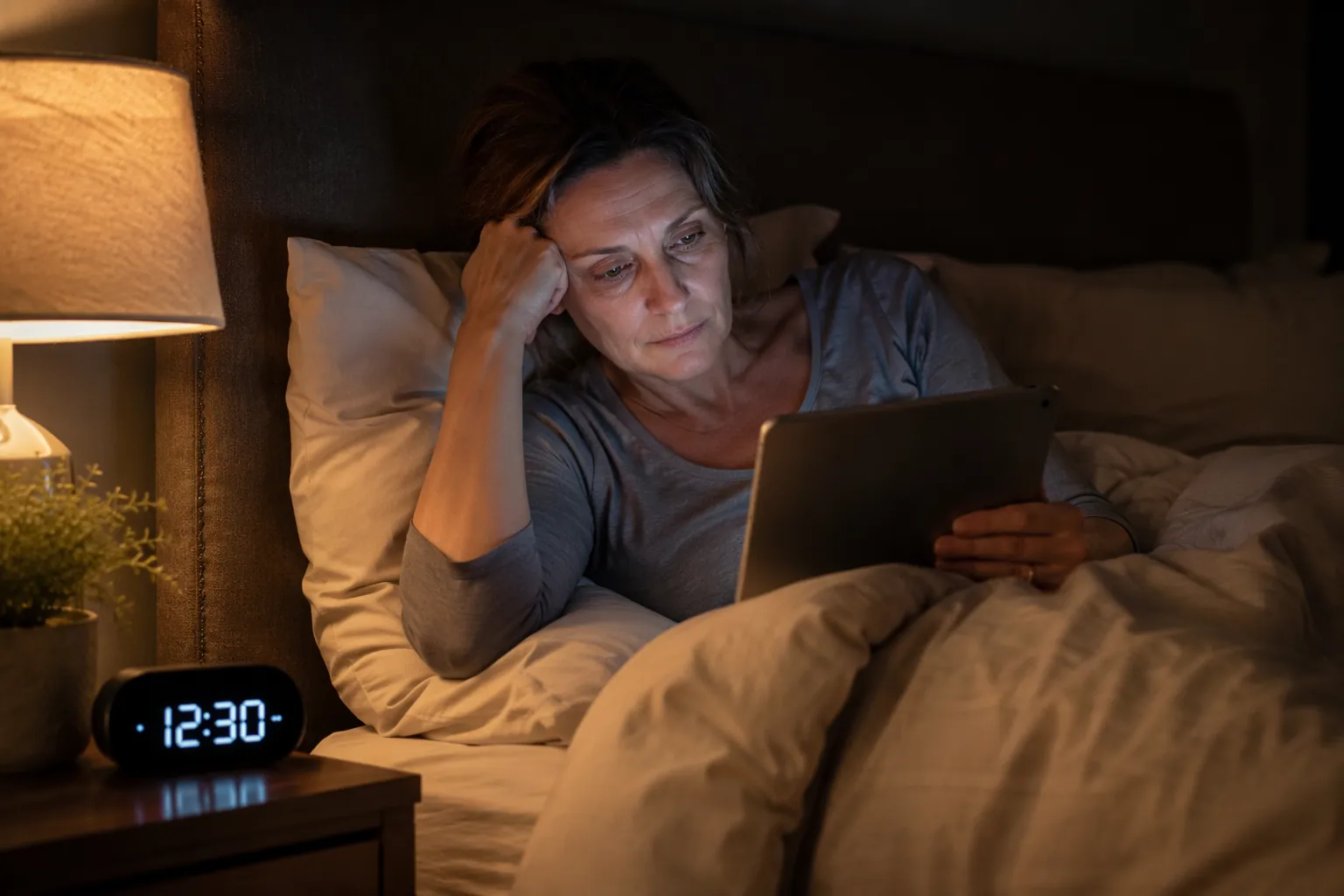
Here is the kind of story that rarely makes it into tidy sleep advice. It is a composite, not a documented case: a woman in her late 40s gets everyone fed, answers the last work message she should not have answered, folds half a load of laundry, and finally sits down with Netflix at 10 p.m. One episode feels earned. The next one starts automatically. The plot has just opened a new problem, someone is keeping a secret, and the remote is somewhere under the blanket. By the time she turns it off, she is tired in her body but oddly awake in her head. Then comes the insult: a hot wake-up, a bathroom trip, or the 3 a.m. inventory of every unresolved problem in her life.
If this sounds familiar, the useful answer is not that she has suddenly become weak-willed. The useful answer is that the same habit can land differently when the sleep system underneath it has changed. Perimenopause narrows the margin for arousal. Binge-watching supplies a lot of arousal in a very polished package.
Why this hits harder now
Sleep problems are common enough in the menopause transition that they should not be treated as a personal failure. Stanford Lifestyle Medicine summarizes the range this way: 40% to 60% of perimenopausal and menopausal women experience sleep difficulties, drawing on Lancet research cited in its review of perimenopause and sleep [1]. That does not mean every bad night is “just hormones.” It does mean that the body may be working with less stability than it had ten years earlier.
The Apple Women’s Health Study added a useful newer detail in May 2026: in a sleep sub-analysis of 338 participants, 60% showed increased wake-after-sleep-onset in the 18 months leading up to menopause, and 84% of perimenopausal participants who tracked sleep reported changes they attributed to menopause [2]. The average increase reported in the study was modest, and averages can hide women whose nights change dramatically. Still, the pattern matters because it points beyond generic aging. Around the final menstrual period, many women are not simply “getting older”; their sleep is becoming easier to interrupt.
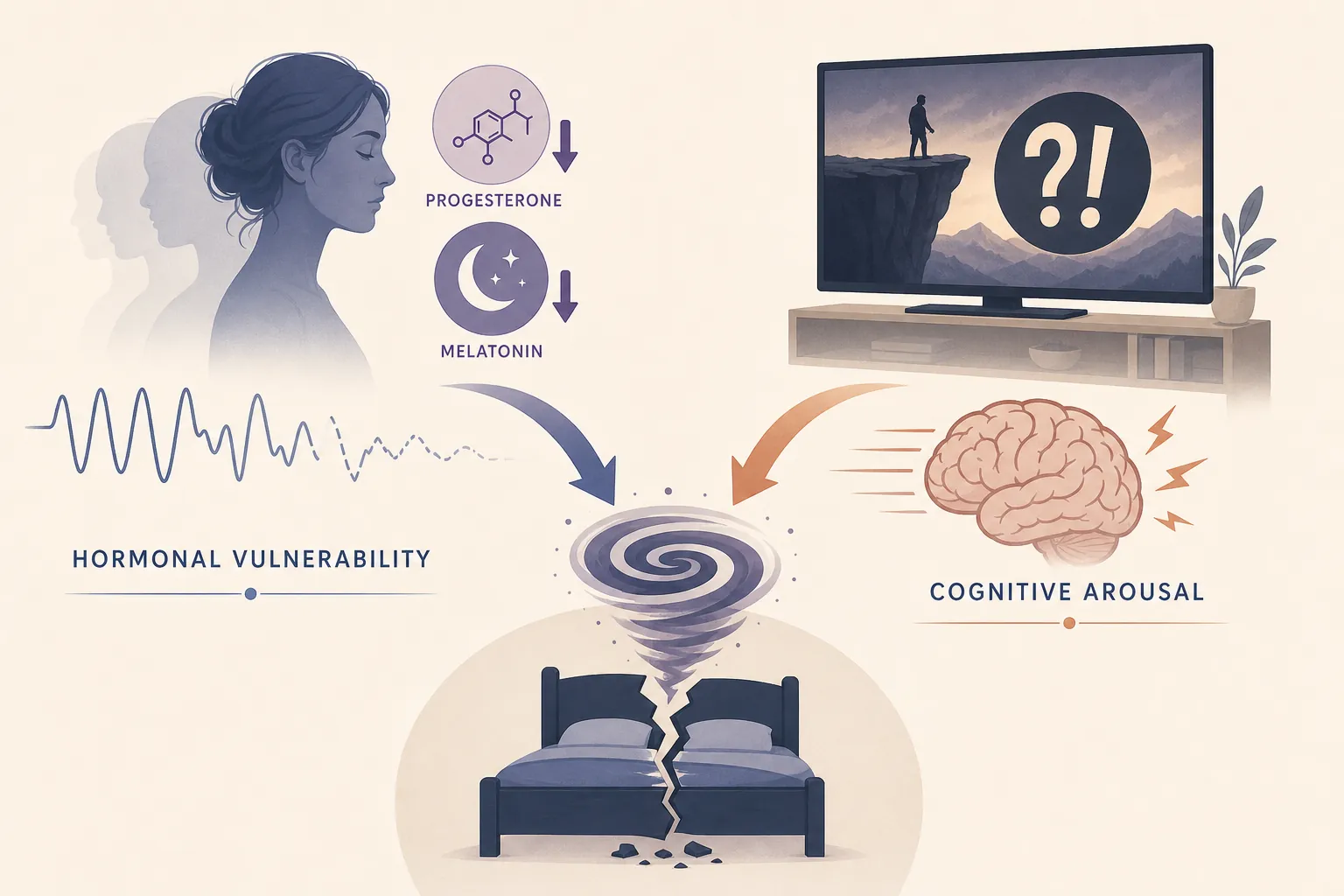
One reason is progesterone. Progesterone has sleep-promoting, calming effects through pathways related to GABA, the brain’s major inhibitory neurotransmitter; as progesterone declines during perimenopause, that sedating support can weaken, contributing to lighter sleep and more nighttime awakenings [1]. This is the part many screen-time lectures miss. A woman can do the same evening routine and get a different result because her baseline has moved.
Melatonin may also become less dependable. GoodRx’s review of perimenopause insomnia notes that melatonin levels significantly decline during perimenopause, which can make circadian timing more vulnerable [3]. Evening light still matters, but blue light is not the whole plot. If the brain is already less securely anchored to sleep, both light exposure and mental stimulation have more room to cause trouble.
The binge is not just screen time
The strongest reason not to reduce this to “screens are bad” is the binge-watching research itself. In a 2017 Journal of Clinical Sleep Medicine study, Exelmans and Van den Bulck found that binge viewers had a 98% higher likelihood of poor sleep quality compared with non-binge viewers; the average binge session lasted 3 hours and 8 minutes [4]. More important than the percentage is the mechanism: cognitive pre-sleep arousal fully mediated the relationship between binge viewing and poorer sleep [4].
That finding changes the conversation. The problem was not simply that a television emitted light or that minutes disappeared from the sleep schedule, though both can matter. The key pathway was that the mind stayed activated. A good series is designed to do exactly that. It carries unfinished emotional business from one episode into the next: cliffhangers, betrayals, danger, romantic tension, a mystery that almost resolves and then widens again. The viewer may be lying still, but the brain is still following consequences.
The same study also gives permission to be more precise. Regular non-binge television viewing was not the significant predictor of poor sleep quality in that analysis [4]. That distinction is helpful, because it keeps the advice from becoming silly. Watching one calm episode is not the same sleep exposure as letting a high-stakes season finale roll into the next installment at 11:47 p.m.
There is a caveat: the Exelmans and Van den Bulck study was conducted in young adults ages 18 to 25, not in perimenopausal women [4]. So it does not directly prove that binge-watching is more damaging during perimenopause. The more careful conclusion is a synthesis: binge-watching can increase pre-sleep cognitive arousal, and perimenopause can make sleep lighter, more fragmented, and less hormonally buffered. Put those together at bedtime, and a habit that used to be merely late can become physiologically expensive.
| The pressure on sleep | What is happening | Why it matters at bedtime |
|---|---|---|
| Perimenopause baseline | Declining progesterone, melatonin changes, night sweats, and more wake-after-sleep-onset | Sleep is easier to interrupt and harder to re-enter |
| Binge-watching foreground | Autoplay, cliffhangers, emotional investment, and unresolved storylines | The brain stays engaged after the screen turns off |
| The compound effect | A lighter sleep system meets a more activated mind | Falling asleep may take longer, and awakenings may become stickier |
What “one more episode” does after 10 p.m.
Autoplay deserves some blame, but not all of it. The deeper issue is that streaming platforms remove natural stopping points. Old broadcast television had irritating commercials, end credits, and the mild inconvenience of waiting a week. Streaming often hands over the next decision in seconds. If the nervous system is already alert from a plot twist, the easiest option is to keep going.
A 2019 American Academy of Sleep Medicine survey found that 88% of U.S. adults reported losing sleep because of binge-watching [5]. That survey was not specific to perimenopausal women, so it should be used as context rather than proof for this life stage. Still, the emotional data are telling: 24% reported frustration and 23% reported worry [5]. Frustration and worry are not neutral bedtime states. They can keep the insomnia loop going, especially when the first bad night becomes evidence that the next one will be bad too.
This is where perimenopause adds its own aggravation. A younger version of the same person might have watched too late, slept heavily anyway, and complained the next morning. Now the late episode may collide with a hot flash, a lighter sleep stage, a wired feeling of alertness, or the particular loneliness of being awake when the house is quiet. The body wakes; the story is still running; then the mind supplies its own sequel.
Sleep tips that respect the actual mechanism
The practical goal is not to become a person who never watches anything after dinner. For many women, the last hour of the day is the first hour that belongs to them. The goal is to stop handing the most fragile part of the night to the most activating kind of entertainment.
Change the content before you change the habit
If bedtime viewing is staying, make the last show less sticky. This is where regular television’s non-binge finding becomes useful. The lower-risk choice is not necessarily “no screen.” It is a show with fewer unresolved stakes: a rewatch, a gentle comedy, a documentary without a crime-board plot, cooking, travel, home renovation, or anything where you do not feel punished for stopping.
- Save thrillers, prestige dramas, true crime, and emotionally loaded finales for earlier in the evening or weekends.
- Use rewatches strategically. Familiar plots create less “what happens next?” pressure.
- Avoid starting a new series in bed. Pilot episodes are engineered to recruit attention.
- If the show is making you sit up, search fan theories, or negotiate “just one more,” it is no longer a wind-down show.
Stop before the cliffhanger, not after it
Most advice says to set a bedtime. That helps only if the stopping point does not land on a narrative hook. A more realistic rule is to stop at a low-arousal scene: after the problem has temporarily resolved, before the next episode’s final escalation, or even ten minutes before the end if the show predictably uses the last minutes to trap you.
That may feel absurdly tactical, but it matches the mechanism. If cognitive arousal is the problem, then the moment you stop matters. Turning off the screen while your brain is holding an unsolved threat is different from turning it off after a quiet scene.
Build a decompression bridge
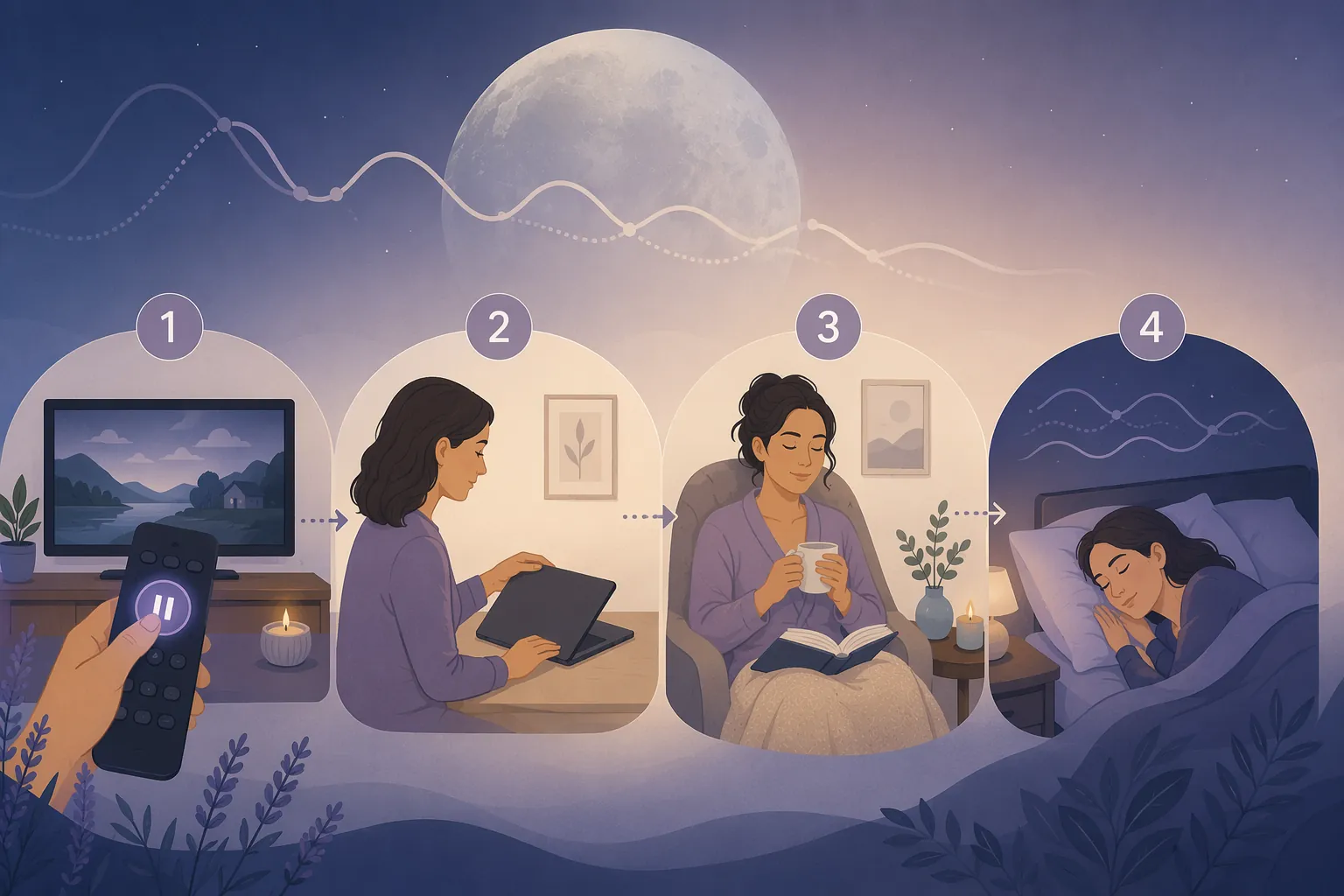
Going straight from a charged episode to lights-out asks the brain to drop from narrative chase to sleep on command. A decompression bridge gives it another state to pass through. It does not need to be elaborate or photogenic.
- Turn off autoplay before the first episode starts, not when willpower is already tired.
- Move the final 10 to 20 minutes away from the plot: wash your face, lower the lights, stretch gently, or sit somewhere other than the bed.
- Give the brain a boring landing strip: a familiar paper book, a quiet audio track, simple breathing, or a written list of tomorrow’s first tasks.
- If worry starts, write the concern down with the next possible action. Do not solve your life at 12:18 a.m.
Treat blue light as one contributor
Blue light is not fake. It can matter more when melatonin signaling is already less robust during perimenopause [3]. Use the simple fixes: dim the screen, turn on night shift settings, keep the device farther from your face, and lower room lights gradually. If you watch on a tablet in bed with the brightness turned up, the light exposure and the mental arousal are working together.
But blue-light blocking alone is unlikely to fix a cliffhanger brain. If the glasses are on and the show is still making your heart rate climb, the bigger problem is not the wavelength. It is the activation.
Use CBT-I principles when insomnia becomes patterned
Once insomnia becomes persistent, ordinary sleep hygiene often feels insulting because it is too mild for the loop you are in. Cognitive behavioral therapy for insomnia, or CBT-I, is designed for that loop. Stanford Lifestyle Medicine notes CBT-I as an effective treatment pathway for insomnia in perimenopause, and its logic fits this problem because it addresses conditioned arousal, unhelpful sleep thoughts, and the bed becoming a place where the brain practices being awake [1].
In practice, CBT-I may include keeping a consistent wake time, reserving bed for sleep and sex rather than hours of scrolling or streaming, getting out of bed briefly if you are awake and keyed up, and reducing the pressure to “try harder” to sleep. Those steps are more demanding than dimming a screen. They are also more appropriate when the problem has moved from a few late nights into a conditioned pattern.
Do not blame Netflix for every wake-up
A bedtime binge can worsen sleep, but it should not become the explanation for every disrupted night. Night sweats, anxiety, alcohol, medications, thyroid issues, pain, restless legs, and sleep apnea can all fragment sleep. Perimenopause can also increase sleep apnea risk; Stanford’s review notes that declining estrogen may weaken upper airway muscles, and snoring, gasping, or witnessed pauses in breathing should prompt evaluation for a sleep study rather than another round of self-blame [1].
This boundary matters. If you are waking with choking or gasping, if a partner notices breathing pauses, if daytime sleepiness is severe, or if insomnia persists despite reasonable changes, the next step is clinical help. A streaming routine can be redesigned. Sleep apnea needs diagnosis.
The last hour does not have to be perfect
Bedtime streaming is not uniquely sinful. It is pleasure, escape, company, and sometimes the only quiet adult space left in the day. The problem is that during perimenopause, the body may no longer absorb a high-arousal, late-night binge as easily as it once did.
So redesign the last hour instead of pretending you will never want another episode. Watch the gripping show earlier. Make the bedtime show less demanding. Stop before the cliffhanger. Put a small buffer between plot and pillow. If insomnia has hardened into a pattern, bring in CBT-I rather than another lecture about discipline. The point is not to remove comfort from the night. It is to stop asking a hormonally more fragile sleep system to fight a story that was built to keep you awake.
References
- How Perimenopause Affects Sleep – Stanford Lifestyle Medicine — Stanford Lifestyle Medicine
- A Transition of Seasons: Sleep Patterns and Changes in Perimenopause — Apple Women’s Health Study / Harvard Chan School, May 2026
- Perimenopause Insomnia: Why You're Waking Up Tired — GoodRx
- Binge Viewing, Sleep, and the Role of Pre-Sleep Arousal — Journal of Clinical Sleep Medicine, 2017
- New survey: 88% of US adults lose sleep due to binge-watching — American Academy of Sleep Medicine, 2019
Explore the mechanism
Next step
Spot an error or have clinical feedback?
Because this article covers clinical, medication, or safety information, we use a moderated correction channel instead of open public comments. Let us know if something about “Why Perimenopause Turns a Netflix Binge Into a Sleepless Night” needs a closer look.
Send feedback on this article