Why Cancer Disrupts Sleep in Older Adults
Sleep problems are common in older adults with cancer, but they are not simply side effects of aging or treatment. This article explains the distinct biological mechanisms behind cancer-related sleep disruption and why older patients require targeted, non-pharmacological first-line approaches.
When an older adult with cancer starts sleeping badly, the easy answer is usually too easy. It may be the cancer. It may be treatment. It may be pain, sweats, bathroom trips, opioids, anxiety, steroids, fatigue, or a sleep-wake schedule that has been pulled apart by appointments and daytime exhaustion. Aging matters too, but it usually acts more like an amplifier than a single explanation.
That distinction matters because “of course you’re not sleeping—you’re older and you have cancer” is not a diagnosis. It does not tell a patient why they are awake at 2 a.m. after radiation, why hot flashes started after hormone therapy, why pain medication makes sleep feel shallow, or why a caregiver now hears the same parent walking to the bathroom several times a night. Cancer and sleep disturbances often sit at the crossing point of several systems at once.
Sleep problems are common in cancer, but the age pattern is more complicated than people assume
A large systematic review and meta-analysis by Al Maqbali and colleagues pooled 160 studies involving 46,279 people with cancer and estimated that sleep disturbance affected 60.7% of cancer patients overall. The same paper placed sleep disturbance in the general population at about 32%, which gives the cancer number its proper weight: this is not a minor complaint hovering around ordinary sleeplessness rates.[1]
The age split is worth reading carefully. In that analysis, the highest reported prevalence was not in the oldest patients. It was 67% in the 40–49 age band, while patients over 70 had a reported prevalence of 48%.[1] That does not make sleep disruption unimportant in older adults. It means the honest claim is narrower and stronger: sleep disturbance is very common in older people with cancer, but older age alone does not explain who reports the most trouble.
There are several plausible reasons for that pattern. Younger patients may receive different treatment intensities, have different cancer types, or report symptoms differently. Older patients may underreport sleep problems, may attribute them to aging, or may be represented differently because of survivorship and study participation patterns. The available data do not support a neat ranking in which every added decade automatically means worse cancer-related sleep.
The persistence also matters. The same meta-analysis reported a peak prevalence of 70.8% in advanced cancer and found substantial sleep disturbance even years after diagnosis, with 40–51% of survivors reporting significant disruption 5–9 years after diagnosis.[1] For the older patient who finished treatment and is still sleeping poorly, that history is not a reason to shrug. Survivorship does not always return sleep to its old baseline.
The National Cancer Institute also describes sleep problems as common in people with cancer and notes that insomnia in people with cancer is much more frequent than in the general population.[2] So the practical starting point is not whether the problem is “real enough.” It is which part of the sleep system has been disrupted.
The same complaint can come from different broken sleep mechanisms
Two older adults can both say, “I can’t sleep,” and be describing different biological problems. One cannot fall asleep after daytime naps and late appointments have shifted the day’s rhythm. Another falls asleep quickly but wakes drenched from hormone-therapy sweats. Another wakes every time neuropathy flares. Another is sedated by opioids but gets little restorative sleep. These are not interchangeable problems, even when they all produce the same weary morning.
Inflammation can disturb the brain systems that regulate sleep
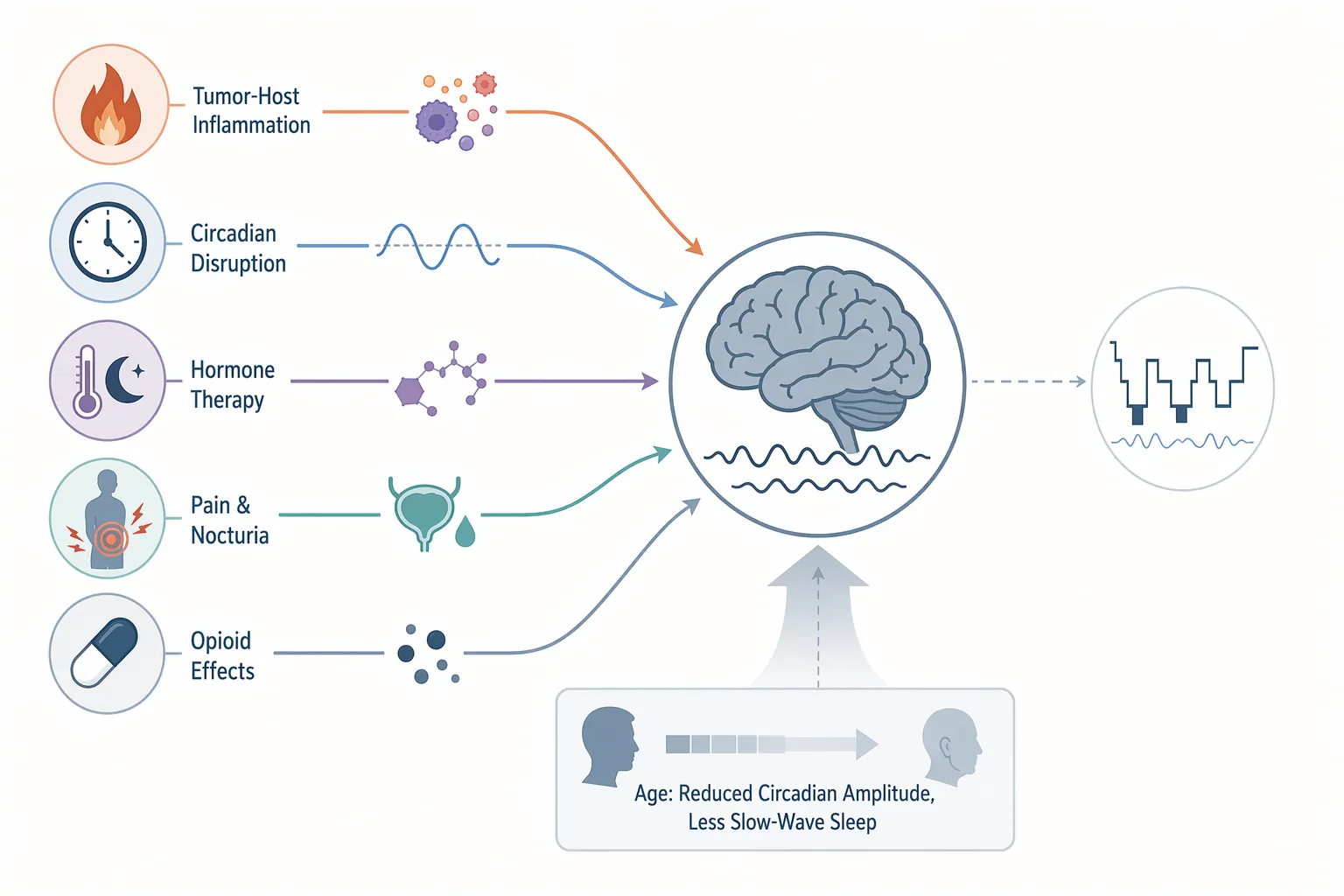
Cancer is not only a mass or a scan finding. It also involves communication between the tumor and the host immune system. Inflammatory signaling can affect sleep-regulating brain regions, including pathways involving cytokines such as IL-1, IL-6, and TNF-α, with effects on areas involved in sleep timing and regulation, including the preoptic area and the suprachiasmatic nucleus.[3]
This is one reason patients sometimes describe a strange mix of exhaustion and wakefulness. The body feels ill and depleted, but the sleep that follows is fragmented or unrefreshing. Inflammation does not simply press a “sleep” button. It can change sleep depth, timing, and continuity, and it often overlaps with pain, mood symptoms, appetite changes, and treatment effects.
In older adults, that disruption lands on a sleep system that is already less forgiving. With age, slow-wave sleep tends to be reduced, sleep continuity is more fragile, circadian signals may be weaker, and nighttime awakenings become easier to trigger. A younger patient may also have severe cancer-related insomnia, as the prevalence data show. But in an older patient, a smaller added stressor can be enough to break the night into pieces.
Treatment schedules and fatigue can flatten the day-night rhythm
Cancer treatment can disrupt sleep without acting directly like a stimulant. Chemotherapy, radiation, surgery, and related medications can change daytime activity, meal timing, light exposure, napping, pain levels, and appointment routines. The American Cancer Society lists treatment effects, pain, medications, anxiety, and changes in routine among contributors to sleep problems in people with cancer.[4]
Radiation is a common example. A patient may become profoundly fatigued, nap in the late afternoon, eat dinner later, move less, and then lie awake at night because the body has received mixed signals about when the active part of the day ended. Chemotherapy can add nausea, neuropathy pain, and cortisol or stress-system disruption. Surgery can add postoperative pain and anesthesia aftereffects. None of these has to be dramatic to matter; sleep is sensitive to repeated small timing changes.
Older adults are especially vulnerable to this kind of rhythm erosion because circadian amplitude often weakens with age. The sleep-wake system depends on contrast: light versus dark, activity versus rest, daytime alertness versus nighttime sleep pressure. Cancer care can blur that contrast. A day of waiting rooms, low movement, irregular meals, and unintended naps may look medically uneventful, but it can be a very poor setup for sleep.
Pain and nocturia break sleep after it has started
Some sleep disturbance is not about falling asleep at all. It is about staying asleep. Bone pain, surgical pain, neuropathy, positioning discomfort, constipation, urinary urgency, and nighttime bathroom trips can turn the night into a series of short sleep attempts. Nocturia is already more common with aging, and cancer treatment can make the timing and consequences of bathroom trips more disruptive.
This is where vague advice about “sleep hygiene” can become irritating. A patient who wakes because pain spikes when they roll over does not primarily have a pillow problem. A prostate cancer patient waking repeatedly to urinate is not simply failing to relax. A caregiver who hears these awakenings may notice the pattern before the patient says it clearly: sleep begins, then symptoms keep reopening the night.
Hormone therapy can add heat to an already fragile night
Hormone therapies used in breast and prostate cancer can affect sleep through hot flashes and night sweats. Estrogen-blocking therapy in breast cancer and androgen deprivation in prostate cancer are both associated with vasomotor symptoms that can wake a patient abruptly, soak clothing or bedding, and make it hard to return to sleep.[4]
The sleep consequence is not just the moment of heat. A sweat episode may require changing clothes, cooling the room, drinking water, using the bathroom, or sitting up until the body settles. In an older adult whose sleep pressure is already lighter in the second half of the night, one hot flash can become a long wake period.
Opioids may sedate without restoring normal sleep architecture
Pain treatment can improve sleep when it reduces the pain that keeps someone awake. But opioids can also change sleep itself. Mechanistic reviews describe opioid-related decreases in REM sleep and slow-wave sleep, along with increased risk of central apneas.[3] That helps explain a familiar complaint: “I took the pain medicine and slept, but I still woke up exhausted.”
Sedation and sleep are not the same thing. This distinction is especially important in older adults, who may already have less slow-wave sleep and may be taking several medications. A drug that makes someone drowsy can still leave sleep fragmented, shallow, or breathing-disrupted. That does not mean opioids are never appropriate in cancer care. It means opioid timing, dose, breathing symptoms, daytime sleepiness, and nighttime awakenings deserve specific attention rather than being filed under “normal tiredness.”
Aging makes the system easier to disrupt, but it should not take the blame by itself
Normal aging changes sleep. Older adults often have lighter sleep, less slow-wave sleep, more awakenings, earlier sleep and wake timing, weaker circadian signaling, and more nighttime urination. Those changes can make sleep less resilient. They do not make severe or new sleep disruption meaningless.
The difference is visible in the timeline. If an older adult “always napped a little” but becomes unable to sleep through the night after radiation, that change deserves more than an age-based explanation. If hot flashes began after hormone therapy, the timing matters. If sleep became shallow after opioid escalation, the medication history matters. If awakenings track pain, urinary symptoms, or steroids, the pattern matters.
A useful way to think about aging is as a reduction in reserve. The older sleep system may have less ability to absorb inflammation, pain, irregular daytime activity, or medication effects without visible consequences. That is different from saying the patient was destined to sleep badly. It also leaves room to intervene.
The cancer-sleep relationship may run both ways, but fear is not precision
Researchers often describe the relationship between cancer and sleep as bidirectional. Cancer-related inflammation, treatment effects, stress-system changes, and symptoms can disturb sleep. Poor sleep, in turn, can affect immune function, including natural killer cell activity and cytokine patterns that are biologically relevant to cancer.[3]
That does not mean a patient should be told that insomnia is worsening their cancer. Much of the human evidence is correlational, and biologic plausibility is not the same as proof of an individual patient’s disease course. The responsible message is less frightening and more useful: sleep is connected to immune and inflammatory systems, so persistent sleep disruption deserves care. It should not become another source of blame.
Prevalence numbers also vary because studies do not all measure the same thing in the same way. Some use tools such as the Pittsburgh Sleep Quality Index, others use the Insomnia Severity Index, and others use measures of daytime sleepiness such as the Epworth Sleepiness Scale. The 60.7% estimate is a serious anchor, not a universal constant that applies identically to every clinic, cancer type, treatment phase, or age group.[1]
What to bring up first with the care team
The next oncology or primary care visit should not have to wait for a crisis. A patient or caregiver can bring a short, concrete sleep history: when the problem started, whether it is trouble falling asleep or staying asleep, what time awakenings happen, whether sweats, pain, urination, breathing pauses, anxiety, nausea, or medication timing are involved, and how daytime naps or fatigue have changed.
The most useful first question is not “Can I have something to sleep?” It is “What seems to be waking me up or shifting my sleep?” That question points toward targeted help. If late naps are replacing nighttime sleep, the plan may focus on daytime light, activity, and fatigue pacing. If pain breaks sleep, analgesic timing or symptom control may need review. If nocturia dominates, urinary symptoms and evening fluids may need attention. If hormone therapy causes night sweats, the treatment team can discuss ways to manage vasomotor symptoms. If opioids are involved, the team may need to look at sleep quality, breathing risk, and the balance between pain relief and sleep architecture.
Medication safety deserves caution in this age group. The 2023 American Geriatrics Society Beers Criteria identifies many medications as potentially inappropriate for adults 65 and older, including several sedating drugs commonly used for sleep or anxiety in other settings.[5] That does not mean medication is never used. It means adding a sedative to a complex cancer regimen should not be the reflex response, especially when the actual driver may be pain, hot flashes, nocturia, circadian disruption, or opioid-related sleep changes.
For many older adults with cancer, first-line help should usually start with non-pharmacological approaches matched to the mechanism: stabilizing the sleep-wake schedule, protecting daytime light and movement when possible, reducing long or late naps, addressing symptom timing, adapting the bedroom for sweats or pain, and using behavioral insomnia care when insomnia has become conditioned. Those measures are not “wellness extras.” They are ways of treating the sleep system that cancer and treatment have disrupted.
The important thing is to stop treating sleep disturbance as an unavoidable background noise of aging with cancer. It is common, often persistent, and usually multifactorial. That makes it worth naming clearly, tracking carefully, and bringing back to the care team until the mechanism—not just the complaint—has been addressed.
References
- Prevalence of Sleep Disturbance in Patients With Cancer: A Systematic Review and Meta-Analysis. PubMed Central. 2022.
- Sleep Problems in People with Cancer. National Cancer Institute.
- Sleep disorders in cancer: interactions and intrinsic links. Frontiers in Oncology. 2025.
- What Causes Sleep Problems?. American Cancer Society.
- 2023 AGS Beers Criteria. Guideline Central. 2023.
Explore the mechanism
Next step
Spot an error or have clinical feedback?
Because this article covers clinical, medication, or safety information, we use a moderated correction channel instead of open public comments. Let us know if something about “Why Cancer Disrupts Sleep in Older Adults” needs a closer look.
Send feedback on this article