
How Extreme Heat Disrupts Sleep More in Older Women
Extreme heat and menopause create a compounding physiological vulnerability that disrupts sleep more severely for older women than for other groups. Learn how estrogen-driven thermoregulatory dysfunction and age-related heat dissipation decline combine to fragment sleep architecture, and why standard advice misses this double threat.
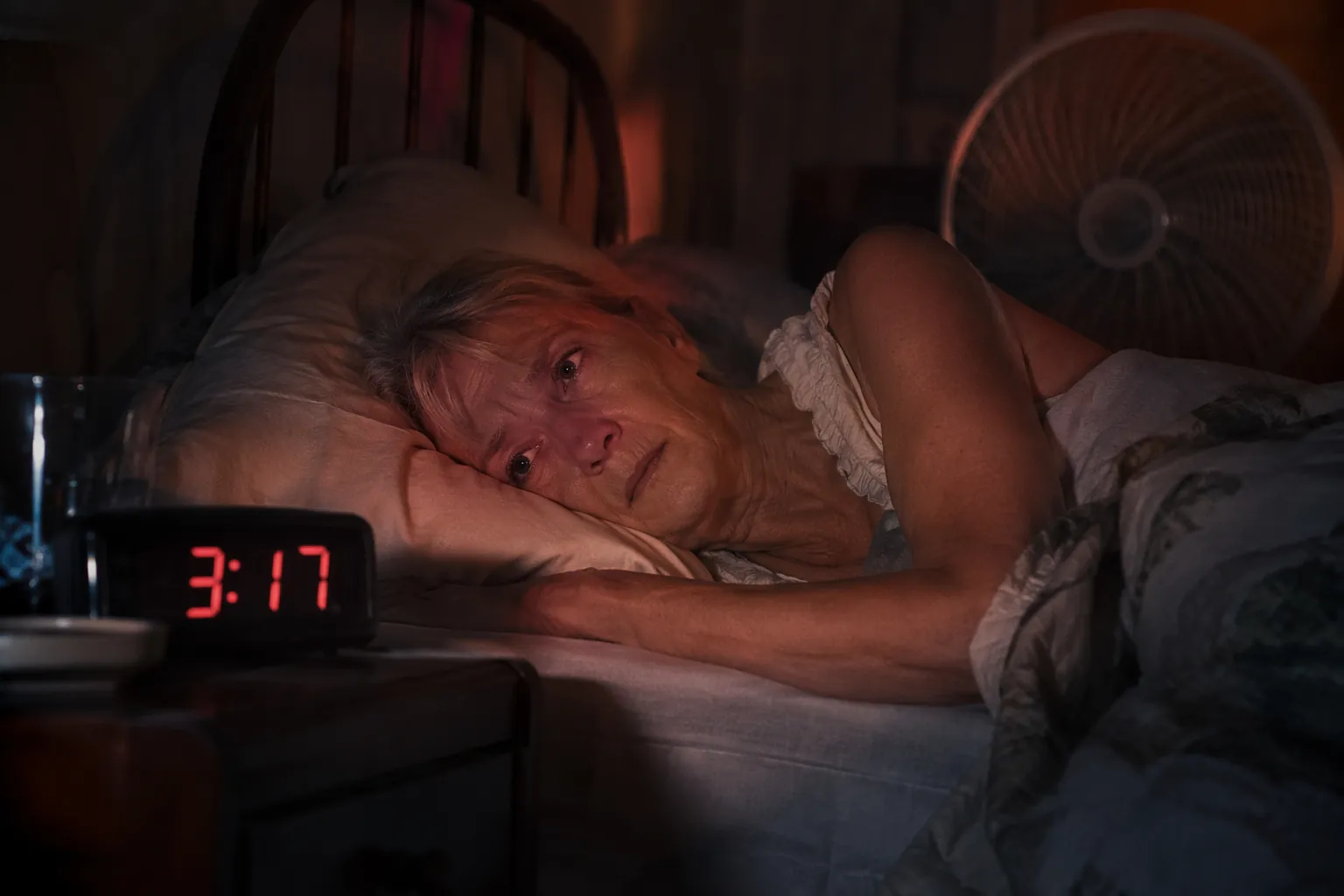
“Keep the bedroom cool” is thin advice when the problem is not only the room. For an older woman who has hot flashes or night sweats, extreme heat does not simply add discomfort to menopause sleep problems. It pushes on the same temperature-control system that is already easier to trigger, while aging can make it harder for the body to dump heat once the night has warmed up.
That overlap matters because the danger is not just a sweaty night or a shorter sleep window. It is repeated arousal, fragmented sleep architecture, reduced recovery time, and a body that may begin the next hot day with less physiological reserve. The phrase “extreme heat dangers and sleep disruption in older women” sounds broad, but the most important group to name clearly is narrower: older women with vasomotor symptoms, especially those living through hot nights without reliable cooling.
The overlap starts in the body’s heat-control system
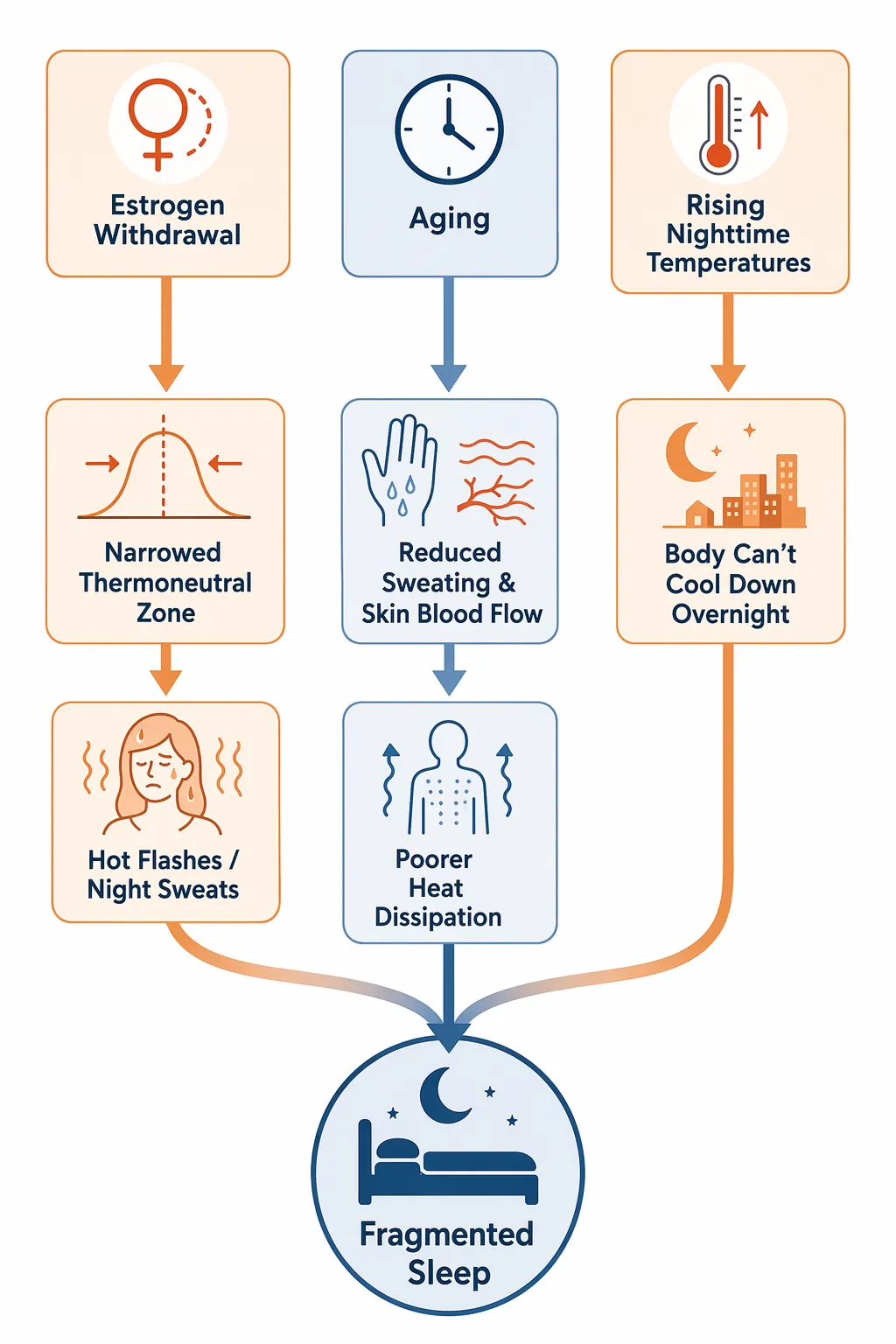
In menopause, the key mechanism is not poor willpower, poor sleep hygiene, or a failure to buy the right bedding. Estrogen withdrawal narrows the thermoneutral zone, the internal range in which the body can stay comfortable without launching strong cooling or warming responses. When that range narrows, smaller shifts in core or skin temperature can set off vasomotor symptoms: the sudden heat, sweating, and arousal that many women know as hot flashes or night sweats.
Those episodes are common enough to be treated casually, which is part of the problem. Hot flashes and night sweats affect up to 80% of menopausal women, and one sleep-focused analysis reported that 69.4% of hot flash episodes interfered with sleep.[1] Prevalence does not mean inevitability, and it certainly does not mean the same severity for every woman. It does mean that a large group is already trying to sleep with a thermoregulatory trigger point that can be set off by relatively small thermal changes.
Extreme heat then arrives not as a separate nuisance, but as a second pressure on the same system. A warm bedroom can raise the thermal load just when sleep normally depends on the body’s ability to cool. If a woman’s thermoneutral zone is already narrowed by vasomotor symptoms, the margin for error is smaller: a room that might be merely uncomfortable for someone else may be enough to trigger repeated night-sweat episodes, awakenings, and difficulty returning to sleep.
Why “older adult” is too blunt a category
Heat guidance often identifies older adults as vulnerable, then moves quickly to hydration, shade, cooling centers, and air conditioning. Those recommendations can be lifesaving. But “older adults” is a large category, and it can hide sex-specific physiology that becomes relevant before the oldest ages.
The Penn State H.E.A.T. study is useful here because it complicates the lazy assumption that heat vulnerability is mainly a problem of very old age. In a controlled chamber study of 72 healthy adults ages 40 to 92 performing light activity, researchers found that age and biological sex were the two strongest predictors of heat vulnerability, and that women ages 40 to 64 were physiologically as vulnerable to heat as men ages 65 and older.[2]
That finding does not prove that every midlife or older woman will sleep worse than every man during a heat wave. It also does not isolate menopausal sleep symptoms. Its value is more precise: it shows that sex and age can combine in measurable heat vulnerability, even among healthy adults, and that the female body’s heat response deserves more specific language than a generic “older adult” label.
Aging adds another layer because heat dissipation becomes less efficient. Sweating capacity and skin blood flow tend to decline with age, which can reduce the body’s ability to move heat from the core to the skin and release it. For a woman with night sweats, that is an awkward physiological trap: the body may be quicker to trigger a heat-loss episode, yet less efficient at cooling itself in a hot environment.
Hot nights remove the recovery window
Nighttime heat is not only daytime heat that lingers after sunset. Sleep depends on the body’s nightly cooling rhythm. When nighttime minimum temperatures stay high, the body loses a normal chance to unload heat, settle into deeper sleep, and recover before the next day’s exposure.
Large sleep datasets show why that cooling failure deserves attention. A 2025 Nature Communications study analyzed 23 million sleep records and found that each 10°C increase in daily mean temperature was associated with 9.67 fewer minutes of total sleep and a 20.1% increase in the odds of sleep insufficiency. Deep sleep declined by 2.82% per 10°C, the largest proportional loss of any sleep stage in the study.[3]
Deep sleep is not the only measure that matters, but its loss is clinically suggestive because it points to sleep quality, not just sleep duration. A person can spend a miserable eight hours in bed and still fail to get consolidated, restorative sleep. For women with vasomotor symptoms, repeated hot flashes or night sweats can create exactly that pattern: a night that looks long enough on the clock but is broken into pieces by thermal arousal.
The Nature Communications study used Chinese Huawei wearable users, so its estimates should not be casually pasted onto every U.S. bedroom. Still, the scale of the dataset and its sleep-stage findings help widen the point beyond subjective discomfort. Heat is associated with measurable changes in sleep duration, sleep insufficiency, and deep sleep, and those are the same domains that night sweats can disrupt.
Wearables and surveys point in the same direction
U.S. wearable data add a smaller but still relevant estimate. A 2025 USC/Keck study using 12 million nights of Fitbit data found that a 10°C increase in nighttime temperature was associated with 2.63 minutes of lost sleep among U.S. adults, with greater effects among females.[4] The average number may sound modest, but averages are good at smoothing out the person who is repeatedly waking drenched at 2 a.m., changing clothes, checking on a parent, or deciding whether it is worth turning on an expensive air conditioner.
An earlier UC San Diego analysis took a different route, using survey data from 765,000 respondents. It found that a 1°C anomalous nighttime temperature was associated with 3 additional nights of insufficient sleep per 100 people per month. The effect was twice as large for adults 65 and older and three times larger for people with incomes below $50,000.[5]
That study used self-reported sleep data from 2002 to 2011, so it cannot fully reflect current air-conditioning access, housing conditions, or more recent heat patterns. But its income finding remains important because adaptation is not evenly distributed. “Cool your bedroom” lands differently in a shaded single-family home, an upstairs apartment, a nursing home, and a bedroom where the electric bill is already being rationed.
| Pressure on sleep | What changes in the body or environment | Why it matters for older women with VMS |
|---|---|---|
| Estrogen withdrawal | The thermoneutral zone narrows | Smaller temperature shifts can trigger hot flashes or night sweats |
| Vasomotor symptoms | Heat, sweating, and arousal interrupt the night | Sleep can fragment even when time in bed looks adequate |
| Aging | Sweating capacity and skin blood flow decline | The body may dissipate heat less efficiently |
| Hotter nights | The normal cooling and recovery window shrinks | Thermal arousal becomes harder to escape |
| Low adaptive capacity | AC, housing quality, caregiving support, and utility costs vary | The person most affected may have the fewest practical options |
The double vulnerability is a synthesis, not a single definitive trial
The evidence does not yet include one perfect study that compares older women with active vasomotor symptoms during heat waves against older women without symptoms and younger adults under the same real-world conditions. That matters. The strongest claim is not that every older woman loses the same amount of sleep during extreme heat, or that menopause alone explains heat-related sleep loss.
The stronger, better-supported claim is that several lines of evidence converge. Menopause can destabilize thermoregulation through a narrowed thermoneutral zone. Vasomotor symptoms can fragment sleep. Aging can reduce heat dissipation through changes in sweating and skin blood flow. Hotter nights are associated with shorter and poorer sleep in large datasets. Together, these mechanisms make older women with hot flashes or night sweats a distinct heat-and-sleep risk group, even though the exact size of the combined effect still needs more direct study.
The distinction between women with and without vasomotor symptoms is essential. An older woman who does not have hot flashes or night sweats may still be vulnerable to heat because of age, medications, chronic illness, housing, or caregiving strain. But the estrogen-related thermoregulatory mechanism described here does not apply equally to everyone over 50. Naming VMS prevents both overgeneralization and dismissal.
Why standard advice runs out
Generic heat-safety advice is built around exposure: get cool, drink fluids, avoid exertion, use air conditioning when possible, check on vulnerable people. Menopause sleep advice is often built around symptom management: reduce triggers, adjust bedding, consider treatment options, protect a regular sleep routine. Both frames can be useful, but the older woman with night sweats during a heat wave is living in the overlap.
The overlap changes the practical meaning of the advice. A fan may help evaporation only if the room conditions allow the body to shed heat. Lightweight bedding may reduce insulation but cannot widen a narrowed thermoneutral zone. A cool shower may offer temporary relief but does not solve an upstairs room that never cools overnight. Air conditioning may be the most direct intervention, yet it is also the recommendation most constrained by cost, housing quality, outages, landlord decisions, and access.
This is where individual advice can become unfair. If guidance stops at “keep the bedroom cool,” the remedial work falls on the person who is already awake: the woman changing damp sleepwear, the caregiver checking whether an older parent is confused or overheated, the clinician trying to decide whether the complaint belongs in a menopause conversation, a heat-illness conversation, or both.
Heat risk is also a health-equity problem
The sleep problem sits inside a broader heat-risk landscape. The 2024 Lancet Countdown reported that heat-related deaths among people older than 65 reached the highest levels on record in 2023, 167% higher than in the 1990s.[6] That mortality context should not turn every bad night into a medical emergency, but it does show why older adults’ heat exposure cannot be treated as a minor comfort issue.
For older women with vasomotor symptoms, the inequity is specific. Low income can limit air-conditioning use. Poorly insulated housing can hold heat overnight. Women of color may be more likely to live in neighborhoods and housing shaped by longstanding environmental and infrastructure inequities. Caregiving can add another layer: the person losing sleep may also be responsible for monitoring someone else’s heat risk.
The clinical language should be specific enough to match that reality. A woman with hot flashes who sleeps badly during a heat wave is not simply failing at sleep hygiene. She may be experiencing a compounded physiological load: a narrower internal temperature comfort range, repeated vasomotor arousals, reduced age-related cooling capacity, and an environment that no longer cools reliably at night.
What better guidance would name
Better guidance would not need to abandon standard heat precautions or menopause care. It would connect them. Clinicians, caregivers, and public-health materials should ask whether an older woman has hot flashes or night sweats when discussing heat exposure and sleep. Menopause care should ask whether hot nights, lack of cooling, or fear of utility costs are worsening symptoms. Heat-safety messaging should recognize that sleep fragmentation can be part of heat vulnerability, not merely a comfort complaint after the serious risks have been addressed.
That shift would also make advice less patronizing. It would move from “try to keep cool” toward a more accurate explanation: during extreme heat, the body may have less room to regulate temperature, fewer ways to dissipate heat, and less overnight recovery. For older women with vasomotor symptoms, those forces can converge in the middle of the night, exactly when sleep is supposed to be repairing the day’s strain.
Older women with VMS should be understood as a distinct heat-and-sleep risk group, especially when low income, lack of air conditioning, caregiving demands, or racial inequities reduce adaptive options. Future guidance should name the compounded physiology directly instead of splitting it across separate advice silos for menopause on one side and heat exposure on the other.
References
- Sleep and menopause: a narrative review, PMC.
- Older women more vulnerable to heat than their male peers, researchers find, Penn State News, 2024.
- Climate warming may undermine sleep duration and quality, Nature Communications, 2025.
- Fitbit data shows rising nighttime temperatures reduce sleep, Keck School of Medicine of USC, 2025.
- Losing Sleep Over Climate Change, UC San Diego Today, 2017.
- The 2024 report of the Lancet Countdown on health and climate change, Lancet Countdown, 2024.
Explore the mechanism
Next step
Spot an error or have clinical feedback?
Because this article covers clinical, medication, or safety information, we use a moderated correction channel instead of open public comments. Let us know if something about “How Extreme Heat Disrupts Sleep More in Older Women” needs a closer look.
Send feedback on this article