
What the 2025 Research Says About Cannabis for Menopause Sleep
An evidence-tiered review of cannabis for menopause-related sleep disruption. Translates survey data, professional society stances, ongoing trials, and the biological rationale to help perimenopausal readers make an informed decision with their clinician.
By 2025, the honest answer on cannabis for menopause sleep is neither “it works” nor “there is nothing here.” Many midlife women who use cannabis say they use it for sleep, and many say it helps. But those reports come mainly from surveys, not from completed randomized controlled trials designed to test cannabis for menopause-related sleep disruption. The major menopause societies remain cautious, especially for vasomotor symptoms such as hot flashes and night sweats, because the evidence is still insufficient.
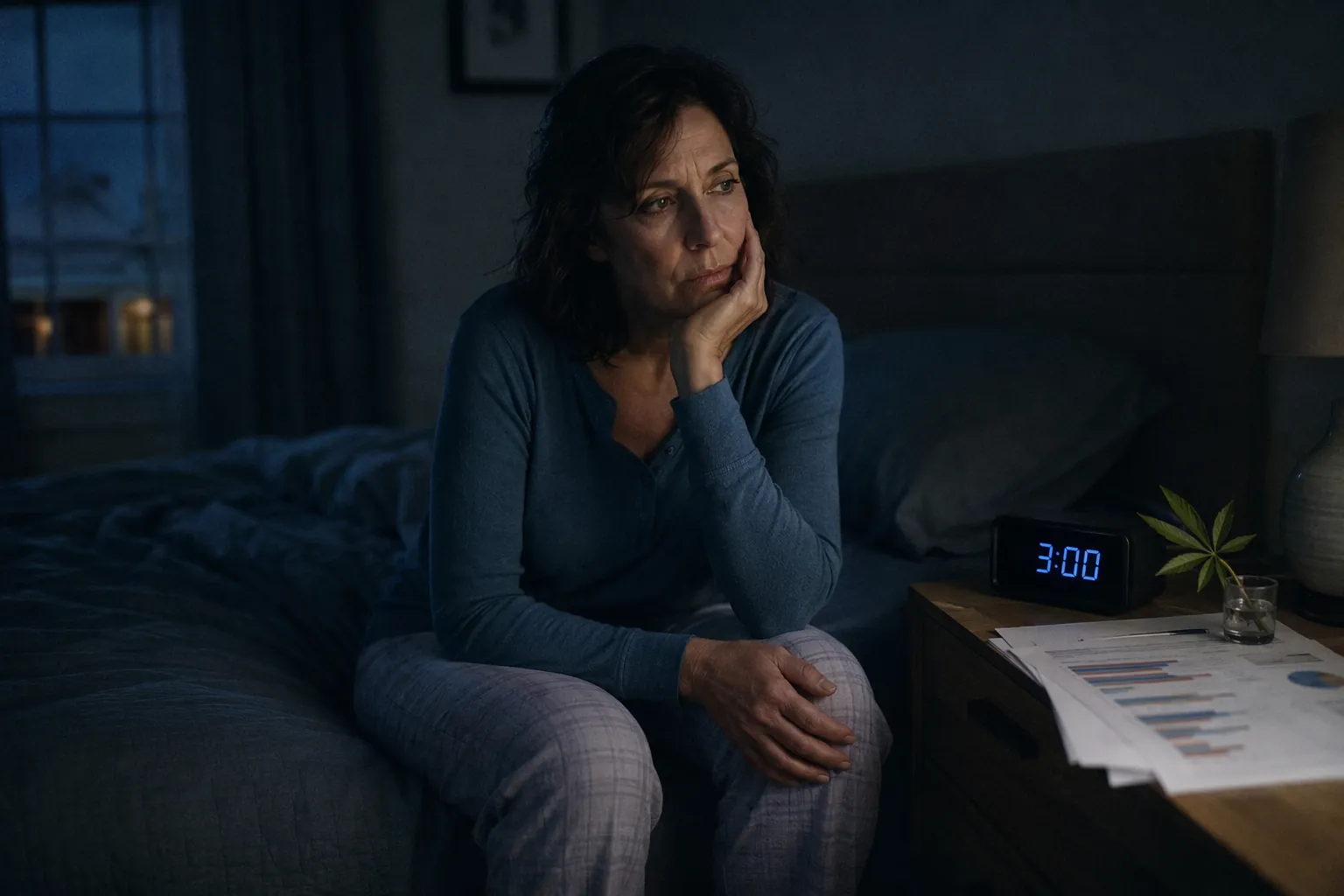
That distinction matters at 3 a.m. If night sweats are waking you, insomnia is stretching into months, and a friend says a gummy changed her life, “no evidence” is too blunt to be useful. But “women say it helps” is also not the same as clinical proof. The current research sits in the uncomfortable middle: promising self-reports, plausible biology, incomplete safety answers, and trials still in progress.
The short version of the evidence
Menopause-related sleep disruption is common enough that interest in cannabis should not be treated as fringe. In one 2024 PubMed-indexed abstract, 61% of menopausal women reported sleep difficulties, 44% met criteria for chronic insomnia, and vasomotor symptoms lasted a median of 7.4 years.[1] Those numbers do not prove cannabis helps. They do explain why people look beyond “sleep hygiene” when they have been awake, hot, and functional-on-paper for years.
The cannabis-specific findings are consistent but limited. In a 2022 survey of medical cannabis use during perimenopause and postmenopause, 67% of respondents who used cannabis said they used it for sleep improvement, and 86% of current users reported benefit.[2] In a 2023 cross-sectional survey of 1,485 women aged 35 and older, 65% reported cannabis use for sleep, 74% found it at least moderately helpful, and CBD/THC blends were the most commonly reported product type at 57.9%.[3]
Those are not trivial signals. They are also not efficacy trials. They do not randomly assign people to cannabis or placebo, standardize dose and formulation, verify menopausal symptom patterns objectively, or separate the person who sleeps better after THC from the person whose anxiety eases after CBD from the person whose hot flashes changed for unrelated reasons.
Professional guidance reflects that uncertainty. The Menopause Society’s 2023 nonhormone therapy position statement lists cannabinoids as “not recommended” for vasomotor symptoms, with Level II evidence.[4] That is an important guardrail, but it should be read precisely: the recommendation addresses hot flashes and night sweats, not cannabis for sleep as a standalone endpoint. The Society of Obstetricians and Gynaecologists of Canada has also stated there is no evidence to support cannabis for menopause symptoms, as summarized by Harvard Health.[5]
| Evidence type | What it can tell us | What it cannot tell us yet |
|---|---|---|
| Surveys of midlife cannabis users | Many users report using cannabis for sleep and finding it helpful | Whether cannabis outperforms placebo or which formulation works best |
| Professional society statements | Current clinical guardrails, especially for vasomotor symptoms | A definitive answer for sleep-only use |
| Mechanistic research | Why the endocannabinoid system is scientifically plausible in menopause sleep disruption | Whether a product improves real-world sleep outcomes |
| Ongoing clinical trials | What researchers are now testing under controlled conditions | Any result before data are published |
What the surveys actually show
The Dahlgren survey is useful because it asked the question many clinical trials have not yet answered: how are perimenopausal and postmenopausal people actually using medical cannabis? Sleep stood out. Two-thirds of cannabis users in the survey reported using it for sleep improvement, and a large majority of current users reported benefit.[2]
The Babyn survey points in the same direction with a larger sample. Among 1,485 women aged 35 and older, sleep was again one of the most common reasons for cannabis use, and nearly three-quarters of respondents who used it found it at least moderately helpful. The product detail is also clinically relevant: CBD/THC blends were more common than CBD-only or THC-only approaches.[3]

The temptation is to treat 74% or 86% as a near-answer. That is where the evidence needs slowing down, not dismissing. A survey can capture lived experience at scale. It can show that sleep is not a minor side use. It can show that women are making product choices in the absence of strong clinical guidance. But it cannot control for self-selection: people who had unpleasant effects, no benefit, anxiety, next-day grogginess, or medication concerns may have stopped using cannabis and may be less likely to appear as satisfied current users.
Both major surveys also had demographic limits, including predominantly white samples, which weakens generalizability.[2][3] That matters because menopause care, sleep burden, cannabis access, product quality, clinician counseling, and legal risk are not distributed evenly. A finding from a self-selected group of users should not be stretched into a universal menopause recommendation.
Why “not recommended” is not the same as “impossible”
The Menopause Society’s position is sometimes flattened into a simple anti-cannabis message. The actual clinical point is narrower and more useful: cannabinoids are not recommended for vasomotor symptoms because the evidence is insufficient.[4] If the main problem is hot flashes and night sweats, that guidance matters directly. If the main problem is insomnia without prominent vasomotor symptoms, the statement still signals caution, but it does not replace a sleep-specific trial.
A 2021 systematic review on cannabis use for vasomotor symptoms, mood, insomnia, and sexuality in menopause similarly underscored the evidence gap rather than establishing a clear therapeutic role.[6] The problem is not that researchers have proved cannabis fails for menopause sleep. The problem is that they have not yet produced the kind of controlled evidence needed to know who benefits, at what dose, with which cannabinoid profile, for how long, and at what tradeoff.
That is a different conversation from whether a reader’s experience is “real.” A person can truly feel that a product helps her fall asleep, and the field can still lack proof that the product reliably treats menopause-related sleep disruption better than placebo or other options.
The biology is plausible, but it is not a shortcut to proof
There is a real scientific reason cannabinoids keep appearing in menopause sleep discussions. Estrogen interacts with the endocannabinoid system, including FAAH, the enzyme that breaks down anandamide. As estrogen changes during the menopause transition, endocannabinoid signaling may also shift, including CB1-related tone in brain regions involved in sleep and temperature regulation.[7]
That mechanism gives researchers a reasonable hypothesis: if the menopause transition disrupts estrogen-linked endocannabinoid signaling, cannabinoids or cannabinoid-modulating compounds might affect sleep, mood, thermoregulation, or symptom perception. It is not a guarantee that an edible, oil, vape, or capsule improves menopausal insomnia in a predictable way.
Sleep physiology adds another reason formulation matters. THC can acutely make some people sleepy, but acute sedation is not the same as durable sleep improvement. Cannabis sleep literature has raised concerns about tolerance, REM suppression, and withdrawal-related insomnia after regular THC use. CBD is often discussed differently, including possible indirect effects through anxiety reduction and FAAH inhibition, but CBD effects appear dose-dependent and should not be assumed from a label alone.[8]
This is why broad shopping advice can be misleading. “Cannabis for sleep” is not one intervention. A low-THC CBG-dominant formulation, a THC edible, a CBD isolate oil, and a mixed CBD/THC product can have different effects, different impairment risks, and different interaction concerns.
The trials to watch are not results yet
The most important change in the 2025 research landscape is not a published efficacy result; it is the move toward controlled testing. Washington State University announced a Phase 2 randomized, double-blind, placebo-controlled trial of a hemp-derived, non-intoxicating cannabinoid formulation for menopause symptoms. The formulation is described as CBG-dominant and low in THC, with about 100 participants planned; WSU reported that results were expected in late 2026.[9]
That design is the kind of evidence the field has been missing. Randomization helps separate product effect from expectation. A placebo comparison matters in sleep research because insomnia symptoms are highly responsive to context, hope, nightly variation, and measurement method. A defined formulation matters because “cannabis” otherwise hides too many variables.
Western Sydney University has also been identified as studying medicinal cannabis for menopause-related sleep, but the available details are limited in the research materials reviewed here. Until results are published and peer-reviewed, these studies should be treated as active questions, not as evidence that cannabis works.
How to interpret the gap if you are deciding now
The practical decision is harder than the headline. A reader does not live inside an evidence hierarchy; she lives inside the next workday after another broken night. Still, the hierarchy helps separate what can be said from what is being marketed.
- If the claim is “many women use cannabis for menopause sleep and report benefit,” the 2022 and 2023 surveys support that.
- If the claim is “cannabis is proven to treat menopause-related insomnia,” the current evidence does not support that.
- If the claim is “professional societies recommend cannabinoids for hot flashes or night sweats,” that is inaccurate; current guidance does not recommend them for vasomotor symptoms.
- If the claim is “the biology makes the question worth studying,” that is reasonable.
- If the claim is “new trials may clarify the answer,” that is true, but results are still pending.
A clinician-facing conversation should be more specific than “Should I try cannabis?” The relevant questions are: What symptom are you trying to treat — sleep onset, 3 a.m. waking, night sweats, anxiety, pain, or all of these at once? What product type are you considering? Does it contain THC? How often would you use it? What would count as success? What would make you stop?
Medication review belongs in that conversation, not as fine print. CBD can affect cytochrome P450 pathways — the same broad interaction issue often compared with grapefruit — and may alter levels of some common midlife medications, including certain blood pressure drugs, SSRIs, and cholesterol medications.[8] THC-containing products add impairment concerns, next-day effects for some users, and safety issues around driving, alcohol, sedatives, and fall risk.
The current judgment is therefore narrow but clear: cannabis for menopause sleep is reasonable to discuss with a clinician, especially if symptoms are severe and other options have failed or are unsuitable. It is not proven for menopause-related sleep disruption. It is not recommended by major menopause guidance for vasomotor symptoms on current evidence. And it is not something to combine casually with midlife medications while assuming “natural” means low-risk.
References
- Perimenopausal sleep patterns, PubMed, 2024.
- A survey of medical cannabis use during perimenopause and postmenopause, PubMed.
- Cannabis use for menopause in women aged 35 and over: a cross-sectional survey, PMC, 2023.
- The 2023 nonhormone therapy position statement of The North American Menopause Society, PubMed, 2023.
- Are women turning to cannabis for menopause symptom relief?, Harvard Health Blog, 2022-10-24.
- Systematic review of cannabis use on vasomotor symptoms, mood, insomnia and sexuality, PubMed, 2021.
- Cannabis, Menopause & the Endocannabinoid System, Project CBD.
- CBD for Menopause, Midi Health.
- New research investigates hemp-derived cannabinoids for relief from menopause, WSU News, 2025-02-25.
Safety & eligibility read
Cross-check against other interventionsExplore the mechanism
Next step
Spot an error or have clinical feedback?
Because this article covers clinical, medication, or safety information, we use a moderated correction channel instead of open public comments. Let us know if something about “What the 2025 Research Says About Cannabis for Menopause Sleep” needs a closer look.
Send feedback on this article