
Sleep tips for 108°F weather and menopause hot flashes
When extreme heat collides with menopause hot flashes, generic cool-sleep advice is dangerously insufficient. This article delivers a layered, evidence-backed micro-climate strategy to help you sleep through 108°F nights — from cooling mattress pads and pre-bed showers to low-cost alternatives for homes without air conditioning.
At 108°F, the usual menopause sleep tips start to sound insulting. A fan pushes warm air around. A light sheet still traps sweat. Cotton feels virtuous for about 20 minutes, then damp. When a hot flash starts in a room that never cooled down after sunset, your body is trying to dump heat into an environment that has nowhere useful for that heat to go.
That is why the plan has to change. The job is not simply to “sleep cooler.” It is to build a small, survivable sleep micro-climate around your body: a place where heat can move away from your skin, sweat can evaporate or be wicked away, and the bed does not keep handing heat back to you.
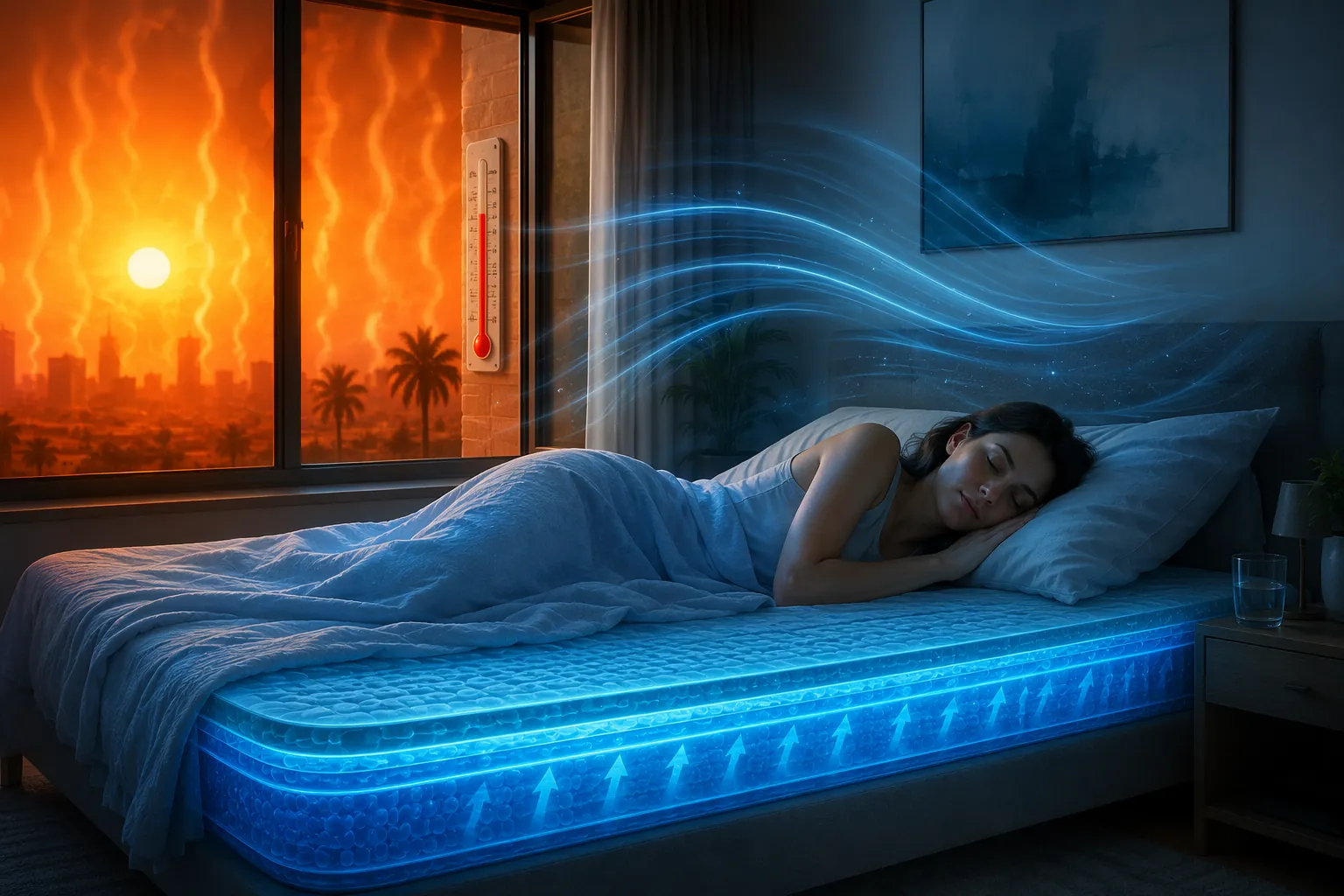
Why 108°F Makes Hot Flashes Harder to Escape
A hot flash is not just feeling warm. In symptomatic postmenopausal women, researchers have described a sharply narrowed thermoregulatory “null zone” — the range in which the body does not need to trigger sweating or shivering — with one study reporting a null zone of 0.0°C in women with hot flashes compared with a wider zone in women without them.[1] In plain English: the body has less room for error.
Extreme heat takes away the escape route. During a flash, blood flow to the skin increases and sweating begins because the body is trying to shed heat. That only works well if the air, bedding, mattress surface, or clothing around you can accept that heat and moisture. When the room is still hot at midnight, the mattress is warm, and sweat cannot dry, the flash can feel as if it keeps restarting.
Large sleep data make the stakes less personal and more concrete. A Nature Communications study using 23 million sleep records found that for each 10°C, or 18°F, increase in ambient temperature, the odds of sleep insufficiency rose by 20.1%, while deep sleep declined by 2.82%; women over 45 were among the groups most affected.[2] That does not prove that every hot night causes a specific person’s insomnia, but it does explain why common-sense fixes can collapse during a heat wave.

Start With the Room, but Do Not Stop There
If you have air conditioning, use it as the first layer, not as a moral test of toughness. The often-cited cool bedroom range for sleep is far below a 108°F heat-wave room, but the immediate goal tonight is simpler: create any meaningful temperature difference between your body and the air or surface touching it. Even a partial drop matters if it lets sweat evaporate and keeps the mattress from becoming a heat sink.
If the room is hotter than the hallway, a lower floor, or another part of the home, move. Menopause sleep advice often assumes a bedroom is the fixed location. In extreme heat, the sleeping location is negotiable. A mattress on a cooler floor, a sofa in the lowest room, or a temporary sleeping spot closer to a working window unit can be more effective than making a hot bedroom prettier.
- Close blinds or curtains before the room heats up, especially on sun-facing windows.
- Open windows only when outdoor air is cooler than indoor air; otherwise you may be importing heat.
- Use cross-ventilation when possible: one opening for intake, another for exhaust.
- Put the fan where it moves cooler air toward the sleep area or pushes hotter air out, rather than aiming warm air at your face all night.
- Unplug or move heat-producing electronics away from the bed.
A fan is still useful. It is just not enough by itself when the air is very hot and humid. Its best job is to help evaporation and air exchange; if sweat is trapped in bedding or the room air is stagnant and hot, the fan cannot finish the job.
The Bed Surface Is the Main Cooling Layer
The bed is where many hot-flash plans fail. You can cool the room somewhat and still lie on a warm mattress that stores body heat under your back, hips, and chest. For menopause night sweats, the surface touching the body matters because it controls the skin-to-bed temperature gradient. If that surface actively pulls heat away, the hot flash has somewhere to go.
Cooling mattress pads and water-based bed systems are useful for this reason. They are not magic menopause treatments; they are heat-transfer tools. A pad circulating cooled water can keep the sleep surface below skin temperature for hours, which a regular sheet cannot do after it has warmed up under you.
The best concrete evidence here comes from a Wake Forest pilot study of a cooling mattress pad in women with vasomotor symptoms. Participants using the pad had a 30% improvement in sleep scores, up to a 50% reduction in hot flash severity, and reported decreases in hot flash severity, hot flash frequency, and night-sweat frequency; specifically, 57% reported decreased severity, 60% reported decreased frequency, and 64% reported decreased frequency of night sweats.[3] It was a pilot study, so it should not be treated as final proof for every device or every sleeper. It is still far more relevant than another reminder to buy breathable sheets.
Newer smart-bed systems are starting to make similar claims. Eight Sleep reported a 57% reduction in hot flashes over one week compared with not using its system, according to a 2026 news report.[4] That is interesting, especially because it points in the same direction as the mechanism: active bed-level cooling may matter. But the figure should be read as manufacturer-linked, news-reported data unless and until a peer-reviewed publication is available.
| Bed layer | What it does | When it helps most |
|---|---|---|
| Water-based cooling pad or active cooling mattress system | Creates a sustained cool surface under the body | Repeated night sweats, hot mattress, room that only partly cools |
| Cooling gel or passive topper | May feel cool briefly, then can warm up | Milder heat or as a backup, not the main plan at 108°F |
| Moisture-wicking sheet or sleepwear | Moves sweat away from skin so it dries faster | Clammy wake-ups, sweat-triggered discomfort, shared bed |
| Light blanket kept easy to remove | Prevents chill after sweat without trapping heat at flash onset | Alternating hot flashes and post-sweat chills |
If you are shopping, prioritize adjustable temperature, washable or protected layers, noise level, return policy, and whether the system can cool your side only. A shared bed does not require shared suffering. The point is not to make the whole room cold enough for everyone; it is to cool the person whose body is misfiring at 2 a.m.
If You Do Not Have AC or a Cooling Pad
A serious heat plan cannot assume central air, a spare room, and a $1,000 bed device. If your choices are a fan, a window, a bathroom, and whatever fabric is clean, the target is still the same: reduce heat load, increase evaporation, and keep sweat from sitting on the skin.
- Sleep lower. Heat rises, so a lower floor or even a temporary floor setup may be cooler than a lofted or upstairs bed.
- Create a directed air path. Use one fan to pull cooler night air in or push hot indoor air out, depending on which side is cooler.
- Use a damp towel strategically. Place it near, not over, large parts of your body if covering yourself makes you feel trapped; the goal is evaporation, not a wet blanket.
- Cool the pulse points briefly. A cool cloth at the neck, chest, wrists, or behind the knees can reduce skin heat during the first surge of a flash.
- Keep a dry change layer nearby. A fresh top or pillowcase at 3 a.m. is not indulgent; it prevents damp fabric from holding heat against the skin.
Public health and clinical sleep guidance for hot weather without air conditioning commonly emphasizes reducing daytime heat gain, using ventilation when outdoor temperatures drop, moving to cooler parts of the home, and using fans safely as part of a broader cooling strategy.[5] For hot flashes, those steps need one extra emphasis: do not let the bed become the warmest object in the room. Rotate pillows, use the thinnest workable sleep surface, and avoid foam-heavy layers that hold heat if they are making symptoms worse.
Fabric is not a cure, but it can remove one irritant. Cotton absorbs moisture and can stay wet. Many people do better with lightweight moisture-wicking sleepwear or sheets made from fibers marketed as bamboo, Tencel, eucalyptus-derived lyocell, or athletic wicking blends. The useful feature is not the label; it is whether the fabric pulls sweat away from your skin and dries quickly enough that you do not wake up chilled, sticky, and then hot again.
Use Water Before Bed Without Overcooling Yourself
A cold shower sounds logical during a heat wave, but it can backfire for some people by making the body defend its temperature. A lukewarm shower is the better first try. Clinical guidance from Concierge Medicine of Westlake recommends a 15-minute lukewarm shower about 90 minutes before bed, describing evaporative cooling that can lower core body temperature for up to one hour.[6] Treat that as practical clinical guidance, not as a controlled-trial protocol.
The timing matters. Showering and immediately climbing into bed while still damp can soak sheets and turn the bed clammy. Shower, towel off lightly, let the skin finish drying in moving air, then get into the coolest sleep setup you can create. If you tend to wake drenched, keep a second small towel within reach so you can dry the chest, neck, and back without fully waking yourself up.
Hydration helps, but chugging a large glass right before bed may simply trade hot-flash wake-ups for bathroom wake-ups. Drink steadily earlier in the evening, and if you are sweating heavily, consider whether you need electrolytes rather than plain water alone. Anyone with heart, kidney, blood-pressure, or fluid-restriction concerns should follow their clinician’s guidance on fluids and electrolytes.
When a Hot Flash Starts Anyway
Even a good setup will not prevent every flash. The rescue plan should be boring, reachable, and repeatable, because complicated advice evaporates at 3 a.m.
- Remove the top layer first, even if you think you will feel chilled later.
- Expose the chest, neck, or legs to moving air so sweat can evaporate.
- Use a cool cloth on the neck or upper chest for a few minutes.
- Shift to a cooler section of the mattress or rotate the pillow.
- Change only the wettest layer if damp fabric is keeping you awake.
This is where paced respiration belongs: not as a substitute for cooling a dangerous room, but as a nervous-system tool once you have opened a path for heat to leave. Slow abdominal breathing at 5 to 7 breaths per minute reduced objectively measured hot flash frequency by about 50% in Freedman’s research.[7] That does not mean breathing can overcome a 108°F bedroom. It means that once you are no longer sealed inside heat and wet fabric, slow breathing may help reduce the next surge.
Triggers Still Matter, Just Not More Than the Heat
Alcohol, caffeine, spicy foods, and late strenuous exercise can worsen hot flashes for some people, and menopause clinicians commonly advise watching those patterns during summer heat.[8] On a 108°F night, though, trigger management is a supporting layer. Skipping wine will not make a hot apartment safe or turn a heat-soaked mattress into a cooling surface.
For tonight, make the changes that have the shortest path to sleep: avoid alcohol close to bed, move hard workouts earlier, keep dinner lighter if spicy food reliably sets you off, and stop caffeine early enough that it is not adding alertness to overheating. Then put your main effort back where it belongs: room heat, bed heat, sweat, and rescue cooling.
A Practical Hierarchy for a 108°F Night
If you can only do a few things, do them in this order. First, reduce the room’s heat load: block sun during the day, ventilate only when outdoor air is cooler, move to the lowest or coolest available sleeping location, and use fans to exchange air rather than stir heat. Second, cool the bed surface: an active cooling pad or water-based system is the strongest environmental tool if you have access to one. Third, manage moisture: wicking fabric, dry backup layers, and quick towel changes prevent sweat from becoming another heat trap. Fourth, use pre-bed lukewarm water and paced breathing as support, not as the whole plan.
Persistent, severe, or newly changing night sweats deserve medical follow-up, especially if they come with unexplained weight loss, fever, chest symptoms, heavy bleeding, or symptoms that do not fit your usual menopause pattern. But the immediate sleep answer during extreme heat is not another lecture about being relaxed. At this temperature, a fan and lighter bedding are not a plan. You need a layered micro-climate that actively moves heat and moisture away from your body.
References
- Reduced thermoregulatory null zone in postmenopausal women with hot flashes — American Journal of Obstetrics and Gynecology, 1999
- Climate warming may undermine sleep duration and quality... — Nature Communications
- Results of a pilot study of a cooling mattress pad to reduce vasomotor symptoms and improve sleep — PubMed, 2022
- Hot flashes? New tech for your bed tackles menopause pest — New York Post, 2026
- Tips for sleeping in hot weather without AC — HealthPartners
- Night Sweats & Menopause Relief for Summer — Concierge Medicine of Westlake
- Menopausal hot flashes: mechanisms, endocrinology, treatment — PMC
- Managing menopause hot flashes in the summer — Ohio State Wexner Medical Center
Safety & eligibility read
Cross-check against other interventionsExplore the mechanism
Next step
Spot an error or have clinical feedback?
Because this article covers clinical, medication, or safety information, we use a moderated correction channel instead of open public comments. Let us know if something about “Sleep tips for 108°F weather and menopause hot flashes” needs a closer look.
Send feedback on this article