
Which painkiller is safest for perimenopause pain and sleep?
A traffic-light guide to choosing a painkiller for perimenopause pain that won’t worsen your insomnia, based on a key sleep-lab study and expert recommendations.
At 11 p.m., the best painkiller for perimenopause pain is usually not the strongest one on the shelf. It is the one least likely to trade one problem for another: less joint pain now, more awakenings later.
For many people, the practical bedtime answer looks like this: acetaminophen first if it is safe for you; topical options such as diclofenac gel or lidocaine patches when the pain is localized; oral NSAIDs such as ibuprofen, aspirin, or naproxen used more cautiously and preferably earlier in the day rather than as the default near-bedtime choice.

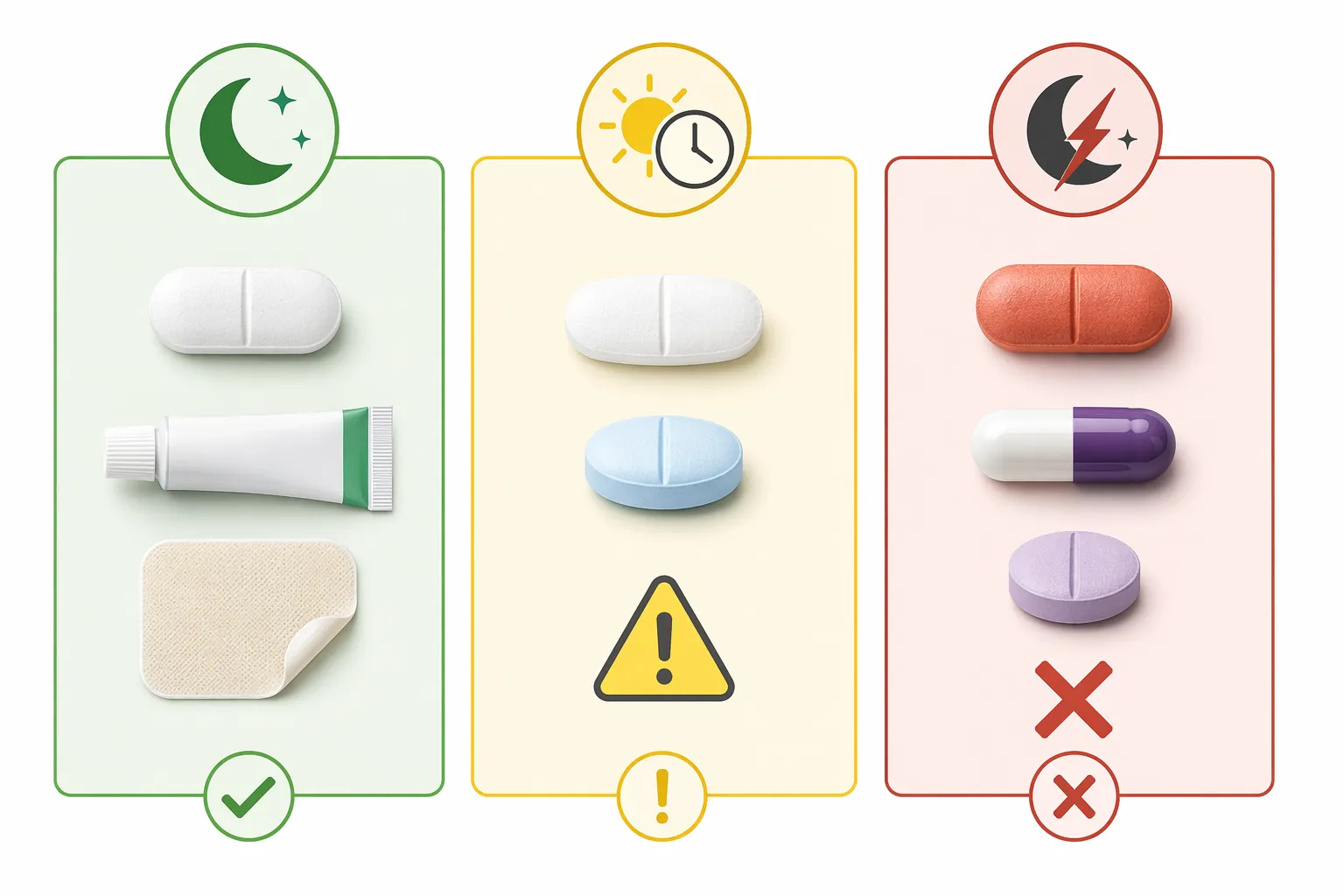
The Bedtime Traffic Light
| Choice | Best fit at night | Why it belongs there |
|---|---|---|
| Green: acetaminophen | Often the first OTC option to consider for bedtime pain, if you can take it safely | In a sleep-lab trial, acetaminophen did not differ from placebo on sleep measures, while aspirin and ibuprofen worsened awakenings and sleep efficiency.[1] |
| Green: topical diclofenac gel or other topical NSAID | Localized joint or muscle pain, especially when you want lower whole-body exposure | A rheumatologist quoted by Mass General Brigham describes topical diclofenac as having minimal systemic absorption compared with oral NSAIDs.[4] |
| Green: topical lidocaine patches | Localized surface-level pain, tender spots, or pain that is easy to cover with a patch | It can be useful when the goal is local relief without adding an oral pain medicine at bedtime. |
| Yellow: low-dose, short-course oral NSAIDs | Occasional use earlier in the day, with food, when inflammation is the clear driver | They may still be reasonable for some people, but the sleep-fragmentation signal matters when insomnia is already part of the problem.[1] |
| Red: high-dose NSAIDs near bedtime | Avoid as a routine night strategy unless your clinician has specifically advised it | Higher-dose or repeated nighttime use raises the chance that pain relief comes with more disrupted sleep continuity. |
| Red: opioids and PM combination products | Not a casual bedtime workaround | PM products often rely on diphenhydramine; NIH information cited by WebMD describes its sleep-aid efficacy as not well established.[5] |
That table is not a moral ranking. It is a sleep-protection ranking. If your pain is severe, new, one-sided with swelling, linked to injury, or accompanied by neurologic symptoms, the problem has already moved beyond drugstore sorting.
Why Oral NSAIDs Are the Bedtime Problem
The most relevant study for this exact question is older, but unusually direct. In a 1994 randomized sleep-lab study of 37 healthy adults, researchers used polysomnography to compare aspirin, ibuprofen, acetaminophen, and placebo. Aspirin and ibuprofen increased nighttime awakenings and reduced sleep efficiency. Acetaminophen showed no significant difference from placebo on any sleep measure.[1]
The study did not enroll perimenopausal women specifically. That matters. It means the result should not be dressed up as a menopause trial. But the finding is still hard to ignore because it measured the thing the reader cares about: not whether the medication reduced pain, but whether sleep stayed intact.
NSAIDs work partly by inhibiting prostaglandins. That can reduce inflammatory pain, but prostaglandin signaling is also involved in sleep regulation. In someone whose nights are already fragmented by hot flashes, anxiety surges, bathroom trips, or 3 a.m. waking, adding a medication with evidence of increasing awakenings is not a small detail.
This is where casual advice gets sloppy. “Take an ibuprofen before bed” may sound harmless if the only goal is less pain. For a perimenopausal woman who is already protecting a fragile night, the better question is whether the painkiller helps her stay asleep after the pain quiets down.
This Pain Is Common, Even When It Gets Brushed Off
Joint and muscle pain in perimenopause is not a niche complaint. Flo Health reports that more than 50% of perimenopausal women have joint pain, and Midi Health cites a 2020 meta-analysis of 16 studies reporting musculoskeletal pain in 71% of women during the menopause transition.[2][3]
Those numbers do not prove that hormones cause every sore hip, stiff hand, or aching shoulder. They do explain why so many women arrive at bedtime with pain that feels too ordinary to call the doctor about and too disruptive to ignore.
The trap is that perimenopause often attacks sleep from more than one direction. Pain makes it harder to fall asleep. Night waking makes pain feel louder the next day. Poor sleep can also lower patience for the careful medication decisions that would protect the next night. If you need the fuller sleep-side explanation, a guide to perimenopause and sleep disruption is the better place to unpack the full loop; here, the medication decision is the point.
Green: Acetaminophen When Bedtime Sleep Matters
Acetaminophen is the cleanest OTC fit when the main job is pain relief without adding a known sleep-fragmentation signal. In the Murphy sleep-lab study, it did not significantly change sleep compared with placebo.[1]
That does not make acetaminophen risk-free or universally appropriate. It is not an anti-inflammatory drug, so it may be less satisfying for pain that is clearly driven by inflammation. It also needs careful dose limits, especially for anyone with liver disease, heavy alcohol use, or other medications that already contain acetaminophen.
But for the very specific question of a bedtime painkiller that is less likely to worsen insomnia, acetaminophen deserves to be considered before oral ibuprofen, aspirin, or naproxen.
Green: Topical Options for Local Pain
If the pain has an address — one knee, one thumb joint, one shoulder area — a topical option may be more sensible than swallowing a whole-body medication at night.
Topical diclofenac, sold over the counter as Voltaren Arthritis Pain Gel in the U.S., is still an NSAID, but it is applied to the skin rather than taken by mouth. Mass General Brigham quotes rheumatologist Candace Feldman, MD, MPH, ScD, explaining that topical diclofenac has minimal systemic absorption, which is why it can be a useful option for localized arthritis-type pain.[4]
The important caveat is that no direct sleep-lab study in perimenopausal women has compared topical NSAIDs with oral NSAIDs for nighttime awakenings. The reason topical diclofenac sits in the green lane is not because it has proven menopause-specific sleep benefits. It sits there because lower systemic exposure is a reasonable advantage when the pain is local and the night is already vulnerable.
Topical lidocaine patches are another local option. They do not treat inflammation, but they can quiet a defined area of pain for some people. They are most logical when the discomfort is superficial or localized enough that a patch actually covers the problem.
Yellow: Oral NSAIDs, but Earlier and Narrower
Ibuprofen, aspirin, and naproxen are not banned from midlife. They can be useful, especially for inflammatory pain. The yellow-light point is about timing and habit: they are a worse default near bedtime for someone trying not to worsen insomnia.
- Use the lowest effective dose for the shortest reasonable time.
- Take them earlier in the day when possible instead of right before sleep.
- Take them with food to reduce stomach irritation.
- Avoid stacking multiple NSAIDs unless a clinician has explicitly told you to.
- Be more cautious if you have kidney disease, ulcers, reflux, high blood pressure, cardiovascular disease, are on blood thinners, or have been told to avoid NSAIDs.
The practical distinction is not “NSAIDs are bad.” It is that an NSAID taken after dinner for a short flare is a different decision from using high-dose ibuprofen at bedtime every night and wondering why sleep still feels shredded.
Red: The Bedtime Shortcuts That Deserve More Caution
High-dose NSAIDs near bedtime are the first red-light pattern, especially when they become routine. The issue is not only side effects in the broad medical sense. It is the specific chance that the medication reduces pain while still breaking up the night.
Opioids do not belong in a casual OTC-style bedtime decision. They may be prescribed for specific situations, but they bring risks that are out of proportion to ordinary perimenopause aches and need clinician supervision.
PM combination products deserve their own warning because they look tidy: one pill for pain, one ingredient for sleep. Many rely on diphenhydramine, the sedating antihistamine in products such as Advil PM or Tylenol PM. NIH information cited by WebMD states that diphenhydramine’s effectiveness as a sleep aid is “not well established.”[5]
Sedation is not the same as restored sleep. A product can make you feel knocked out and still leave you groggy, dry-mouthed, constipated, or less clear the next morning. For a woman already dealing with night waking, the promise of a simple PM label should not outrank how she actually functions the next day.
When This Is Bigger Than an OTC Choice
If the pattern is moderate-to-severe pain plus broken sleep plus hot flashes, the next conversation may not be about choosing between acetaminophen and ibuprofen. It may be about whether the whole symptom cluster needs clinician-level treatment.
Gabapentin is one option clinicians may discuss. Mayo Clinic lists gabapentin as a nonhormonal prescription option that may help reduce hot flashes, and the MGH Center for Women’s Mental Health describes evidence that gabapentin can improve sleep quality in menopausal women with hot flashes.[6][7]
This is not an OTC substitute and not a casual sleep aid. For hot flashes, sleep disruption, and pain-related use in this context, gabapentin is off-label and not FDA-approved for these indications. It can also cause side effects such as dizziness or next-day sedation, so it belongs in a clinician conversation, especially if you drive early, care for others at night, take other sedating medications, or have kidney disease.
If insomnia itself has become the main injury, a dedicated discussion of sleep medication choices — for example, how to choose between suvorexant and melatonin for insomnia — is more useful than adding more pain products to the bedside table.
A Reasonable Tonight Plan
For localized pain, start with the most local option that fits the pain: topical diclofenac for arthritis-like joint pain, or a lidocaine patch for a defined tender area. For more general aches when acetaminophen is safe for you, it is usually the cleaner bedtime OTC choice from a sleep-continuity standpoint.
If an NSAID is clearly what works for an inflammatory flare, try not to make the bedtime dose the habit. Use it earlier, keep the course short, take it with food, and pay attention to whether your night becomes more broken even when the pain improves.
The safest painkiller for perimenopause pain and sleep is not chosen by pain intensity alone. It is chosen by what happens after the pain eases: fewer awakenings, not more; a night that repairs you, not another problem to troubleshoot at 3 a.m.
References
- Sleep disruption by over-the-counter medications, PubMed, 1994
- Perimenopause Joint Pain: Causes and Treatment, Flo Health
- Menopause Joint Pain: Causes and Treatment, Midi Health
- Voltaren Gel: What It Is, Uses, Side Effects & More, Mass General Brigham
- Diphenhydramine Oral: Uses, Side Effects, Interactions, Pictures, Warnings & Dosing, WebMD
- Hot flashes - Diagnosis & treatment, Mayo Clinic
- Gabapentin Improves Sleep Quality in Menopausal Women with Hot Flashes, MGH Center for Women’s Mental Health
Explore the mechanism
Next step
Spot an error or have clinical feedback?
Because this article covers clinical, medication, or safety information, we use a moderated correction channel instead of open public comments. Let us know if something about “Which painkiller is safest for perimenopause pain and sleep?” needs a closer look.
Send feedback on this article