
Does Cannabis Suppress REM Sleep in Menopause?
Menopausal women often turn to cannabis for sleep, but THC suppresses REM sleep through brain CB1 receptors. This article explains how that mechanism creates a double burden on already-compromised sleep architecture and why the evidence remains indirect for this specific population.
Yes, cannabis can suppress REM sleep in menopause if the product contains enough THC to have a meaningful brain effect. More precisely: THC, not “cannabis” as a whole, is the cannabinoid most consistently linked with reduced REM sleep and lower REM density, largely through activation of CB1 receptors in sleep-regulating brain regions including the pons and basal forebrain.[1][2] The part I would not overstate is menopause-specific proof. No randomized trial has directly measured cannabis’s effect on polysomnography-defined REM sleep in perimenopausal or postmenopausal women.
That distinction matters because many women are not using cannabis casually at this point in life. They are using it after nights broken by hot flashes, early-morning awakenings, mood swings, and the particular exhaustion that comes from being awake at 3 a.m. and expected to function normally by 8. In a BMJ Open survey of women aged 35 and older who used cannabis for menopause symptoms, 65.1% reported using cannabis for sleep and 73.5% found it helpful.[3] Helpfulness is a real clinical signal. It is not, by itself, a sleep architecture study.

Why the question is not fringe
Cannabis use for menopause-related symptoms has moved far enough into ordinary behavior that clinicians should stop treating the question as an outlier. Dahlgren and colleagues surveyed medical cannabis use during perimenopause and postmenopause and documented use patterns across menopause stages, although the sample was self-selected and not a population estimate.[4] Harvard Health, discussing survey data on menopause symptom relief, reported that 79% endorsed cannabis for menopause symptoms and 67% endorsed it for sleep.[5]
Those numbers do not prove cannabis improves menopausal sleep. They show that many women are already making a practical decision in the absence of clear medical guidance. The more useful clinical question is not whether they feel something. It is what kind of sleep they may be getting in exchange.
Menopause already makes sleep architecture easier to disrupt
Menopause is not simply “poor sleep because of stress.” Hormonal transition changes the physiology that supports stable sleep. Declining estrogen and progesterone affect sleep architecture, thermoregulation, breathing stability, and arousal threshold. In the SWAN data summarized in a menopause sleep review, 39–47% of perimenopausal women and 35–60% of postmenopausal women reported sleep disorders.[6]
That wide range is important. Menopause does not produce the same sleep pattern in every woman. Some have hot flashes that repeatedly pull them toward wakefulness. Some develop insomnia without obvious vasomotor symptoms. Some have mood symptoms, restless legs, sleep apnea risk, or medication effects layered on top. But the common clinical pattern is lighter, more fragmented sleep with more awakenings and less confidence that sleep will hold.
REM sleep sits inside that fragile system. It is not the only meaningful sleep stage, and it should not be treated as a mystical scoreboard. Still, REM contributes to emotional regulation, memory processing, and next-day cognitive steadiness. Those are not abstract concerns for a woman who already notices word-finding problems, irritability, or the feeling that her mind is less resilient after a bad night.
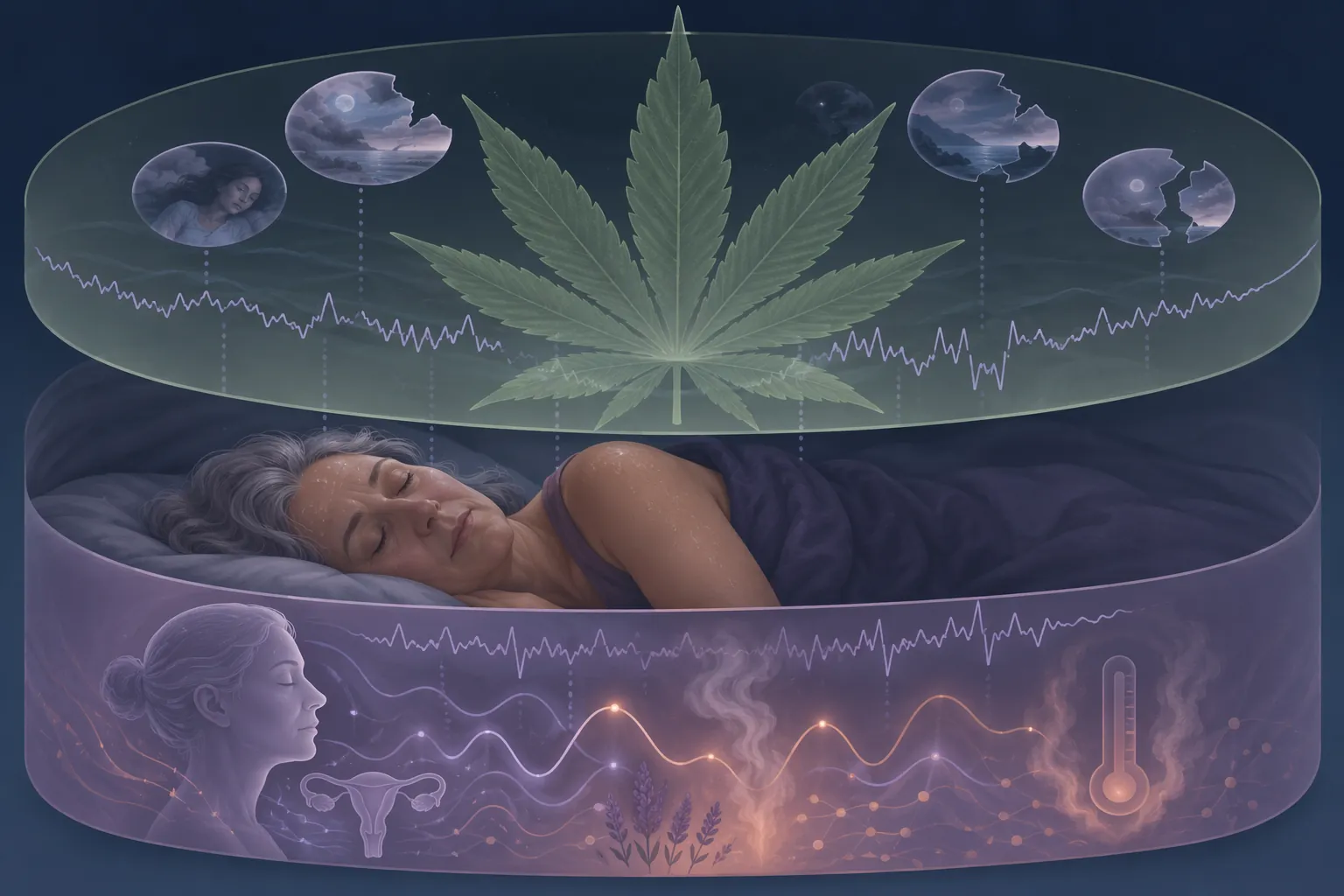
What THC does to REM sleep
The strongest sleep-stage concern is tied to THC. THC acts as a CB1 receptor agonist. CB1 receptors are distributed in brain networks that help regulate sleep and wakefulness, including brainstem and forebrain regions involved in REM generation and control. In the sleep literature reviewed by Kaul and colleagues, acute THC decreases REM sleep and REM density.[1] Kolla and colleagues, reviewing cannabinoids and sleep in Mayo Clinic Proceedings, also describe acute REM suppression and the development of tolerance with continued use.[2]
“Suppresses REM” does not mean a person has no REM at all. It means the proportion, timing, density, or expression of REM can be reduced. In practical terms, someone may fall asleep faster after THC and still have less REM-rich sleep than she would have had without it. Those two experiences can coexist.
The architecture data are imperfect. Much of the older cannabis sleep-stage research came from small studies, many from the 1970s, and does not map neatly onto today’s products with higher THC potency and variable THC:CBD ratios. A polysomnography study discussed in the Kaul review reported REM percentage of 17.7% in chronic cannabis users, compared with a typical REM proportion of about 20–25%.[1] That is not a menopause study, and it should not be stretched into a precise prediction for an individual woman. It does, however, fit the broader REM-suppression signal.
The hidden trade-off: easier sleep onset can still be poorer sleep architecture
A common patient report is clinically believable: “I take cannabis and I finally fall asleep.” That may reflect reduced anxiety, sedation, fewer remembered awakenings, or less distress about being awake. None of that is trivial. If a woman has been sleeping four broken hours a night, a faster descent into sleep can feel like being handed her life back.
The problem is that sleep satisfaction and sleep architecture are not the same measurement. Subjective improvement asks, “Did the night feel better?” Polysomnography asks, “What happened to sleep stages, awakenings, continuity, respiratory events, and timing?” A sedating compound can improve the first while distorting parts of the second.
| What may improve | What may still be affected |
|---|---|
| Falling asleep faster | Lower REM sleep or REM density with THC |
| Less distress about awakenings | Persistent wake after sleep onset |
| A stronger feeling of being sedated | Tolerance with repeated use |
| Short-term relief during a difficult symptom period | Withdrawal-related insomnia or REM rebound after stopping |
This is where menopause changes the clinical meaning of the trade-off. If REM were being trimmed in a person with otherwise stable, consolidated sleep, the consequences might be different. In menopause, the sleep system may already be taking hits from night sweats, awakenings, mood symptoms, and hormonal changes. Adding THC-related REM suppression can become a double burden: less stable sleep to begin with, plus a compound that likely pushes one vulnerable sleep stage lower.
Chronic use and stopping are separate issues
The acute effect of THC is only one part of the decision. With repeated use, tolerance can develop, meaning the same dose may no longer produce the same perceived sleep benefit.[2] The Kaul review also reports that chronic THC use can decrease slow-wave sleep and increase sleep onset latency and wake after sleep onset.[1] In other words, the pattern can shift from “this helps me sleep” to “I need this to sleep, and sleep is still not very good.”
Stopping can also be rough. Kaul and colleagues report that 67–73% of adults experience sleep difficulty during cannabis withdrawal, and REM rebound can last up to 6–7 weeks.[1] REM rebound means REM can come back more intensely after a period of suppression, often with vivid dreams or disturbed sleep. That does not mean every menopausal woman who stops cannabis will have weeks of severe symptoms. It does mean the future version of the patient deserves consideration, not just the exhausted version making tonight’s decision.
CBD and mixed products make the answer less tidy
The phrase “cannabis suppresses REM” can be too broad if it erases product differences. THC-dominant products are the main concern for REM suppression. CBD, THC:CBD combinations, dose, route, timing, and individual metabolism all change the likely sleep effect. Modern dispensary products also vary in ways that older sleep studies did not test.
That variability does not make the REM question disappear. It makes casual reassurance harder. A low-THC product, a high-THC edible, and a balanced THC:CBD preparation should not be discussed as though they are the same exposure. When the product contains enough THC to be sedating, REM suppression is a plausible hidden cost.
What the evidence still cannot tell us
The missing study is straightforward: take a well-characterized group of perimenopausal and postmenopausal women, measure sleep with polysomnography, document menopausal symptoms and hormone therapy status, define the cannabis product and dose, and compare REM outcomes over time. That study is not what we currently have.
Instead, we have converging but indirect evidence. General cannabis sleep studies show THC-related REM suppression. Menopause sleep studies show a life stage with more sleep fragmentation and hormonal effects on sleep architecture. Surveys show many menopausal women use cannabis for sleep and often report benefit. Those lines point in the same direction, but they are not the same as direct proof in the exact population.
The survey evidence also has limits. The Babyn menopause survey relied on a self-selected sample and may not generalize to all menopausal women, particularly across race, income, geography, medical access, and cannabis legality.[3] A systematic review by Mejia-Gomez and colleagues found only three studies meeting criteria for cannabis use in menopause, describing a paucity of literature.[7] That thin evidence base is one reason cannabis has not become guideline-supported treatment for menopause symptoms.
A clinically restrained bottom line
For the question “does cannabis suppress REM sleep in menopause,” the most honest answer is: THC likely does, but the menopause-specific evidence is indirect. The mechanism is credible. The general sleep-stage literature supports REM suppression. Menopausal sleep is already vulnerable to fragmentation and hormonal disruption. What we do not yet have is a direct PSG trial showing exactly how much THC changes REM sleep in perimenopausal or postmenopausal women.
So I would not dismiss a woman who says cannabis helps her sleep. I also would not let “it helps” end the conversation. If the product contains THC, the likely trade-off is that sleep may feel easier while REM-related architecture is less protected. Major clinical societies do not recommend cannabis for menopause symptoms because the evidence remains insufficient, and that caution is appropriate until the studies catch up with what patients are already doing.
References
- Effects of Cannabinoids on Sleep and their Therapeutic Potential for Sleep Disorders, Neurotherapeutics, 2021.
- The Effects of Cannabinoids on Sleep, Mayo Clinic Proceedings, 2022.
- Cannabis use for menopause in women aged 35 and over: a cross-sectional survey, BMJ Open, 2023.
- A survey of medical cannabis use during perimenopause and postmenopause, Menopause, 2022.
- Are women turning to cannabis for menopause symptom relief?, Harvard Health, 2022.
- Sleep Disorders and Menopause, Journal of Menopausal Medicine, 2019.
- The impact of cannabis use on vasomotor symptoms, mood, insomnia and sexuality in perimenopausal and postmenopausal women: a systematic review, Climacteric, 2021.
Safety & eligibility read
Cross-check against other interventionsExplore the mechanism
Next step
Spot an error or have clinical feedback?
Because this article covers clinical, medication, or safety information, we use a moderated correction channel instead of open public comments. Let us know if something about “Does Cannabis Suppress REM Sleep in Menopause?” needs a closer look.
Send feedback on this article