
Can You Take Tylenol and Naproxen Together for Perimenopause Sleep Pain?
Waking with perimenopause-related pain? This article explains whether taking Tylenol (acetaminophen) and naproxen (Aleve) together is safe for sleep, provides dosing and timing guidance tailored to midlife women, and covers when to seek more definitive treatments.
Yes, many adults can take Tylenol and naproxen together for short-term pain relief, including pain that is keeping them awake during perimenopause, as long as both medicines stay within safe dose limits and you do not have a reason to avoid either one. Tylenol is acetaminophen. Aleve is naproxen, an NSAID. They are not the same drug class, they work through different pain pathways, and they are cleared differently by the body, which is why several medical sources describe the combination as acceptable when dosed correctly.[1][2][3][4]
That answer is useful only if it comes with boundaries. This is a “tonight and a few days” strategy, not a standing perimenopause sleep plan. If you are around or over 50, have kidney disease, liver disease, ulcers, high blood pressure, heart disease, heavy alcohol use, take blood thinners, take an SSRI, or use blood pressure medicine, the safe-looking over-the-counter choice can become more complicated.

A Practical Way to Time Tylenol and Naproxen Overnight
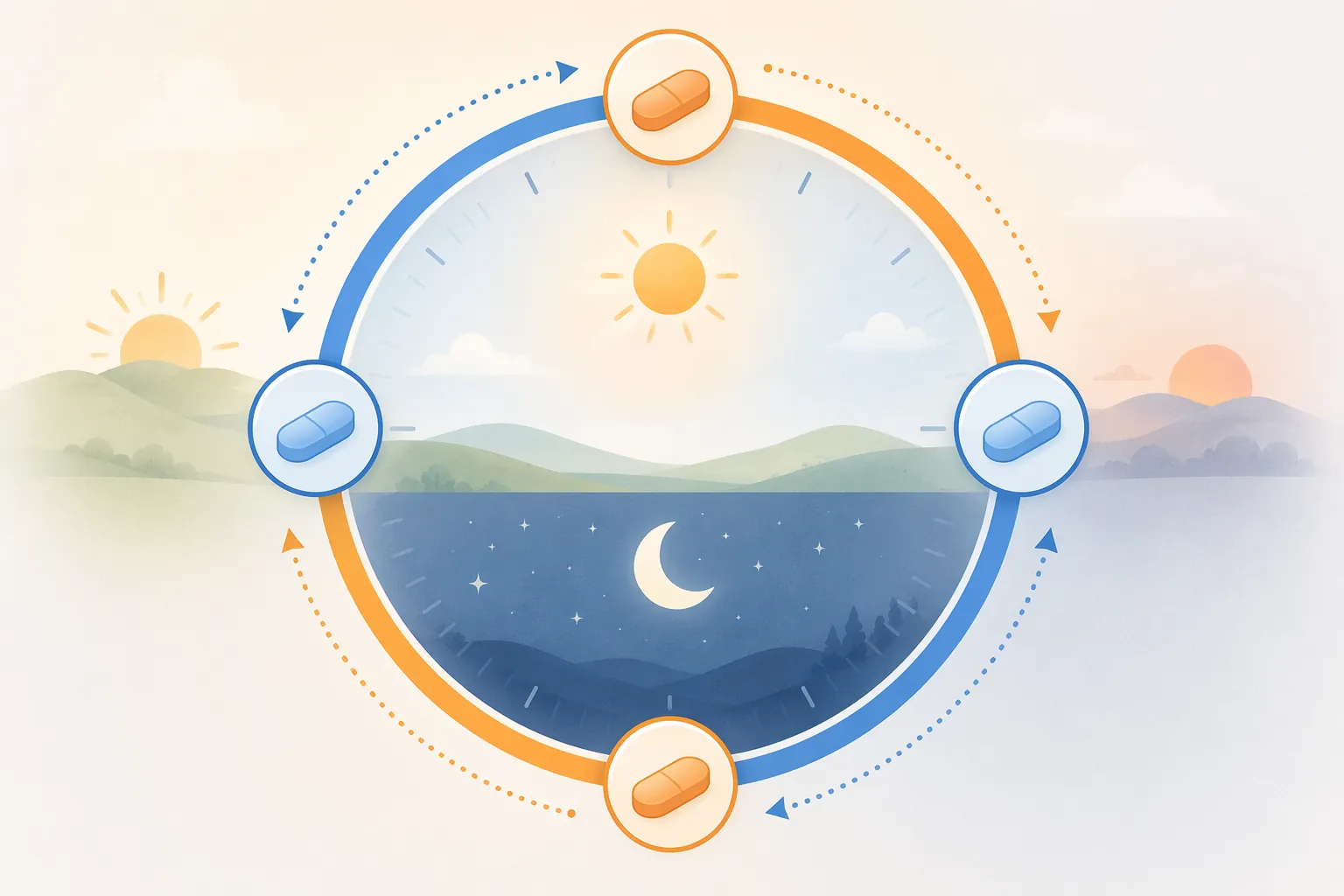
The cleanest way to think about a Tylenol naproxen combo for perimenopause sleep pain is not “double up.” It is “cover pain without stacking the same risk.” Naproxen gives longer anti-inflammatory coverage. Acetaminophen can be placed between naproxen doses because it is not another NSAID.
| Time | Example dose | Why it is spaced this way |
|---|---|---|
| 8 p.m. | Naproxen 220 mg with food | Starts longer-lasting NSAID coverage before the part of the night when pain often wakes you |
| Midnight | Tylenol 500-1,000 mg | Adds non-NSAID pain relief without taking another naproxen dose too soon |
| 6 a.m. | Naproxen 220 mg with food, if still needed | Keeps naproxen at an 8- to 12-hour spacing pattern |
For general adult dosing, naproxen is commonly taken as 220 mg every 8 to 12 hours, with maximum limits depending on product labeling and clinical context. Acetaminophen is commonly taken as 500 to 1,000 mg every 4 to 6 hours, with many adult references listing 3,000 to 4,000 mg per day as the upper range.[1][2][3][4] For women around and over 50, especially if this is not a one-off night, the more conservative acetaminophen ceiling is 3,000 mg per day unless a clinician has told you otherwise.
Two details matter more than the brand names. First, do not take naproxen with ibuprofen, aspirin for pain, or another NSAID unless a clinician specifically directed that plan. That is the kind of stacking that raises gastrointestinal and kidney risk. Second, check every cold, flu, migraine, sinus, or sleep product before adding Tylenol. Acetaminophen is often hidden in combination products, and accidental acetaminophen overload is much easier than most people realize.
Why This Comes Up So Often in Perimenopause
Pain-related waking in this life stage is not a character flaw, and it is not always solved by cooler sheets. Reviews of midlife women report sleep disturbances in roughly 40% to 60% of perimenopausal women, while musculoskeletal pain has been reported in the broad range of 48% to 72%.[5][6] Those ranges do not prove that perimenopause is the only cause of any one person’s hip pain, cramps, headaches, or body aches. They do show why the 2 a.m. medication question is so common.
Hot flashes can break sleep, but they are not the whole story. A woman can wake because her period is heavier and crampier than it used to be, because a shoulder aches when she rolls over, because migraine patterns are changing, or because several mild pains become loud once the house is quiet. In that setting, treating pain can sometimes protect sleep continuity, even when the pain treatment is not a sleep medication.
One randomized trial looked at adults with chronic low back pain and sleep disturbance and found that naproxen plus diphenhydramine improved wake-after-sleep-onset by 42 minutes compared with naproxen alone.[7] That study did not test Tylenol, did not focus on perimenopausal women, and should not be read as a reason to add antihistamine sleep aids casually. Its narrower value is that it supports the pain-sleep link: when pain is part of the wake-up loop, pain control can change the night.
The Guardrails Matter More After 50
The combination is not automatically dangerous because it mixes two medicines. The bigger issue is that each medicine has its own organ-specific limit. Naproxen asks more of the stomach, kidneys, blood pressure system, and cardiovascular risk profile. Acetaminophen asks more of the liver, especially at higher doses, with alcohol use, or when it appears in multiple products at once.
Stomach and Bleeding Risk
Naproxen can irritate the stomach lining and increase the risk of gastrointestinal bleeding. That risk is higher if you have a history of ulcers or GI bleeding, take blood thinners, take corticosteroids, drink heavily, or combine NSAIDs. SSRIs, which many midlife women use for mood symptoms, anxiety, or sometimes hot flashes, can also add to bleeding concern when paired with NSAIDs.
If naproxen is part of the night’s plan, taking it with food is a small but sensible protection. Food does not erase bleeding risk. Black stools, vomiting blood or coffee-ground-like material, severe stomach pain, faintness, or unusual bruising should not be managed by changing the schedule at home.
Kidneys, Blood Pressure, and Heart Risk
NSAIDs such as naproxen can reduce kidney blood flow, especially when someone is dehydrated, has kidney disease, is older, or takes certain blood pressure medicines. This is one reason the advice changes for women who are no longer 28 and otherwise medication-free. A dose that was uneventful years ago may deserve more caution if you now take an ACE inhibitor, an ARB, a diuretic, or several daily medications.
NSAIDs can also raise blood pressure or complicate cardiovascular risk for some people. That does not mean no one with midlife blood pressure issues can ever use naproxen. It means repeated nighttime use should be brought into the same conversation as your blood pressure readings, kidney labs, and cardiovascular history rather than treated as a private sleep workaround.
Liver Risk From Acetaminophen
Acetaminophen is often gentler on the stomach than NSAIDs, but its safety depends heavily on total daily dose. The liver does not care whether the acetaminophen came from regular Tylenol, a nighttime cold product, a prescription pain medicine, or a migraine combination. It all counts toward the same daily total.
For a woman in the perimenopause-to-postmenopause age band, especially one who drinks alcohol, has fatty liver disease, has hepatitis, eats very little during illness, or is using multiple medications, 3,000 mg per day is the safer ceiling to keep in mind unless her own clinician has set a different limit. If you already took 1,000 mg at dinner and 1,000 mg at midnight, the next dose is not just about the clock; it is about the day’s running total.
When the Answer Should Be No, or Not Without Medical Advice
Do not use a Tylenol and naproxen combination as a do-it-yourself sleep-pain plan if you have been told to avoid NSAIDs, have active stomach bleeding or a recent ulcer, have significant kidney disease, have severe liver disease, take warfarin or another anticoagulant, are on multiple blood pressure medicines with kidney concerns, or are using other acetaminophen-containing products and cannot confidently total the dose.
- Call a clinician promptly if pain is new, severe, one-sided, associated with chest pain, shortness of breath, neurologic symptoms, fever, unexplained weight loss, heavy abnormal bleeding, or a recent injury.
- Ask before combining if you take SSRIs, blood thinners, steroids, ACE inhibitors, ARBs, diuretics, lithium, methotrexate, or regular aspirin.
- Avoid alcohol on nights when acetaminophen is part of the plan, especially if you are near the upper daily limit.
- Do not use combined OTC analgesics for more than 10 days without a clinician’s guidance.
That 10-day line is not magic. It is a practical stop sign. If the combination is needed beyond a short window, the medication question has changed from “Can I take these together tonight?” to “Why is pain or insomnia now frequent enough that I need this much rescue treatment?”
What If Naproxen Is Becoming a Nightly Perimenopause Tool?
Daily or near-daily naproxen use deserves a more specific conversation than “take the lowest dose.” A 2026 Ubie Health guide aimed at women in their 40s and 50s frames recurring naproxen use for perimenopause-related symptoms as a reason to discuss more definitive care, including menopausal hormone therapy when symptoms fit.[8] That is a secondary clinical guide, not the same as a specialty-society guideline, but the logic is sound: a recurring need for NSAIDs is a clue, not a final treatment plan.
The better next step depends on what is actually waking you. If the main pattern is conditioned insomnia — awake, alert, clock-watching, anxious about the next bad night — cognitive behavioral therapy for insomnia is usually the treatment category to understand first. If hot flashes or night sweats are a major driver, menopausal hormone therapy may belong in the discussion for eligible women. If hormones are not appropriate or not preferred, non-hormonal prescription options such as gabapentin, low-dose SSRIs, or dual orexin receptor antagonists may be considered depending on the symptom pattern and medical history.
For a fuller comparison of those options, Restful Ground’s perimenopause insomnia treatment ranking is the more useful next read than another bottle-by-bottle pain reliever article.
For one painful night, Tylenol plus naproxen can be a reasonable short-term bridge when the doses are spaced, the daily totals are counted, and your personal risk factors are not waving red flags. If the bridge is getting used night after night, the job is no longer to perfect the OTC schedule. The job is to identify the driver of the pain and broken sleep, then treat that driver directly.
References
- Can You Take Naproxen and Acetaminophen Together?. Healthline.
- Can you take Aleve and Tylenol together?. Medical News Today.
- Can Acetaminophen and NSAIDs Be Taken Together?. Verywell Health.
- Can You Take Tylenol and Naproxen Together?. Doctronic, 2026.
- Sleep and Sleep Disorders in the Menopausal Transition. Sleep Medicine Clinics, 2018.
- Musculoskeletal Pain in Postmenopausal Women: A Narrative Review. Journal of Clinical Medicine, 2025.
- Effects of naproxen with diphenhydramine on sleep in patients with chronic low back pain: a randomized clinical trial. PubMed, 2022.
- Naproxen for Women 40-50: Expert Relief Guide Steps. Ubie Health, 2026.
Safety & eligibility read
Cross-check against other interventionsExplore the mechanism
Next step
Spot an error or have clinical feedback?
Because this article covers clinical, medication, or safety information, we use a moderated correction channel instead of open public comments. Let us know if something about “Can You Take Tylenol and Naproxen Together for Perimenopause Sleep Pain?” needs a closer look.
Send feedback on this article