
Choosing Sleepwear That Works With Menopause Night Sweats
A fabric-science approach to sleepwear for women over 50: how wool, cotton, bamboo, and silk affect your skin-level microclimate during night sweats, and how to match your personal temperature profile to the right material without sacrificing comfort or style.
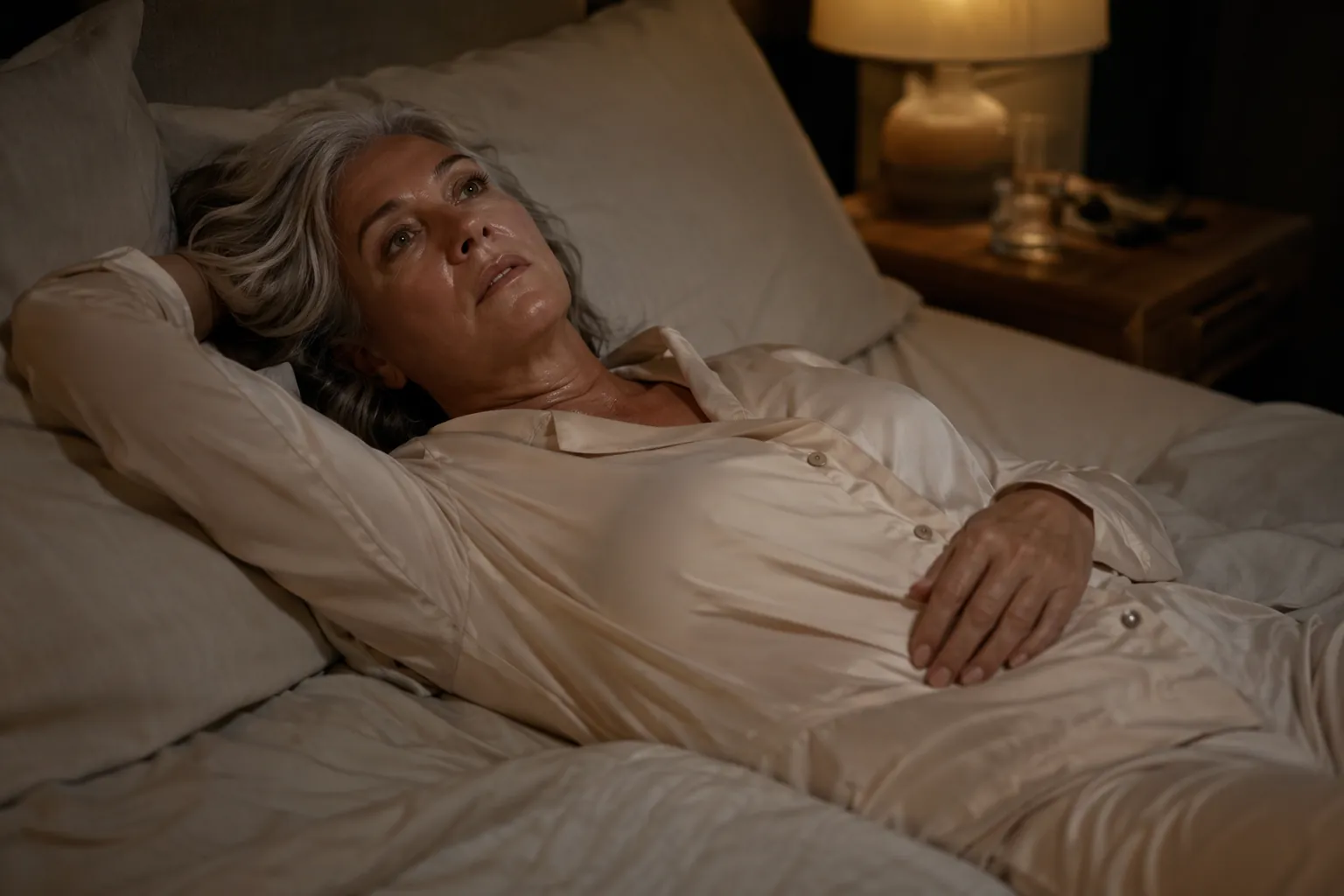
The hard part of a 3 a.m. night sweat is not only the heat. It is the moment after it: the damp neckline, the clammy back, the sheet that suddenly feels wrong, and the small calculation of whether changing clothes will wake you fully. For many women in perimenopause and menopause, ordinary sleepwear starts to behave badly because the body is no longer holding temperature steady in the same way.
That makes sleepwear style inspiration for women over 50 a more serious subject than a pretty pajama drawer. The useful question is not simply “What looks elegant?” It is “What happens at the skin surface when heat rises, sweat appears, and the body then cools too quickly?” A good nightgown or pajama set cannot correct menopause physiology, but it can influence the small climate between skin, fabric, and bedding.
Why Your Old Pajamas May Suddenly Feel Wrong
Menopause-related night sweats are tied to estrogen decline and instability in the hypothalamic systems involved in temperature regulation. The result can be a narrowed comfort zone: a room, blanket, or fabric that once felt neutral may now feel too warm, then too wet, then too cold within the same hour.
Sleepwear can act on only part of that sequence. It cannot stop a vasomotor episode from starting. It can, however, affect how fast sweat is absorbed, whether moisture vapor moves away from skin, how much air circulates through the garment, and whether the fabric continues to feel wet after the sweat has passed.
This is where many “breathable pajama” recommendations stop too early. Breathability matters, but during a night sweat the garment also needs moisture buffering: the ability to take up and release moisture in a way that softens the temperature swing at skin level. A thin fabric that lets air through but leaves sweat sitting cold against the body may still wake you.
The Evidence Points First to Fiber, Not Price
The strongest sleep-specific evidence is not from menopause-only trials; those trials do not yet exist. The best available evidence comes from studies of fiber type, sleep quality, and warm or cool ambient conditions in general adult or older adult populations. That distinction matters. Applying the findings to menopause night sweats is a reasoned thermoregulation inference, not a direct menopause sleepwear trial.
In a randomized crossover study of adults aged 65 and older under warm conditions, participants fell asleep faster in wool sleepwear than in cotton: 12.4 minutes in wool versus 26.7 minutes in cotton at 30°C. The same study reported lower sleep fragmentation in wool than polyester under warm conditions, 12.1 versus 13.7 events per hour, and poor sleepers had significantly less wake after sleep onset in wool than cotton. The study was partly funded by Australian Wool Innovation Ltd., which should be disclosed, but the funding disclosure does not by itself erase the peer-reviewed findings.[1]
A separate textile-and-sleep study helps explain why wool may behave differently. It reported moisture buffering values of 9.9 KJ·m−2 for wool, 6.9 KJ·m−2 for cotton, and 0.6 KJ·m−2 for polyester. In plain language, wool handled moisture-related heat exchange more actively than cotton and dramatically more than polyester in that measurement.[2]
A 2024 systematic review concluded that wool sleepwear appears most beneficial for promoting sleep quality compared with cotton or polyester, while also noting high heterogeneity, small study samples, and limited sleep-specific evidence for non-wool natural fibers.[3]
How the Main Sleepwear Fabrics Behave During Night Sweats
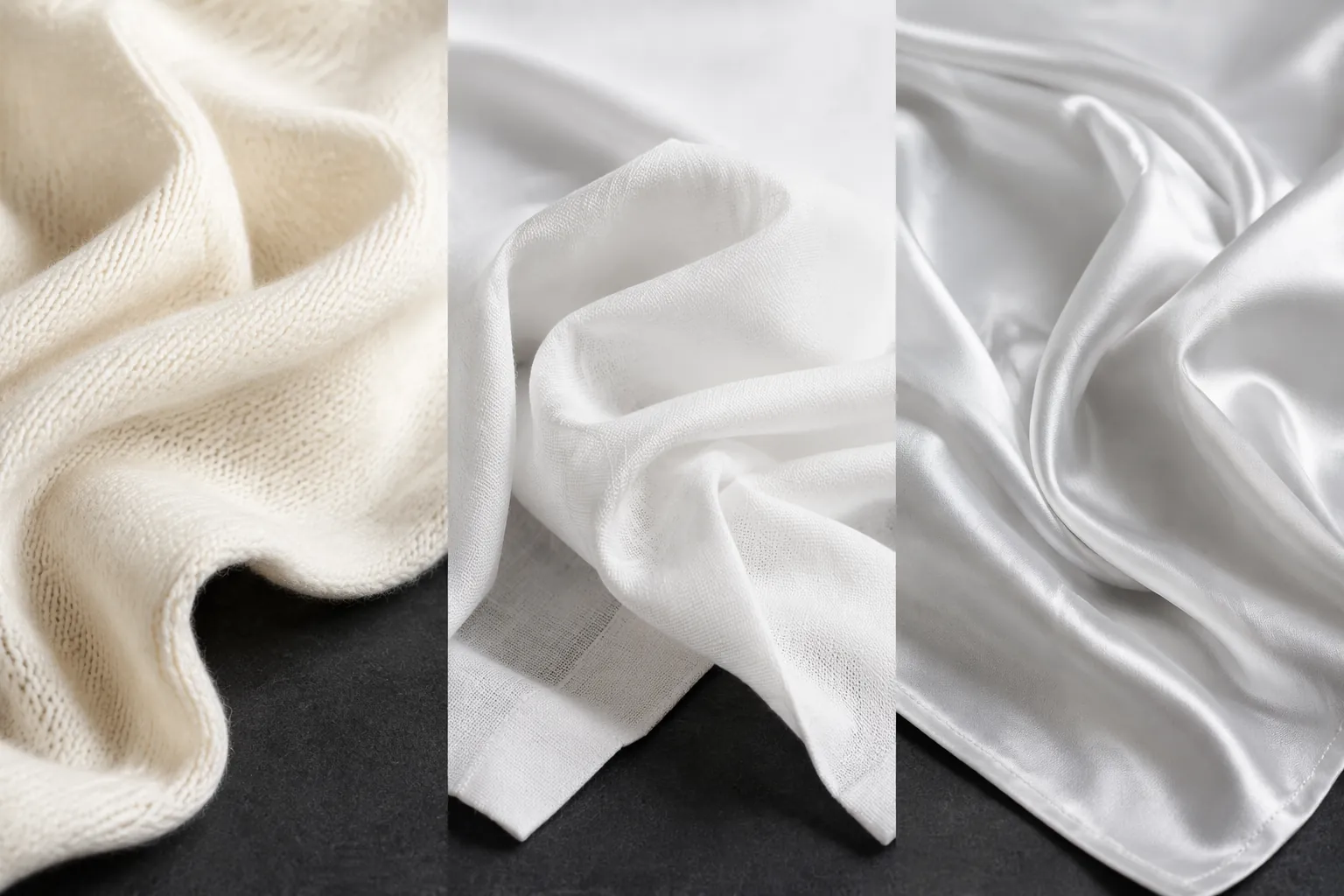
Fabric choice is not a personality test. It is a match between your temperature pattern and the garment’s behavior under stress. A beautiful set that works for a woman who runs mildly warm all night may fail the woman who sweats in sharp waves and then chills. The point is not to find the one correct fabric for every woman over 50, but to stop buying as if every “cooling” label means the same thing.
Wool: the strongest evidence-backed starting point
Fine merino wool is often misunderstood by people who remember heavy winter sweaters. In sleepwear, the relevant version is lightweight, fine-gauge wool: soft, thin, and able to buffer moisture without feeling like a cold wet cloth. The warm-condition sleep study gives wool the clearest practical advantage in the evidence base: faster sleep onset than cotton at 30°C and less fragmentation than polyester in the same warm setting.[1]
For menopause night sweats, wool’s appeal is not that it feels icy. It is that it may smooth the transition between heat, sweat, and post-sweat cooling. When a hot flash breaks into perspiration, a high-moisture-buffering fabric can take up moisture vapor and liquid more gracefully, reducing that sudden clammy feeling that makes you peel the garment away from your ribs.
Style still matters here. The best wool sleepwear choice is usually not a tight thermal base layer. Look for a loose long tee, relaxed short-sleeve set, or midi gown in a lightweight merino jersey. A front-button merino top can be especially practical for women who need to vent heat quickly without undressing completely. Muted cream, charcoal, soft blue, and heather gray are not just tasteful; they also make a technical fabric feel less like outdoor gear and more like real nightwear.
Wool is not universal. Some women dislike the hand feel even in fine merino. Others prefer vegan fibers, need easier high-frequency laundering, or find wool too insulating under their particular bedding. If your skin objects to wool, the answer is not to grit your teeth in the name of evidence. A garment that irritates you will not help you sleep.
Cotton: familiar, washable, but not always enough
Cotton remains useful because it is breathable, washable, widely available, and easy on sensitive skin. A loose cotton voile gown or light cotton lawn pajama can be a sensible choice for women who run only mildly warm or who dislike clingy knits. It also wins on household practicality: if you are changing sleepwear often, uncomplicated laundering matters.
The limitation is what happens once cotton becomes wet. Cotton absorbs moisture, but it may hold on to it in a way that feels heavy or cold against skin. In the moisture-buffering comparison, cotton performed below wool and far above polyester, which puts it in the middle rather than at the top.[2]
If cotton is your preference, cut becomes more important. Choose airy shapes: a sleeveless or short-sleeve midi gown, a boxy top with loose shorts, or a front-button set with enough ease through the torso. Avoid tight ribbed cotton blends if you sweat heavily; they may look neat at bedtime and feel like a damp bandage by morning.
Bamboo, TENCEL, and modal: elegant drape with less sleep-specific proof
Bamboo-derived viscose, TENCEL lyocell, and modal often appear in soft, fluid sleepwear marketed as cooling. They can feel lovely: smooth over the hip, less crisp than cotton, and more graceful in a camisole, wide-leg pajama, or robe. For a woman who wants sleepwear that looks adult and composed rather than clinical, this category has real appeal.
The evidence boundary is important. The sleepwear review found limited evidence for non-wool natural fibers in sleep contexts, so claims about bamboo, TENCEL, and modal should be treated as extrapolations from textile properties and wearer comfort, not as equivalent to wool’s sleep-study findings.[3]
These fabrics may suit women who dislike wool texture, want a silkier drape, or experience moderate warmth rather than drenching sweats. They are also good candidates for removable layers: a light camisole under an open robe, or a soft pajama pant with a button-front top that can be opened during a hot flash. Check the fiber label carefully, because a “bamboo” garment blended heavily with polyester may behave more like synthetic sleepwear than the marketing suggests.
Silk: beautiful, temperature-sensitive, and more delicate
Silk has undeniable elegance. A bias-cut chemise or washable silk pajama set can restore a sense of dignity when menopause has made sleep feel unruly. Silk can also feel comfortable across a range of temperatures because it is light and smooth.
But silk is not automatically the best fabric for heavy night sweats. It can show moisture, may require gentler care, and does not have the same sleep-specific evidence base as wool in the cited trials. For women with occasional warmth and a strong preference for a refined feel, silk may be reasonable. For women waking soaked several nights a week, it is often too precious for the job.
Linen: excellent airflow, sometimes too textured
Linen is appealing when airflow is the main need. A loose linen nightshirt or simple sleeveless gown can feel airy and unfussy, especially in a warm room. It also has a relaxed elegance that suits women who do not want shiny or clingy sleepwear.
Its drawback is tactile. Linen can feel crisp, wrinkled, or rougher than knit fabrics, and some women become more sensitive to texture when they are already sleeping poorly. It is better for the woman who runs hot all night and wants ventilation than for the woman who chills sharply after sweating and needs more moisture buffering.
| Fabric | Best fit | Main caution |
|---|---|---|
| Lightweight merino wool | Sweats in waves, wakes damp, or has warm-condition sleep disruption | Not ideal if wool texture irritates skin or laundering needs are very simple |
| Loose cotton | Mild warmth, sensitive skin, frequent washing | Can stay wet and cold after heavier sweating |
| Bamboo, TENCEL, modal | Moderate warmth, preference for silky drape, dislike of wool | Sleep-specific evidence is limited compared with wool |
| Silk | Occasional warmth, high value on elegance and smooth feel | Delicate care and less suitable for drenching sweats |
| Linen | Runs hot all night and wants airflow | Texture may bother sensitive sleepers; less useful for post-sweat chills |
Match the Garment to Your Temperature Pattern
The most useful sleepwear decision starts with the pattern of your nights, not the prettiest product photograph. Two women can both say “I sleep hot” and need different garments.
- If you run hot all night: prioritize airflow first. Try a loose linen or cotton midi gown, a short-sleeve boxy top, or wide-leg pajama bottoms that do not trap heat at the waist.
- If you sweat in waves: start with lightweight merino wool if your skin tolerates it. Its moisture buffering is the most persuasive reason to test it before buying another synthetic “cooling” set.
- If you chill after sweating: avoid very thin garments that feel cold once damp. Consider wool or a layered camisole-and-robe arrangement so you can remove and replace warmth without a full clothing change.
- If wool bothers your skin: look at TENCEL, modal, or bamboo-derived viscose in loose cuts, while remembering that comfort evidence is not the same as sleep-outcome evidence.
- If elegance matters to you: choose drape and color after the thermoregulation decision. A muted monochromatic set in the right fiber will do more for the night than a beautiful fabric that traps sweat.
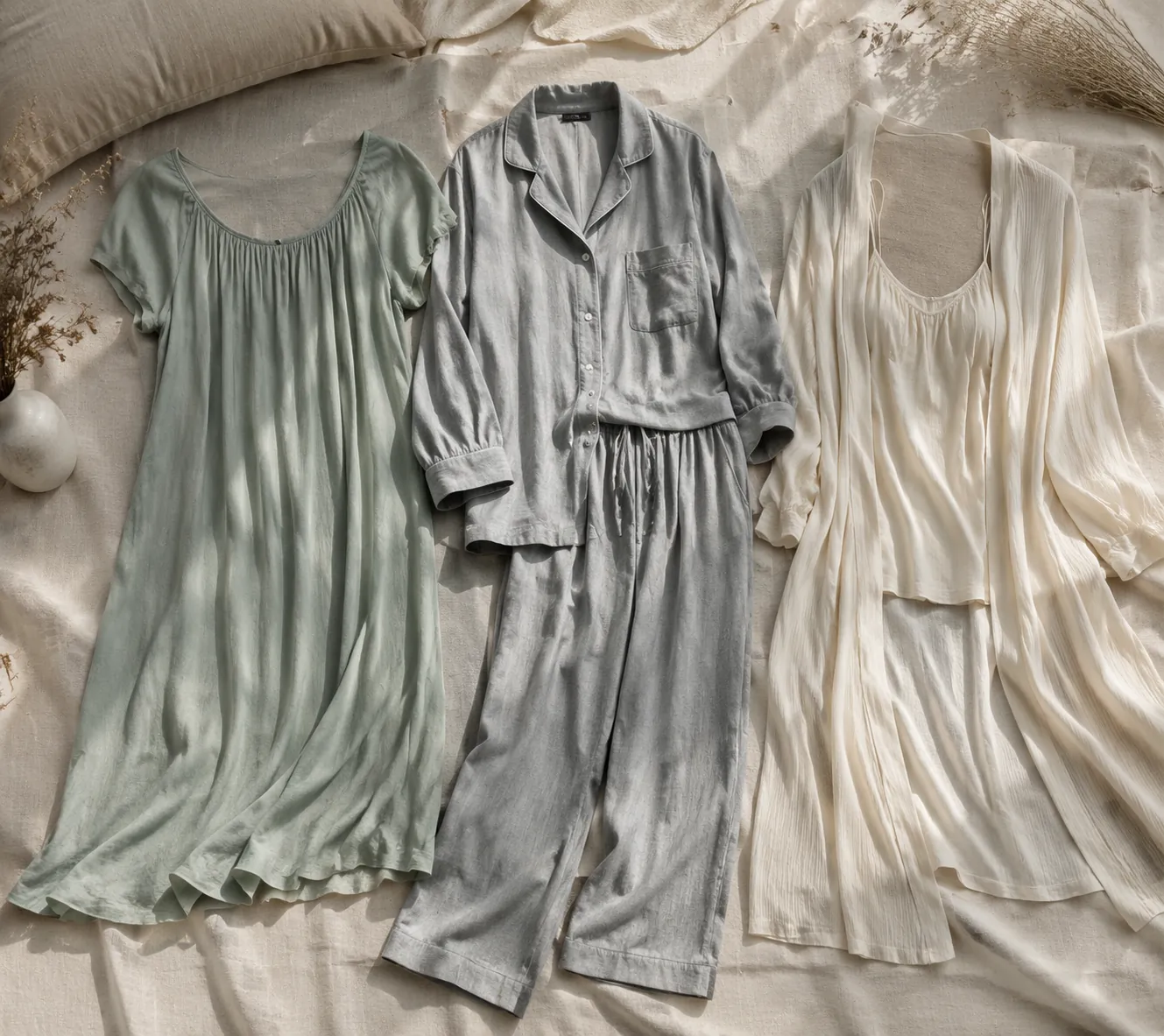
Fit is not a decorative detail. A loose midi gown allows air to move around the torso and thighs. A front-button top lets you vent quickly while half asleep. A camisole under an open robe gives you a layer to remove before the sweat peaks and replace if the chill arrives. These are style choices, yes, but they are also friction-reducing choices for the person doing the laundry at dawn.
Be Careful With “Cooling” Claims
The word “cooling” has become too elastic. Sometimes it means a fabric feels cool to the touch for a few seconds. Sometimes it means a synthetic finish has been added. Sometimes it simply means the garment is thin. None of those claims tells you how the fabric will behave during a real sweat episode.
A better label-reading habit is to ask four questions: What is the actual fiber content? Is polyester doing most of the work? Is the cut loose enough for airflow? Can I remove or open a layer without fully changing clothes? A pricey tight synthetic pajama can be less useful than a modest loose natural-fiber gown if the synthetic fabric holds heat or fails to buffer moisture.
This does not mean every synthetic blend is useless or every natural fiber is perfect. It means the burden of proof should be higher when a garment promises cooling without explaining moisture management, vapor movement, or fit. Your body is already doing enough unpredictable work at night; the garment should not add mystery.
When Sleepwear Is Not the Whole Answer
Sleepwear is one layer of a larger sleep environment. If the room is too warm, bedding is heavy, alcohol is intensifying vasomotor symptoms, or another sleep disorder is fragmenting the night, even the best fabric may only soften the edges. For room-cooling tactics, heat exposure, alcohol timing, and perimenopause sleep patterns, related Restful Ground guides on heat-dome sleep, alcohol and perimenopause sleep, and menopause sleep disruption can sit alongside this decision.
There is also a clinical boundary. Night sweats that are severe, newly appearing, accompanied by fever, unexplained weight loss, chest symptoms, marked fatigue, or signs of another sleep disorder deserve medical attention. If you wake choking, snore heavily, or feel unrefreshed despite enough time in bed, it is worth reading about how to tell sleep apnea from perimenopause symptoms and discussing the pattern with a clinician.
A Sensible Buying Order
For many women with warm-condition sleep disruption, lightweight wool is the most defensible first experiment because it has the strongest sleepwear evidence and the clearest moisture-buffering rationale. That does not make it a prescription. It makes it the first fabric to consider if your skin tolerates it and your main problem is sweating followed by wakefulness.
If wool is wrong for you, move next by temperature pattern rather than by trend: cotton or linen for airflow and washability, TENCEL/modal/bamboo-derived fabrics for soft drape and moderate warmth, silk for lighter symptoms and a more luxurious feel. Then choose the shape that reduces work at 3 a.m.: loose through the torso, easy at the neckline, openable in front, and compatible with a removable robe or wrap.
Only after those decisions should color, print, and polish take over. There is room for beauty here: a sage gown, an ivory robe, a heather-gray button set, a quiet monochrome palette. Elegance is not the problem. The problem is asking elegance to do the work of thermoregulation.
References
Explore the mechanism
Next step
Spot an error or have clinical feedback?
Because this article covers clinical, medication, or safety information, we use a moderated correction channel instead of open public comments. Let us know if something about “Choosing Sleepwear That Works With Menopause Night Sweats” needs a closer look.
Send feedback on this article