
How to Sleep Through a Heat Wave With Night Sweats
Learn how to sleep during a heat wave when you're already dealing with perimenopause or menopause night sweats — separate strategies for cooling the room and cooling your body, plus when home remedies aren't enough and medical options to consider.
When night sweats meet a heat wave, you are not dealing with one sleep problem. You are dealing with two heat sources that pile on top of each other: the internal surge of a vasomotor symptom and the external heat of a bedroom that may no longer cool down after sunset.
That distinction matters because it explains why ordinary advice can feel so insulting by 3 a.m. A fan can move air across your skin. A cotton nightgown can keep damp fabric from clinging as badly. A cooler shower can lower the heat you carry into bed. None of those things corrects the hypothalamic thermoregulation problem behind menopausal night sweats. And medication for vasomotor symptoms does not make an 80°F bedroom safe or comfortable.
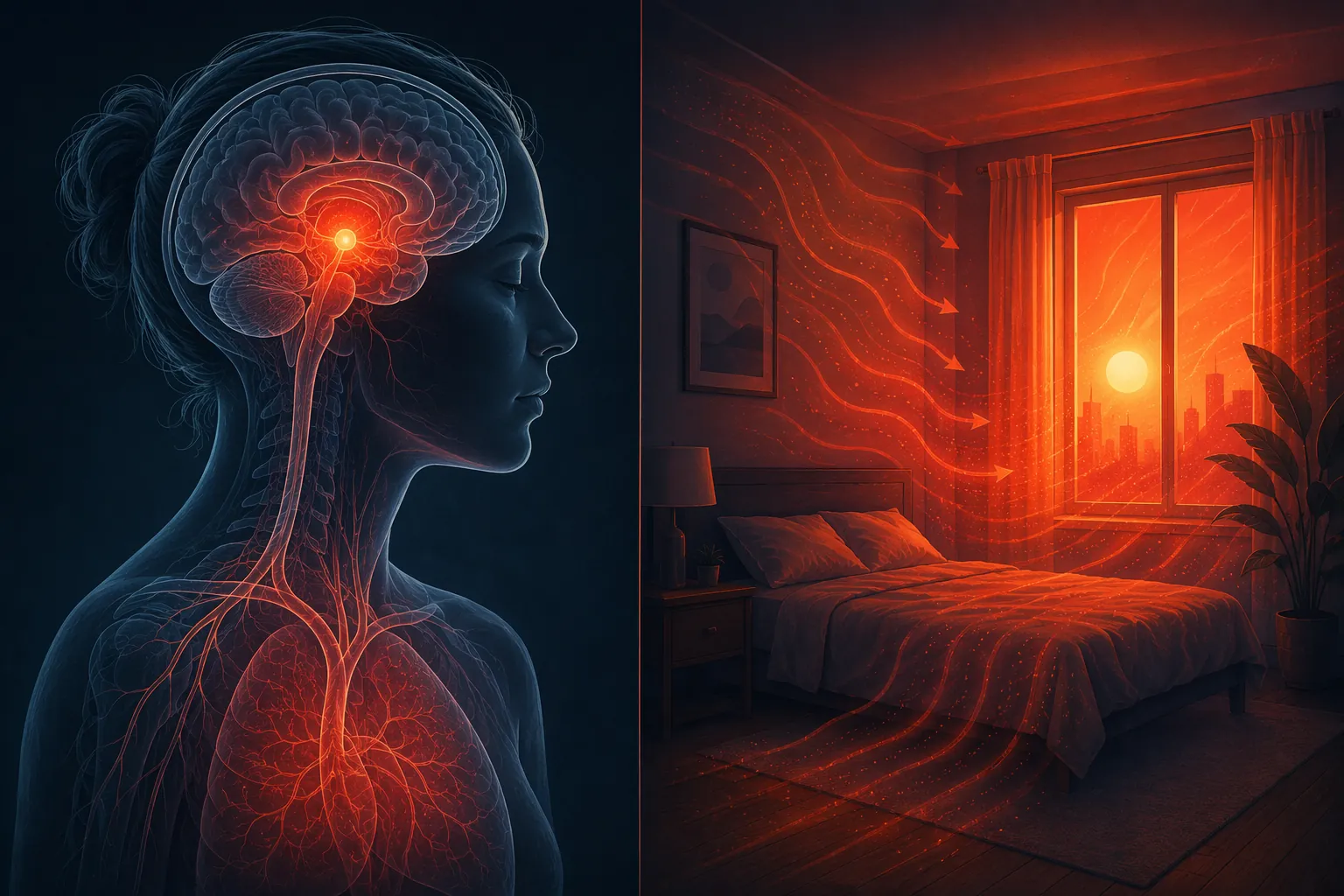
A workable night has to separate the jobs. Cool the room enough that your body has somewhere to dump heat. Cool the body enough that a vasomotor surge does not turn into a full bedding change. Then have a plan for what happens after you wake up drenched, because pretending that will not happen is how people end up lying in wet sheets, furious and wide awake.
First, Name the Two Heat Problems
Menopause-related night sweats are common enough that they should not make anyone feel strange or embarrassed. Temple Health describes night sweats as affecting up to 80% of women during perimenopause and menopause, and ACOG similarly says about 8 in 10 women have hot flashes during the menopause transition [1][2]. Common, however, is not the same as harmless to live with. Waking soaked, losing sleep, and starting the day already depleted are not small inconveniences.
A night sweat is not just being warm. It is part of the same vasomotor instability that causes hot flashes: the body overreacts to small shifts in core temperature and abruptly tries to shed heat. During the day that may feel like flushing, sudden heat, and sweating. At night it can mean waking with damp hair, wet pajamas, and sheets that need to be peeled away.
A heat-wave bedroom is the second problem. When the room stays hot, especially if walls, windows, and bedding have absorbed heat all day, the body has fewer ways to cool itself. Sweat does not help much if the air is humid and still. A mattress that holds warmth can keep feeding heat back into your body. If you are already prone to vasomotor symptoms, that external load can make the internal surges more likely to wake you or harder to recover from.
| Problem | What it does | What helps most |
|---|---|---|
| Vasomotor night sweats | The body abruptly triggers heat, flushing, and sweating from internal thermoregulation instability | Body cooling, trigger timing, and, when needed, medical treatment |
| Heat-wave bedroom | The room, bedding, and air temperature prevent normal overnight heat loss | Room cooling, air movement, lower sleeping location, and reducing stored heat |
| Both together | External heat makes recovery from internal sweating harder, and wet bedding makes sleep more fragile | A combined plan before bed, during the first half of the night, and after a drenched waking |
What Temperature Are You Actually Fighting?
There is no single magic bedroom temperature, and it is worth being honest about that. Sleep Foundation places the ideal bedroom temperature for sleep around 60–68°F, while HealthPartners gives a slightly warmer comfort range of about 68–72°F [3][4]. Those ranges are not identical, but they point in the same direction: sleep tends to do better in a cool room, and sustained heat in the mid-to-high 70s becomes much more disruptive. Sleep Foundation notes sleep can be affected above 77°F, while HealthPartners flags disruption below 65°F or above 75–77°F [3][4].
If your bedroom is 80°F at midnight, the goal for tonight may not be a textbook-perfect sleep environment. The goal may be getting below the most disruptive range, keeping air moving, and making sure you can cool yourself quickly after a sweat. That is less tidy than a temperature rule, but it is closer to the night many people are actually having.
Before Bed: Reduce the Heat You Can Control
The pre-bed window is not for redesigning your whole life. It is for removing the easiest heat loads before your body starts its most vulnerable hours of sleep.
- Move sleep to the coolest safe place available. A lower floor, shaded room, or room with better air movement may beat the usual bedroom during a heat wave.
- Block daytime heat before evening. Close curtains or shades on sun-facing windows during the day, then ventilate only when outside air is cooler than inside air.
- Use fans to move air across skin, not just around the room. If indoor air is very hot, a fan may feel less helpful unless paired with skin cooling or cooler incoming air.
- Choose sleep layers that are easy to change. A light top and spare dry layer within reach can be more useful than trying to find the one perfect fabric.
- Set up a recovery kit before you are half-awake: dry pajamas, a towel, water, a cool cloth, and a spare top sheet or light blanket.
The trigger check belongs here too, but it should stay practical. Alcohol, caffeine, spicy foods, and hot drinks can raise body temperature or provoke symptoms in some people, and several clinical sources advise avoiding common triggers close to bedtime, often in the 2–3 hours before sleep [1][3][5]. That does not mean every woman has the same trigger list or that dinner has to become a disciplinary project. During a heat wave, it means not giving your already stressed cooling system extra work at 10 p.m.
A warm bath right before bed is often suggested for sleep because the later cooling can help some people feel drowsy. In a heat wave with night sweats, that may be too much heat too late. A lukewarm or cool shower, or simply cooling the neck, chest, and feet before bed, is the more sensible experiment.
Early Night: Protect the First Stretch of Sleep
The first half of the night is worth protecting because once you are awake, wet, and irritated, the night has a different job: recovery. Early on, make the bed as easy as possible to cool and as easy as possible to escape.

Start with less bedding than you think you will need, but keep a light layer nearby. Many people with night sweats cycle between too hot and chilled after sweating. If you bury yourself at bedtime, you may trigger heat sooner. If you sleep uncovered and then wake damp under moving air, you may get cold enough to become fully alert. A light, reachable layer gives you options without trapping heat from the start.
If you use cooling bedding or a bed-cooling device, judge it by whether it lowers the overnight burden, not by whether it promises to solve menopause. One free-living 2024 study of 54 adults found that cooling the bed surface in the first half of the night was associated with about 9 more minutes of REM sleep, a 25% increase, along with a 1.2 bpm lower sleeping heart rate and 2.0 ms higher heart-rate variability [6]. That is interesting because it tests the bed surface people actually sleep on, not just a lab chamber.
It is also not a reason to treat a product category as proven therapy. The study was funded by Eight Sleep, several authors were company employees, and the sample was small [6]. The fair conclusion is narrow: actively cooling the sleep surface may help some sleepers during warm nights, and better independent research would be welcome. It should not be sold to a woman waking drenched as if she merely failed to buy the right mattress pad.
After You Wake Drenched: Make Recovery Boring and Fast
The late-night plan should be almost dull. The more decisions you have to make, the longer you stay awake. Once a sweat has happened, the goal is not to analyze it. The goal is to get dry, cool the skin, protect the mattress and pillow, and return to a sleepable state without turning on every light in the house.
- Sit up and peel away wet fabric. Do not stay wrapped in damp sheets hoping it will pass.
- Blot sweat with a towel kept by the bed, especially around the chest, neck, hairline, and back.
- Change only what needs changing. A dry top may be enough; a full pajama search at 3 a.m. is not always worth it.
- Cool the body briefly: cool cloth to the neck or chest, a few sips of water, fan across exposed skin.
- Reset the sleep surface. Put a dry towel over a damp patch or switch to the spare sheet rather than stripping the whole bed unless you have to.
- If the room is still oppressive, move. A sofa, guest room, or lower floor can be the sensible health decision, not a defeat.
This is where many heat-wave sleep articles become too neat. They imagine a person who wakes warm, adjusts a fan, and drifts back off. Menopausal night sweats can be messier than that. If you have to keep a towel on the bed for a week in July, that is not poor sleep hygiene. It is a symptom meeting bad weather.
Hot Flash, Night Sweat, or Heat Illness?
During extreme heat, it is important not to blame everything on menopause. Johns Hopkins describes hot flashes as sudden waves of heat that often last from about 30 seconds to 5 minutes, and notes that for 10–15% of women they are severe enough to disrupt daily function [7]. A typical vasomotor episode comes on, crests, and passes. It may leave you wet, chilled, embarrassed, or angry, but it usually has an episode-like shape.
Heat exhaustion is different. Be more cautious if overheating does not pass, if you feel faint or confused, if you have persistent weakness, nausea, headache, a racing pulse that does not settle, or if you cannot cool down after moving to a cooler place and drinking fluids. Those symptoms deserve urgent medical attention, especially during a heat wave. Menopause can explain night sweats; it should not be used to wave away systemic heat illness.
When Home Cooling Is Not Enough
If the room becomes survivable but the drenched awakenings continue, the remaining problem is probably not the window, the sheets, or your discipline. It is time to talk about treating vasomotor symptoms themselves.
Non-hormonal options are real clinician discussions, not afterthoughts. Fezolinetant targets neurokinin 3 receptors involved in hypothalamic thermoregulation; ACOG notes liver testing is needed before treatment and at months 1, 2, 3, 6, and 9 [2]. Other non-hormonal medications used for hot flashes and night sweats include gabapentin, SSRIs such as paroxetine, and clonidine, depending on the person’s symptoms, medical history, and medication risks [5][7].
Hormone therapy should also be named plainly. Estrogen therapy, with progesterone added for people who still have a uterus, is considered the most effective treatment for menopausal vasomotor symptoms, including night sweats [2][5][7]. That does not make it right for everyone. ACOG describes small increased risks, including deep vein thrombosis and breast cancer risks that vary by regimen, route, and individual risk profile [2]. Those caveats are reasons for a careful conversation, not reasons to pretend the most effective option does not exist.
A heat wave is also a poor time to make abrupt medication changes without medical advice. If you already use hormone therapy or another prescribed treatment for vasomotor symptoms, do not stop it because the weather has made symptoms more noticeable unless your clinician tells you to. Heat can expose that a plan is not controlling symptoms well enough; it does not automatically mean the plan should be abandoned overnight.
The Decision Point
For tonight, separate the work. Make the room cooler or move to the coolest safe place. Enter bed with less stored body heat. Keep dry layers and a towel within reach. Use fans, breathable bedding, and surface cooling as tools, not as proof that you can outsmart vasomotor symptoms with enough gear.
If those changes get you through an ugly stretch of weather, good. If they only make the room bearable while the soaking awakenings continue, the next step is not a better pillowcase. It is a clinician conversation about treating night sweats as the medical symptom they are.
References
- Menopause Night Sweats, Temple Health
- Hormone Therapy for Menopause, American College of Obstetricians and Gynecologists
- The Best Temperature for Sleep, Sleep Foundation
- Best Temperature for Sleep, HealthPartners
- Hot Flashes: What Can I Do?, Cleveland Clinic
- Effects of Bed Cooling on Sleep in Free-Living Adults, PubMed Central, 2024
- Introduction to Menopause, Johns Hopkins Medicine
Safety & eligibility read
Cross-check against other interventionsExplore the mechanism
Next step
Spot an error or have clinical feedback?
Because this article covers clinical, medication, or safety information, we use a moderated correction channel instead of open public comments. Let us know if something about “How to Sleep Through a Heat Wave With Night Sweats” needs a closer look.
Send feedback on this article