
Does cooler weather actually improve perimenopause sleep?
Cooler weather can improve perimenopause sleep, but the benefit depends on the bedroom microclimate, not the outdoor forecast. This guide explains the season-linked data, why temperature matters more when your thermoneutral zone narrows, and which winter conditions can erase the advantage.
If cooler months seem to give you a better shot at sleep during perimenopause, you are probably not inventing the pattern. The best answer is yes, cooler weather is associated with better perimenopause sleep on average — especially fewer hot flashes, fewer night sweats, and less reported trouble sleeping — but the useful variable is not the outdoor forecast. It is the small climate around your sleeping body: room temperature, bedding, air dryness, and morning light.
The winter side matters because most seasonal sleep advice stops at “avoid summer heat.” The companion piece Is August really the worst month for perimenopause sleep? explains the summer peak. This article follows the other half of the same question: why January can look better in the data, and why that advantage may disappear in a heated, dry, over-layered bedroom.
The clearest perimenopause data point: July is the peak, January is the trough
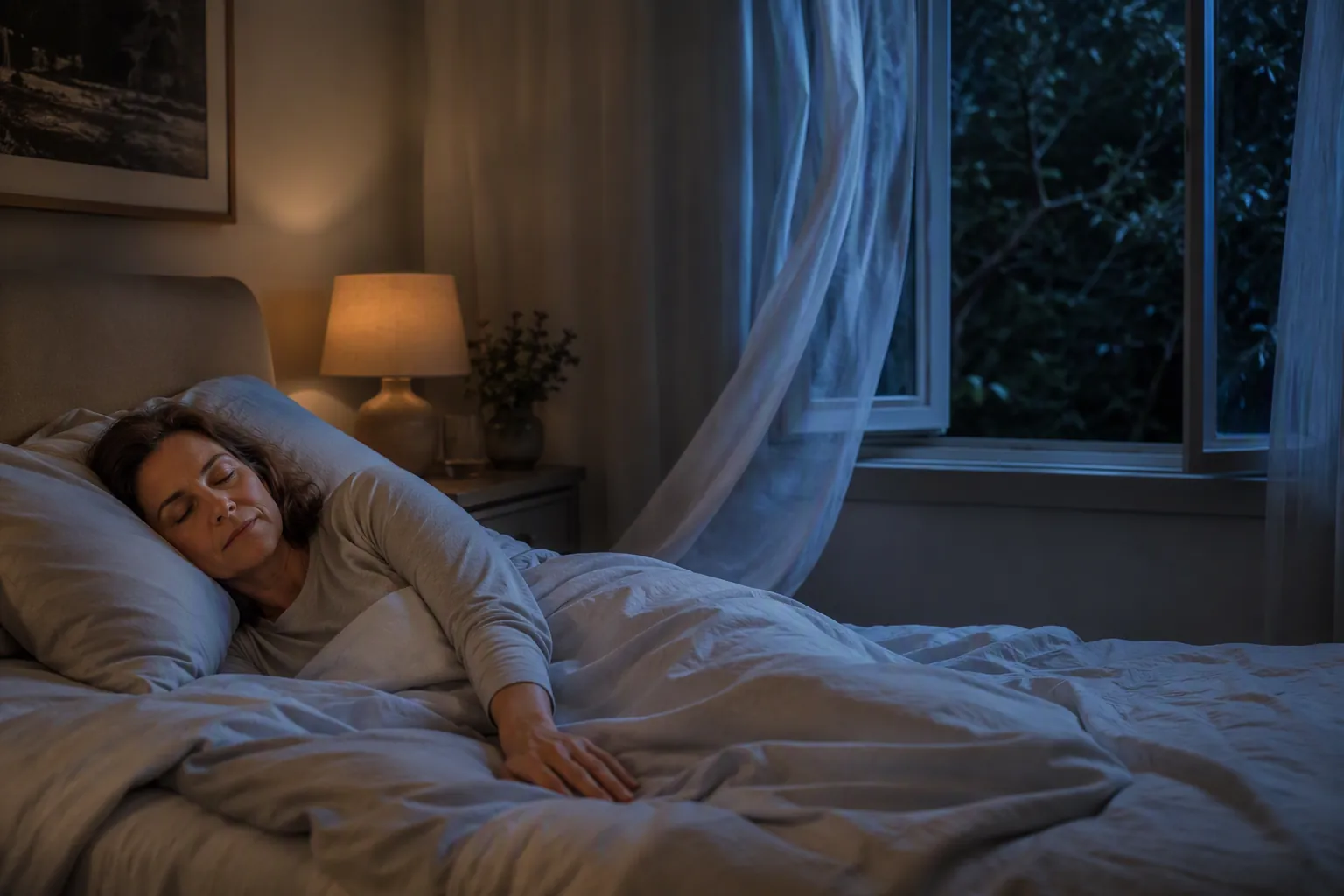
The strongest evidence comes from the SWAN Menstrual Calendar substudy, which followed 955 midlife women with monthly symptom calendars for 10 years. In that dataset, hot flashes, night sweats, and trouble sleeping all showed seasonal variation: the highest frequency was in July and the lowest was in January. At the seasonal peak, the odds were 66% higher for hot flashes, 50% higher for night sweats, and 24% higher for trouble sleeping compared with the seasonal minimum; the abstract reports that night sweats peaked about one month before July.[1]
That is a more useful answer than “some people like cool rooms.” SWAN is directly about midlife women and menopause-transition symptoms, not a generic winter-sleep survey. It also lines up with what many women describe in a less formal way: the same body that feels unmanageable on a hot night may become easier to settle when the season stops pushing heat into the bedroom.
The restraint matters, though. SWAN used self-reported calendars, and the seasonal pattern is observational. It does not prove that January air itself “treats” perimenopause insomnia, and it does not mean every woman will sleep better in winter. It shows that, across a large midlife cohort, symptoms that commonly break sleep were least common in January and most common in summer.[1]
Objective sleep data point in the same direction, with caveats
A separate wearable-device study from Japan adds supporting context because it measured sleep rather than relying only on symptom calendars. In that broader population sample, total sleep time was shortest in July at 6.64 hours and longest in January at 7.30 hours, a difference of about 40 minutes. Sleep efficiency was about 2.7% lower in summer, and wake after sleep onset was longest in August at 49.0 minutes compared with 35.3 minutes in December. The authors identified ambient temperature as the principal driver of the seasonal sleep variation.[2]
This is not perimenopause-specific proof. The sample was drawn from the general Japanese population and was skewed older, so it should not be treated as a direct measurement of U.S. women in their 40s and 50s. Still, it is useful because it shows the same broad seasonal shape with objective sleep metrics: cooler months were associated with longer, more efficient sleep, while summer brought more time awake after sleep onset.[2]
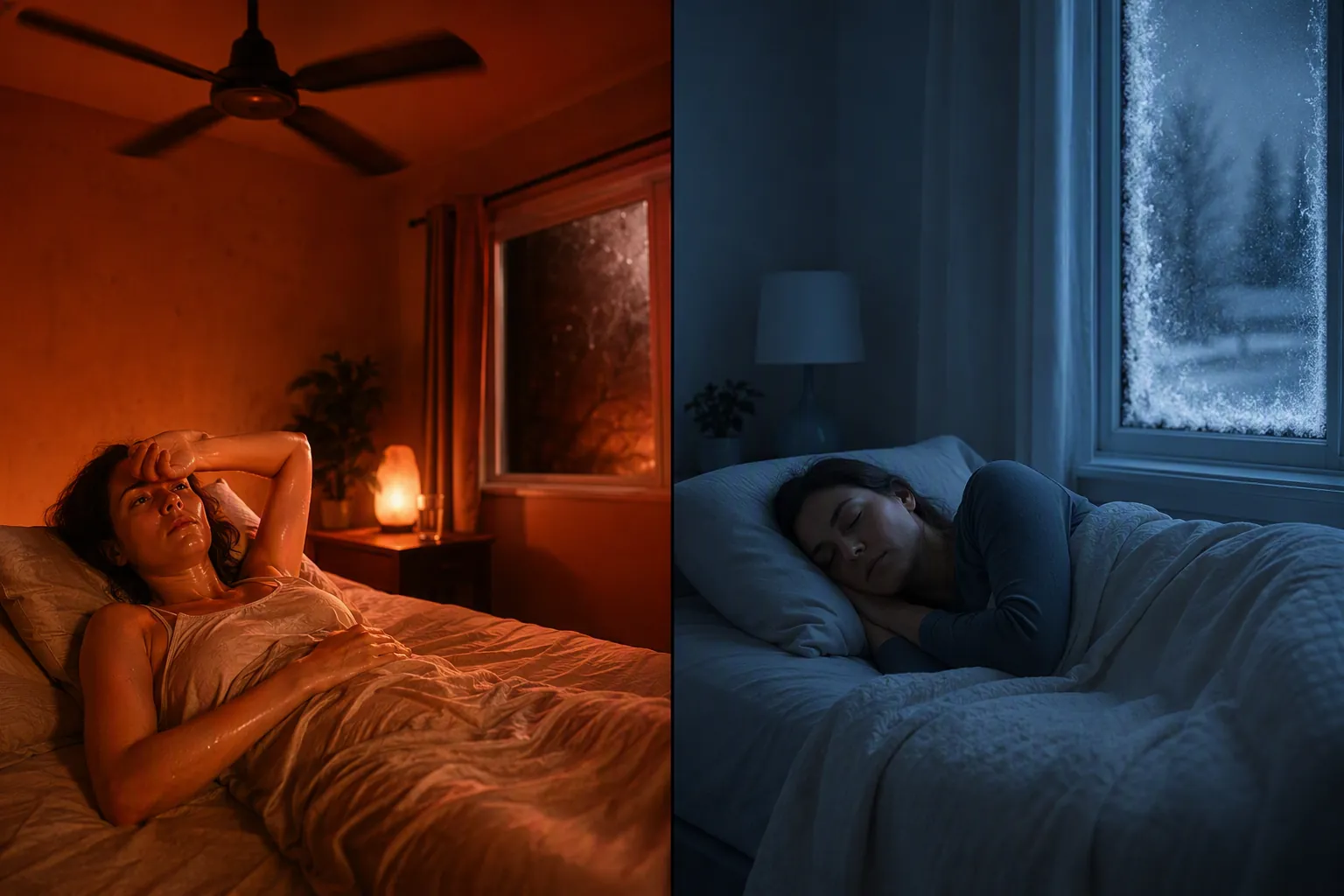
The same study also helps set a boundary that is easy to lose in winter advice. Sleep efficiency did not simply improve as outdoor temperatures fell forever; the relationship was U-shaped, with efficiency deteriorating below about 5°C. That supports a practical distinction: cool can help, but cold can become another sleep stressor.[2]
Why cooler can help when hormones are making sleep temperature-fragile
Sleep is not temperature-neutral. Core body temperature begins falling roughly two hours before sleep onset, and that decline is part of the physiology that helps the body enter sleep. With bedding, an often-cited comfortable room range is roughly 19–21°C, while the skin microclimate under the covers sits much warmer, around 31–35°C.[3]
That “microclimate” word is the hinge. You do not sleep in the weather report. You sleep in a layer of air between your skin, pajamas, sheets, blankets, mattress, and room. A bedroom that is technically cool can still trap heat under a dense comforter. A bedroom that feels fine at bedtime can become too warm after the heat cycles on at 2 a.m. A window cracked open can help one sleeper and make another tense up against cold air.

Perimenopause can make that margin thinner. In a classic thermoregulation study, women with hot flashes had an interthreshold zone of 0.0°C, compared with 0.4°C in asymptomatic women. In plain terms, the temperature buffer between sweating and shivering was narrowed in women with hot flashes.[4]
That finding does not mean every night waking in perimenopause is caused by room temperature. It does explain why small environmental changes can feel outsized. If your thermal comfort zone is narrowed, the same blanket, thermostat setting, or closed bedroom door may be tolerable one week and sleep-breaking the next.
When winter helps — and when the house cancels it
Cooler weather becomes useful when it lowers the heat load around the sleeping body without making the body defend against cold. That is a narrower target than “make the room cold,” and it is why some women notice better sleep in October or January while others feel no winter relief at all.
| Winter condition | How it can affect perimenopause sleep |
|---|---|
| Cool room, breathable bedding | May support the normal evening drop in core temperature and reduce heat buildup around the skin. |
| Central heating cycling overnight | Can turn a cool evening bedroom into a warm, dry early-morning bedroom. |
| Heavy blankets or heat-trapping sleepwear | Can create a hot skin microclimate even when the room itself is cool. |
| Room that feels cold rather than cool | Can increase discomfort, tension, or awakenings because the body has to defend against cold. |
| Very short or dim winter mornings | Can weaken the circadian signal that helps stabilize sleep timing. |
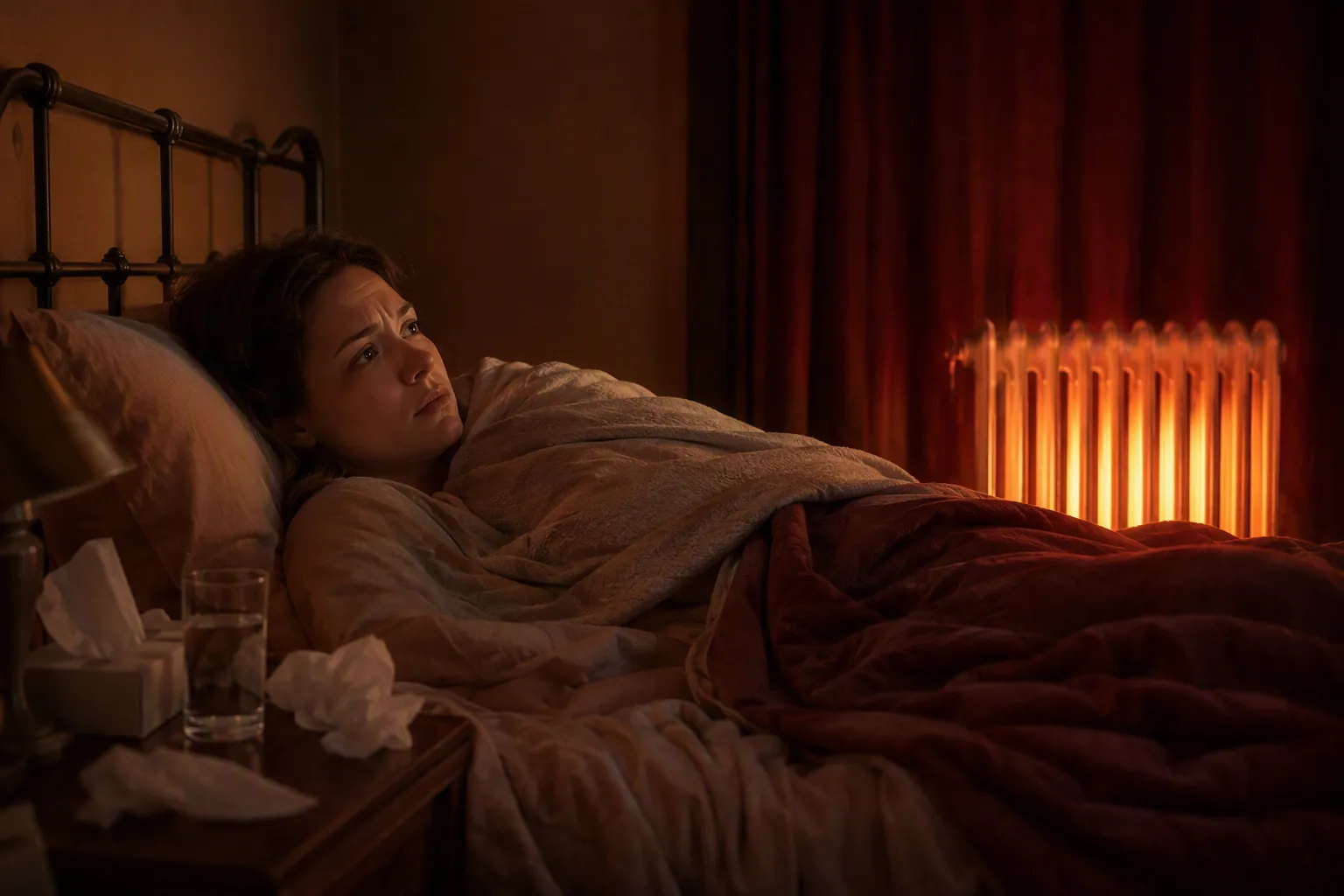
Central heating is the most common winter trap because it solves one problem by creating two others: heat buildup and dry air. In a Japanese winter housing study, bedroom heater use was associated with poorer sleep and dry nose or throat. The same study also found that perceived cold mattered: people who reported always feeling cold in the bedroom had Pittsburgh Sleep Quality Index scores 2.25 points higher than those who did not, meaning worse sleep quality.[5]
That study should be used carefully. Japanese winter bedrooms in the research context were often below 13°C, so the cold-bedroom findings do not map perfectly onto a typical heated U.S. home. But the pattern is still useful: both an overly heated room and a room that feels too cold can be sleep-hostile. The winter advantage sits between those two failures.[5]
The practical target is cool, not cold
There is no single perimenopause bedroom temperature proven to work for everyone. The best-supported direction is a cool, stable room with enough bedding flexibility that heat can escape before a full wake-up happens.
Several pieces of evidence point to the same middle zone without being identical. The wearable study found worse sleep efficiency at very low outdoor temperatures below about 5°C, which argues against romanticizing cold.[2] The winter housing paper cites the World Health Organization’s approximate 18°C minimum for bedrooms.[5] Sleep guidance commonly gives adults a target bedroom range around 60–67°F, and perimenopause sleep guidance from Stanford Lifestyle Medicine and the Apple Women’s Health Study also emphasizes a cool sleep environment.[6][7]
Those numbers are not interchangeable. Outdoor temperature, room temperature, bed temperature, and skin microclimate are different measurements. A bedroom at 65°F with a heavy comforter can feel hotter to the body than a room a few degrees warmer with lighter, more adjustable layers. For perimenopause sleep, the better test is what happens between midnight and morning: fewer heat surges, less sweating, less tossing off covers and pulling them back on, and fewer awakenings from dry throat or chill.
A simple winter sleep experiment that does not turn your bedroom into a project
If you suspect cooler weather improves your sleep quality in perimenopause, test the room you actually sleep in rather than trying to copy a perfect number. Keep the experiment boring: change one condition for several nights, then decide whether awakenings, night sweats, or morning grogginess changed enough to matter.
- Start with the thermostat, not the window. If heat cycles on overnight, try a slightly lower nighttime setting before adding cold outdoor air.
- Make bedding easier to vent. One lighter blanket plus an optional layer is often more forgiving than one heavy, heat-trapping cover.
- Notice dryness separately from heat. Waking with a dry nose or throat may point to heated dry air rather than a perimenopause symptom alone.
- Do not force cold exposure. If you tense up, wake chilled, or pile on more bedding to compensate, the room is no longer helping the sleep-temperature system.
- Track the second half of the night. Many heat-linked wakings show up after several hours under covers, not at bedtime.
This is also where symptom tracking can be more honest than memory. A few notes — bedtime room feel, bedding, heater use, night sweats, wake time, morning light exposure — can reveal whether January is helping you or whether the house is quietly recreating August under the covers.
Winter can still hurt sleep through light and mood
Temperature is not the only seasonal signal. Short winter daylight can make sleep feel heavier, later, and less refreshing, especially for people vulnerable to seasonal affective disorder. The American Academy of Sleep Medicine’s Sleep Education site notes that more than 10 million Americans may have seasonal affective disorder, that it is more common in women, and that people with SAD may sleep more than two extra hours per night in winter while also having more difficulty waking.[8]
That is one reason winter is not automatically the easy season. A cooler bedroom may reduce heat-related waking while darker mornings make the sleep schedule drift. For some women, the fix is not more cooling at all; it is keeping morning light and wake time steady enough that the circadian system gets a clear daytime signal.
So, does cooler weather actually improve perimenopause sleep?
On average, yes. The perimenopause-specific SWAN data show the lowest reported hot flashes, night sweats, and trouble sleeping in January, and objective seasonal sleep data from a broader population show longer, more efficient sleep in cool months.[1][2] The mechanism is plausible: sleep onset depends partly on a falling core temperature, and hot-flash physiology narrows the comfortable thermal buffer.[3][4]
But the season only gives you an opening. The sleep-relevant question is whether your bedroom stays cool without becoming cold, dry, or heat-trapping. January’s advantage is real in the data; the forecast is only the starting point.
References
- Seasonal variation in self-reported hot flashes, night sweats, and trouble sleeping: The Study of Women’s Health Across the Nation, Menopause, 2020
- Seasonal Variations in Sleep in Japan: A Nationwide Observational Study Using a Wearable Device, Frontiers in Digital Health, 2021
- The Temperature Dependence of Sleep, Frontiers in Neuroscience, 2019
- Reduced thermoregulatory null zone in postmenopausal women with hot flashes, American Journal of Obstetrics and Gynecology, 1999
- Perception of bedroom environment and sleep quality in winter, Nagoya Journal of Medical Science, 2021
- Sleep & Perimenopause, Stanford Lifestyle Medicine
- Sleep Patterns and Changes in Perimenopause, Apple Women’s Health Study, Harvard T.H. Chan School of Public Health
- How Seasonal Affective Disorder Disrupts Sleep, Sleep Education, American Academy of Sleep Medicine
Explore the mechanism
Next step
Spot an error or have clinical feedback?
Because this article covers clinical, medication, or safety information, we use a moderated correction channel instead of open public comments. Let us know if something about “Does cooler weather actually improve perimenopause sleep?” needs a closer look.
Send feedback on this article