
Is August really the worst month for perimenopause sleep?
An evidence-backed answer to whether August heat truly costs perimenopausal women more sleep. Named studies show vasomotor symptoms peak in summer, heat's per-degree sleep toll nearly triples versus winter, and the effect does not ease by late August — the seasonal hit is real, not imagined.
August can feel like the worst month for perimenopause sleep because it sits inside a real summer peak. The honest version is more precise than the complaint: the evidence does not prove that August, as a single calendar month, is uniquely cruel. It does show that late-summer nights land where several burdens overlap — vasomotor symptoms are seasonally higher, heat takes more sleep per degree in summer than in winter, and that summer sleep penalty does not appear to fade by the end of the season.
That distinction matters if you have already done the obvious things — lighter bedding, cooler shower, fan, thermostat negotiations — and are still waking drenched, changing position on damp sheets, then checking the clock with the particular dread of someone who has to be functional in the morning. A bad night can be random. A run of late-August nights can be a pattern. The better question is whether the pattern has been measured.

The perimenopause-specific evidence points to a summer peak
The strongest evidence for the “this month really is different” feeling comes from the Penn Ovarian Aging Study, published in Menopause in 2020. In that analysis, the odds of hot flashes, night sweats, and trouble sleeping were 66%, 50%, and 24% greater at the seasonal peak than at the seasonal minimum.[1]
Those numbers are useful because they are not just saying that summer is uncomfortable. They connect the season to the exact cluster that ruins sleep in perimenopause: the internal heat event, the sweat, and the sleep complaint that follows. The study’s seasonal peak is not a claim that every woman will have 66% more hot flashes in August, and it is not a ranking of all twelve months from best to worst. It is an odds comparison across the seasonal cycle: at the peak, these symptoms were substantially more likely than at the low point.
That is the difference between vague validation and a measurement that earns its place. If night sweats are appearing more often in late summer, the Penn data give that experience a seasonal frame. The body has not necessarily become newly unreliable; it may be meeting a month that sits near the high point of a symptom rhythm already seen in midlife women.
It is also why August should be handled carefully. The study supports a summer seasonal peak, not a standalone August verdict. But for someone living through late summer in the United States, “August feels worse” is a defensible inference from summer-peaking vasomotor symptoms — as long as it is not dressed up as proof that one named month has been scientifically crowned.
Summer heat takes more sleep per degree, and August does not get a pass
The Penn study tells us that perimenopause symptoms have a seasonal rhythm. A separate sleep-and-temperature analysis explains why a late-summer hot night can still cost so much sleep even after weeks of warm weather. Minor et al., published in One Earth in 2022, found that each 1°C increase in nighttime minimum temperature was associated with about 0.55 minutes less sleep in summer, compared with about 0.20 minutes less sleep in winter — nearly a threefold larger per-degree sleep loss in summer.[2]
That finding answers a more technical version of the 3 a.m. suspicion. The same temperature change does not appear to have the same sleep cost in every season. Heat at night is not simply one more comfort problem layered onto an otherwise stable sleep system; in summer, the measured sleep penalty per degree is larger.
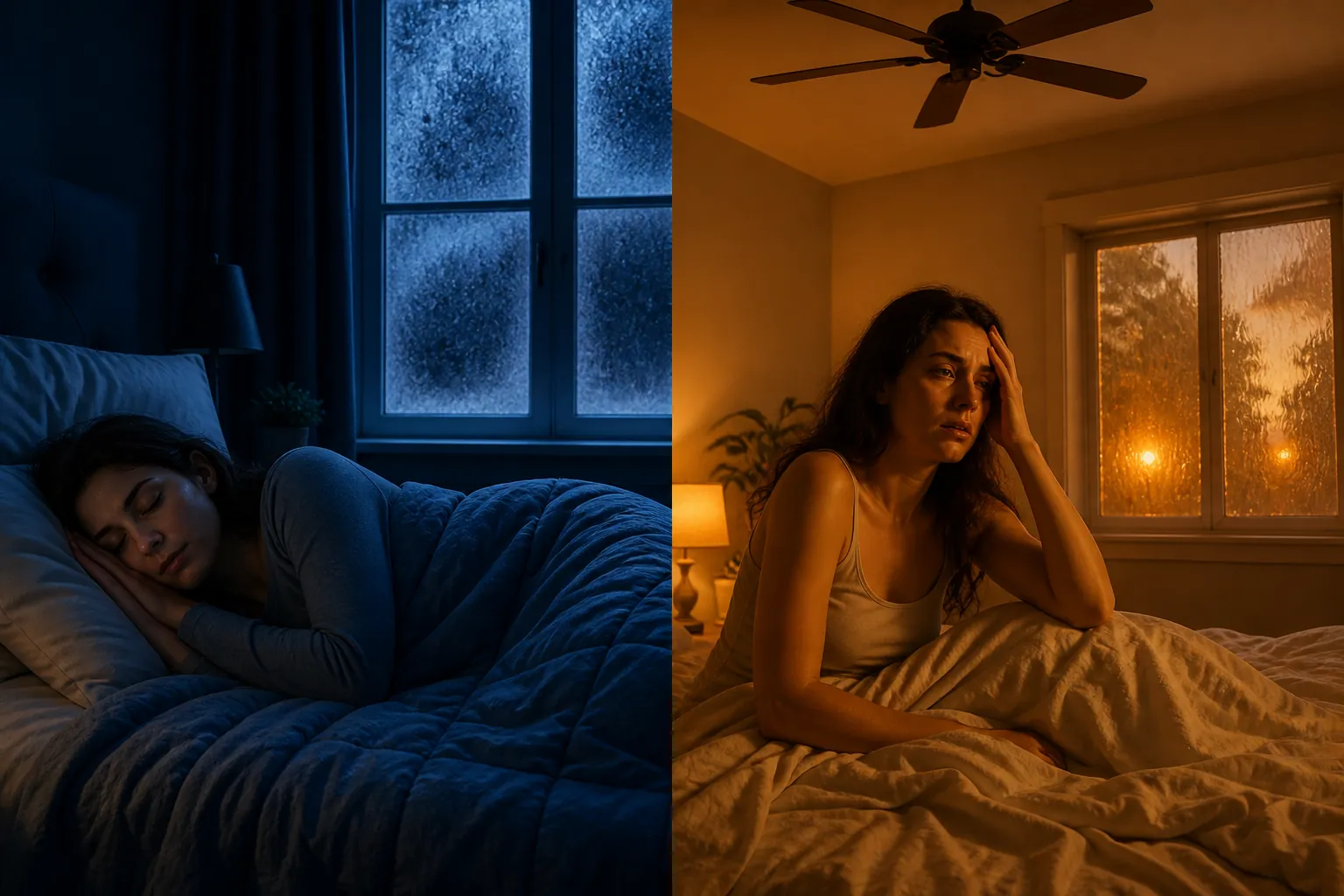
The part that may feel least fair is the lack of obvious late-summer adaptation. In the same analysis, the sleep loss per degree in the last summer month was similar to, or marginally larger than, the loss in the first summer month; for the Northern Hemisphere comparison, August did not look easier than June.[2] So if you have been telling yourself that your body should have adjusted by now, the data do not give that expectation much support.
The absolute-temperature findings are more concrete. On nights above 30°C, sleep was about 14 minutes shorter than in the least-affected temperature bin. When nighttime minimum temperatures rose above 25°C, the probability of a short night — defined as less than 7 hours of sleep — increased by 3.5 percentage points.[2] Fourteen minutes can sound small if it is treated like a neat subtraction from a calm night. It feels different when it is attached to a sweat-soaked wake-up, a sheet change, and the lighter sleep that follows.
There is a geographical catch, too. Minor et al. found larger per-degree sleep losses in already-warm regions, which means the same late-summer pattern may bite harder where nights start from a warmer baseline.[2] A southern August is not just a northern August with more complaining; the nighttime floor can sit higher, and the sleep penalty can accumulate from there.
What this evidence does not support is a dramatic claim that women lose vastly more sleep per degree of heat than men. The same paper estimated a modest female-versus-male difference in per-degree sleep loss, about −0.34 versus −0.27 minutes per °C.[2] For perimenopause, the more convincing story is not an exaggerated sex gap in heat sensitivity. It is the collision of summer heat with a life stage in which hot flashes, night sweats, and trouble sleeping are already seasonally more likely.
Climate change is the outer layer, not the whole explanation
The seasonal pattern is enough to explain why late summer can feel worse. Climate change adds another layer: more heat retained at night, placed on top of perimenopause and on top of summer’s stronger per-degree sleep penalty.
Climate Central estimated that across 253 U.S. cities, higher nighttime temperatures cost the average person about 36 hours of sleep per year during 2020–2025. Of that annual sleep loss, about 4 hours — roughly 13% — was attributable to human-caused climate change. The climate-attributable share has roughly tripled in U.S. cities since the early 1970s.[3]
That does not mean climate change caused any one August night sweat. It means the background conditions are shifting in the direction that makes bad sleep more likely: hotter nights, more hours above sleep-disrupting thresholds, and less relief after sunset. NPR’s explanation is bluntly relevant here: nights are the sleep problem because nighttime temperatures are warming faster than daytime temperatures, with the shallow near-ground air layer trapping heat absorbed during the day.[4]

This is where it helps not to flatten the explanation. A single bad night may come from one hot bedroom, one late meal, one stress spike, one hormone-driven sweat, or no obvious reason at all. A seasonal pattern is different: the odds of vasomotor symptoms rise, summer heat extracts more sleep per degree, and the hoped-for August adaptation may not arrive. A climate trend is wider still: the night itself is becoming less cooling in many places.
So is August really the worst month?
As a strict scientific claim, “August is the worst month for perimenopause sleep” goes one step beyond the available evidence. The better-supported claim is that late-summer August nights sit inside a credible peak zone: vasomotor symptoms are seasonally higher, heat-sensitive sleep loss is stronger in summer than winter, and the per-degree penalty does not clearly ease by the end of summer.
That is enough to take the experience seriously without overnaming the villain. If your sleep is worse in August, the pattern is not automatically a personal failure, a sudden collapse of resilience, or proof that every future month will be like this. It is a measurable seasonal burden landing on a body already dealing with perimenopausal heat disruption.
This piece is not going to pretend the answer is another checklist of fans, showers, sheets, and thermostat targets. If you need the tactics, use the practical guides on sleeping in extreme heat during perimenopause and sleeping through a heat advisory when you’re perimenopausal. If humidity is part of the misery, the Florida heat and night-sweats guide is the more specific place to go. The point here is narrower: August may not be proven uniquely worst, but late-summer heat disrupting perimenopause sleep is real enough to show up in the data.
References
- Seasonal variation of hot flashes and night sweats in the Penn Ovarian Aging Study, Menopause, 2020
- Rising temperatures erode human sleep globally, One Earth, 2022
- Climate Change is Costing People Sleep, Climate Central, July 15, 2026
- Hot nights cost sleep. Climate change is making it worse, NPR, July 22, 2026
Explore the mechanism
Next step
Spot an error or have clinical feedback?
Because this article covers clinical, medication, or safety information, we use a moderated correction channel instead of open public comments. Let us know if something about “Is August really the worst month for perimenopause sleep?” needs a closer look.
Send feedback on this article