
Evidence-Based Sleep Treatments After Earthquake Trauma
Earthquake-related insomnia and nightmares often don't respond to generic sleep advice. This guide reviews the two evidence-based treatments—CBT-I and Imagery Rehearsal Therapy—that have the strongest support for trauma-disrupted sleep.
If it has been several weeks since the earthquake and sleep still has not returned, the question changes. The problem is no longer whether a darker room, a calmer evening routine, or fewer headlines might help. Those measures can still be supportive, especially in the first nights after a disaster, but persistent sleep issues after earthquake trauma need a different level of care: one that treats insomnia and nightmares as trauma-disrupted sleep, not as a failed bedtime habit.
This article is educational, not a diagnosis or a substitute for medical care. If insomnia, nightmares, panic, intrusive memories, severe daytime impairment, PTSD symptoms, or thoughts of self-harm are present, the safest next step is clinical evaluation. The same is true if you are using alcohol, sedating over-the-counter products, or other substances to get through the night.
The treatment map is relatively plain: Cognitive Behavioral Therapy for Insomnia, usually called CBT-I, is the strongest non-drug treatment framework for persistent insomnia; Imagery Rehearsal Therapy, or IRT, is the best-supported behavioral treatment for trauma-related nightmares. They can be combined because they work on different parts of the same night. CBT-I targets the learned pattern of lying awake, monitoring, and losing confidence in sleep. IRT targets the recurring dream sequence that makes sleep feel like another exposure.
If you are still in the acute phase, the first priority may be basic safety, shelter, aftershock planning, and nervous-system settling rather than formal insomnia treatment. For that stage, see this phased guide to sleeping after an earthquake or the more anxiety-focused guide, Earthquake Anxiety Keeping You Awake? Once sleep has stayed impaired for weeks, however, continuing to repeat only early-stage advice can leave a survivor doing more and more work with less and less return.
When earthquake sleep disruption stops being ordinary
Bad sleep immediately after an earthquake is not, by itself, a sign that something has gone wrong. The body has learned that the ground can move without warning. A person may wake at small noises, sleep lightly, keep shoes near the bed, or resist the vulnerable moment of falling asleep. In the first days, that vigilance may sit close to survival behavior.
The clinical concern grows when the danger has changed but the night has not. Weeks later, the person may still spend long stretches awake scanning for aftershocks, replaying the collapse or evacuation, waking from nightmares, or avoiding sleep because dreams feel too close to the original event. The next day is not just tiring; it becomes harder to work, care for children, make decisions, drive safely, attend appointments, or tolerate normal stress.
Earthquake sleep research is not perfect, but it is strong enough to make one point impossible to dismiss: for many survivors, sleep disturbance outlasts the news cycle. In a study highlighted by the American Academy of Sleep Medicine, 94% of surveyed Haiti earthquake survivors reported insomnia, and 42% showed clinically significant PTSD two years later; the sample included 165 participants, so the figure should not be treated as a universal earthquake rate, but it does show the scale that can appear in an exposed group [1].
A study of Wenchuan earthquake survivors living in temporary housing found that 83.2% had sleep problems 17 to 27 months after the earthquake, and 79.3% of those with sleep problems identified insomnia as their primary symptom [2]. That detail matters. Telling someone in temporary housing to perfect a bedroom routine can miss the actual problem: the bed, the building, the neighborhood, and the future may all still feel unsettled.
The Wenchuan study also has limits. Like many disaster-sleep studies, it relied on self-report measures rather than overnight sleep-lab testing [2]. That means it is useful for understanding symptom burden, not for making precise claims about sleep architecture. Prevalence also changes depending on who is studied, when they are studied, where they are living, and what instrument is used. The responsible conclusion is narrower and still important: persistent insomnia and nightmares after earthquakes are common enough that survivors should not be sent back to generic sleep tips as if they are simply undisciplined.
Why sleep hygiene is supportive, not the treatment
Sleep hygiene is not useless. Reducing caffeine late in the day, protecting a wind-down period, getting morning light, and keeping the sleep area as safe and predictable as possible can all reduce unnecessary strain on the system. The problem is that sleep hygiene was never designed to carry the full weight of trauma-conditioned insomnia.
After an earthquake, the barrier to sleep may not be a missing routine. It may be a learned association: bed equals vulnerability, darkness equals reduced control, sleep equals failure to detect danger. A person can put the phone away and still lie there listening for movement in the walls. They can avoid late coffee and still wake from the same dream at 3 a.m. The surface behavior looks like insomnia; underneath it is often threat monitoring.
That distinction is why an evidence hierarchy matters. General tips may sit low on the ladder for chronic or trauma-linked insomnia, while structured therapies change the behavior and beliefs that keep the sleep problem alive. For a broader comparison, this evidence-tier guide to sleep tips explains why common advice and clinical treatments should not be treated as interchangeable.
Alcohol and over-the-counter sedating products deserve particular caution. They may make someone feel knocked out, but sedation is not the same as restored sleep. Alcohol can fragment sleep later in the night, worsen breathing risk in susceptible people, and blunt the emotional processing that healthy sleep is supposed to support. OTC sleep aids can cause next-day grogginess, falls, confusion, medication interactions, and a false sense that the problem has been treated when the trauma-sleep loop is still intact. A clinician can help weigh short-term medication use when it is appropriate, but self-medicating night after night is a poor substitute for treatment.
CBT-I: rebuilding the conditions for sleep after threat
CBT-I is not a list of calming suggestions. It is a structured behavioral treatment that usually includes sleep tracking, stimulus control, sleep restriction or sleep compression, cognitive work, and relapse planning. In ordinary chronic insomnia, it helps reverse the pattern of spending too much time in bed awake, frustrated, and alert. After earthquake trauma, the same tools often need a trauma-informed frame, because the alertness may have started as protection.
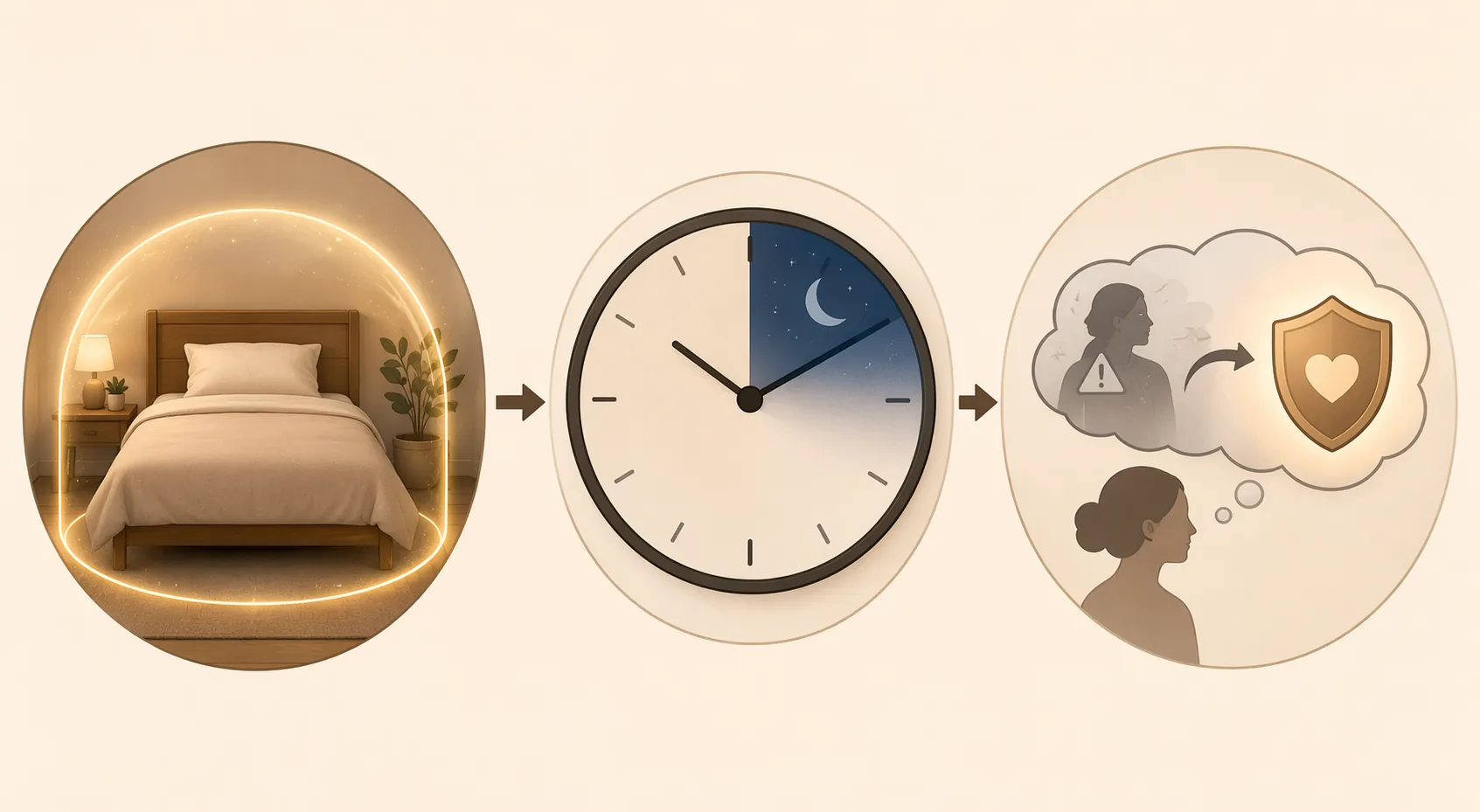
A good CBT-I clinician does not simply tell an earthquake survivor to get out of bed after 20 minutes as if the person were restless for no reason. The work starts by identifying what the bed has become. For some survivors, it is the place where the shaking began. For others, it is where they listened for aftershocks, waited for children to breathe, or replayed whether they should have moved faster. Stimulus control tries to rebuild the bed as a cue for sleep rather than a cue for surveillance.
In practice, that may mean leaving the bed when wakefulness turns into sustained monitoring, doing something quiet in a pre-selected safe place, and returning only when sleepiness is present. The point is not punishment. The point is to stop training the brain that bed is where the night watch happens. In trauma-informed care, the plan has to respect real safety needs: exits, shoes, medication, a flashlight, a family communication plan, or aftershock instructions may need to be settled before the person can practice letting go.
Sleep restriction is often the part that sounds least compassionate and is most easily misunderstood. It does not mean depriving a vulnerable person of sleep for the sake of discipline. It means temporarily narrowing the sleep window so that fragmented, shallow sleep begins to consolidate. If someone spends nine hours in bed but sleeps in broken pieces for five, the bed has become a long arena for wakefulness. A clinician-guided sleep window aims to increase sleep pressure, reduce long awake periods, and then expand time in bed as sleep becomes more efficient.
This part should be supervised carefully when there is severe daytime sleepiness, bipolar disorder, seizure risk, unsafe driving, unstable medical illness, or other complicating factors. Earthquake survivors may also be dealing with injuries, crowded housing, caregiving demands, or shift work after displacement. CBT-I is structured, but it is not supposed to be rigid in the face of unsafe circumstances.
The cognitive part of CBT-I is where earthquake-related insomnia often becomes most visible. The belief may not be “I am bad at sleeping.” It may be “If I fall asleep, I will not sense the next aftershock,” “If I dream, I will be back there,” or “If I stop listening, I am putting my family at risk.” These beliefs should not be mocked or brushed aside. They are attempts to preserve safety. Treatment asks whether the strategy is still protecting the person or whether it is now keeping the body in a state where recovery cannot happen.
A trauma-informed CBT-I plan may separate realistic preparedness from endless vigilance. Preparedness can happen before bed: check official updates, secure a safe exit path, place essential items nearby, agree on a family plan. Vigilance is what continues after those steps are complete: listening, bracing, scanning, replaying. CBT-I does not ask a survivor to pretend the earthquake never happened. It asks the nervous system to learn that the safety plan is allowed to hold the night, so the body does not have to.
For readers who want background on how hyperarousal can keep trauma and sleep locked together, this trauma-sleep explainer on Prince Harry’s sleep struggles covers the mechanism in a different context. The mechanism matters because insomnia after trauma is rarely just a nighttime problem. Poor sleep can make daytime threat perception sharper, emotional regulation weaker, and the next night more difficult.
What CBT-I usually asks the survivor to do
| Treatment element | What it targets after earthquake trauma | What it can look like in care |
|---|---|---|
| Sleep diary | Unclear patterns, underestimated sleep, long awake periods | Tracking bedtimes, wake times, awakenings, naps, nightmares, and daytime impairment |
| Stimulus control | Bed becoming linked with fear, scanning, or replaying | Using bed mainly for sleep and leaving bed when wakefulness becomes sustained alertness |
| Sleep restriction or compression | Fragmented sleep spread across too much time in bed | Temporarily narrowing the sleep window, then expanding it as sleep consolidates |
| Cognitive restructuring | Beliefs that constant wakefulness is necessary for safety | Testing the difference between realistic preparedness and all-night monitoring |
| Relapse planning | Aftershocks, anniversaries, repairs, relocation, or legal and insurance stress | Planning how to respond if sleep worsens again instead of starting over with panic |
That table is not a self-treatment protocol. It is a way to recognize whether a clinician is offering actual CBT-I rather than relabeled sleep hygiene. Real CBT-I is measured, adjusted, and reviewed. It asks for homework, but it should also ask what the survivor is carrying into the night.
IRT: treating nightmares as something workable
Nightmares after an earthquake can be literal or altered. Some people dream of the room shaking. Others dream of being trapped, failing to reach someone, hearing a sound, or watching ordinary ground become unreliable. The content varies, but the effect is often the same: sleep becomes a place where the person is ambushed.

Imagery Rehearsal Therapy gives the nightmare a concrete intervention. The patient writes down the recurring nightmare, changes the script while awake, and rehearses the revised version repeatedly so that the sleeping brain has a different pathway available. The revised dream does not have to be cheerful or unrealistic. It has to be different enough to reduce helplessness, terror, or repetition.
The American Academy of Sleep Medicine has described IRT as a Level A standard of care for trauma-related nightmares. A review of nightmare treatments explains the basic method: the person rescripts the nightmare and rehearses the changed version, with the goal of reducing nightmare frequency and distress [3].
The earthquake-specific evidence here is less direct than the mechanism may make it sound. Much of the IRT literature comes from PTSD populations such as veterans, sexual assault survivors, and people with mixed trauma histories, not from earthquake survivors alone [3]. That does not make IRT irrelevant to earthquakes. It means the claim should be honest: IRT is strongly supported for trauma-related nightmares, and its use after earthquake nightmares is an application of that trauma-nightmare evidence rather than proof from large earthquake-only trials.
A hypothetical example shows the logic without pretending to be a case report. A survivor repeatedly dreams that the building starts shaking and there is no exit. In IRT, the revised version might include noticing the shaking earlier, reaching a reinforced doorway, hearing a trusted voice, finding open ground, or changing the ending so the dream no longer stops at helplessness. The survivor rehearses that new version while awake. The treatment is not trying to erase memory. It is trying to stop one terrifying sequence from owning the night.
Some survivors are afraid that changing the dream means lying to themselves. That fear deserves respect. IRT is not a statement that the earthquake was safe, that losses did not happen, or that the survivor should feel fine. It is a rehearsal-based method for reducing repeated nightmare exposure. The waking record of what happened can remain truthful while the sleeping script becomes less punishing.
When CBT-I and IRT belong together
Many survivors do not have cleanly separated symptoms. They avoid bed because they cannot fall asleep, and they cannot fall asleep because they fear the nightmare. They wake from the nightmare, then spend the next hour scanning the room. By morning, they are exhausted enough to nap, which lowers sleep pressure that night. The loop is behavioral, cognitive, and emotional at the same time.
A combined non-pharmacological route makes sense when insomnia and nightmares are both maintaining the problem. CBT-I can reduce the amount of time spent awake in bed, rebuild the bed-sleep association, and address beliefs about needing to stay awake. IRT can reduce the nightmare threat that makes sleep feel unsafe in the first place. Neither treatment requires the survivor to discuss every detail of the earthquake in the way trauma-processing therapies might, though trauma-informed coordination is often important when PTSD symptoms are prominent.
- CBT-I is usually the better starting point when the main problem is long sleep latency, frequent awakenings, irregular sleep timing, or spending hours awake in bed.
- IRT becomes especially important when recurring nightmares are driving fear of sleep or causing repeated awakenings.
- A combined plan is often appropriate when nightmares trigger awakenings and insomnia behaviors keep the rest of the night unstable.
- Medical or psychiatric evaluation should come first when there is suicidality, severe depression, psychosis, substance dependence, dangerous sleepiness, untreated sleep apnea symptoms, or major medication complexity.
Disaster recovery adds practical barriers that tidy treatment descriptions can miss. A person may be sleeping in a shelter, sharing a room, dealing with repairs, or caring for relatives. CBT-I may need modification if there is no private bedroom. IRT may need pacing if writing the nightmare down is overwhelming. The treatment is evidence-based; the delivery still has to be humane.
The same trauma-sleep pattern appears after other frightening events, even when the details differ. Readers comparing disaster and accident-related sleep disruption may find it useful to read about hurricane anxiety and sleep or sleep after a car accident. The point is not that every trauma is the same. It is that sleep often becomes the place where the nervous system continues to test whether danger has ended.
What to look for in actual care
The most useful question is not whether a provider says they treat sleep. It is whether they can explain the treatment structure. For CBT-I, they should be able to describe sleep diaries, stimulus control, sleep-window adjustment, cognitive work, and how they monitor safety. For nightmares, they should be able to explain nightmare rescripting or IRT without making it sound like forced positive thinking.
A trauma-informed provider should also be able to hold two truths at once: the survivor’s vigilance once made sense, and the same vigilance may now be prolonging impairment. Care becomes thin when it treats every fear as irrational. It also becomes thin when it only validates the fear and never helps the person sleep again.
- Ask whether the provider offers CBT-I specifically, not just general sleep counseling.
- Ask how they adapt sleep restriction or stimulus control when trauma, displacement, or aftershock fear is present.
- Ask whether they use Imagery Rehearsal Therapy or another structured nightmare-focused intervention.
- Ask how they coordinate care if PTSD symptoms, depression, panic, injury, sleep apnea, or medication issues are also present.
- Ask what improvement will be measured: sleep onset, awakenings, nightmare frequency, nightmare distress, daytime functioning, or all of these.
Sleep hygiene can remain part of the plan, but it should not be the whole plan. For a focused version of what belongs in that supportive layer, see the evidence-based sleep hygiene checklist for insomnia. The clinical threshold is different when weeks have passed and the person is still afraid of the bed, still replaying the earthquake, or still waking from trauma dreams.
At that point, the evidence-supported next step is not another round of generic tips. It is finding CBT-I from a qualified clinician, a trauma-informed therapist familiar with nightmare rescripting or IRT, or an accredited sleep or behavioral sleep medicine resource that can assess the full picture and treat the part of the night that is actually keeping the person trapped.
References
- Disturbed sleep linked to mental health problems in earthquake survivors. American Academy of Sleep Medicine. 2019.
- Sleep problems in Wenchuan earthquake survivors in temporary housing. 2016.
- Nightmare Rescripting: Using Imagery Techniques to Treat Sleep Disturbances in Post-traumatic Stress Disorder. 2022.
Safety & eligibility read
Cross-check against other interventionsExplore the mechanism
Next step
Spot an error or have clinical feedback?
Because this article covers clinical, medication, or safety information, we use a moderated correction channel instead of open public comments. Let us know if something about “Evidence-Based Sleep Treatments After Earthquake Trauma” needs a closer look.
Send feedback on this article