
How Glamping Retreats Deliver Better Sleep During Menopause
A glamping retreat can help menopause sleep disruption by targeting the three physiological drivers—temperature dysregulation, circadian rhythm disruption, and elevated cortisol—but only when the site is selected for specific environmental features. This guide explains the physiology and how to choose a glamping experience that delivers real benefits.
By the time a woman starts searching for glamping retreats for better sleep during menopause, she has usually tried the sensible things already. The bedroom is cooler. The curtains are darker. The caffeine cutoff is earlier. The phone is out of reach. And still, at 3 a.m., she is awake: hot, damp, alert, and irritated by advice that seems written for someone whose body is not changing its rules overnight.
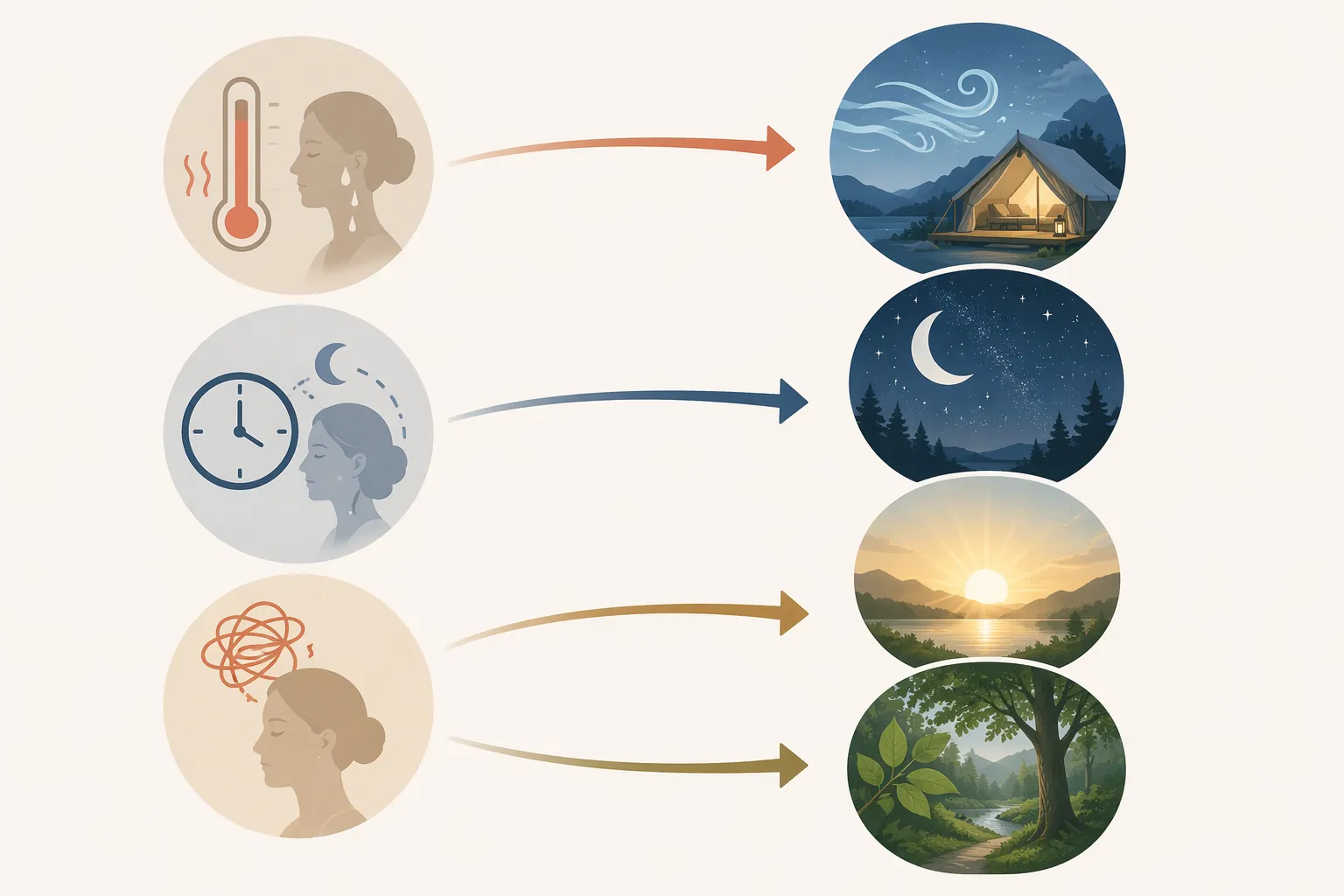
The case for glamping is not that canvas walls are charming or that a nicer mattress outdoors can do what a home mattress cannot. The more useful question is whether a site can provide four environmental conditions menopause-disrupted sleep often needs at the same time: cool night air, real darkness, easy morning light, and enough nature exposure to settle a nervous system that has been running too hot in more than one sense.
The Sleep Problem Is Not One Problem
Menopause sleep disruption is often treated as ordinary insomnia with better marketing. That misses the body mechanics. Estrogen decline is tied to thermoregulation problems and vasomotor symptoms; night sweats are repeatedly described in menopause coverage as a major driver of insomnia. Progesterone changes can contribute to more fragmented sleep. Elevated cortisol and life-stage stress can make early-morning waking feel less like grogginess and more like an alarm state with no alarm clock.[1][2]
Those drivers overlap, but they are not interchangeable. A woman waking from heat needs a different environmental assist than a woman whose circadian rhythm is being pushed later by evening light. A woman who is awake before dawn with a racing mind may need less stimulation before bed, but she may also need daytime conditions that help her stress physiology downshift earlier. A good glamping site is interesting only if it can press on several of these levers at once.
What Glamping Can Do That a Hotel Room Usually Cannot
A luxury hotel can make a room dark, quiet, and cold. Sometimes that is enough. But hotel sleep is usually engineered through insulation, blackout fabric, sealed windows, and mechanical cooling. Glamping, when chosen well, works differently: the body is placed in a climate and light environment that does more of the work passively.
That distinction matters most for temperature. Sleep onset depends partly on the body’s ability to release heat and let core temperature fall. For someone with night sweats, a thermostat set low is not the same as steady cool air around the structure. Air conditioning cycles on and off; it can overshoot, dry the air, or leave hot pockets under bedding. A site where nighttime temperatures naturally sit in the 60–68°F range gives the body a more continuous cooling background. It does not cure vasomotor symptoms, and it should not be sold as if it does. But it can reduce the environmental friction around a body already struggling to regulate heat.
This is why the season and elevation matter more than whether the tent has a soaking tub. A desert site may be a terrible sleep choice in summer and a useful one in a cooler shoulder season. A mountain platform that drops into the right temperature range at night may be more physiologically relevant than a resort room with twelve pillow options. The feature to verify is not “climate-controlled” in the brochure. It is the actual overnight low during the nights you plan to be there.
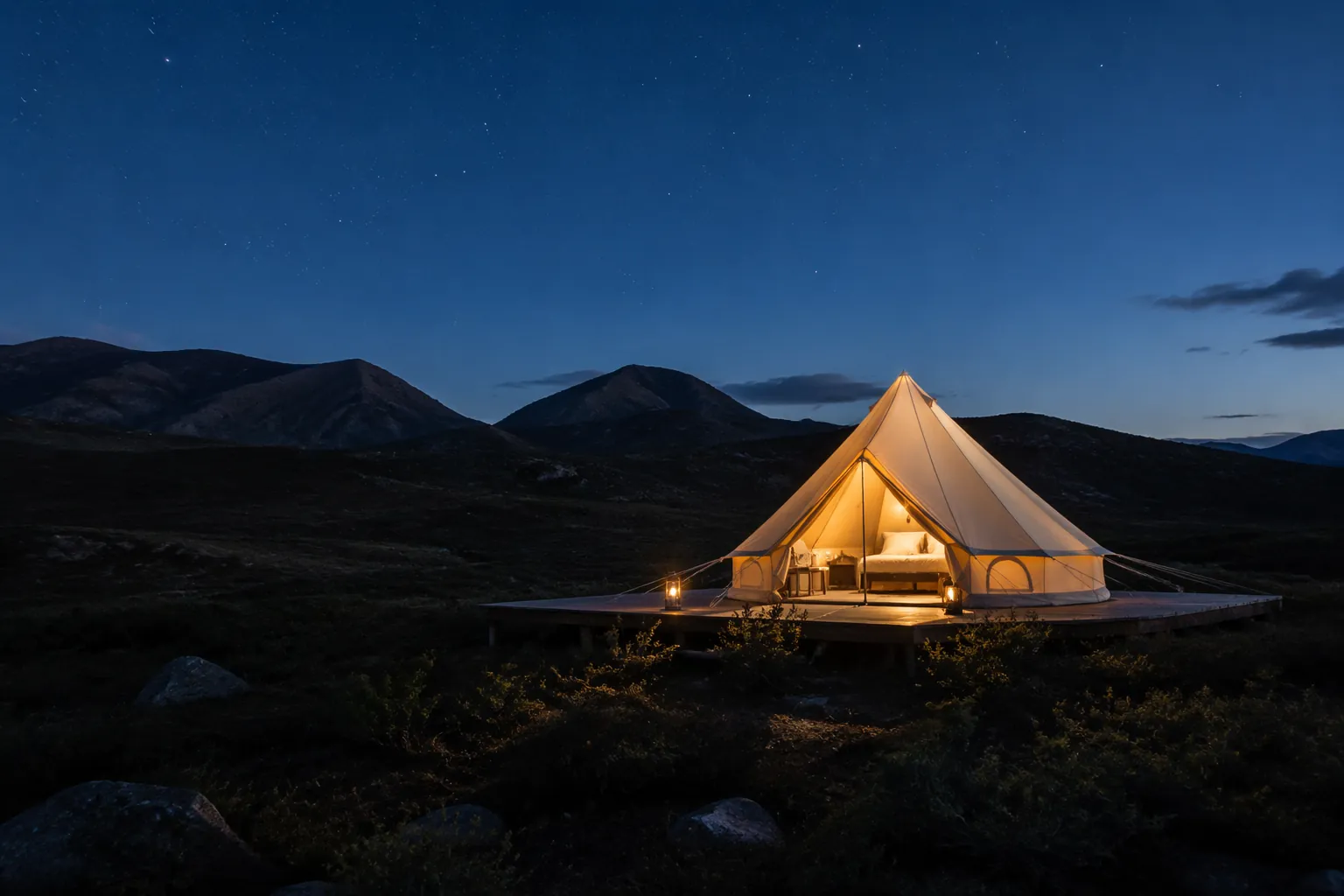
Darkness is the second part of the stack, and here the difference between decorative “stargazing” copy and measurable darkness matters. Condé Nast Traveler’s 2023 sleep-tourism reporting pointed to dark-sky glamping, including StarStruck Glamping in Alpine, Texas, near Big Bend country, as an example of sleep travel built around unusually low light pollution. The article described the area as among the least light-polluted in the lower 48 states.[3]
That example is useful because it makes “dark” concrete. International Dark Sky locations can offer nighttime conditions below 1 lux, a level that suburban bedrooms often cannot approach because light leaks in from streets, porches, neighboring houses, parking lots, and electronics.[3] StarStruck should not be mistaken for a menopause program; it is not evidence that glamping operators are treating menopause insomnia. It is evidence that some glamping environments can supply a level of darkness that is hard to reproduce at home or in a hotel corridor lit through the door crack all night.
Darkness only solves half of the circadian problem. The other half is morning light. A tent or cabin that lets a woman step outside within minutes of waking, without crossing a lobby, elevator, parking garage, or breakfast line, changes the morning sequence. Bright outdoor light early in the day helps anchor circadian timing. For menopause sleep, that matters because a fragmented night can tempt the whole day to drift: later light exposure, later alertness, later sleep pressure, another difficult night.
Nature exposure is the quieter mechanism, and it should not be inflated into a cure-all. The useful finding is narrower: forest-biology and shinrin-yoku studies have reported salivary cortisol reductions within about 20–30 minutes of nature exposure.[4] That does not mean a weekend outside resolves chronic hyperarousal. It does suggest that the setting can help move stress physiology in the right direction before bedtime, especially when the day includes unstructured time outdoors rather than a packed itinerary of wellness appointments.
The Menopause Retreat Market Is Not the Same Thing
Dedicated menopause retreats have become visible enough that a woman comparing options may find herself choosing between a medicalized wellness weekend, a spa resort, and a simple place to sleep outside. Published coverage has described programs ranging from Kripalu’s menopause retreat pricing at $545 for six nights plus accommodation, to the Feisty Menopause weekend around $2,500, to Canyon Ranch’s M/Power program at about $7,000 for four days, and Indagare trips at $12,000 and up.[1][5][6][7]
Those programs may offer education, community, movement, nutrition guidance, or access to clinicians, depending on the retreat. That is a different product from a glamping stay. Typical glamping costs are often discussed in the broader market as roughly $200–600 per night, but that range is not menopause-specific and will vary by location, season, and structure type. The reason to consider glamping is not that it is a cheaper menopause retreat. It is that the environment itself may be the intervention worth testing.
As of Q3 2026, the important gap is plain: there is no well-established category of glamping retreats explicitly designed and studied for menopausal sleep. The current argument is physiological and practical, not product-based. A reader is selecting conditions that match known sleep drivers; she is not buying proven menopause insomnia treatment in tent form.
A Site-Selection Filter That Starts With the Body
The fastest way to make glamping irrelevant to menopause sleep is to choose it like a vacation photo. The right filter is less glamorous and more useful.
| Condition to Verify | Why It Matters for Menopause Sleep | What to Check Before Booking |
|---|---|---|
| Cool nights | Supports the core temperature drop needed for sleep onset and may reduce heat load during night sweats | Actual overnight lows for the dates booked; aim for the 60–68°F range |
| Dark-sky setting | Limits nighttime light exposure that can interfere with circadian signaling | International Dark Sky proximity, rural light maps, tent placement away from paths and parking lights |
| Blackout-capable construction | Prevents early artificial light or sunrise from ending sleep too soon | Canvas thickness, window coverings, door gaps, nearby site lighting |
| Immediate morning light | Helps re-anchor circadian timing after fragmented sleep | Ability to step outside into open sky soon after waking |
| Real nature immersion | Gives the nervous system repeated low-demand exposure rather than scheduled relaxation performance | Walking access, quiet outdoor seating, low traffic noise, limited itinerary pressure |
The temperature line deserves the least compromise. If the forecasted low is too warm, the stay becomes an outdoor version of the same problem. Air conditioning in a tent may make the listing more comfortable, but it does not replace a climate that cooperates all night. For women whose worst symptom is waking drenched, booking by season is not a detail; it is the intervention.
The darkness line also needs verification. “Remote” does not always mean dark. A site can be rural and still have floodlights around the bathhouse, string lights on every platform, or vehicle headlights crossing the tent wall. Ask whether exterior lights are motion-triggered, whether they can be turned off, and how far the sleeping structure sits from communal paths.
Morning light should be easy enough that it happens before decision fatigue begins. If getting light requires dressing fully, driving to a trailhead, or waiting for a guided activity, it is less likely to become part of the sleep reset. The best version is almost embarrassingly simple: wake, open the flap or door, step into outdoor light, and let the body receive a clear daytime signal.
What Glamping Should Not Be Asked to Treat
A well-chosen glamping stay can reveal something valuable: whether cooler air, darker nights, morning light, and less indoor stimulation noticeably reduce wakeups. That is a useful diagnostic experience. It can help a woman separate “my habits are bad” from “my environment is working against a body in transition.”
It is not a substitute for care. Chronic insomnia is commonly treated with CBT-I, which typically requires 4–8 weekly sessions; a weekend outside cannot reproduce that behavioral treatment structure. Severe vasomotor symptoms may warrant a discussion of hormone therapy or other medical options. Snoring, gasping, marked daytime sleepiness, restless legs, sudden symptom changes, or signs of thyroid disease deserve evaluation rather than another environmental workaround.
Readers comparing environmental changes with treatment options may want a more evidence-ranked view of perimenopause insomnia treatments. If medication-adjacent choices are already on the table, a separate comparison of suvorexant and melatonin for insomnia may be more relevant than booking another trip. And because perimenopause sleep disruption can connect with broader cardiometabolic risk, night sweats and repeated short sleep also belong in a larger health conversation about sleep in perimenopause.
The Calibrated Answer
Glamping retreats can help some women sleep better during menopause when they are chosen for physiology rather than atmosphere. The site has to do real work: keep the night naturally cool, protect darkness, make morning light immediate, and put the body in contact with nature long enough for stress physiology to shift. If those conditions are missing, the stay may still be pleasant, but it is not a serious sleep intervention.
The honest promise is modest and still worthwhile. Glamping can be an environmental adjunct and a way to learn what helps the body sleep. It should sit alongside evidence-based menopause and insomnia care, not compete with it.
References
- What Are Menopause Retreats and How Do They Help? — National Geographic
- Menopause Retreats Are the Next Big Thing in Wellness — CNN
- Sleep Tourism Is Trending, With A.I.-Equipped Hotel Beds and Glamping Under Dark Skies — Condé Nast Traveler, 2023
- Japanese forest-bathing / shinrin-yoku studies on salivary cortisol — PubMed
- Are Menopause Retreats Worth It? — Women’s Health
- What Happened When I Went to a $7,000 Menopause Retreat — Good Housekeeping
- These Retreats Help Women Navigating Menopause — AFAR
Explore the mechanism
Next step
Spot an error or have clinical feedback?
Because this article covers clinical, medication, or safety information, we use a moderated correction channel instead of open public comments. Let us know if something about “How Glamping Retreats Deliver Better Sleep During Menopause” needs a closer look.
Send feedback on this article