
How to Manage Perimenopause Insomnia During an El Niño Winter
Warm El Niño winter nights compound the hot flashes and night sweats of perimenopause, creating a dual thermoregulatory challenge. This guide explains why your sleep is worse during an El Niño winter and offers evidence-based remedies that address both internal heat and external heat simultaneously.
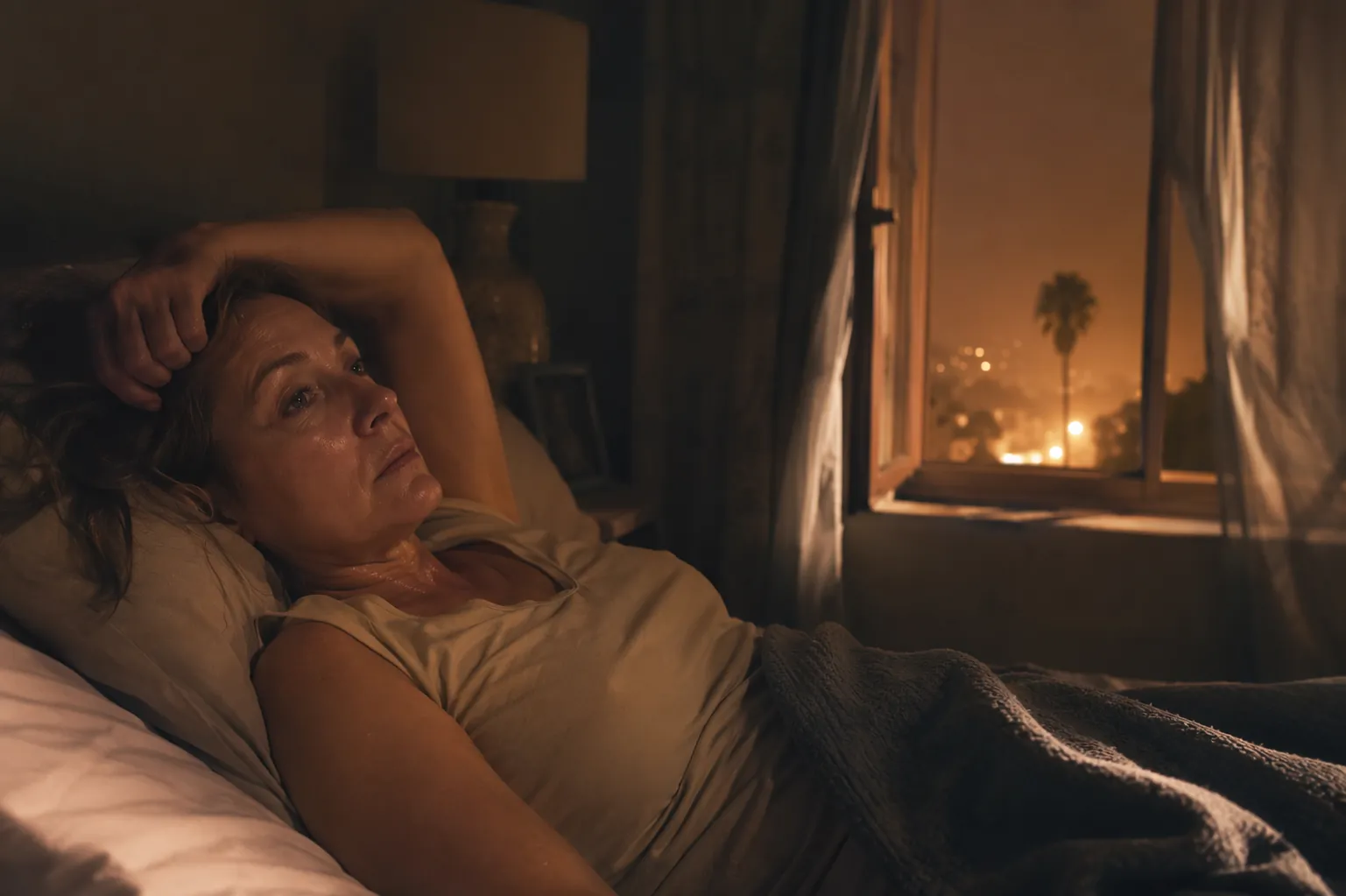
The hard part about a warm El Niño winter is not that the calendar is wrong. It is that your body may be counting on winter to do a job it usually does quietly: give the bedroom enough cool air to recover after a hot flash or night sweat. When that relief is weaker, a 2:40 a.m. sweat episode can turn into changing a shirt, flipping the pillow, checking the thermostat, and then lying awake long after the heat has passed.
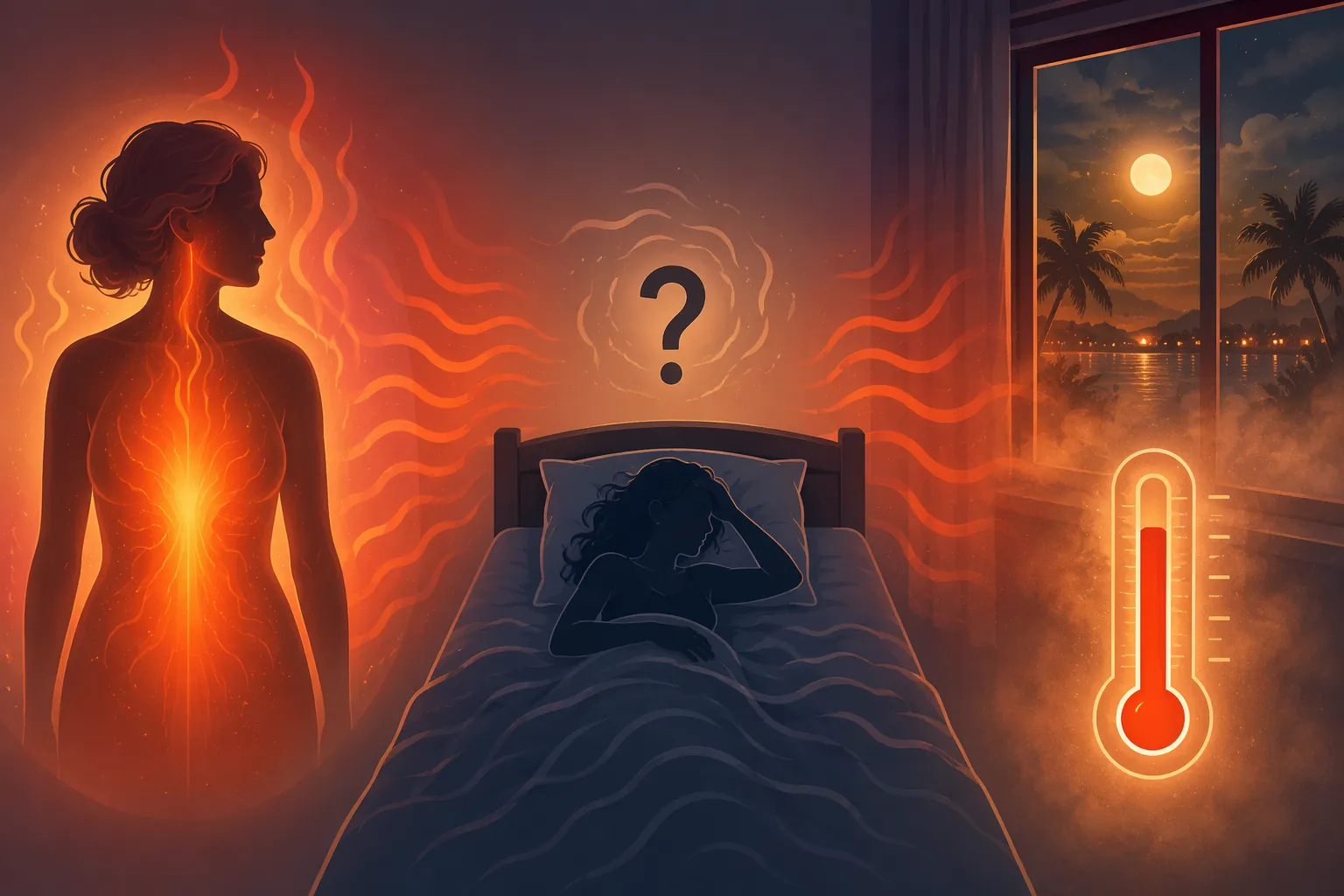
For perimenopausal women, that is a different problem from simply buying lighter pajamas. Vasomotor symptoms are already making the body’s comfort zone narrower from the inside. El Niño can add warmer nights, wetter regional patterns, and in some places air-quality stress from the outside. The result is not one clean cause of insomnia. It is two imperfect heat-control systems colliding in the same bed.
Why This Winter Can Feel Different
NOAA announced in June 2026 that El Niño had formed, with a 96% chance of persisting through winter 2026-2027 and a 63% chance of reaching “very strong” status.[1] That does not mean every region gets the same winter, and it does not mean every warm bedroom can be blamed on El Niño. It does mean this is a reasonable winter to pay closer attention to nighttime heat, humidity, and how your usual hot-flash routines are holding up.
In practical terms, El Niño often shifts the winter jet stream, tending to bring warmer conditions to parts of the northern United States and wetter conditions across the southern tier.[2] The National Weather Service describes these winter impacts regionally rather than as a single national forecast, which matters because a woman in the Upper Midwest, the Gulf Coast, and the Southwest may be dealing with different mixtures of warmth, dampness, heating-system use, and ventilation.[3]
The sleep problem begins when nighttime temperature stops falling enough to help the body shed heat. A large U.S. survey study found that each 1°C increase in nighttime temperature was associated with about three additional nights of insufficient sleep per 100 people per month. The same analysis found stronger effects in older adults and greater effects in women than in men.[4] The survey data came from 2002-2011, and air conditioning access and habits have changed since then, so the exact size of the effect should not be treated as fixed for 2026. The direction of the problem is still useful: warmer nights make insufficient sleep more likely, and not everyone is affected equally.
The Perimenopause Layer: Heat From the Inside
A hot flash is not just feeling a little warm. During perimenopause, the body can become quicker to launch heat-loss responses: flushing, sweating, a racing sensation, and sudden wakefulness. By the time you are fully awake, the sweat has already done its damage. The bed is damp, the skin cools unevenly, and the brain has received enough alarm signals to make returning to sleep harder.
This is where the larger temperature-sleep studies are helpful, not because they prove a special diagnosis called “El Niño winter insomnia,” but because they give scale to a private experience. A 2025 Nature Communications study analyzed 23 million wearable sleep records from Huawei users in China and found that women were significantly more susceptible than men to temperature-driven sleep insufficiency and sleep loss.[5] The study did not measure indoor bedroom temperature or air-conditioning use, and its population is not the same as U.S. perimenopausal women. Still, it is notable because sex-based vulnerability was not treated as an afterthought.
That distinction matters when advice is reduced to “keep the room cool.” A cooler room helps, but perimenopause can make the internal trigger easier to set off. If the room is also warmer or more humid than usual, the body has less margin for error after the sweat begins.
The El Niño Layer: Heat, Humidity, and Sometimes Air
The outside layer is not only the number on the thermostat. Humidity changes how well sweat evaporates. A damp room can leave you clammy rather than cooled, especially after a night sweat. In a house where the heat is still running because it is technically winter, a mild, humid night can also make ventilation awkward: open the window and the room feels wet; close it and the room feels stale.
Air quality may be another route for some sleepers. A 2025 BMC Public Health study covering 3,100 U.S. counties from 2017-2024 found that, during El Niño phases, extreme PM2.5 exposure was associated with about a 9.5% higher risk of insufficient sleep. Women and people in high-humidity environments were more vulnerable in the analysis.[6] That does not mean particle pollution is the main explanation for every restless El Niño night. It does mean that if your awakenings come with congestion, coughing, chest tightness, or poor local air-quality alerts, the problem may not be solved by lighter bedding alone.
Use a Two-Layer Remedy Plan
The most useful remedies match the problem. If the heat is coming from both the body and the bedroom, treating only one layer leaves the other layer untouched. Start with the changes that reduce damage during a sweat episode, then adjust the room so your body has somewhere cooler and drier to return.
| Layer | What You Are Trying To Reduce | Useful Starting Moves |
|---|---|---|
| Internal heat | Hot flashes, night sweats, sweat-soaked awakenings | Breathable layers, moisture-wicking sleepwear, bedding that dries quickly, clinician review if symptoms are frequent or severe |
| External heat | Warm room air, humidity, poor ventilation, nighttime heat retention | Cool-bedroom target, humidity control, ventilation or cooling plan, air-quality checks when breathing symptoms appear |
| Sleep timing | Long wake periods after a sweat episode | Morning bright light, steady wake time, reduced clock-checking during awakenings |
Make Night Sweats Less Disruptive
For the internal layer, think in terms of recovery speed. A night sweat may still happen, but the goal is to keep it from turning the bed into a damp heat trap. Loose, breathable sleepwear in separate top and bottom pieces is easier to change than a single heavy garment. A dry backup shirt within reach can prevent a full bedroom expedition at 3 a.m.
Bedding should let heat and moisture move away from the body. Some people do well with lightweight natural fibers; others prefer moisture-wicking or phase-change materials. The useful test is not the label. It is what happens twenty minutes after a sweat: does the fabric dry, or does it stay cold and wet against the skin?
Layering beats one heroic blanket. A thin top layer that can be pushed aside, a lighter base layer, and a spare dry pillowcase nearby can reduce the amount of bed disruption after an episode. If you share a bed, separate covers may be less romantic in theory and far more humane in practice.
Revisit Vasomotor Symptom Treatment If the Nights Are Escalating
If hot flashes and night sweats are frequent, severe, or newly worse, environmental fixes may not be enough. This is the point to talk with a clinician about vasomotor symptom management, including whether hormonal or non-hormonal prescription options are appropriate for your health history. That conversation should be individualized; it is not something to solve by copying someone else’s medication plan or adding a supplement because it sounds “natural.”
Bring specifics rather than a general complaint of “bad sleep.” Note how often you wake sweating, whether you need to change clothes or bedding, whether episodes cluster before your period, whether alcohol or late meals worsen them, and whether you are having daytime impairment. A clinician can do more with a pattern than with a blur.
Cool the Room You Actually Sleep In
For the external layer, use the 60-67°F bedroom range as a starting target, not a moral test. Some perimenopausal women need the lower end after night sweats; others wake chilled if the room is too cold after sweating. The better question is whether the room gives you a reliable cool landing place after your body overheats.
- Check the bedroom temperature near the bed, not only the hallway thermostat.
- Use a fan to move air across the bed if the room feels stagnant, but avoid blowing air so strongly that sweat chills you awake.
- If you use heat at night, try a lower overnight setting and warmer pre-bed clothing rather than a warmer bedroom.
- If outdoor air is mild but damp, ventilation may need to be paired with dehumidification rather than simply opening a window.
Humidity deserves its own attention during an El Niño winter, especially in wetter regions. A room can be technically cool and still sleep poorly if sweat does not evaporate. If the air feels heavy, sheets stay damp, or condensation appears on windows, a dehumidifier or HVAC humidity setting may help more than another blanket change.
Do Not Ignore Breathing Clues
When poor sleep clusters with haze, smoke, high PM2.5 alerts, congestion, wheeze, or morning headaches, treat air quality as part of the sleep environment. That may mean closing windows on bad-air nights, using appropriate filtration, keeping bedroom dust down, and discussing respiratory symptoms with a clinician. A hot-flash plan and an air-quality plan can coexist; one does not cancel the other.
Protect the Morning After a Bad Night
After several broken nights, circadian timing can start to drift. You sleep later when you can, nap hard in the afternoon, and then the next night becomes even more fragile. Morning bright light is not a cure for night sweats, but it is a useful anchor when heat has made sleep irregular. Get outdoor light soon after waking when possible, or use bright indoor light if weather, safety, or schedule makes that unrealistic.
Keep the wake time reasonably steady during a bad stretch. That does not mean punishing yourself after a miserable night. It means giving the sleep-wake system one stable cue while you troubleshoot the heat and humidity problems.
A Simple Tracking Method for the Next Two Weeks
You do not need a complicated sleep diary. For two weeks, track only the variables that would change your next decision. The purpose is to separate “I slept badly” into a pattern you can act on.
- Sweat pattern: Did you wake hot, damp, soaked, or chilled after sweating?
- Room pattern: What was the approximate bedroom temperature, and did the room feel dry, damp, stagnant, or overheated?
- Weather pattern: Were nights unusually warm, humid, stormy, or hazy for your area?
- Breathing pattern: Did you notice congestion, coughing, wheezing, snoring changes, or morning headache?
- Function pattern: Were you able to work, drive, care for others, and regulate mood the next day?
If awakenings cluster around sweating, strengthen the internal layer and consider medical review. If they cluster around damp warm nights, adjust humidity and cooling. If they cluster around air-quality alerts or breathing symptoms, treat ventilation and filtration as sleep tools, not household extras.
When to Get Medical Help
A warmer El Niño winter can make sleep worse, but it should not become a reason to dismiss persistent insomnia. Seek medical review if insomnia lasts despite a reasonable internal-plus-external cooling plan, if hot flashes or night sweats are severe, if symptoms change suddenly, or if sleep loss is interfering with driving, work, caregiving, mood, or safety.
Also get evaluated if awakenings come with chest pain, fainting, unexplained weight loss, fever, heavy bleeding, new severe anxiety, loud snoring with pauses in breathing, or morning headaches that suggest poor overnight breathing. Not every bad night in midlife is hormones, and not every warm winter night is El Niño.
If this winter feels worse, you are not imagining a failure of discipline. The more useful explanation is narrower and more actionable: your internal heat triggers may be easier to set off, while the bedroom may be less able to cool you down. Work both layers over the next few nights, track what actually wakes you, and bring the pattern to a clinician when self-management no longer restores function.
References
- El Niño forms, expected to strengthen, say NOAA forecasters, NOAA, June 2026.
- El Niño & La Niña (El Niño-Southern Oscillation), NOAA Climate.gov.
- El Nino Impacts on Winter Weather, National Weather Service.
- Nighttime temperature and human sleep loss in a changing climate, Science Advances, 2017.
- Ambient temperature and sleep insufficiency: a global wearable-based study, Nature Communications, 2025.
- Extreme PM2.5 exposure during El Niño phases and insufficient sleep risk across US counties, BMC Public Health, 2025.
Explore the mechanism
Next step
Spot an error or have clinical feedback?
Because this article covers clinical, medication, or safety information, we use a moderated correction channel instead of open public comments. Let us know if something about “How to Manage Perimenopause Insomnia During an El Niño Winter” needs a closer look.
Send feedback on this article