How El Niño Impacts Sleep During Hurricane Season
El Niño suppresses Atlantic hurricanes, yet it can still disrupt your sleep through three distinct pathways: warmer nights, altered air pollution patterns, and storm anxiety. This article explains the mechanisms and why they affect different life stages in different ways.
El Niño can make Atlantic hurricane season look quieter on a forecast map and still make sleep harder in a Gulf or Atlantic Coast bedroom. That is the part many explanations skip. A suppressed season does not remove warm, damp nights, smoky or hazy air, alert fatigue, evacuation memories, or the small nightly calculations people make when a tropical outlook appears on their phone.
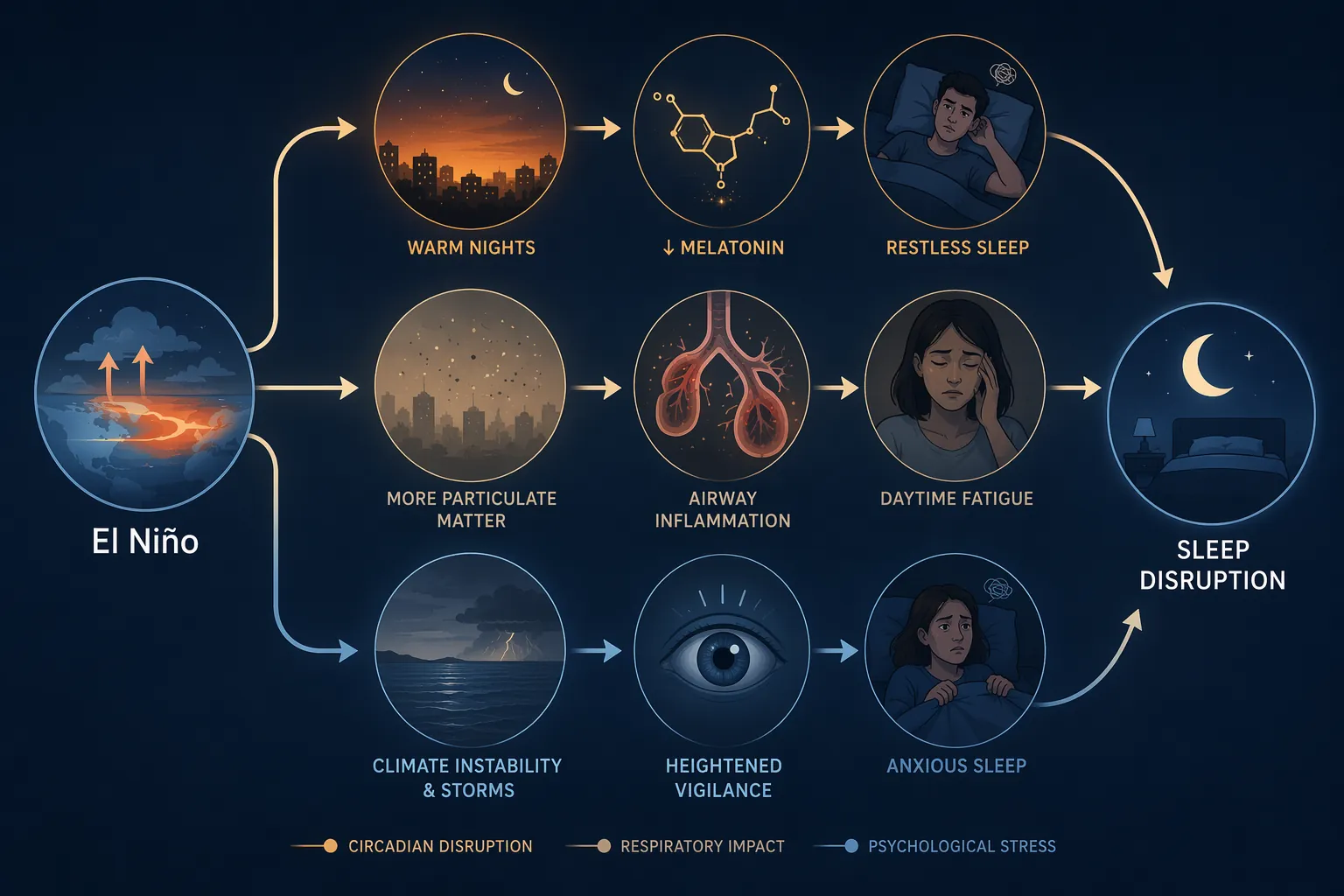
The sleep effect is not mainly “more hurricanes, less sleep.” During hurricane season, El Niño can act through three different pathways: nighttime heat that keeps the body from cooling down cleanly, PM2.5 pollution patterns that appear to change the relationship between air quality and insufficient sleep, and storm vigilance that can stay active even when the statistical season is below average.
The hurricane count is the wrong place to stop
El Niño is often described in hurricane coverage because it tends to increase wind shear over the Atlantic basin, which can suppress tropical cyclone development. That matters for public risk, but it is not a sleep diagnosis. A person does not need a landfall in their county to lose sleep. They may lose it because the bedroom never cools, because smoke or fine particles irritate the airway, or because the nervous system keeps treating every update as unfinished business.
That distinction is especially important in August, September, and October, when the atmosphere can feel quiet and oppressive at the same time. A “lower activity” season can still contain a dangerous storm. It can also contain long warm nights, poor air, and repeated watchful checking. Those are sleep exposures, even when they are not dramatic weather events.
Warm nights keep the sleep system from stepping down
Sleep onset depends partly on heat leaving the body. Core temperature drops, skin blood flow changes, melatonin rises, and the brain gets a clearer biological signal that night has begun. When hurricane-season nights stay warm and humid, that sequence becomes less efficient. The person may technically be tired, but their body is still working as if the day has not fully released its grip.
This is one reason El Niño can matter even without a local storm. If the warm-night season stretches into fall, sleep can be chipped away in small increments: later sleep onset, more awakenings after sweating, more time spent adjusting sheets or fans, and earlier waking because the room warms again before dawn. The nightly loss may look minor from the outside, but repeated heat-fragmented sleep is not minor to the person trying to function the next day.
Older adults deserve particular attention here. Aging already changes sleep architecture, circadian timing, nighttime urination patterns, medication burden, and thermoregulation. A warm bedroom can therefore land on a system with less reserve. The older patient who says, “I wake at 4:30 when the nights get sticky,” may not be describing anxiety at all. They may be describing a temperature problem that happens to arrive during hurricane season.
Perimenopause can make this pathway louder. Vasomotor symptoms, heat sensitivity, and sleep fragmentation already cluster together for many people in this stage. A warm, humid night does not have to cause the hormonal cascade to worsen the experience of it. It simply gives an already heat-reactive system less room to recover. For a deeper sleep-specific discussion of that physiology, see why perimenopause disrupts sleep.
The air-quality pathway is the most direct ENSO-to-sleep signal
The strongest direct evidence connecting ENSO phase with sleep does not come from hurricanes. It comes from PM2.5, the fine particulate matter small enough to reach deep into the lungs and participate in inflammatory pathways. In a 2025 county-level study of 3,100 U.S. counties from 2017 through 2024, Majeed and Zuberi examined whether ENSO phase changed the relationship between PM2.5 exposure and insufficient sleep. During El Niño years, extreme PM2.5 levels were associated with about a 9.5% higher risk of insufficient sleep, with a reported risk ratio of 1.095 and p<0.001.[1]
That is an effect-modification finding. In plain language, the study is not simply saying “pollution is bad for sleep.” It is saying the sleep risk linked with PM2.5 changed depending on the ENSO phase. El Niño, La Niña, and neutral years all modified the PM2.5-sleep relationship, which is important because it prevents a false comfort: El Niño may suppress some Atlantic storm formation, but it does not cancel the air-quality pathway.[1]
A 9% to 11% relative increase can sound abstract until it is placed against the baseline. In the same study, U.S. adult insufficient sleep prevalence was 34.3%, and it rose 4.5% from 2017 to 2024.[1] When a problem is already common, a relative increase does not need to be spectacular to matter. It can mean more people crossing from “short but manageable” sleep into a pattern that affects blood pressure, mood regulation, pain sensitivity, driving alertness, glucose control, or pregnancy-related fatigue.
The likely biology is not mysterious, although the ENSO-specific pathway is still emerging. PM2.5 can irritate the airway, promote inflammation, worsen nasal or lower-airway symptoms, and contribute to neural inflammatory signaling. A sleeper may experience this as congestion, coughing, lighter sleep, more awakenings, or a morning that feels unearned after enough hours in bed. People with asthma, allergic airway disease, sleep apnea risk, pregnancy-related congestion, or older-adult respiratory vulnerability have less margin.
The caveat matters. The Majeed and Zuberi study used annual county-level data, so it cannot prove that a specific hazy week in September during hurricane season caused a specific person’s insomnia. It also cannot tell a pregnant reader, a perimenopausal reader, or an ADHD adult exactly how much risk belongs to them. Its value is narrower and still important: it gives a direct U.S. signal that ENSO phase can modify the PM2.5-insufficient sleep relationship, and that El Niño years are not automatically benign for sleep.[1]
For readers who already track air-quality alerts, this is where the sleep question becomes practical rather than theoretical. If poor air nights line up with shorter sleep, morning headaches, airway symptoms, or more awakenings, the relevant exposure may not be the named storm at all. It may be the air entering the bedroom. The related guide on how Code Purple air quality affects sleep follows that mechanism more closely.
Storm anxiety does not wait for landfall
The anxiety pathway is easier to overstate, so it should be kept precise. A forecast cone is not a trauma exposure for everyone. Many people check it, make a plan, and sleep. But for people with prior evacuation experience, caregiving responsibilities, pregnancy concerns, financial fragility, flood history, or neurodivergent difficulty closing open loops, the same alert can become a nightly vigilance cue.
After Hurricane Katrina, the American Academy of Sleep Medicine reported increased insomnia complaints and a reversal in the male patient ratio, with clinicians pointing to existential and evacuee concerns as part of the sleep disruption.[2] That is not evidence that every hurricane-season alert causes insomnia. It is evidence that catastrophic weather can change who presents with sleep disturbance and what kinds of worries keep them awake.
More recent storm-anxiety work from UAB describes activation of the salience network, insula, and frontal cortex during storm anxiety, the same broad threat-monitoring territory clinicians hear when patients say they cannot stop scanning the radar or replaying “what if” plans at bedtime.[3] The brain is not being irrational by monitoring danger. The problem is timing: a threat network that remains active at midnight competes directly with the downshift needed for sleep.
This is the paradox of an El Niño hurricane season. Fewer Atlantic storms may lower one layer of objective risk, but the season still contains enough uncertainty to activate people who are sensitive to weather threat. A single named storm, a stalled rain event, a flood watch, or a memory of a previous evacuation can be enough. For practical anxiety tools, it makes more sense to use a dedicated guide such as how to sleep during flood threat anxiety than to pretend the mechanism is solved by explaining El Niño one more time.
Different sleepers carry different parts of the burden
The same El Niño season can disturb four people for four different reasons. That is why broad statements like “weather affects sleep” are not very useful. The exposure that matters most depends on physiology, responsibilities, prior experience, and how the nervous system handles uncertainty.
| Sleeper | Pathway most likely to matter | Why it may show up at night |
|---|---|---|
| Perimenopause | Warm nights, then anxiety if sleep loss accumulates | Heat sensitivity and night sweats can make a humid bedroom feel like a trigger rather than a backdrop. |
| Pregnancy | Air quality and vigilance | Airway congestion, fetal-safety concerns, and responsibility planning can make both haze and storm alerts harder to ignore. |
| Older adulthood | Warm nights, air quality, and sleep-disordered breathing vulnerability | Thermoregulatory reserve, respiratory vulnerability, medications, and earlier wake timing can make small exposures feel larger. |
| ADHD adulthood | Storm anxiety and open-loop monitoring | Forecast uncertainty can become a persistent attention demand, especially when checking temporarily relieves anxiety. |
For perimenopausal women, temperature deserves first position. Warm nights can amplify awakenings that were already likely to occur. Once several nights go poorly, the anxiety pathway can enter secondarily: the person begins bracing for another bad night before the room is even dark. That is a different clinical picture from storm phobia, and it asks for different judgment.
For pregnant people, the burden is often mixed. Pregnancy can bring nasal congestion, reflux, positional discomfort, and more frequent awakenings before weather enters the room. Add PM2.5, heat, and a storm watch, and the night can become a stack of small interruptions. The evidence does not prove a specific El Niño-pregnancy sleep effect. The more careful statement is that pregnancy contains plausible vulnerability to the air-quality and vigilance pathways, and those pathways can be active during El Niño hurricane seasons.
Older adults may feel all three pathways, but not always in the same week. Heat can shift wake time earlier. PM2.5 can aggravate airway symptoms. Storm preparation may involve medication refills, power-dependent devices, transportation, pets, or another person’s care. A younger adult may read a forecast and decide to check again tomorrow. An older adult managing oxygen equipment, mobility limits, or a spouse’s needs may not get that clean mental stopping point.
ADHD adults often describe the storm-anxiety pathway less as fear and more as an unfinished task. The brain keeps returning to the cone, the spaghetti models, the gas tank, the school closure possibility, the generator question. Checking gives a brief drop in uncertainty, then reopens the loop when the next advisory time approaches. For that pattern, preparedness can help because it turns monitoring into a bounded task. The same principle appears in earthquake preparedness and sleep anxiety, even though the hazard is different.
Barometric pressure is interesting, but it should stay in the margins
Some sleepers notice pressure changes before storms and wonder whether barometric pressure is part of the El Niño-hurricane-season sleep story. There is limited evidence worth mentioning, especially for sleep-disordered breathing. In a Seattle study of 537 patients, lower barometric pressure from weather systems was associated with an increase in obstructive apnea index of 0.3 events per hour for each millibar decrease.[4]
That finding should not be stretched too far. The study was conducted in a specific sleep-clinic population in Seattle, near 200 feet elevation, with high baseline apnea burden.[4] It does not prove that hurricane-zone pressure drops meaningfully disturb sleep for the general population. For an older adult with known obstructive sleep apnea, it may be one more reason a storm system feels rough. It is not strong enough to carry the article’s main explanation.
What the evidence can and cannot say in 2026
The cleanest direct ENSO-sleep evidence is the PM2.5 finding from Majeed and Zuberi. It is direct because ENSO phase is part of the analysis, sleep insufficiency is the outcome, and PM2.5 is the exposure whose sleep association changes by ENSO phase. It is also limited because annual county averages cannot show what happens during one hurricane-season week, inside one bedroom, after one alert-heavy evening.[1]
The temperature and anxiety pathways are supported by separate bodies of sleep, heat, disaster, and anxiety research, but they have not been unified into a single study showing exactly how El Niño changes sleep for perimenopausal women, pregnant people, older adults, or ADHD adults during Atlantic hurricane season. Those life-stage judgments are careful synthesis, not direct stratified proof.
So the most calibrated answer is this: El Niño can reduce Atlantic hurricane activity and still worsen sleep during hurricane season. It can do that through warmer nights, altered PM2.5-related sleep risk, and vigilance around severe weather that does not disappear just because the seasonal average looks less threatening. The evidence is uneven, and the strongest direct signal currently runs through air quality. The lived burden, however, often arrives as a mix: a hot room, irritated breathing, and a brain that keeps waiting for the next update.
References
- Majeed & Zuberi, BMC Public Health 2025
- Catastrophic events can affect a person’s sleep, American Academy of Sleep Medicine, 2007
- Understanding and managing storm anxiety during tornado season, UAB Medicine
- The effect of weather on sleep-disordered breathing
Explore the mechanism
Next step
Spot an error or have clinical feedback?
Because this article covers clinical, medication, or safety information, we use a moderated correction channel instead of open public comments. Let us know if something about “How El Niño Impacts Sleep During Hurricane Season” needs a closer look.
Send feedback on this article