How Perimenopause Sleep Loss Accelerates Your Biological Age
Perimenopause sleep disruption may accelerate biological aging by up to 6 percent, with insomnia adding nearly two extra biological years. This guide explains the epigenetic clock evidence and which sleep strategies are proven to slow that clock for women in perimenopause.
The sleep change that sends many women looking for “anti-aging sleep secrets for perimenopause” is not always classic insomnia. It is waking hot, suddenly alert, with the sheets kicked off and the mind already counting tomorrow’s obligations. After enough nights like that, the worry changes shape: Is this just getting older, or is this making me older?
That fear is not silly, but it needs careful language. In a UCLA-led epigenetic clock analysis, menopause was independently associated with about a 6% acceleration in biological aging, separate from chronological age. In related work using Women’s Health Initiative data, postmenopausal women who reported five insomnia symptoms were biologically nearly two years older than peers without those symptoms.[1] Those findings do not prove that one bad perimenopause month ages the body by years. They do say that the menopause transition, sleep disruption, and biological-aging markers belong in the same clinical conversation.

That distinction matters because women in their 40s and early 50s are often offered two unhelpful extremes. One is panic: every night waking becomes a longevity emergency. The other is dismissal: hot nights, broken sleep, and daytime fog are treated as the price of midlife. The better reading is narrower and more useful. Perimenopausal sleep disruption is common, biologically plausible, and treatable; the evidence is strong enough to act on, but not strong enough to promise that any sleep plan will “reverse” epigenetic age.
What “biological age” means here
Biological age, in this context, usually refers to epigenetic clock measures. These clocks look at patterns of DNA methylation—chemical marks on DNA that shift with age and with certain health exposures. They are not a mirror, a skin score, or a moral report card on how well someone has slept. They are statistical tools that estimate whether tissues appear biologically older or younger than expected for a person’s chronological age.
The menopause-aging findings are attention-grabbing because they separate menopause timing from simple birthday aging. The insomnia finding is similarly important because it suggests sleep symptoms add a measurable biological-age signal in postmenopausal women. But both are observational findings, not proof that treating perimenopause insomnia will roll back the clock. As of now, no completed interventional trial has shown that CBT-I, hormone therapy, melatonin, cooling, or any combined sleep program reverses menopause-related epigenetic aging.
That is where the word “anti-aging” either becomes useful or becomes advertising. Useful means this: identify sleep disruption during the hormonal transition, reduce fragmentation, lower physiologic stress around the night, and treat the mechanism that is actually waking the person. Advertising means implying that a supplement, tracker, or bedtime ritual has been proven to make perimenopausal cells younger. The evidence supports the first version, not the second.
Perimenopause sleep loss is usually a wake-up problem, not just a falling-asleep problem
Sleep disturbance affects an estimated 40–60% of women during the menopausal transition, and the pattern often centers on nighttime awakenings rather than difficulty falling asleep.[2] That detail changes the plan. A woman who falls asleep normally at 10:30 p.m. and wakes three times drenched, then lies awake with a racing mind, does not have the same problem as someone whose main issue is a delayed bedtime and scrolling until midnight.
Vasomotor symptoms are part of the story, but they do not explain every minute awake. In objective sleep research, hot flashes accounted for about 27% of wake-after-sleep-onset during the menopausal transition.[2] That is a meaningful share. It is also a warning against oversimplifying. Some awakenings are thermoregulatory. Some are conditioned insomnia. Some may be circadian. Some belong in a medical evaluation because sleep apnea, restless legs, pain, mood symptoms, medications, alcohol, and thyroid problems can all complicate midlife sleep.
The hormonal biology is not vague. Declining and fluctuating estradiol and progesterone are linked with a narrower thermoneutral zone, meaning smaller changes in body temperature can trigger heat-loss responses. Melatonin signaling may also shift across midlife, while repeated awakenings can train the brain into cortical hyperarousal: the body wakes, then the mind learns to stay vigilant.[2][3] This is why ordinary sleep hygiene—avoid caffeine late, keep a schedule, make the room dark—can be helpful and still be nowhere near enough.
The plausible aging pathway runs through fragmentation
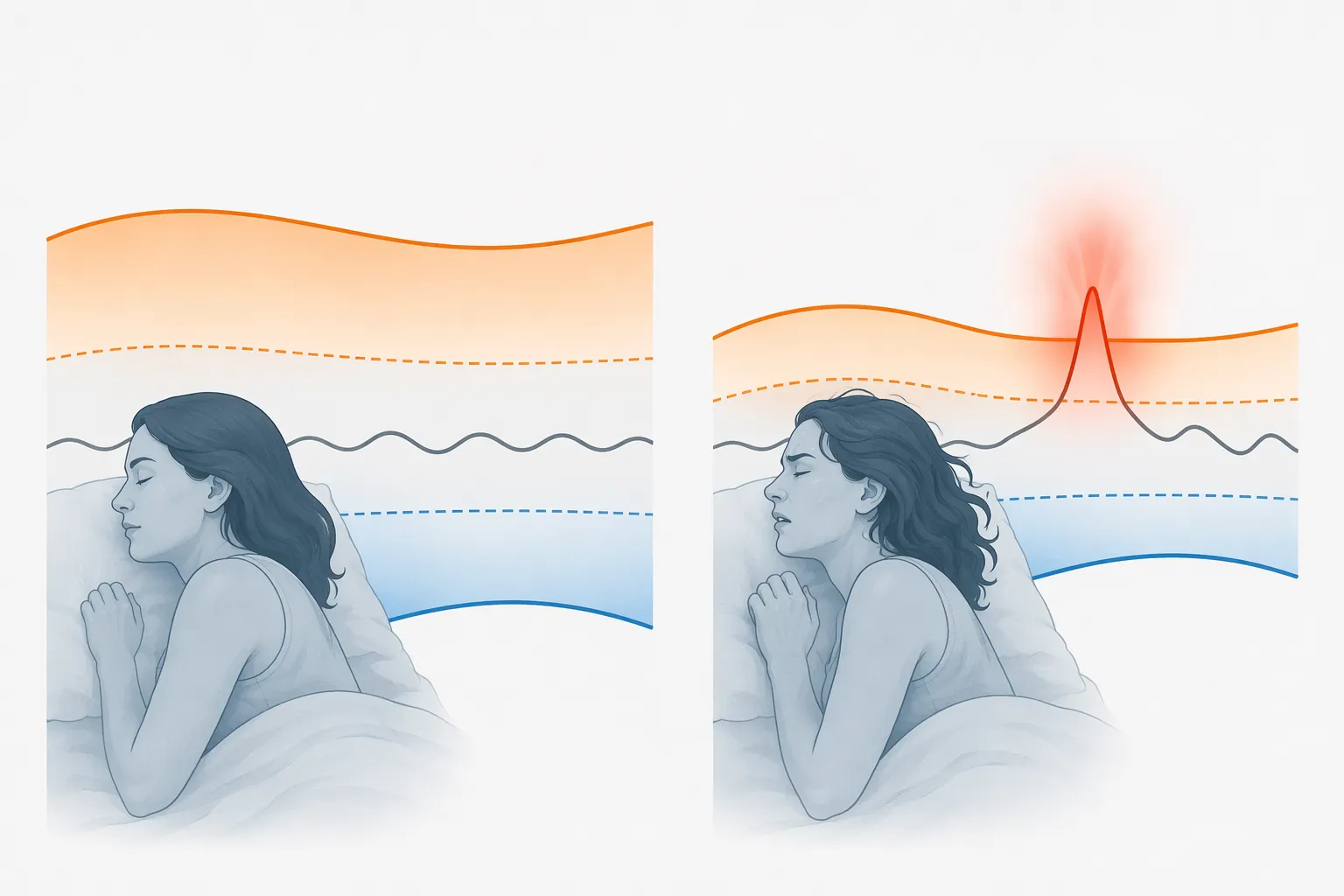
The most credible sleep-aging pathway in perimenopause is not that a hot flash itself “ages” the body in a simple one-to-one way. The larger concern is fragmentation: repeated arousals, shortened consolidated sleep, sympathetic activation, and the next-day metabolic and emotional load of functioning on broken rest. When this pattern repeats over months or years, it becomes easier to understand why insomnia symptoms would show up alongside older epigenetic profiles.
Thermoregulation is one route. A narrowed thermoneutral zone means the sleeping body has less margin before heat becomes an alarm. A small internal temperature shift may be enough to trigger sweating, heart pounding, or full awakening. Once awake, many women do the second shift of insomnia: checking the clock, worrying about work, wondering whether this is dementia, aging, or loss of control.
Circadian signaling is another route. Melatonin is not simply a “sleep hormone”; it helps time the biological night. Reviews of sleep and melatonin in the menopausal transition describe age- and menopause-related changes in sleep regulation, including melatonin pathways.[3] That does not make melatonin a universal fix, but it does make circadian timing worth asking about, especially when sleepiness arrives too late, mornings feel brutal, or bright evening light and irregular schedules are part of the pattern.
Hyperarousal is the third piece many women recognize instantly. The first awakenings may be hormonal; the later ones become learned. The brain begins to associate the bed with monitoring: Am I hot? Did I sleep enough? Why am I awake again? This is where behavioral treatment earns its place. It is not telling someone to calm down. It is retraining the sleep system after repeated hormonal disruption has made vigilance feel necessary.
Choose the intervention by what is waking you
The practical mistake is ranking every sleep strategy as if it were equivalent. A cooling pillow, CBT-I, hormone therapy, melatonin, and a wearable sleep score do not answer the same question. The first decision is not “What is the best anti-aging sleep hack?” It is “What mechanism is driving the night awakenings?”
| Dominant pattern | Most relevant sleep target | Evidence-weighted next step |
|---|---|---|
| You wake repeatedly and then cannot return to sleep, even when heat is not obvious | Conditioned insomnia and hyperarousal | CBT-I is the strongest starting point |
| You wake hot, sweaty, flushed, or with a pounding heart | Vasomotor-driven fragmentation | Temperature management, and discussion of MHT when symptoms are primary |
| You are sleepy too late, mornings are difficult, or your schedule/light exposure is drifting | Circadian timing and melatonin signaling | Light timing first; low-dose melatonin may be considered cautiously |
| Snoring, gasping, leg discomfort, severe mood symptoms, pain, or medication effects are present | Possible comorbid sleep or medical disorder | Medical evaluation before assuming this is only perimenopause |
When insomnia has taken over, CBT-I has the strongest trial evidence
Cognitive behavioral therapy for insomnia is the intervention in this evidence base that deserves first-line status when insomnia patterns dominate. In the MsFLASH randomized clinical trial, telephone-delivered CBT-I was tested in peri- and postmenopausal women with vasomotor symptoms and insomnia. Remission rates were reported in the 54–84% range, compared with sleep hygiene education.[4]
The format matters. This was not a luxury sleep retreat or months of in-person psychotherapy; it was telephone-delivered CBT-I. The comparison matters too. It was not tested head-to-head against menopausal hormone therapy. So the right conclusion is not that CBT-I beats every other perimenopause treatment. The right conclusion is that CBT-I directly treats the insomnia component and has randomized-trial support in the population women are asking about.
CBT-I usually works through several levers: tightening the sleep window, reducing time awake in bed, changing the behaviors that train the brain to stay alert at night, and addressing catastrophic sleep thoughts. For a perimenopausal woman, that last piece is not trivial. “I am awake again, so I am aging faster” may be an understandable fear after reading epigenetic-clock research, but it is also exactly the kind of thought that can intensify arousal at 3 a.m.
Access is the weak point. Many women cannot easily find a trained CBT-I provider, and insurance coverage can be uneven. Digital CBT-I programs, sleep psychologists, behavioral sleep medicine clinics, and clinicians trained in insomnia protocols may all be worth exploring. What should not happen is for a woman with months of repeated awakenings to be handed only a one-page sleep hygiene sheet and told the evidence-based work has been done.
When heat is the alarm, the room and the hormones both matter
If the awakening begins with heat, sweating, flushing, or a pounding pulse, temperature management is not cosmetic comfort. It is aimed at one of the mechanisms fragmenting sleep. The point is to widen the margin between “comfortable enough to stay asleep” and “hot enough to wake.”
- Lower the bedroom temperature before the first hot-flash window rather than waiting until you wake overheated.
- Use layers that can be removed without fully waking: breathable pajamas, separate blankets, and moisture-wicking bedding if sweating is prominent.
- Reduce evening heat load from alcohol, heavy late meals, hot baths close to bedtime, and overheated rooms.
- Track hot flashes separately from awakenings for one to two weeks so the pattern is visible before a clinical visit.
For some women, these changes are enough to reduce awakenings. For others, they are only the baseline. If vasomotor symptoms are the main driver, menopausal hormone therapy belongs in the conversation with a qualified clinician. It should not be treated as a footnote after lavender, collagen, and “just keep the room cool.” Hormone therapy has its own eligibility questions and risk-benefit profile, but when hot flashes are repeatedly breaking sleep, the mechanism is hormonal and deserves hormonal-level consideration.
Readers who want more practical temperature detail can use companion guides on perimenopause insomnia during an El Niño winter and heat-wave sleep tips by life stage. The physiology is the same even when the weather is not dramatic: a body with less thermal margin needs a sleep environment that does less provoking.
When timing is the problem, be careful with melatonin
Melatonin is often sold as if more is better. For perimenopause sleep, that is too blunt. If the issue is circadian timing—sleepiness arriving late, inconsistent bed and wake times, bright light exposure at night, or difficulty anchoring mornings—then light timing and schedule regularity come first. Low-dose melatonin may be reasonable to discuss, especially in the 0.3–1 mg range often used for circadian timing, but the evidence does not establish one universal perimenopause dose.
This is also where “anti-aging” claims get ahead of the sleep evidence. Melatonin has biologic roles beyond sleep, and menopause-related reviews discuss its possible relevance to aging-linked systems, but that does not mean a nightly supplement has been proven to slow epigenetic aging in perimenopausal women.[3] Dose, timing, formulation, morning grogginess, medication interactions, and medical history all matter. A poorly timed dose can blur the next morning without fixing the 2 a.m. hot flash.
What not to let crowd out the real treatment
Generic sleep hygiene is not useless. Caffeine timing, alcohol reduction, morning light, regular wake time, and a dark room can all support sleep. The problem is proportionality. If a woman is waking drenched three times a night, “put your phone away” is not an adequate treatment plan. If she has learned to lie awake for two hours after each hot flash, cooling the room alone may not retrain insomnia. If her biological night has drifted later, a random high-dose melatonin gummy may not solve the timing problem.
Wearables can help when they reveal patterns: sleep timing, awakenings, temperature trends, alcohol effects, or cycle-stage changes. They can hurt when they turn every rough night into a score to fear. The epigenetic findings are already emotionally loaded; adding nightly performance anxiety is not neutral for someone prone to hyperarousal.
Supplements marketed for “cellular youth” deserve the same skepticism. If a product’s main promise is anti-aging but it does not reduce awakenings, hot flashes, circadian misalignment, or insomnia behavior, it is not addressing the perimenopause sleep-aging pathway that matters here. Postmenopausal readers who want a broader look at cellular and skin-level sleep aging can read What Anti-Aging Sleep Science Reveals for Women Over 50; the perimenopausal question is more specific because the transition itself is still unfolding.
The window worth taking seriously
Perimenopause is not just a preview of menopause, and its sleep disruption is not just a nuisance attached to aging. It is a stage when fluctuating hormones, thermoregulation, circadian timing, and learned insomnia can pile onto one another. The epigenetic clock evidence gives weight to what many women already sense in their bodies: repeated broken sleep feels different from an occasional bad night.
The hopeful part is not a promise of biological age reversal. It is that the waking pattern can often be named. If insomnia is dominant, CBT-I has the strongest direct evidence. If hot flashes are breaking the night, temperature management and, when appropriate, MHT deserve real consideration. If timing has drifted, circadian treatment and cautious melatonin use may belong in the plan. That is a more demanding answer than “accept it,” and a more honest one than “buy this anti-aging secret.”
Protecting sleep during perimenopause may be one of the few anti-aging strategies that is both biologically plausible and immediately relevant to how women actually feel: fewer hot awakenings, less dread at 3 a.m., and a body that is not being asked to perform midlife on fragmented rest.
References
- Menopause, sleepless nights may make women age faster, UCLA Health
- Sleep and sleep disorders in the menopausal transition, Sleep Medicine Clinics, 2018
- Sleep, melatonin, and the menopausal transition, Sleep Science, 2017
- Telephone-based CBT-I in perimenopausal and postmenopausal women with vasomotor symptoms, JAMA Internal Medicine, 2016
Explore the mechanism
Next step
Spot an error or have clinical feedback?
Because this article covers clinical, medication, or safety information, we use a moderated correction channel instead of open public comments. Let us know if something about “How Perimenopause Sleep Loss Accelerates Your Biological Age” needs a closer look.
Send feedback on this article