
How to Sleep During Flood Threat Anxiety
When a flood watch or warning keeps your brain in survival mode, falling asleep can feel impossible. This protocol walks you through a step-by-step approach to decouple safety planning from bedtime, contain worry to scheduled daylight hours, and create a sleep-ready environment without ignoring real danger.
First decide whether sleep is even the right goal. A flood watch means flooding is possible; a flood warning means flooding is occurring or expected soon enough that you should act for your specific location, not treat the night like normal sleep time.[1] If there is an active warning for your exact area, visible rising water, a shelter instruction, or any local order to move, stay awake, monitor, and follow official guidance. For the fuller safety framework, use How to decide if you can sleep during a flood warning before you try to settle down.
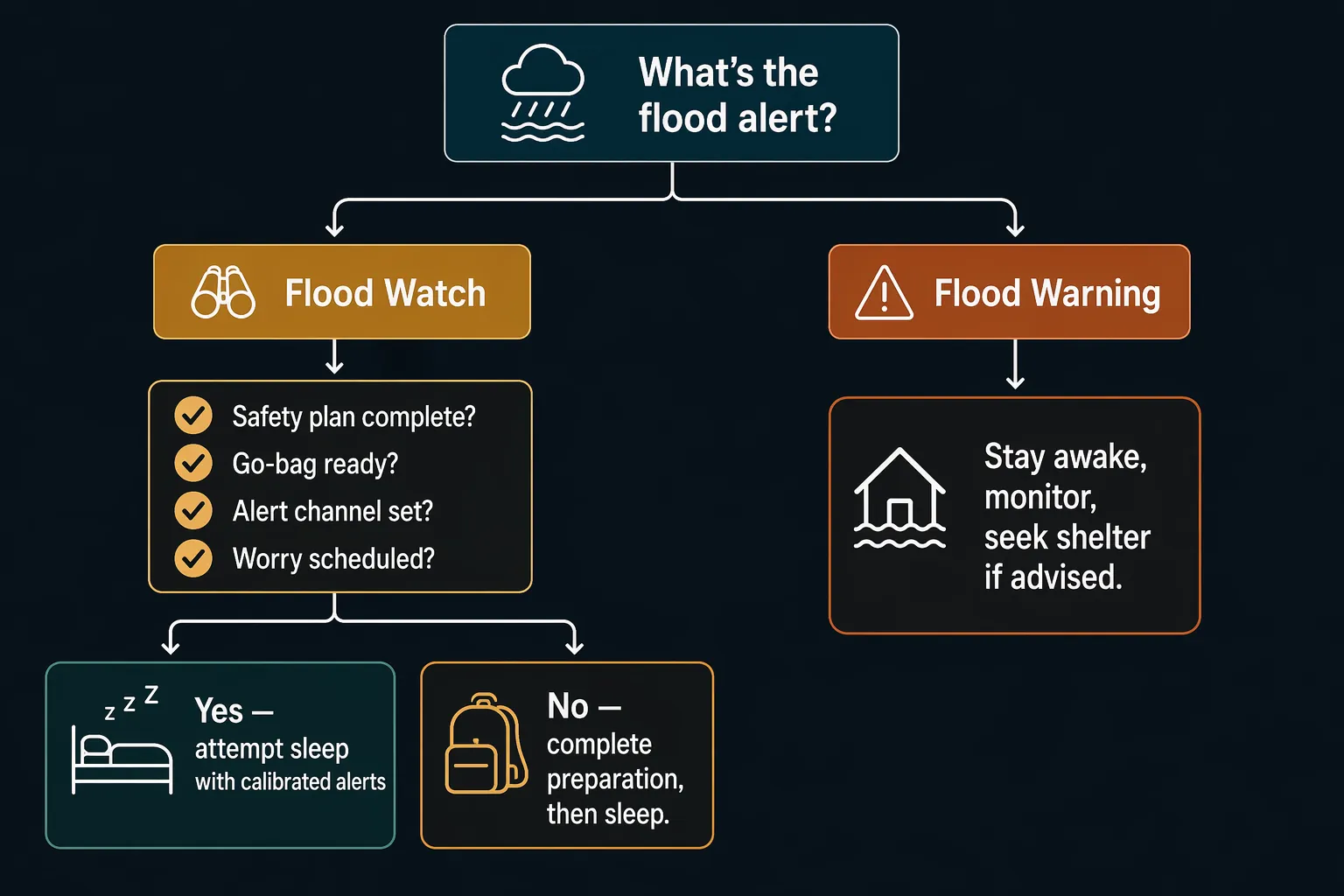
If the threat is watch-level, your home is not already taking on water, your evacuation or shelter plan is ready, and you have a reliable alert source set to wake you only for action-level information, then attempting sleep is reasonable. That does not mean pretending nothing is happening. It means doing the useful safety work before bed, then refusing to keep re-running the same unfinished loop in the dark.
The Night Protocol
On a flood-threat night, the real problem is usually not ignorance about sleep hygiene. It is that the brain has a job open: watch the water, watch the phone, listen for rain changes, imagine the lowest road filling first. The protocol has to close that job without making you less safe.
| When | Action | What it settles |
|---|---|---|
| Before bedtime | Finish flood preparation while you are still upright and thinking clearly. | Safety is handled by a plan, not by lying awake. |
| Daylight or early evening | Use a 15-minute worry container for flood what-ifs. | Planning thoughts get a place that is not the bed. |
| At bedtime | Choose one alert channel and one wake-up threshold. | The night has rules instead of constant checking. |
| After a non-actionable wake-up | Check only what you pre-decided, then return to bed. | Monitoring does not become an all-night scroll. |
| When your body still feels keyed up | Use grounding after preparation is complete. | Calming does not replace safety work. |
Finish the Safety Work Before the Bed Becomes the Command Center
Do the practical checks early enough that they are not happening from under the covers. The National Weather Service and storm-anxiety guidance from CoxHealth both emphasize the same basic sequence: make a plan, prepare, then put the plan away instead of repeatedly consuming weather updates.[1][3] That last part matters. A plan that stays mentally open all night keeps asking the brain to supervise it.
For a flood-threat night, the closure ritual can be plain and physical: shoes by the bed, phone charged, flashlight reachable, medications and essentials in the go-bag, important documents protected or ready, pets accounted for, car parked where it will not be trapped if that is safe and realistic for your property, and the route or shelter location named. If you live where roads flood fast, include the roads you will not take. A route that depends on guessing in the rain is not really a route.
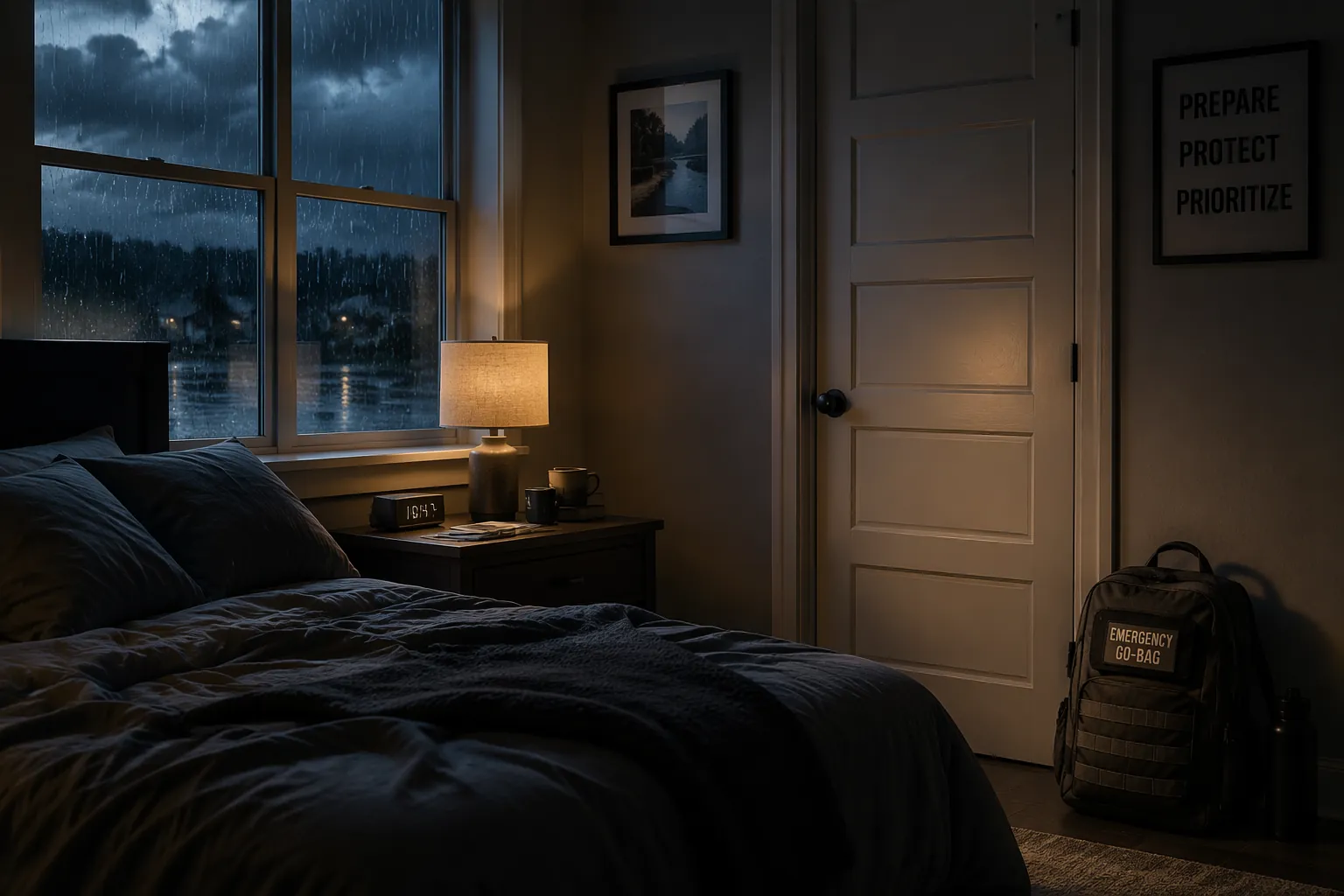
Then write the decision threshold where you can see it before bed, not where you have to negotiate with yourself at 2 a.m. A useful version sounds like this: “I get up if my county alert says flood warning for my location, if water is visible near the house, if authorities tell my area to move or shelter, or if my named contact calls twice.” Your wording can differ. The point is that the night no longer depends on repeated emotional polling.
Once those items are done, say the closure out loud if that helps: “The bag is by the door. The alert source is on. The threshold is written. I will wake for action, not for every thought.” It may feel stiff. That is fine. You are not trying to inspire yourself; you are marking the plan as complete.
Move the What-If Session Out of Bed
CBT-I includes tools that can be adapted for acute sleep anxiety, including setting aside structured worry time and getting out of bed when wakefulness turns into a conditioned struggle. In a 2026 NPR piece, sleep researcher Dr. Aric Prather describes scheduling 15 minutes for worry earlier in the day so the brain has a designated place to process concerns before bedtime.[2] This is not the same as clinician-led CBT-I for chronic insomnia. It is a self-directed piece of the approach, useful because flood worry otherwise chooses its own time.
Use the 15 minutes while there is still light, or at least well before you get into bed. Divide a page into two columns: “What could happen?” and “What is my action?” Keep the entries practical. “The creek rises” belongs on the page. “Everything will be ruined” may be the feeling underneath it, but it does not give you a next move. Translate it into the concrete version: “If water reaches the driveway, I move to the pre-chosen location or follow the official instruction.”
Stop when the timer stops. If a new thought arrives in bed, do not debate it there. Use a short phrase: “That goes on tomorrow’s worry page unless it meets tonight’s wake-up threshold.” If it does meet the threshold, get up and act. If it does not, the bed is not the planning room.
Forecast uncertainty can make this especially hard because the mind keeps trying to solve an update that has not arrived yet. If storm-track changes and forecast-checking loops are the main trigger, the same worry-container idea also fits the anticipatory anxiety described in Why Hurricane Season Forecasts Trigger Sleep Anxiety and How Tropical Storm Paths Disrupt Sleep Before the Wind Starts.
Explore the mechanism
Next step
Spot an error or have clinical feedback?
Because this article covers clinical, medication, or safety information, we use a moderated correction channel instead of open public comments. Let us know if something about “How to Sleep During Flood Threat Anxiety” needs a closer look.
Send feedback on this article