
Why Extreme Heat Warnings Hit Midlife Women's Sleep Harder
Extreme heat warnings pose a heightened sleep risk for women in perimenopause and menopause because two thermoregulation challenges collide: ambient heat prevents the necessary nighttime core temperature drop, and the menopause-compromised hypothalamic thermostat triggers hot flash cascades. This article explains the dual physiology behind the disruption.
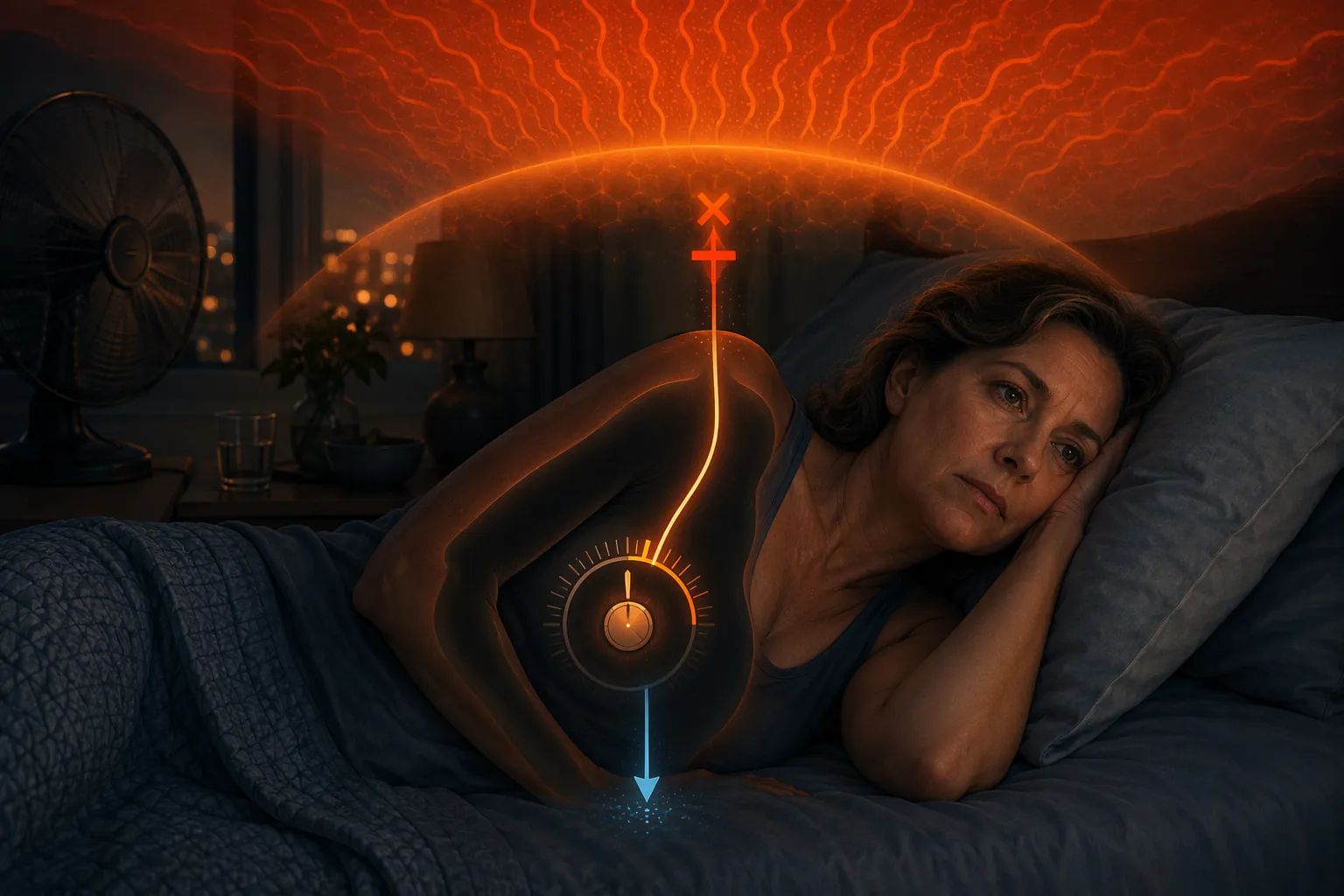
When an extreme heat warning says there may be “little to no overnight relief,” that is not just a weather phrase for a woman who is already waking hot at midlife. Overnight relief is the window her body normally uses to cool itself into sleep. If that window disappears, the problem is not that she forgot to keep a better bedtime routine. The room, the skin, the brain’s thermostat, and the hot flash system may all be working against sleep at the same time.
That is the clearest way to understand how extreme heat warnings disrupt sleep for midlife women: the same hot night becomes a different physiological event after perimenopause begins. Heat already interferes with the body’s normal sleep-cooling process. Menopause-related changes then narrow the temperature range the brain tolerates before it triggers a heat-dumping response. One hot bedroom can become two overlapping thermostat problems.
Sleep Begins With a Cooling Job
Before hot flashes enter the picture, ordinary sleep onset depends on controlled heat loss. The body does not simply “relax” into sleep. Core temperature normally falls by about 1°C as heat moves from the body’s core toward the skin and out into the surrounding air. When the bedroom is too warm, especially above about 25°C or 77°F, that skin-based heat loss becomes less efficient, making it harder to start sleep in the first place. [1]
This is why advice that stops at “make the room cool” often sounds insultingly thin. The important fact is not the tidiness of the bedroom. It is whether the body can unload heat through the skin fast enough to create the temperature drop that sleep onset requires. A warm, humid night can block that process even for someone with no menopause symptoms at all.
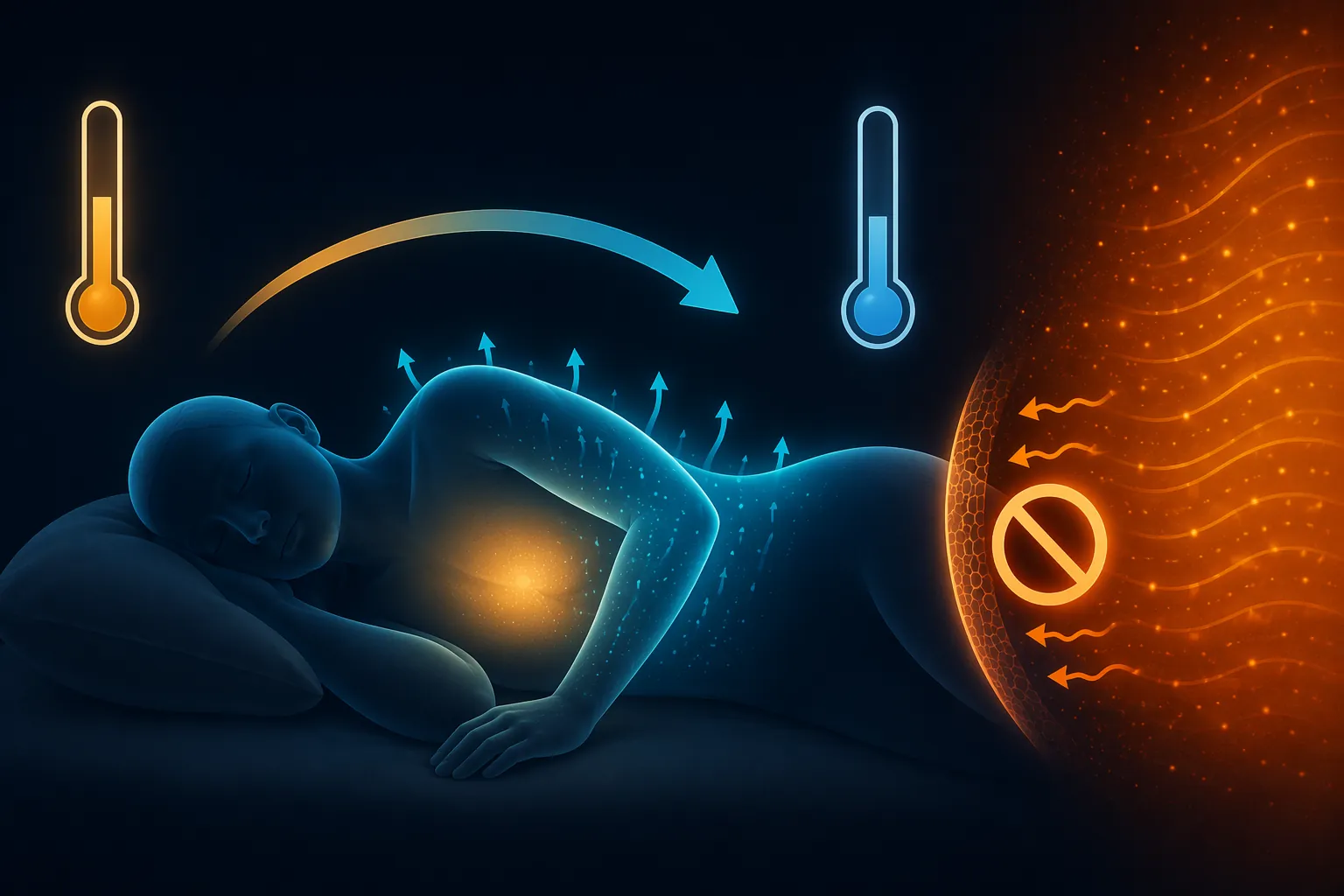
Humidity matters because sweating only helps when sweat can evaporate. A damp, stagnant bedroom may let the skin feel wet without producing much cooling. The sleeper gets the discomfort of sweating without the full thermoregulatory benefit. She may lie still, turn the pillow, remove a layer, and still feel as if her body cannot find the off-ramp into sleep.
Then Perimenopause Narrows the Brain’s Comfort Zone
The second thermostat sits in the hypothalamus, the brain region that helps regulate body temperature. During perimenopause and menopause, declining estrogen is associated with a narrowed thermoneutral zone: the range of internal temperature the body accepts before it starts emergency cooling or warming responses. With a narrower zone, a small rise in internal temperature can be interpreted as a problem that needs immediate correction. [2][3]
That is the mechanism behind the familiar “out of nowhere” quality of a hot flash. It can feel irrational because the room is not always objectively extreme. But the trigger is not only the room. It is the relationship between a small temperature change and a more reactive hypothalamic threshold. A degree of warmth that used to be tolerable may now be enough to set off vasodilation, sweating, a racing or startled feeling, and full awakening.
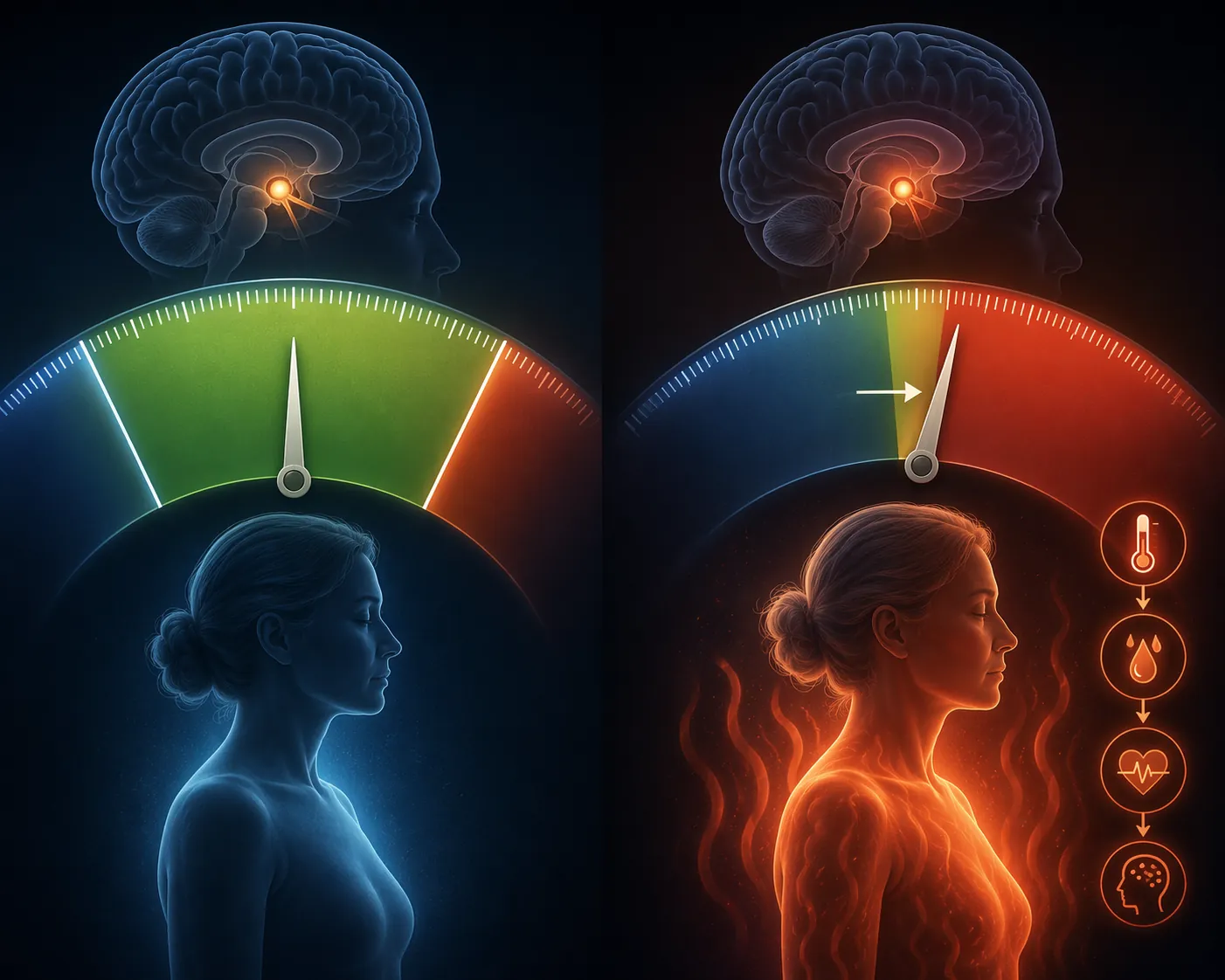
The cruel timing is that sleep itself depends on a stable cooling slope. A hot flash interrupts that slope with a burst of heat loss behavior: blood vessels widen, sweat appears, the sleeper wakes, and bedding may become damp. If the bedroom air is cool enough, the body may re-cool and return to sleep. During an extreme heat warning with poor overnight relief, the room may not allow that recovery. The flash ends, but the heat load remains.
The 2:40 A.M. Loop
The sequence is often more useful than the label. A warm bedroom reduces heat loss through the skin. Sleep onset is delayed, or early sleep is lighter. A small internal temperature rise crosses a narrower menopause-related threshold. The hypothalamus responds as if the body needs urgent cooling. A hot flash wakes the sleeper. Sweating begins, but the warm air does not help evaporation enough. Re-cooling fails. The sleeper waits, overheated and alert, for a system that cannot reset.
| Part of the night | What is happening physiologically | What the sleeper notices |
|---|---|---|
| Before sleep | Core temperature needs to fall by about 1°C | Sleep feels delayed despite feeling tired |
| Warm room | Heat loss through the skin is impaired | Sheets, pajamas, or mattress feel too warm |
| Menopause threshold | A smaller temperature rise can trigger a heat-dumping response | A hot flash feels sudden or disproportionate |
| After the flash | Sweating may not cool effectively if air stays hot or humid | The body feels damp, awake, and unable to settle |
Nighttime hot flashes are often described as brief events, lasting about 1 to 5 minutes, and hot flashes can recur many times across a day. [1] The sleep cost is not limited to those minutes. The larger loss comes from what happens afterward: the wakefulness that follows, the time spent trying to cool down, the bedding that now feels wrong, and the alertness that arrives once the nervous system has been pulled out of sleep.
That distinction matters clinically. A woman may say, “I was only hot for a few minutes, but I was awake for an hour.” That report is not contradictory. The flash can be short while the failed re-cooling period is long.
Why Heat Warnings Are Different From an Ordinary Warm Night
A heat warning is not a sleep diagnosis, and current public warning systems are not designed around perimenopausal hot flash physiology. Still, the phrase “little to no overnight relief” maps onto the missing physiological opportunity: the nighttime period when the environment should help the body shed heat. Reports on heat risk increasingly emphasize that hot nights can be dangerous because the body does not get its usual recovery period. [4]
For midlife women, the same lack of relief lands on a more sensitive thermal control system. The environmental side says, “You cannot cool well through the skin.” The menopause side says, “A smaller rise is enough to trigger an alarm.” These are not separate inconveniences politely taking turns. They can compound within the same sleep period.
No published study has directly measured National Weather Service HeatRisk levels against hot flash-related sleep outcomes in perimenopausal or menopausal women. That connection has to be stated carefully. The evidence supports the mechanism from adjacent directions: heat exposure worsens sleep at the population level, and menopause changes thermoregulation in a way that can make heat more disruptive. The specific heat-warning-to-hot-flash pathway has not yet been tested as a single controlled question.
The Population Data Fits the Pattern, With Limits
Large sleep datasets cannot tell us what one woman felt at 2:40 a.m., but they can show whether hotter nights leave measurable marks on sleep. In a USC-led analysis using All of Us Research Program data from 14,232 adults and 12.5 million nights, a 10°C nighttime temperature increase was associated with later sleep onset, less REM sleep, and less deep sleep. The same analysis found that females lost 22.9% more sleep per 10°C nighttime temperature increase than males, and women ages 40 to 50 lost 19.6% more sleep per degree than women under 40. [5]
Those age and sex differences do not prove that every lost minute came from hot flashes. They do, however, fit the clinical suspicion that heat exposure is not evenly distributed across bodies. A dataset can register the timing shift and sleep-stage loss; physiology helps explain why midlife women may be more vulnerable to those shifts.
The All of Us sample also has limits. The study population was predominantly female, White, and non-Hispanic, which means the findings should not be stretched into a complete picture of sleep vulnerability across all U.S. communities. [5] Large does not automatically mean fully representative.
When Women Name the Problem as “Too Hot”
A women-specific analysis from the Sister Study gets closer to the complaint itself, though it should be treated as preliminary because it was posted as a medRxiv preprint in 2025. Among 33,545 U.S. women, 9% reported trouble sleeping due to feeling “too hot” at least three times per week. The prevalence reached 15% among non-Hispanic Black women. Feeling “too hot” during sleep was associated with 1.88 times higher prevalence of long sleep onset latency and 1.57 times higher prevalence of poor sleep maintenance. [6]
That 15% figure deserves attention without a made-up explanation attached to it. The evidence cited here does not establish why non-Hispanic Black women reported this outcome more often. It does show that “too hot” sleep disruption is not a vague comfort complaint. It is associated with difficulty falling asleep and difficulty staying asleep, which are the two places midlife patients so often describe the night breaking apart.
The Sister Study also helps separate attitude from behavior. These women were not merely saying they disliked warm rooms. They were reporting sleep trouble tied to feeling too hot. That does not prove causation, and the preprint status matters, but the measure is pointed in the right direction for the symptom people actually bring into clinic.
Why the Usual Advice Feels Too Small
Keeping the bedroom cooler can help because it supports heat loss through the skin. Breathable bedding, lighter sleepwear, airflow, and reducing trapped humidity all aim at the same mechanism: make it easier for the body to move heat away from the core and let sweat evaporate. These are not moral habits. They are environmental assists for thermoregulation.
But during an extreme heat warning, especially in a home that stays hot overnight, the usual tips can hit a ceiling. A fan may move warm air. A cool shower may help briefly, then the body returns to the same hot room. Lightweight sheets may reduce insulation without solving the ambient heat load. The person lying awake may have done the reasonable things and still be trapped in a physiology problem.
That is why the conversation should change. The relevant question is not whether she is trying hard enough to sleep. It is whether her sleep environment allows the core-temperature drop that sleep requires, and whether her menopause-stage thermostat is lowering the threshold for repeated heat alarms.
A More Accurate Way to Understand the Night
The midlife hot night is easy to misread because each piece can sound minor by itself. The room is a few degrees warmer. The flash lasts a few minutes. The sleeper wakes once, then twice, then again. By morning, the cumulative effect looks like insomnia, but the machinery underneath is thermal.
Extreme heat warnings hit midlife women’s sleep harder not because women in this stage are less resilient, more anxious, or suddenly careless about bedtime. The environmental heat load can block the normal nighttime cooling needed for sleep, while menopause-related narrowing of the thermoneutral zone can make small rises feel like emergencies to the hypothalamus. On a night with little relief, those two failures can stack.
References
- Too Hot to Sleep? Night Sweats, Menopause and Heatwaves — The Sleep Scientist
- Sleep & Perimenopause — Stanford Lifestyle Medicine
- Menopause, Summer & Hot Flashes — Women’s Integrated Healthcare
- Today’s Climate: Heat Wave Night Sleep — Inside Climate News, 2025
- Study links rising temperatures to reduced sleep in U.S. adults — Keck School of Medicine of USC
- Trouble Sleeping Due to Feeling Too Hot and Sleep Health Among Women in the Sister Study — medRxiv, 2025
Explore the mechanism
Next step
Spot an error or have clinical feedback?
Because this article covers clinical, medication, or safety information, we use a moderated correction channel instead of open public comments. Let us know if something about “Why Extreme Heat Warnings Hit Midlife Women's Sleep Harder” needs a closer look.
Send feedback on this article