How Heat Watch and Heat Warning Help You Prepare for Hot Flash Sleep
Borrow the National Weather Service's two-alert system to prepare for menopausal hot flashes at bedtime and respond effectively when they hit, shortening wake-after-sleep-onset time and reducing anxiety.
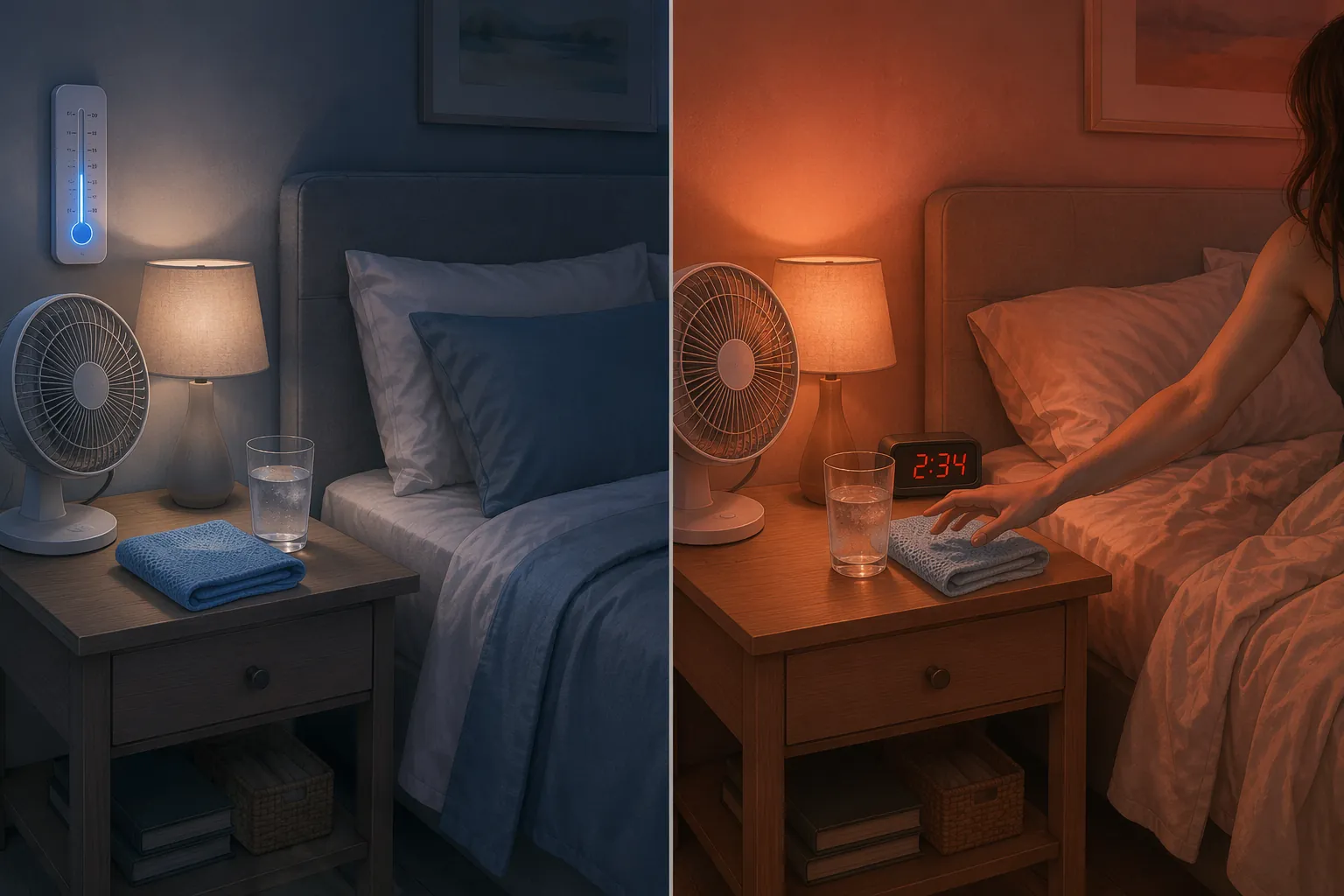
A heat watch and a heat warning are real weather-alert terms: broadly, a watch means dangerous heat conditions are possible, while a warning means they are happening or expected soon. For hot flash sleep, the same split is useful in a different way: before bed, you are in Heat Watch; when the flush starts at 2:34 a.m., you are in Heat Warning.
That distinction matters because night sweats are not just a little warmth under the covers. In an American Academy of Sleep Medicine survey, 75–80% of women reported hot flashes during the menopausal transition, and 35% of women ages 45–64 said night sweats disrupted sleep.[1] In a sleep-lab study discussed by the Society for Women’s Health Research, about 70% of nighttime hot flashes woke women and accounted for roughly 27% of wake-after-sleep-onset time.[2]
If that sounds familiar, the problem is not that you are overreacting to a minor nuisance. A hot flash can mean sweat on the neck and chest, a blanket kicked away, a partner stirred, a quick calculation about whether to change clothes, and then the harder part: convincing your brain that this one awakening does not mean the whole night is lost.
Why hot flashes wake you so abruptly
During the menopausal transition, estrogen fluctuations affect the hypothalamus, the part of the brain involved in temperature regulation. Clinical explanations from Yale Medicine and Johns Hopkins describe a narrowed thermoneutral zone: the body has less margin before a small rise in core temperature triggers sweating, flushing, and the urge to throw off covers.[3][4]
That physiology is why cooling the sleep environment is rational, even if it is not a complete cure. A cooler room, breathable layers, and staged cooling tools are not moral tests of whether you are doing menopause correctly. They are ways to reduce the number of temperature decisions your half-awake brain has to make.
The caveat is important: prevalence numbers come largely from U.S.-based research, often with cohort limitations, and SWAN data show racial differences in hot flash frequency. They should not be read as if every woman has the same pattern, duration, or frequency of hot flashes. Some people have rare mild warmth. Some are woken repeatedly. Some have night sweats from causes other than menopause.
The two jobs: prepare before bed, respond during the episode
The useful question is not, “How do I prevent every hot flash tonight?” That may not be under your control. The better question is, “What job am I supposed to be doing right now?”
| Phase | When it applies | Your job |
|---|---|---|
| Heat Watch | The hour or two before sleep | Lower the odds that a small temperature rise becomes a full wake-up, and place tools where you can reach them without thinking. |
| Heat Warning | The moment a flush, sweat, or heat surge starts | Use the smallest effective intervention, avoid bright light and panic, and make returning to sleep the next task. |
This is a modest framework, not a treatment claim. It will not make every night smooth. Its value is that it keeps you from designing a new rescue plan while your skin is hot, your pajamas are damp, and the clock is suddenly very interesting.
Heat Watch: set the room and the bedside before you are desperate
Heat Watch begins before the first sweat. This is the preparation window, usually the last 60–90 minutes before sleep, when you arrange the environment so the middle of the night requires fewer choices.
Start with a cooler room, then adjust for your body
A bedroom around 65–68°F is often suggested as a sleep-friendly starting range, and it fits the physiology: if the thermoneutral zone is narrowed, reducing heat load before sleep gives the body a little more room before it tips into flushing.[3][4] But this range is a starting point, not a prescription. Some people sleep poorly when they feel chilled. Some share a room with a partner who runs cold. Some live where air-conditioning cost or availability changes the calculation.
If 65°F makes you tense your shoulders or curl up tightly, it is not helping. Try a slightly warmer setting with more targeted cooling: a fan angled across the bed rather than straight at your face, a lighter top layer, or a cool pillow surface that does not require turning the whole room into a refrigerator.
Use layers that can be changed with one hand
Layered bedding is not about making the bed look sensible. It is about making the bed adjustable while you are half awake. A light blanket over a sheet, or a breathable cover that can be pushed to the side without uncovering the whole body, gives you more control than one heavy comforter that is either on or off.
Moisture-wicking bedding and breathable sleepwear help most when they are part of that same system. The goal is not to stop sweat from existing. It is to keep damp fabric from staying against the skin long enough to trigger the next problem: feeling chilled, waking more fully, and needing another round of rearranging.
Move likely triggers out of the late evening
For the last three or more hours before bed, treat alcohol, heavy spicy meals, and late intense heat exposure as possible accelerants. Not every woman has the same triggers, and trigger tracking can become its own exhausting hobby. Still, alcohol is a common enough sleep disruptor in perimenopause that it deserves special attention; if evenings are already fragmented, the practical move is to separate drinking from bedtime and watch what changes. Restful Ground’s guide to how alcohol disrupts sleep in perimenopause goes deeper on that pattern.
Pre-cool without turning bedtime into a project
A lukewarm-to-cool shower 60–90 minutes before sleep can help some women enter bed less heat-loaded. Keep it gentle. A very cold shower right before bed may feel dramatic, but if it leaves you alert, shivering, or annoyed, it has solved the wrong problem.
The same rule applies to every pre-bed intervention: it should make the night simpler. If a cooling gadget, special fabric, or elaborate routine creates more vigilance, it belongs on probation. Menopause sleep is already full of monitoring; the preparation phase should remove monitoring where it can.
Stage the tools where your hand will find them
Before lights out, place cold water within reach and put a cooling towel, cloth, or other cool compress where you can use it without standing up. If condensation bothers you, set the glass or bottle on a small towel. If you use a fan, decide the setting before bed. If you tend to change tops after sweating, keep a dry shirt close enough that you do not have to open drawers.
- Room: cool enough to reduce heat load, not so cold that you tense up.
- Bedding: light layers that can be moved separately.
- Clothing: breathable or moisture-wicking, with a dry backup if needed.
- Bedside: water, cooling towel, and any fan control within reach.
- Evening: likely triggers moved at least three hours away from bedtime when possible.
This is Heat Watch. Nothing is wrong yet. You are simply making the room ready so that if heat arrives, you are not negotiating with the nightstand, the laundry basket, the thermostat, and your own alarmed thoughts all at once.
Heat Warning: respond to the flush without waking the whole brain
Heat Warning starts when the event is happening: a wave of heat, prickling skin, sudden sweat, chest or neck warmth, or the familiar impulse to throw off every cover. The job changes. You are no longer optimizing the bedroom. You are keeping the response brief and dim.
Notice the first signs, then use the smallest tool
Early recognition helps because it prevents the scramble. If you feel the heat rising, uncover one layer, take a few sips of water, or place the cooling towel at the back of the neck or upper chest. Do the first useful thing, not all possible things.
This is where the bedside staging earns its keep. You should not have to turn on the overhead light, search for a towel, walk to the kitchen, or decide whether the fan is worth the noise. Those are daytime decisions. At night, the intervention should be almost boring.
Keep light low and movement limited
Bright light tells the brain more morning is happening than you intend. If you need visibility, use the lowest light that lets you move safely. A small amber night-light is different from a phone screen held close to the face. The phone is especially tempting because it offers company when you feel suddenly awake, but it also turns a body event into a news, email, or clock-checking event.
Limit standing if you can. Sit up only as much as needed. Change clothes only if damp fabric will keep waking you. If you do need to change, use the dry top you staged during Heat Watch and return to bed without making the episode a full reset of the night.
Give the mind one plain sentence
The physical heat may pass faster than the mental alarm. Many women know the second wave: “Now I’m awake. Tomorrow is ruined. This keeps happening. I can’t do this again.” That spiral is understandable, but it is also arousing. It asks the brain to solve tomorrow at the exact moment you need it to stand down.
Choose one sentence before you need it. Not a cheerful slogan. Something plain enough to believe at 3 a.m.: “This is a hot flash; I know the next step.” Or: “I do not have to judge the whole night right now.” Or: “Cool, breathe, return.”
That kind of reframing does not pretend the awakening is pleasant. It simply keeps one awakening from recruiting the whole nervous system. The episode still happened. The difference is that you are not adding a second episode of threat monitoring on top of it.
When “probably menopause” deserves a closer look
Menopause is a common reason for night sweats in midlife, but it is not the only one. It is worth seeking medical guidance if night sweats are drenching, new and unexplained, accompanied by fever or unintended weight loss, associated with chest pain or fainting, or happening alongside loud snoring, choking, gasping, or morning headaches.
Sleep apnea can overlap confusingly with perimenopause symptoms, especially when awakenings, sweating, and fatigue are all present. If that is part of your picture, start with Sleep Apnea or Perimenopause? and consider bringing the pattern to a clinician rather than assuming every wet shirt is hormonal.
The payoff is less improvisation
The watch/warning model is useful because it separates two kinds of effort. Before bed, you prepare the conditions: temperature, bedding, clothing, triggers, water, towel, light. During the hot flash, you respond narrowly: notice, cool, stay dim, keep the story small, return.
That will not guarantee uninterrupted sleep. It can make hot flashes less chaotic, reduce the dread that starts before you even turn out the light, and give you a practiced way back after the heat breaks.
References
- Women’s sleep health: menopause and menstrual cycle, American Academy of Sleep Medicine, 2025.
- Menopausal Hot Flashes: Middle-of-the-Night Sleep Intruders, Society for Women’s Health Research.
- Hot Flashes: Why They Happen, Treatment, Prevention, Yale Medicine.
- Managing Hot Flashes: Tips From a Menopause Expert, Johns Hopkins Medicine.
Explore the mechanism
Next step
Spot an error or have clinical feedback?
Because this article covers clinical, medication, or safety information, we use a moderated correction channel instead of open public comments. Let us know if something about “How Heat Watch and Heat Warning Help You Prepare for Hot Flash Sleep” needs a closer look.
Send feedback on this article