
Which Family Beach Resorts Help Perimenopause Sleep?
Standard family beach resorts can undermine perimenopause sleep through centralized AC and noise. This checklist helps you evaluate resorts on room temperature control, separate sleeping zones, morning light access, and kids' club hours — all verifiable before booking.
The booking page will usually tell you the resort has a beach, a pool, a kids’ club, and “climate-controlled” rooms. It may not tell you the one thing that decides whether a perimenopausal parent sleeps: whether the bedroom can be made cold enough, quiet enough, and separate enough from everyone else’s vacation noise.
For the best family beach vacations for better sleep in perimenopause, the first filter is not the prettiest shoreline or the longest amenity list. It is whether the room itself can support a narrower temperature tolerance, night sweats, fragmented sleep, and a nervous system that may not recover easily from late light, hallway noise, or a child whispering from a sofa bed three feet away.
A practical target helps cut through resort language: the bedroom should be able to reach roughly 60–67°F, with 60–65°F often described as ideal for women over 40 trying to optimize sleep temperature.[1] That is not a decorative preference. Perimenopause can narrow the thermoneutral zone by as much as 60%, so a small temperature shift that once felt unremarkable can become enough to trigger sweating and waking.[2]
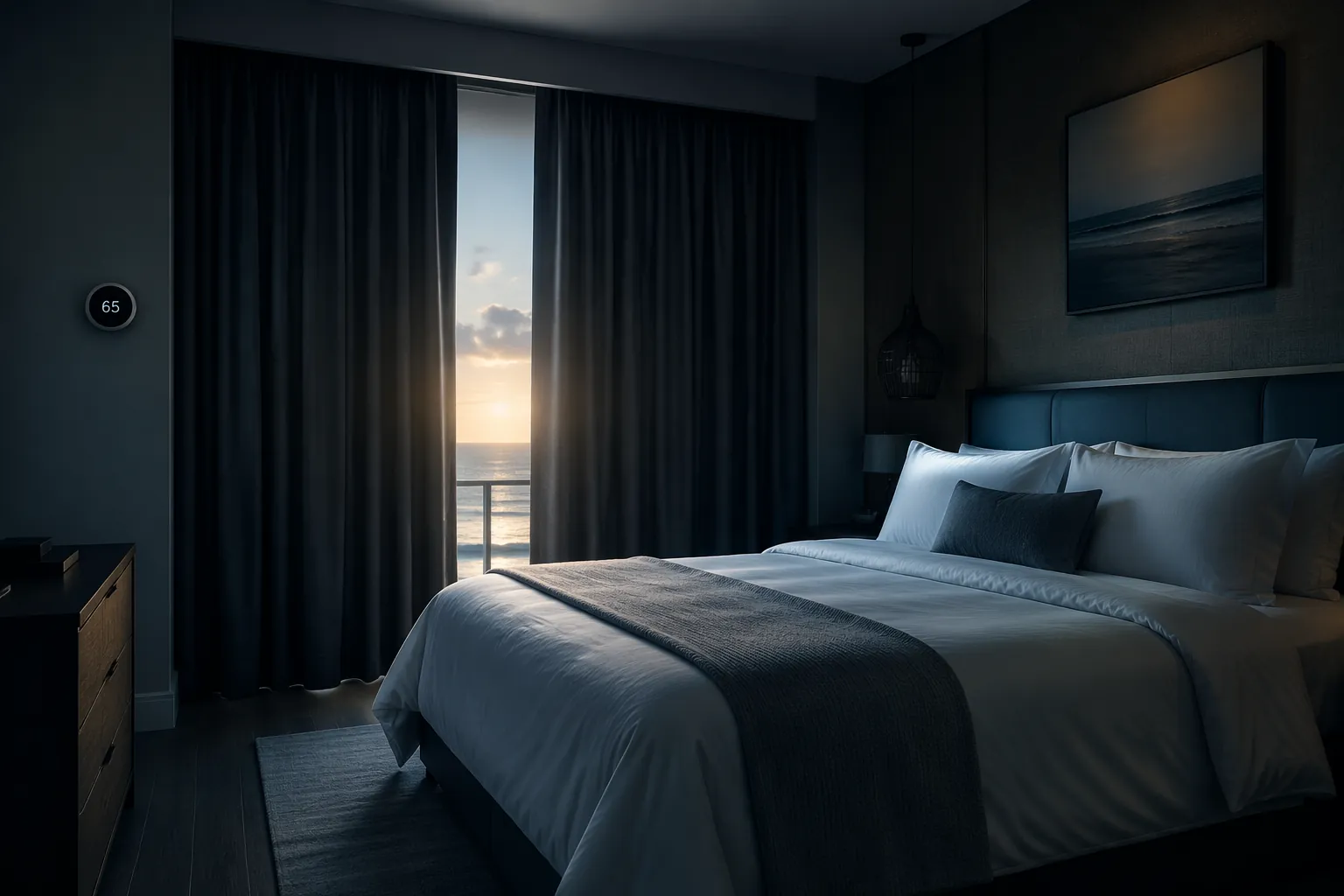
That is why a resort can look restful online and still fail at 2:17 a.m. Centralized HVAC that bottoms out well above the sleep target, one-room “family suites,” pool-bar bass through the balcony door, and kids’ programming that starts too late for a morning walk all push the same problem: the parent absorbs the sleep cost so the family trip can keep looking easy.
Start With the Room, Not the Resort
Sleep disruption is common enough in this life stage that it should be treated as a booking requirement, not a personal quirk. Estimates commonly place significant sleep disruption during perimenopause in the range of 40–60% of midlife women.[3][4] A family beach resort does not need to market itself as a menopause retreat to be usable, but it does need to answer room-level questions clearly.
The phrase “climate controlled” is too vague. It can mean a guest-controlled thermostat. It can also mean a centrally managed system where the property decides the seasonal range, the room never gets below the low 70s, or motion sensors reduce cooling when the room is quiet at night. Before paying a deposit, ask reservations to describe the actual system in the exact room category you are booking.
| Feature to Verify | Why It Matters in Perimenopause | Question to Ask Before Booking |
|---|---|---|
| Individually controlled AC | A narrowed thermoneutral zone makes small heat changes more disruptive. | Can the bedroom thermostat be set by the guest, and can it reach 60–67°F overnight? |
| Separate bedroom with a door | Night sweats and wakeups are harder to settle when children are sleeping in the same open room. | Is this a true one-bedroom suite, or one room with a sofa bed? |
| Blackout curtains | Late exterior light and early unwanted light can fragment already fragile sleep. | Do the sleeping areas have full blackout curtains, including the children’s area? |
| Quiet building or room stack | Evening entertainment, elevators, ice machines, and pool noise can extend cortisol arousal. | Can you place us away from pool bars, nightly entertainment, elevators, and service corridors? |
| Usable kids’ club hours | Childcare only helps sleep if it protects bedtime and the morning recovery window. | What are the current kids’ club hours, age rules, and evening program options? |
The important word in those questions is “current.” Resort pages, third-party booking sites, and old reviews may be out of date. Kids’ club hours change by season. Renovated buildings may have different HVAC from older wings. A room category with “suite” in the name may still be one open sleeping area. The only safe assumption is that marketing copy is a lead, not confirmation.
What “Cold Enough” Means in a Family Resort
Temperature deserves disproportionate attention because it is both physiological and logistical. If a parent is waking with heat surges, the resort’s spa menu will not compensate for a room that cannot cool. A plunge pool at noon is pleasant; a bedroom that stays cool at 3 a.m. is the accommodation.
Ask for the temperature range, not just AC availability. “Does the room have air conditioning?” is too easy to answer yes. A better question is: “In this exact room category, can the guest-controlled thermostat be set to 60–67°F, and will the system maintain that temperature overnight?” If the agent says the hotel is “centrally climate controlled,” follow with: “What is the lowest guest-accessible temperature setting?”
Also ask whether the bedroom and living area share one thermostat. In a true one-bedroom suite, a parent may be able to cool the bedroom while children sleep separately. In an open-plan family room, cooling the parent may mean freezing a child under thin bedding, or keeping the room warmer than the parent’s body can tolerate. That is how “family-friendly” becomes code for nobody sleeping well.
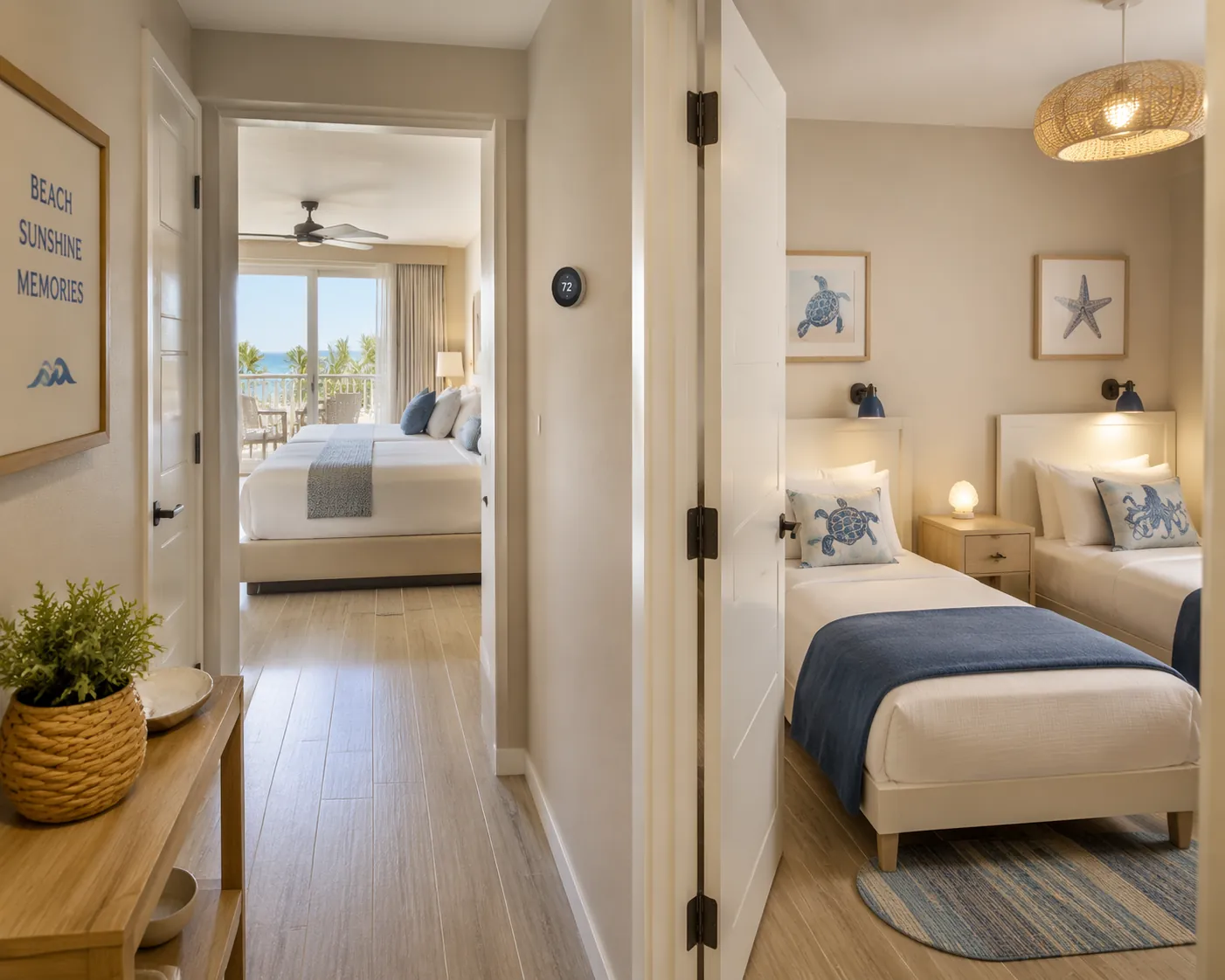
If a property cannot confirm the low end of the thermostat range, you can still ask about mitigation: portable fans, lighter bedding, extra top sheets instead of duvets, balcony screens, shaded room exposure, and whether the windows open safely. These are secondary supports, not substitutes for a room that can reach the sleep range, but they reveal whether the property understands practical sleep needs or is simply repeating hospitality language.
The Email That Gets a Useful Answer
A phone call is useful, but an email creates a record. Keep it short enough that reservations can forward it to rooms management or engineering.
Hello,

I am considering booking [room category] for [dates]. Before I place a deposit, could you please confirm the following for that exact room type?

1. Is the air conditioning individually controlled inside the suite, or centrally controlled by the property?
2. What is the lowest temperature the guest thermostat can be set to, and can it maintain 60–67°F overnight?
3. Is the bedroom fully separate from the children's sleeping area, with a door that closes?
4. Do both sleeping areas have blackout curtains?
5. Can this room be assigned away from elevators, ice machines, pool bars, evening entertainment, and service corridors?
6. What are the current kids' club hours, age requirements, and evening program options for our dates?

Thank you.
If the answer comes back as a polished paragraph that does not address the thermostat range, ask again. If the second answer is still vague, treat that as information. A resort that cannot tell you who controls the AC before booking is unlikely to become more precise when you are awake in the middle of the night.
Separate Sleep Space Is Not a Luxury Upgrade Here
In ordinary family travel writing, a suite is often framed as a comfort splurge. For perimenopause sleep, a separate bedroom with a closing door is a practical sleep accommodation: it reduces noise, light, body heat, and the pressure to stay motionless so everyone else can sleep.
Look carefully at floor plans. “Family suite,” “junior suite,” and “residential-style” do not consistently mean separate sleeping zones. The useful configurations are specific: a one-bedroom suite with a door, connecting rooms, a villa or condo-style unit, or a layout where children’s beds are not in the same open airspace as the primary bed. If a child needs a nightlight, a parent needs darkness. If a child rustles around at 5:40 a.m., a parent needs at least a door between that sound and the next attempt at sleep.
Blackout curtains should be confirmed for every sleeping area, not just the primary bedroom. Many resorts install attractive sheers in living areas where sofa beds are placed. That may be fine for a child who sleeps anywhere and useless for a parent trying to avoid early light after a fragmented night. If the children are in the living area, their light management still affects the whole room.
The Beach Helps Most When the Schedule Lets It
The beach is not just scenery. Sleep specialist Dr. Michael Breus has noted that ocean sounds are the only environmental sound documented to improve sleep quality, describing their effect through parasympathetic activation and reduced cortisol.[5] Morning outdoor light also matters because circadian rhythm timing is closely tied to sleep-wake regulation, and perimenopause can make cortisol timing feel less forgiving.[4][6]
This is where the family logistics either protect the parent or erase the benefit. An east-facing beach path is useful if someone can actually walk it in morning light. A sunrise yoga class is useful if it starts before the family day is already in motion. A beautiful shoreline is less useful if breakfast, childcare, and checkout-style morning chaos keep the parent indoors until the strongest circadian window has passed.
When comparing resorts, ask about the geography in plain terms. Is there a safe beach or coastal path open early? Are rooms or public areas positioned for morning light, especially on east-facing stretches? Are fitness classes offered before 9 a.m., or does “wellness” begin after the parent has already made breakfast decisions, sunscreen decisions, and sibling-peacekeeping decisions?
Kids’ Clubs Should Protect Bedtime, Not Just Fill Time
A kids’ club that opens at 10 a.m. may be perfectly entertaining and still miss the parent’s sleep need. For this kind of trip, childcare has two jobs: it should create a morning window for light and movement, and it should prevent evening activities from pushing the parent’s bedtime later than her body can handle.
Ask for the current opening time, not the general promise of “daily activities.” Ask whether drop-off is available by 8 a.m. or earlier, whether pre-registration is required, whether your child’s exact age qualifies, and whether the club closes for lunch. A child who is technically eligible but only for a two-hour afternoon craft block does not give the parent the same recovery window as a reliably staffed morning program.
Evening programming needs the same scrutiny. Some family resorts offer movie nights, supervised dinners, or evening activities; others list children’s programming but end it before dinner. If your own sleep is most stable with an early bedtime, the question is not whether the kids will have fun. It is whether the resort can keep them safely occupied without turning you into the late-night entertainment coordinator.
Roundups from family travel publications can be useful starting points because they identify resorts with beach access, family room categories, and children’s programming. Parents’ list of family beach resorts, for example, can help build a candidate pool, but it does not settle whether a specific room can cool to the perimenopause sleep range or whether the kids’ club hours work for your travel dates.[7]
Wellness Resorts Are a Clue, Not the Whole Answer
The travel industry has started to notice that midlife women are not asking for generic pampering. Coverage of wellness resorts opening more deliberately to kids and tweens suggests that some properties are trying to combine family travel with spa, recovery, and health programming.[8] Separate reporting on menopause retreats shows an even more direct market: women are willing to travel for sleep, symptoms, and hormonal transition support.[9]
Those retreats are not the same product as a family beach vacation. Carillon Miami’s Inner Glow retreat, for example, is an adult wellness retreat, not a solution for a parent bringing children who need supervised activities.[10] The useful lesson is not that every perimenopausal parent should book a retreat. It is that the needs are real enough to have become travel products, while ordinary family resorts still often leave the most important sleep details buried or unspecified.
Use wellness language cautiously. “Restorative,” “mind-body,” and “sleep ritual” can sit on the same website as a room with one thermostat, thin curtains, and live music under the balcony. A resort earns trust through operational answers: thermostat range, room layout, blackout, quiet placement, early childcare, morning light access.
Food, Drink, and Cooling Amenities Still Matter
Once the room passes the sleep test, smaller amenities can make the trip easier. Menopause travel guidance commonly points to avoiding common symptom triggers such as alcohol, caffeine, spicy foods, dehydration, and irregular routines.[3][11] A resort does not need a medical menu, but it should make the lower-friction choices easy: early dinner reservations, mild dishes, caffeine-free drinks, nonalcoholic options that are not an afterthought, and water access that does not require a bar line.
Cooling amenities are similar. A shaded pool, a quiet indoor lounge, chilled towels, fans on request, and breathable bedding can help manage a hot day before it becomes a hot night. They do not replace AC performance, but they reduce the amount of heat stress a parent carries into bedtime.
How to Compare Candidate Resorts Without Pretending Certainty
There is no reliable public database that ranks family beach resorts by perimenopause sleep support. That absence matters. A resort may be excellent for toddlers, luxury travelers, or multigenerational groups and still be a poor fit for a parent whose sleep depends on cold air and quiet room placement. Published roundups can help you find candidates; they cannot replace property-level verification.
A workable comparison method is simple: eliminate any property that cannot confirm the essentials, then choose among the survivors based on budget, destination, beach quality, and family preferences. This keeps the emotional parts of travel in the decision without letting them override the room conditions that determine whether the parent sleeps.
- Keep only resorts that confirm guest-controlled AC in the exact room category, with a stated lowest setting close to the 60–67°F target.
- Prioritize true one-bedroom suites, connecting rooms, villas, or condo-style layouts over open-plan “family suites.”
- Request quiet placement away from pool bars, nightly entertainment, elevators, ice machines, and service areas.
- Confirm blackout curtains in every sleeping zone, including living areas used by children.
- Verify kids’ club hours, age eligibility, lunch closures, evening options, and whether reservations are required.
- Check whether the property gives easy access to early outdoor light, a safe beach path, or wellness programming before 9 a.m.
If two resorts both pass those tests, then choose the beach your family will love. Choose the better pool, the easier flight, the room with the view, the restaurant your children will actually tolerate. The point is not to turn vacation into a clinical audit. It is to run the audit before the deposit, so the vacation has a fair chance of feeling like one.
The Booking Standard
A family beach resort is perimenopause-sleep-supportive only if it can confirm the conditions that matter at night and in the first hour of the day. The room must be able to get cold enough. The parent must not be sleeping in the same open room as every child. The building should not sit on top of the resort’s evening noise. Morning light should be reachable before the day becomes everyone else’s schedule. The kids’ club should protect that rhythm instead of merely advertising “family fun.”
If the property cannot give straight answers on individually controlled AC, a 60–67°F sleep range, separate sleeping zones, blackout curtains, quiet placement, morning light access, and usable childcare hours, it may still be a beautiful family beach resort. It is just not the right answer to this particular sleep problem.
References
- Sleep-Optimized Bedroom Temperature for Women 40+, Ubie Health
- Perimenopause Night Sweats & Sleep Tips, Concierge Medicine of South Shore
- How to Sleep Better on Vacation During Menopause, Bonafide
- Perimenopause and Sleep, Sleep Foundation
- Could You Sleep Better on a Beach Vacation?, Sharecare
- Mountain Rebalance perimenopause sleep guidance, Mountain Rebalance
- 19 Best Family Beach Resorts in the U.S. and Caribbean, Parents
- For the First Time, These Wellness Resorts Are Opening Up to Kids and Tweens, Condé Nast Traveler
- The Best Menopause Retreats and What They Offer, Afar
- Inner Glow Retreat, Carillon Miami Wellness Resort
- Traveling Tips for Women in Perimenopause and Menopause, MenoLabs
Explore the mechanism
Next step
Spot an error or have clinical feedback?
Because this article covers clinical, medication, or safety information, we use a moderated correction channel instead of open public comments. Let us know if something about “Which Family Beach Resorts Help Perimenopause Sleep?” needs a closer look.
Send feedback on this article