
Three Ways GLP-1 Weight Loss May Improve Perimenopause Sleep
GLP-1 weight loss may improve sleep in perimenopause through three pathways: obstructive sleep apnea reduction, vasomotor symptom relief, and circadian-metabolic stabilization. This article examines the strength of evidence for each mechanism and the critical caveats for perimenopausal women.
The short answer: sometimes, and the pathway matters
If you are asking does GLP-1 weight loss improve sleep in perimenopause, the most honest ranked answer is this: probably yes for some women, most strongly when weight loss reduces obstructive sleep apnea; possibly when weight loss reduces hot flashes or night sweats; and only tentatively through circadian-metabolic effects. That ranking is not a formality. These are different sleep problems, and they do not deserve the same confidence level.
The caveat belongs at the beginning: as of Q3 2026, no prospective trial has measured sleep endpoints specifically in perimenopausal women taking GLP-1 medications. A RAND commentary called for perimenopause-specific research and noted that women ages 50–64 reported GLP-1 use at 20%, making this a high-use group with an evidence gap around the exact sleep question many patients are now asking [1].
| Possible sleep pathway | How strong is the evidence? | What would make it more likely in your case? |
|---|---|---|
| Obstructive sleep apnea reduction | Strongest. Randomized trials measured apnea-hypopnea index changes with tirzepatide and liraglutide in adults with obesity and OSA [2][3]. | Snoring, gasping, witnessed pauses, morning headaches, dry mouth, unrefreshing sleep, or daytime sleepiness. |
| Hot flash or night-sweat reduction | Moderate and inferential. Weight loss has been associated with better vasomotor symptom outcomes, and a 2026 review argues GLP-1 receptor agonists may help VMS [4][5]. | Waking hot, sweaty, flushed, or chilled after sweating, especially if awakenings cluster around temperature surges. |
| Circadian-metabolic stabilization | Emerging. GLP-1 physiology appears connected to circadian timing systems, but human sleep-architecture trials are missing [6]. | Sleepiness, irregular eating timing, metabolic disruption, or diabetes-related fatigue, without clear apnea or night-sweat clues. |
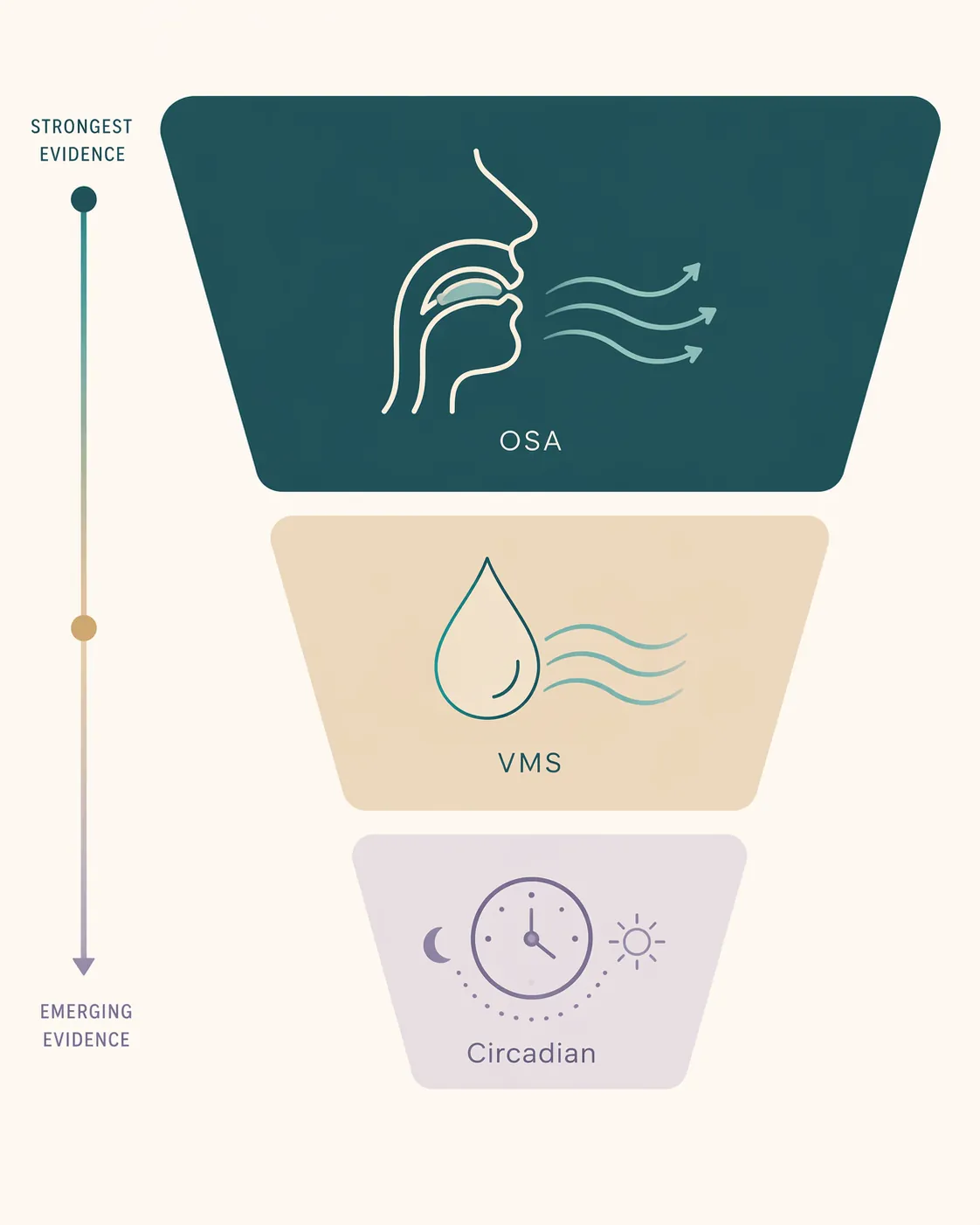
The useful question is therefore not “Will the scale make me sleep?” It is “Which sleep problem is weight loss changing?” Perimenopause can bring lighter sleep, earlier waking, night sweats, anxiety, changing alcohol tolerance, joint pain, and more frequent awakenings. Add weight gain and the picture gets messier. A GLP-1 medication may help one part of that picture without touching another.
The strongest pathway is obstructive sleep apnea
For sleep-specific evidence, obstructive sleep apnea is where the GLP-1 conversation becomes substantial. In OSA, the airway repeatedly narrows or collapses during sleep. The result is not only snoring. It can mean oxygen drops, brief arousals the sleeper may not remember, repeated stress surges, dry mouth, morning headaches, and the cruel experience of spending enough hours in bed yet waking as if the night never repaired anything.
SURMOUNT-OSA tested tirzepatide in adults with obesity and moderate-to-severe obstructive sleep apnea. The trial reported apnea-hypopnea index reductions of up to 63% alongside weight loss of roughly 18–20% [2]. That matters because AHI is not a mood rating or a vague “sleep quality” impression. It counts breathing disruptions per hour of sleep. When that number falls meaningfully, the night can contain fewer airway events, fewer oxygen dips, and fewer arousal chains.
The FDA then approved tirzepatide in December 2024 as the first medication for obstructive sleep apnea, specifically for adults with obesity and moderate-to-severe OSA [7]. That approval does not turn tirzepatide into a general sleep drug. It does mark a real shift: a weight-loss medication produced enough change in a sleep-disordered breathing endpoint to enter OSA treatment discussions.
Tirzepatide is not the only trial signal. In the SCALE Sleep Apnea randomized clinical trial, liraglutide 3.0 mg reduced AHI by 12.2 events per hour compared with 6.1 events per hour with placebo in adults with obesity and moderate or severe OSA [3]. The difference is not theatrical, but it is sleep-specific. It tells us that GLP-1-associated weight loss can reduce measured breathing disruption during sleep in some patients with OSA.
This is the pathway worth checking before a perimenopausal woman is handed only the word “insomnia.” Perimenopause and menopause change the airway risk landscape. Estrogen appears to play a protective role in upper airway patency, and loss of that protection is one plausible reason OSA becomes more relevant across the menopause transition [8]. A meta-analysis estimated that about 47% of perimenopausal women report sleep disorders, though the included studies used varied definitions and instruments, with individual study estimates ranging widely from 16% to 67% [9]. That broad sleep-disorder figure is not the same as OSA prevalence, but it helps explain why “I suddenly sleep badly” is too blunt a complaint to stop at.
Weight can affect OSA because fat distribution around the neck, tongue, abdomen, and upper airway can increase collapsibility and reduce lung volume during sleep. GLP-1 medications that produce substantial weight loss may therefore reduce some of the mechanical load contributing to airway obstruction. If that happens, a woman may notice less snoring, fewer gasping awakenings, less nocturnal panic that is actually an arousal from airway collapse, and less daytime sleepiness.
But here is the boundary: SURMOUNT-OSA and SCALE Sleep Apnea were not designed around perimenopausal women. Their results are highly relevant to OSA with obesity; they are not proof that every exhausted 49-year-old starting Wegovy, Zepbound, Ozempic, or Mounjaro will sleep better. The closer her symptoms are to sleep-disordered breathing, the more directly those trials apply. The more her sleep problem looks like hot flashes, grief, restless legs, medication effects, alcohol-related waking, or early-morning cortisol surges, the less the OSA trials can answer.
The practical implication: screen the breathing problem, not just the bedtime problem
A perimenopausal woman who wakes repeatedly may describe insomnia because that is the word she has. If the awakenings come with snoring, choking, gasping, dry mouth, morning headaches, blood pressure changes, or a bed partner’s report of pauses, the more evidence-backed next question is whether untreated apnea is part of the sleep change. A GLP-1 medication may reduce OSA severity for some patients with obesity, but it should not be asked to diagnose the disorder by trial and error.
That distinction matters because OSA has existing treatments: positive airway pressure, oral appliances for selected patients, positional strategies, surgery in narrower cases, and hypoglossal nerve stimulation for carefully selected patients. Weight-loss medication may become part of that conversation for some people, especially after tirzepatide’s OSA approval, but the treatment plan still depends on confirming the condition and its severity.
Night sweats are the second pathway, but the evidence is less direct
The vasomotor symptom pathway is easy to understand because the sleep disruption is so concrete. A hot flash during the day is unpleasant. A night sweat can splinter the night: heat surge, sweating, waking, throwing off covers, cooling too much, changing clothes, checking the clock, and then trying to re-enter sleep with a faster heart and a fully awake mind.
Weight loss may help some vasomotor symptoms. In Women’s Health Initiative data, women who lost at least 10% of body weight had 56% higher odds of reporting no hot flashes [4]. That is worth taking seriously, especially for someone whose poor sleep is tightly linked to heat and sweating rather than snoring or gasping.
Still, this is not the same kind of evidence as an apnea trial. The WHI analysis was about weight loss and hot flashes; it was not a GLP-1 trial, and sleep improvement was not the endpoint [4]. A 2026 review by Graczyk and Bisschops notes that GLP-1 receptor agonists may improve menopausal vasomotor symptoms and could therefore reduce night-sweat-related sleep fragmentation, but that is a clinical hypothesis built from adjacent evidence, not a completed perimenopause sleep trial [5].
This is where hope needs handling carefully. If GLP-1 treatment leads to weight loss and night sweats become less frequent or less intense, sleep may improve because there are fewer temperature-triggered awakenings. That would be a meaningful result. But if night sweats are being driven primarily by fluctuating estrogen, alcohol sensitivity, a warm sleep environment, medications, or untreated anxiety, weight loss alone may not do much. The symptom pattern matters more than the medication category.
The clue is the awakening itself. Waking drenched, overheated, or chilled after sweating points toward vasomotor disruption. Waking with a snort, gasp, pounding heart, or dry mouth points more toward breathing disruption. Many women have both. That is inconvenient, but it is also why a single “sleep got worse in perimenopause” label can send care in the wrong direction.
The circadian-metabolic idea is intriguing, not settled
The third pathway is the most speculative for actual sleep outcomes. GLP-1 signaling is tied to appetite, glucose regulation, gastric emptying, and energy balance. Circadian systems also regulate feeding timing, insulin sensitivity, body temperature, alertness, and sleep-wake timing. A 2026 review described coupling between GLP-1 physiology and circadian timing systems, which makes it biologically plausible that GLP-1 therapies could influence sleepiness or sleep timing beyond simple weight loss [6].
There are human signals around sleepiness. In a study of exenatide, Epworth Sleepiness Scale scores fell from 12.3 to 5.7 [10]. That is interesting because the Epworth scale measures the tendency to doze in daytime situations; a drop of that size suggests patients felt less sleepy. But it still does not tell us whether their deep sleep increased, REM sleep normalized, awakenings decreased, or circadian phase shifted.
This is where it is especially easy to overstate the evidence. Better glucose stability might reduce nocturnal symptoms for some people. More regular eating patterns might help some circadian cues. Less daytime sleepiness might make activity and light exposure easier. These are plausible links. They are not yet proof that GLP-1 medications repair perimenopausal sleep architecture.
What your sleep pattern can tell you before the scale does
Weight loss is visible. Sleep mechanisms are not. That makes it tempting to use the scale as a proxy for the night: down ten pounds, sleep should be better; down twenty, surely better still. The evidence does not support that shortcut. A smaller amount of weight loss could matter if it reduces airway obstruction. A larger loss might disappoint if the main sleep disruptor is night sweats, pain, depression, thyroid disease, restless legs, alcohol timing, or a partner’s snoring.
| If the main complaint is… | The pathway to consider first | A reasonable clinician-facing question |
|---|---|---|
| Loud snoring, gasping, witnessed pauses, dry mouth, morning headaches, unrefreshing sleep | Obstructive sleep apnea | Should I be screened for OSA or have a sleep study before assuming this is insomnia? |
| Waking hot, sweaty, flushed, or chilled after sweating | Vasomotor symptoms | Could my night sweats be treated directly, and would weight loss be expected to change them? |
| Daytime sleepiness with metabolic symptoms, irregular meals, or diabetes-related fatigue | Circadian-metabolic disruption | Are glucose patterns, medication timing, eating timing, or another metabolic issue affecting my sleepiness? |
| Trouble falling asleep from worry, rumination, or conditioned alertness in bed | Insomnia disorder or stress physiology | Would behavioral insomnia treatment be more relevant than weight loss for this part of the problem? |
None of these questions require deciding in advance whether GLP-1 treatment is “good” or “bad.” They simply prevent the medication from being given credit or blame for the wrong sleep pathway. That matters because a woman can lose weight, improve her AHI, and still need treatment for night sweats. Or she can have fewer hot flashes and still have untreated apnea. Perimenopause is perfectly capable of stacking problems.
The study perimenopausal women still need
The clean study would enroll perimenopausal women with poor sleep, characterize their baseline symptoms, measure OSA objectively, track vasomotor symptoms, and use real sleep endpoints such as polysomnography, actigraphy, validated sleep-quality scales, and daytime function. It would then separate improvements caused by apnea reduction from improvements caused by fewer night sweats, better metabolic stability, or other changes.
That is not the study we have. We have strong OSA trials in broader adult populations with obesity. We have menopause and weight-loss data suggesting possible vasomotor benefit. We have mechanistic circadian work and sleepiness signals that deserve follow-up. We also have rising real-world use among midlife women and an explicit call for research in the very group most likely to ask this question [1].
So the calibrated answer is yes, GLP-1 weight loss may meaningfully improve sleep in perimenopause, especially when it reduces obstructive sleep apnea. It may also help some women whose night sweats improve with weight loss, and it may eventually prove useful through metabolic or circadian effects. But GLP-1 medications are not sleep medications in disguise. For the tired perimenopausal woman, the best next step is not to ask the scale to explain the whole night. It is to identify which sleep disorder, symptom, or physiological stressor is actually waking her.
References
- GLP-1 Agonists in Perimenopause: Unique Risks and Potential — RAND, August 2025
- Tirzepatide for Obstructive Sleep Apnea and Obesity — NEJM, 2024
- Effect of liraglutide 3.0 mg in individuals with obesity and moderate or severe obstructive sleep apnea: the SCALE Sleep Apnea randomized clinical trial — International Journal of Obesity, 2016
- Effects of a dietary weight loss intervention on hot flashes in women — Menopause, 2012
- GLP-1RAs for menopause symptoms review — Graczyk & Bisschops, 2026
- Circadian rhythms and GLP-1 — MDPI, 2026
- FDA Approves First Medication for Obstructive Sleep Apnea — U.S. Food and Drug Administration, December 2024
- Estrogen and OSA — Frontiers in Medicine, 2025
- The global prevalence of sleep disorders during menopause: a systematic review and meta-analysis — Salari et al., 2023
- Exenatide improves excessive daytime sleepiness and wakefulness in obese patients with type 2 diabetes — Journal of Sleep Research, 2013
Explore the mechanism
Next step
Spot an error or have clinical feedback?
Because this article covers clinical, medication, or safety information, we use a moderated correction channel instead of open public comments. Let us know if something about “Three Ways GLP-1 Weight Loss May Improve Perimenopause Sleep” needs a closer look.
Send feedback on this article