
Heat Dome Night Sweats? Why CBT-I Helps Perimenopause Sleep
When a heat dome keeps night temperatures high for days, perimenopause night sweats can trigger conditioned insomnia that persists even after the room cools. This article explains why CBT-I—not just better cooling—is the intervention that breaks the waking cycle.
If you are looking for heat dome sleep tips for perimenopause, you may already be past the easy part of the advice. The fan is aimed at your torso. The sheets are light. The water glass is full. Maybe you have already tried a timed cool shower, moisture-wicking pajamas, a portable AC workaround, or every no-AC trick that sounded remotely reasonable. And still, somewhere around 2 or 3 a.m., a hot flash hits, your shirt is damp, your heart is up, and your brain comes fully online.
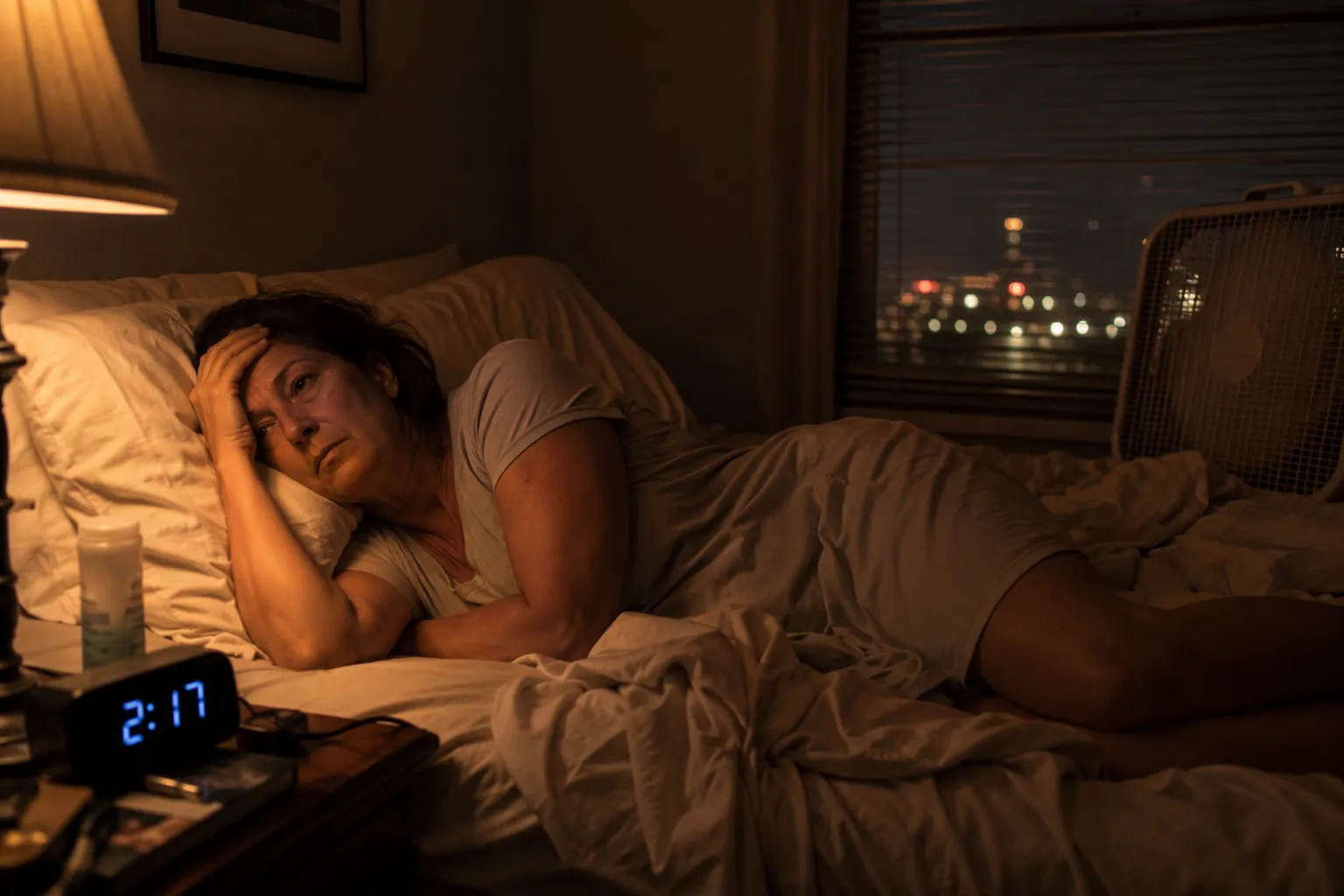
That is the point where the problem can quietly change categories. The first few bad nights may be driven mostly by heat and night sweats. After enough repeats, the wake-up itself can become learned. The bedroom, the clock time, the damp sheets, and the expectation of another ruined night start acting like cues. Cooling still matters, but it may no longer be the whole intervention.
The timing is not theoretical. U.S. news outlets reported a heat dome expanding across the central United States in late July 2026, with dangerous heat affecting millions and oppressive conditions stretching across multiple days.[1][2] Multi-day heat is different from one bad night because the body does not get a clean reset. Neither does the nervous system.
If you still need the environmental layer, start there. Restful Ground has separate guides on sleeping in extreme heat with perimenopause night sweats and sleeping in a heat wave without AC during perimenopause. The escalation starts when you have reduced what you can reduce, but the wake-up has started to feel scheduled.
When the room starts the wake-up, but the brain keeps it going
A heat dome raises the odds of a bad night in an obvious way: the room stays warmer, the bed holds heat, and a perimenopausal hot flash has less room to dissipate. But insomnia often becomes durable through a less obvious pathway. The body wakes for a legitimate reason, then the brain learns to treat that waking as important.
A typical sequence looks like this: night sweats wake you; you change clothes or move to a cooler part of the bed; you check the thermostat; you look at the clock; you calculate how little sleep remains; you listen for whether the fan is doing anything; you start preparing for tomorrow’s fatigue. None of those reactions is irrational. They are attempts to solve a real problem. But they also train attention toward waking.
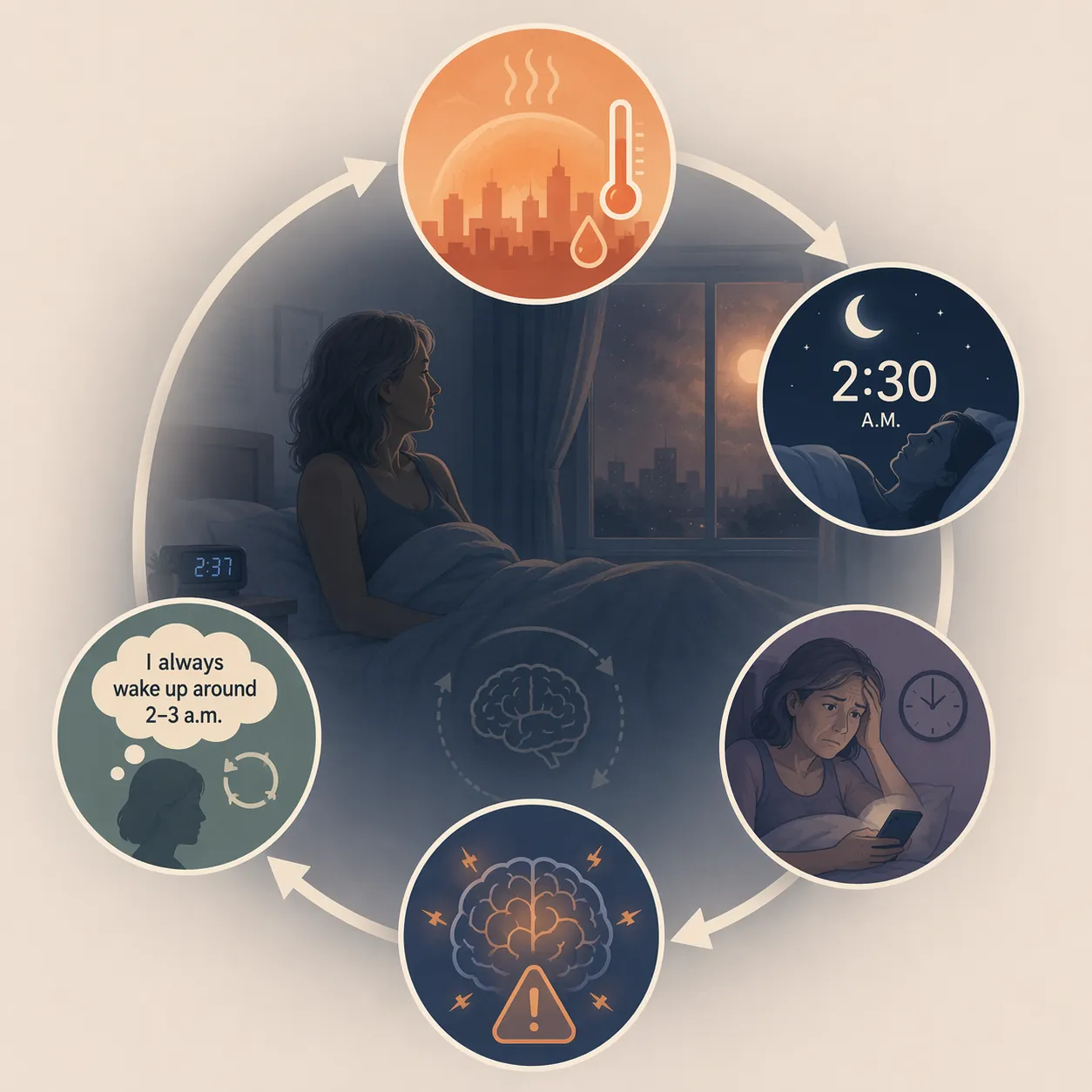
The bed becomes less purely a sleep cue and more of a monitoring station. The clock becomes evidence. The hour itself starts to matter. After enough nights, 2 a.m. is no longer just a time when a hot flash may happen; it becomes the time your brain expects a problem.
This is conditioned insomnia. It does not mean the hot flashes are imaginary. It means the original trigger has been joined by a learned arousal loop. The heat can still be real, the sweating can still be real, and the insomnia can still become partly self-reinforcing.
Why the wake-up gets louder after several nights
One night of waking drenched is miserable. Several nights can make the brain more vigilant. The difference is expectation. On the first night, you may wake, deal with the sheets, and resent the weather. By the fourth or fifth bad night, you may lie down already scanning: Is the room cooling? Is the fan enough? Will I wake again? How bad will tomorrow be?
That pre-sleep scanning matters because it raises arousal before the hot flash even arrives. Then, when a normal partial awakening or a vasomotor symptom occurs, the brain has a ready-made interpretation: here it is again. The reaction becomes faster, sharper, and more wake-promoting.
This is also why cooling advice can start to feel insulting when it is offered as the entire solution. A cooler room may reduce the number or intensity of heat-triggered awakenings for some people. It does not automatically unteach the brain that the bed is where the nightly emergency happens.
CBT-I fits because it targets the learned part of the problem
Cognitive behavioral therapy for insomnia, or CBT-I, is often described too vaguely, as if it were just sleep hygiene with a calmer voice. That undersells it. CBT-I is designed for the exact place where insomnia becomes conditioned: the bed-awake association, the fragmented time in bed, and the dread loop around not sleeping.
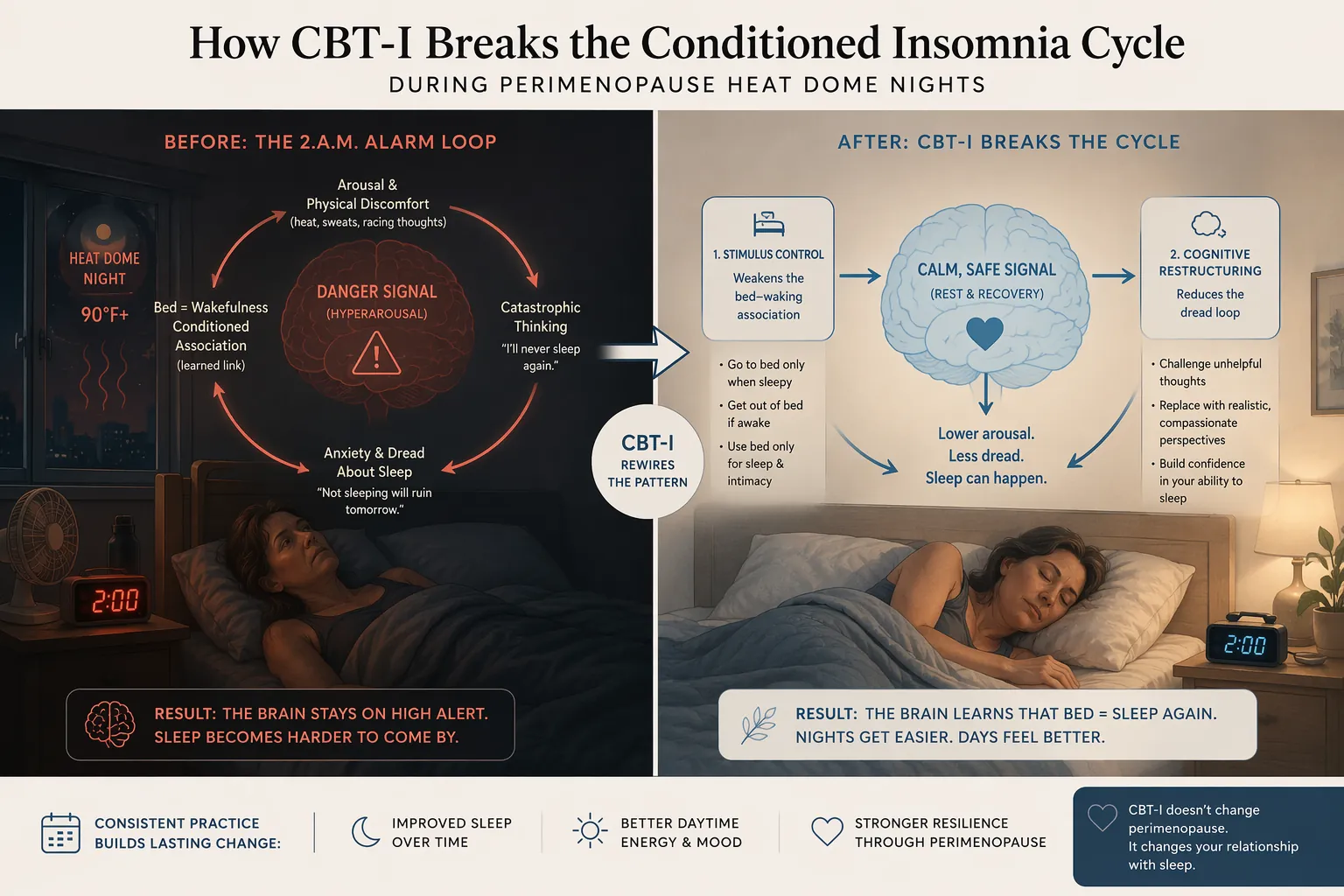
During a heat dome, that distinction matters. CBT-I does not have to make the outdoor temperature reasonable. It does not have to stop every hot flash. Its job is to reduce how much a waking episode expands into an hour or two of alertness.
- Stimulus control works on the bed-awake link. If the bed has become the place where you sweat, panic, calculate, and troubleshoot, stimulus control is the CBT-I component that weakens that association and rebuilds the bed as a sleep cue.
- Sleep consolidation reduces the amount of fragmented, restless time spent in bed. The goal is not to punish you with less sleep; it is to make the sleep window more efficient so the brain gets fewer repetitions of lying awake in the same place.
- Cognitive restructuring addresses the prediction loop: I am going to wake again, I will not function tomorrow, this night is already ruined. Those thoughts may be understandable, but when they arrive every night, they become part of the arousal system.
None of this asks you to pretend the heat is fine. It separates two jobs. Environmental cooling tries to reduce the trigger. CBT-I retrains the response once waking has become conditioned.
The perimenopause evidence is strongest where it needs to be strongest
The most useful evidence here is not generic insomnia research borrowed from another population. A 2016 randomized clinical trial in JAMA Internal Medicine tested telephone-based CBT-I in perimenopausal and postmenopausal women with insomnia and hot flashes.[3] That population matters. The trial was not asking whether CBT-I helps an abstract sleeper in a perfectly controlled bedroom. It was testing women whose sleep was being disrupted in the same broad hormonal neighborhood as the reader dealing with night sweats.
The result is the key distinction: CBT-I improved sleep quality and reduced insomnia severity, but it did not reduce hot flash frequency or severity.[3] That is not a disappointing side note. It is the clinical point. The women did not need their hot flashes to disappear in order for sleep to improve.
For heat-dome sleep, that finding is more relevant than another reminder to lower the thermostat. If the outdoor temperature and the building’s heat retention are beyond your control, an intervention that only works by preventing hot flashes would be fragile. CBT-I works on the sleep disruption pathway. It can reduce the insomnia burden even when vasomotor symptoms remain part of the night.
A 2024 systematic review adds broader support: across studies of menopausal women, CBT-I significantly improved sleep quality and reduced insomnia severity.[4] The review does not turn CBT-I into a heat-wave cure. It does strengthen confidence that the treatment is not merely a general sleep trend being casually pasted onto perimenopause.
There is an important boundary. As of this writing, no authoritative medical body has published a heat-dome-specific CBT-I protocol for perimenopausal sleep. This is a mechanism-based synthesis: extreme heat can trigger repeated night wakings, repeated night wakings can become conditioned insomnia, and CBT-I has evidence for improving insomnia in women with hot flashes even without reducing the hot flashes themselves.
How to know cooling is no longer the whole answer
The escalation point is not the first sweaty night. It is the pattern that remains after you have handled the obvious thermal problems as well as your living situation allows.
- You wake at roughly the same time even on nights when the room is less oppressive.
- You feel alert quickly after waking, as if your brain has been waiting for the signal.
- You spend more time checking, adjusting, calculating, or bracing than actually cooling down.
- You begin dreading bedtime because you already expect the 2 a.m. wake-up.
- The wake-up continues after the worst heat has passed.
At that point, adding another cooling product may still help comfort, but it may not address the learned alarm. The more useful question becomes: what is reinforcing wakefulness after the hot flash has already peaked?
A CBT-I approach would not ask you to lie there sweating in the name of discipline. Practical cooling remains humane and necessary. Change the soaked shirt. Move the blanket. Use the fan. But once the immediate discomfort is handled, the next move should not be a long investigation of the thermostat, the weather app, tomorrow’s schedule, and your remaining sleep debt. That investigation is often the part that teaches the brain to stay awake.
For readers who want the broader treatment context, Restful Ground’s guide to why CBT-I is the first-line treatment for perimenopause insomnia and its evidence ranking of perimenopause insomnia treatments cover the broader evidence beyond this heat-dome scenario.
The access problem is real
The irritating part is that CBT-I is easy to recommend and often hard to get. Trained clinicians may have long waitlists. Insurance coverage can be uneven. People are told to pursue the evidence-backed option, then left to hunt through directories while sleeping badly.
That access gap is worth naming because it affects what someone can do during an active heat dome. If in-person CBT-I is not available quickly, a structured digital program or app may be more realistic than waiting months while the 2 a.m. pattern gets more rehearsed. Restful Ground has separate guidance on why cognitive behavioral therapy for insomnia is so hard to get and how to choose a CBT-I app for chronic insomnia.
The standard for a digital option should be higher than calming graphics and generic bedtime reminders. Look for a program that actually includes the core CBT-I elements: stimulus control, sleep-window guidance, cognitive work, and some way to adjust the plan based on sleep patterns. A heat dome does not make vague sleep wellness more effective.
Cooling still matters, but it may not be the final step
There is no virtue in overheating. Keep the room as cool as your housing, budget, building, and weather allow. Use the environmental fixes that reduce sweating and make the bed tolerable. During extreme heat, comfort is not cosmetic.
But if heat-dome night sweats have turned into predictable, anxious wakefulness, the target has widened. The room may have started the waking. The brain may now be maintaining it. CBT-I is the tool that addresses that learned insomnia loop, even when the weather refuses to cooperate.
References
- Heat Dome Expands Across The Central United States, Creating Dangerous Conditions For Millions — U.S. News, July 25, 2026.
- Scorching US heat wave — The Guardian, July 25, 2026.
- Telephone-Based Cognitive Behavioral Therapy for Insomnia in Perimenopausal and Postmenopausal Women With Vasomotor Symptoms: A MsFLASH Randomized Clinical Trial — JAMA Internal Medicine, 2016.
- Cognitive behavioral therapy for insomnia to improve sleep quality in menopausal women: a systematic review and meta-analysis — PMC, 2024.
Safety & eligibility read
Cross-check against other interventionsExplore the mechanism
Next step
Spot an error or have clinical feedback?
Because this article covers clinical, medication, or safety information, we use a moderated correction channel instead of open public comments. Let us know if something about “Heat Dome Night Sweats? Why CBT-I Helps Perimenopause Sleep” needs a closer look.
Send feedback on this article