
Coping with Grief and Insomnia During Perimenopause
Perimenopause and grief each disrupt sleep through different mechanisms, but when they converge the effect is compounded. This article explains why generic sleep advice falls short and which evidence-based treatments—especially CBT-I—are safe and effective for this specific combination.
The hour that exposes this problem is often not bedtime. It is 2:17 a.m., after the first hot wake-up, when the sheets are damp, the room feels wrong, and the mind has found the one memory it cannot leave alone.
For a perimenopausal woman grieving a death, a divorce, a friendship rupture, a lost version of her body, or the end of fertility, insomnia can feel like a cruel sorting test. Is this hormones? Is it grief? Is it depression? Is it aging? Did she drink too much wine, scroll too long, fail to meditate properly, fail to be resilient enough?
That last interpretation deserves to be thrown out early. Grief and insomnia in women are not usually solved by trying harder to relax. During perimenopause, the body is already more vulnerable to sleep disruption. Grief then adds emotional hyperarousal, dream disturbance, and long wakeful stretches in bed. The result is not just two separate sleep problems happening at once. It is a convergence on the same sleep-wake systems.

Why Sleep Can Fall Apart So Completely
Perimenopause raises the odds of sleep disturbance. A 2024 Frontiers in Sleep review reported that perimenopausal women had 29% higher odds of sleep disturbance compared with premenopausal women, and that women overall had higher insomnia prevalence than men, with an odds ratio of 1.58 in the reviewed literature.[1] That does not mean every woman in midlife will develop insomnia. It means the transition itself changes the sleep terrain.
Bereavement adds its own burden. Sleep Foundation’s summary of prolonged grief and sleep literature reports insomnia criteria in 22% of bereaved women compared with 16% of non-bereaved women, and insomnia symptoms in 91% of people with complicated grief.[2] Those numbers are not a diagnosis for the woman awake tonight. They are evidence that this pattern is common enough to study and specific enough that “keep a regular bedtime” is too blunt to be the whole answer.
The two signatures can look different at first. Hormonal sleep disruption often announces itself through heat: night sweats, sudden awakenings, a body that cannot cool down, and second-half-of-night fragmentation. Grief insomnia often announces itself through attachment and replay: the mind returning to the person who died, vivid dreams that jolt her awake, rehearsals of what happened, or a waking dread that makes the bed feel unsafe.
| Pattern at Night | Often Points Toward | Why It Matters |
|---|---|---|
| Hot wake-ups, sweating, throwing off covers, then chilling | Vasomotor instability during perimenopause | Cooling and hormone-focused treatment may reduce the trigger that starts the awakening |
| Long stretches awake after a dream or memory of the deceased | Grief-related hyperarousal and REM disruption | The problem is not only sleep onset; it is the bed becoming a place of emotional rehearsal |
| Early morning waking with rapid mental replay | Either pathway, often both | Guessing the single cause is less useful than reducing wake-in-bed time |
| Feeling exhausted but unable to settle physically | Hormonal arousal, stress-system activation, or both | Treatment needs to address the sleep mechanism, not only the feeling of distress |
The Synergy Is the Point
There is not yet a single definitive study that measures the combined effect of perimenopause and grief on insomnia in one clean model. That matters. The honest conclusion is not “science has proven the exact interaction.” The honest conclusion is that the separate literatures point toward overlapping biology: perimenopause destabilizes sleep through hormonal and temperature regulation changes, while grief destabilizes sleep through emotional hyperarousal, REM fragmentation, and stress-system activation.[1][2]
In perimenopause, declining and fluctuating estrogen can affect serotonergic regulation and vasomotor stability. A hot flash is not just a nuisance layered on top of sleep. It can trigger an awakening, and once the awakening happens, the grieving mind has an opening. The body starts the alarm; the mind supplies the material.
Grief, meanwhile, makes sleep emotionally expensive. REM sleep is involved in emotional memory processing, but grief-related hyperarousal can fragment REM. The person then wakes not restored from the memory work but caught inside it. Poor sleep can make the next day’s grief harder to regulate, and intensified grief can make the next night’s sleep more fragile. That is the loop.
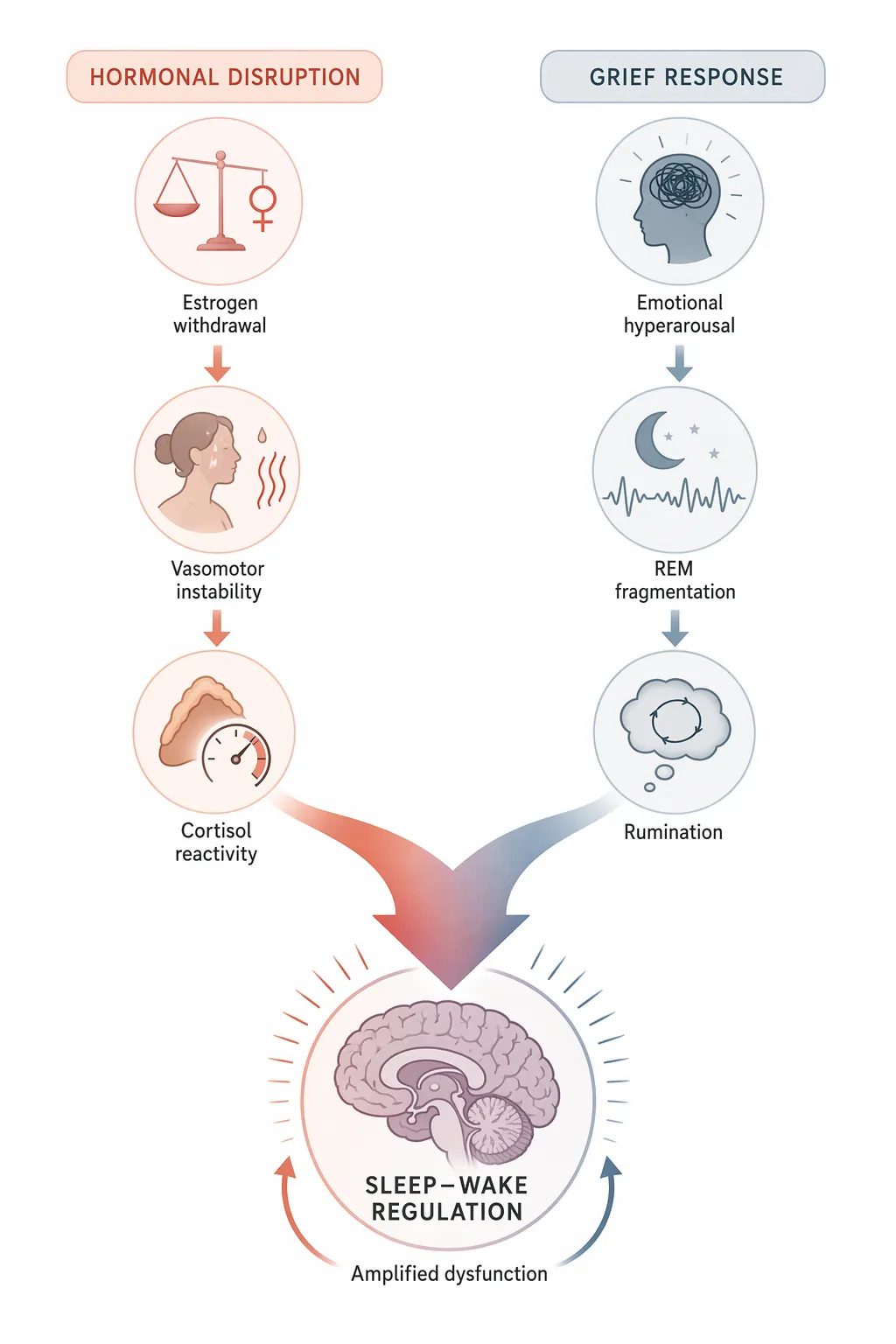
This is why “perimenopause plus grief” understates the problem. A woman may not be losing sleep in two neat piles. She may be experiencing a single amplified state: heat makes her wake, grief keeps her awake, and repeated wakefulness teaches her brain that the bed is where the night’s hardest thoughts happen.
Why Wake-in-Bed Time Deserves More Attention Than It Gets
One of the most useful findings for this particular problem comes from Project HEART. In bereaved spouses, sleep efficiency—not just subjective sleep quality—was the sleep measure linked with inflammatory markers including C-reactive protein and IL-6. Bereaved spouses with low sleep efficiency showed a 2- to 3-fold stronger association between sleep disturbance and inflammation than non-bereaved controls.[3]
Sleep efficiency is the percentage of time in bed actually spent asleep. That makes it a practical mercy of a metric. It moves the conversation away from “How awful does your sleep feel?” and toward “How much time is your nervous system spending awake in the place it is supposed to stand down?”
The finding should not be treated as final proof that every bereaved perimenopausal woman with low sleep efficiency is developing inflammation-related illness. Project HEART was a moderate-sized study, and larger replication would strengthen the case. But it does give a concrete clinical direction: lying in bed for hours trying to endure wakefulness is not neutral. It can deepen the learned association between bed, alertness, heat, memory, and threat.
The Grief That Has No Funeral
Bereavement is not the only grief that can appear in this life stage. Some women enter perimenopause while grieving fertility, sexual confidence, cultural visibility, a younger body, a role that organized the family, or the assumption that time was still wide open. This is often described clinically as disenfranchised grief: a loss that is real to the person experiencing it but not fully recognized by the surrounding culture.
This part requires care. There is no direct evidence showing that ambiguous perimenopausal grief independently causes insomnia or multiplies bereavement insomnia. It is better understood as a clinically plausible layer. A death may wake older losses. A hot flash may feel like evidence that the body has crossed a line without permission. A night of grief for a parent may become a night of grief for the self who used to call that parent, need that parent, or still feel like someone’s daughter.
Naming this does not make it pathology. It makes room for treatment to be more precise. A woman can need grief support and still need insomnia treatment. She can need hormone evaluation and still need help with rumination. Validation is not the same as care if it leaves her awake for another season.
The First-Line Move: Treat the Insomnia Mechanism
Cognitive behavioral therapy for insomnia, or CBT-I, is the strongest fit for this combined problem because it works directly on the mechanisms that keep insomnia alive: conditioned arousal, excessive wake-in-bed time, irregular sleep drive, catastrophic sleep thoughts, and behaviors that accidentally train the brain to stay alert at night.
In peri- and menopausal women with hot flashes, CBT-I has been associated with a 5.2-point reduction in Insomnia Severity Index scores compared with control, which is why it sits in the top evidence tier for perimenopause insomnia treatment.[4] That matters here because CBT-I does not require proving whether the first awakening came from estrogen fluctuation or grief. It targets what happens next.
The pieces of CBT-I can sound severe until they are explained properly. Stimulus control asks a person to leave the bed when she is awake for a sustained period, not as punishment, but to stop the bed from becoming the nightly site of grieving, sweating, calculating, and bracing. Sleep restriction or sleep compression narrows time in bed at first so sleep becomes more consolidated. Cognitive work addresses the thoughts that make wakefulness more threatening. Relaxation may be included, but it is not the whole treatment.
For grief-related insomnia, the evidence is still emerging. Pilot data in bereaved parents showed large effects for prolonged grief symptoms, with d=1.0 at 9 months and d=2.6 at 18 months.[4] Those are promising signals, not a guarantee. A 2026 PLOS ONE paper by de Lang and colleagues describes a protocol for a systematic trial of CBT-I for people with comorbid prolonged grief disorder and insomnia, with results expected in October 2027; because it is a protocol, it should not be cited as proof that the treatment works for that group yet.[5]
Still, the clinical logic is strong. CBT-I does not ask a grieving woman to stop loving the person who died. It asks her to stop giving insomnia unlimited access to the bed. In practice, that can mean moving the 2 a.m. replay to a chair in low light, keeping the bed for sleep and sex, setting a consistent wake time, and building enough sleep pressure that the next night has a better chance of holding.
What CBT-I Changes in This Specific Collision
- It reduces wake-in-bed time, the metric Project HEART suggests may matter more physiologically than subjective sleep quality alone.
- It rebuilds sleep efficiency instead of asking the woman to remain in bed and hope grief softens by morning.
- It addresses conditioned arousal, which can develop when hot flashes and grief repeatedly occur in the same bed.
- It avoids medication interactions and next-day impairment concerns that become more important as women move through midlife.
- It can run alongside grief therapy, hormone treatment, or depression care rather than competing with them.
Where Grief Therapy and Hormone Treatment Fit
CBT-I should not be asked to do every job. If the grief itself has become prolonged, disabling, or dangerous, grief-focused treatment matters. Complicated Grief Therapy can reduce grief severity, though sleep may not fully resolve from grief treatment alone. In one APA Focus source, combining Complicated Grief Therapy with antidepressant treatment was associated with a drop in trouble-sleeping rates from 49% to 15%.[6]
That kind of result is important but conditional. It does not make antidepressants a universal sleep treatment for bereaved perimenopausal women. It suggests that when complicated grief or depression is present, treating the psychiatric condition may improve sleep as part of a broader care plan. The sleep mechanism may still need direct treatment, especially when low sleep efficiency and conditioned wakefulness have been present for months.
Menopausal hormone therapy has a different role. If night sweats and vasomotor symptoms are driving repeated awakenings, a clinician may consider MHT or HRT depending on the woman’s age, health history, risk profile, and treatment goals. Hormone therapy can be relevant when the body’s heat surges are the spark. It is less likely to resolve the entire grief-insomnia loop if the bed has also become a place of rumination and alarm.
The cleanest care plan is often not either-or. It may be CBT-I for insomnia, grief-focused therapy for prolonged or traumatic grief, and menopause care for hot flashes. The sequencing depends on severity and safety. Suicidal thoughts, inability to function, severe depression, or traumatic intrusive symptoms should move mental health care to the front of the line.
Why Sleep Aids Are Not the Center of the Plan
Hypnotic medications can sometimes have a short-term role under medical supervision, but they are a poor place to begin as a general coping strategy for grief and insomnia in women moving through midlife. Project HEART data noted that older perimenopausal women were more than twice as likely to use sleep medications after widowhood.[3] That does not prove misuse. It does show how easily bereavement can become a medication moment.
The concern is not moral. It is safety. Sedative-hypnotics can bring next-day impairment, falls, dependence, cognitive side effects, and interaction risks, especially as women age or take other medications. Beers Criteria concerns become more relevant for older midlife and postmenopausal women, so these drugs should be individualized rather than treated as the obvious answer.
Melatonin also deserves modest expectations. In older adults, the sleep-onset improvement reported in the available evidence is small, roughly 7.5 to 15.6 minutes, and the American Academy of Sleep Medicine gives a weak recommendation against melatonin for chronic insomnia.[7] A supplement that slightly shifts sleep timing is not built to untangle hot flashes, grief dreams, conditioned arousal, and low sleep efficiency.
How to Cope Tonight Without Training the Insomnia
Coping does not mean forcing sleep. Once insomnia has become conditioned, trying harder often raises arousal. The immediate goal is to protect the bed-sleep connection while treating grief with enough respect that it is not shoved into the darkest hour with no container.
- If you are awake for a sustained stretch, leave the bed and sit somewhere dim and quiet until sleepiness returns.
- If grief surges, let it have a place outside the bed: a chair, a notebook, a voice memo, a brief ritual, or a scheduled daytime grief practice.
- If heat starts the awakening, reduce the thermal trigger where possible: lighter bedding, layered sleepwear, a cooler room, and medical evaluation for severe night sweats.
- Keep the wake time steady even after a bad night, because sleeping late can weaken the next night’s sleep drive.
- Avoid using alcohol as grief anesthesia; it may feel sedating early and then worsen second-half-of-night fragmentation.
These steps are not a full substitute for CBT-I. They are the pieces most likely to prevent tonight from strengthening the insomnia pattern. The difference is subtle but important: the aim is not to ban grief from the night. The aim is to stop insomnia from using grief as its nightly fuel.
When to Bring in a Clinician
This article is informational, not medical advice. Last reviewed: July 27, 2026. A clinician should be involved when insomnia persists, sleep efficiency stays low, daytime functioning is deteriorating, grief feels stuck or unbearable, depression symptoms are present, or sleep medications are becoming frequent.
It is also worth checking for conditions that can hide inside the same complaint. Sleep apnea can worsen around midlife and may show up as unrefreshing sleep, morning headaches, dry mouth, snoring, gasping, or repeated awakenings. Restless legs, thyroid disease, medication effects, pain, alcohol use, and panic symptoms can also complicate the picture. A woman should not have to prove that her insomnia is “serious enough” before someone looks for treatable contributors.
The practical judgment is simple: do not spend months trying to decide whether grief or perimenopause is the real cause. In many women, both are pressing on the same sleep system. Treat the insomnia mechanism directly, especially wake-in-bed time and low sleep efficiency. Use grief-focused care when grief is prolonged or disabling. Use menopause-focused care when vasomotor symptoms are driving awakenings. Do not reduce this compounded problem to willpower.
References
- Frontiers in Sleep review, Frontiers in Sleep, 2024.
- Sleep and Grief, Sleep Foundation.
- Project HEART sleep disturbance and inflammation findings, Psychosomatic Medicine.
- Perimenopause Insomnia Treatments Ranked by Evidence, Restful Ground.
- CBT-I for comorbid prolonged grief disorder and insomnia protocol, PLOS ONE, 2026.
- Complicated Grief Therapy and antidepressant treatment sleep findings, APA Focus.
- Is Melatonin Safe for Older Adults?, Restful Ground.
Safety & eligibility read
Cross-check against other interventionsExplore the mechanism
Next step
Spot an error or have clinical feedback?
Because this article covers clinical, medication, or safety information, we use a moderated correction channel instead of open public comments. Let us know if something about “Coping with Grief and Insomnia During Perimenopause” needs a closer look.
Send feedback on this article