
How to Cool Both Heat Waves and Hot Flashes for Sleep
Learn why extreme heat waves are a unique sleep threat for menopausal women and discover evidence-based remedies that address both the internal heat source (menopause) and the external heat wave at the same time.
The miserable part of looking for a menopause remedy during an extreme heat wave is that most sleep advice sounds as if the room is the only problem. Use a fan. Wear lighter pajamas. Open a window. That can be reasonable on a merely warm night. It can feel almost insulting at 3 a.m. when the air is hot, humid, and still, and the heat is also arriving from inside your own body.
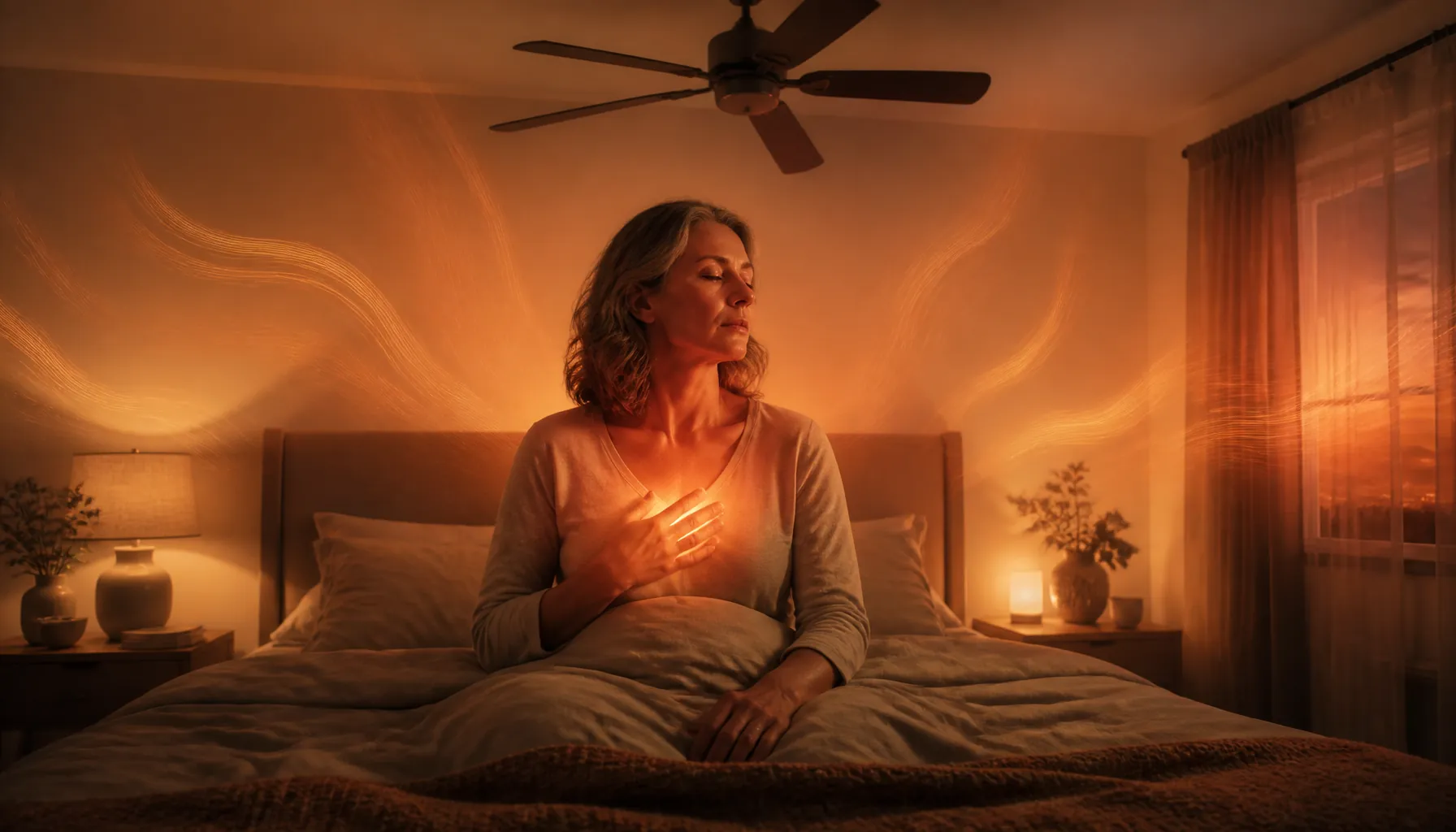
The useful question is not simply, “How do I cool down?” It is, “Which heat burden am I treating right now?” During perimenopause and menopause, the body can trigger a hot flash from a relatively small rise in core temperature. During a heat wave, the bedroom makes it harder to dump that heat. One system is setting off heat-dissipation alarms from the inside; the other is blocking the exits from the outside.
Why Heat Waves Hit Menopausal Sleep Differently
Hot flashes are not just feeling warm. They are a thermoregulatory event. Estrogen withdrawal is understood to narrow the hypothalamic thermoneutral zone, the temperature range in which the brain does not need to launch sweating, flushing, and other heat-loss responses. With a narrower zone, a smaller internal temperature rise can trigger a full-body cooling response that wakes you, soaks sleepwear, and leaves the bed suddenly unusable. Yale Medicine describes hot flashes as affecting about 75% of women during menopause, and the SWAN study found a median duration of 7.4 years, with symptoms lasting up to 14 years for some women.[1][2]
That long duration matters because it means many women are not dealing with an occasional bad summer. They are moving through years in which the internal thermostat is more reactive, then encountering hotter nights that give the body less room to correct. A hot flash can start the wake-up. The hot room can keep it going.
Large sleep-temperature data support what many women already know from the sheets. In a Nature Communications repeated-measure study of 214,445 participants and 23 million wearable sleep records, each 10°C rise in daily mean temperature was associated with a 20.1% increase in the odds of sleep insufficiency, a 9.67-minute decrease in total sleep, and the largest relative decline in deep sleep, at 2.82%.[3] The study population was Chinese and drawn from Huawei wearable users, so it should not be treated as a perfect mirror of U.S. adults. Still, its stratified findings matter here: the temperature-related sleep effects were stronger in women and in people over 45.[3]
The age and sex pattern is not a random footnote. In 2024, the American Academy of Sleep Medicine reported that 50% of women aged 45–64 said menopause disrupted their sleep.[4] Separate heat physiology reporting in 2026 noted that women tend to produce less sweat and begin sweating at a higher temperature than men, which can impair heat dissipation during heat waves.[5] Put those pieces together carefully: the data do not prove that every hot bedroom wake-up is menopausal, and they do not prove that every menopausal woman will be affected the same way. They do explain why this particular combination is so punishing.
The Bottleneck Is Heat Loss
Sleep depends on a small, ordinary cooling process. As bedtime approaches, the body shifts heat toward the skin and extremities so core temperature can fall. Deep sleep is especially sensitive to disruption in that nightly temperature rhythm. A heat wave interferes with the process before menopause enters the story.
Menopause then narrows the safety margin. If the brain is already quicker to interpret a small internal temperature change as too hot, and the bedroom air is too warm to receive the heat the body is trying to release, the same woman may wake repeatedly from both the trigger and the failed recovery. This is why the common sequence feels so relentless: heat surge, sweating, covers off, brief cooling, damp chill, covers on, another surge, another wake-up.
A 2023 systematic review in Maturitas concluded that there is a strong rationale for climate change affecting hot flushes, based on physiologic mechanisms and epidemiological evidence.[6] That is not the same as saying climate change “causes menopause symptoms.” The narrower, better-supported conclusion is enough: hotter environments can plausibly and measurably aggravate an already vulnerable thermoregulatory system.
Match the Remedy to the Heat Source
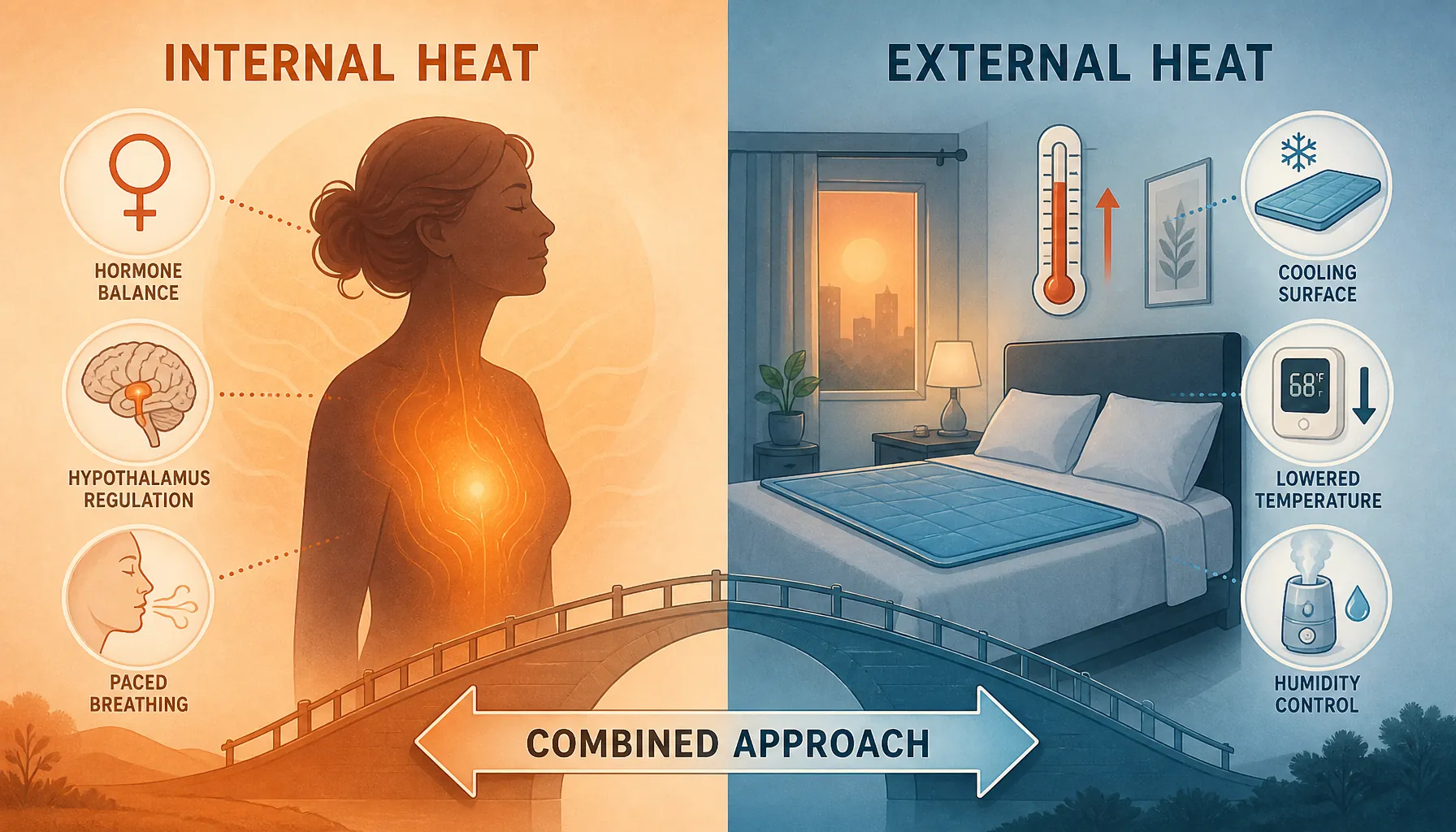
The most practical way to choose remedies is to split the problem in two without pretending the two sides stay separate. Internal interventions reduce the hot flash trigger or change the sleep response to it. External interventions help the body lose heat despite the weather. During an extreme heat event, many women need both.
| Heat burden | What is happening | Remedy direction |
|---|---|---|
| Internal menopausal trigger | A narrowed thermoneutral zone makes smaller core-temperature changes more likely to trigger flushing, sweating, and waking. | Discuss vasomotor symptom treatment, including MHT/HRT when appropriate, nonhormonal NK3 antagonists, CBT-I adapted for hot flashes and insomnia, and symptom-response skills such as paced respiration. |
| External heat-wave load | The bedroom air, bedding, humidity, or mattress surface prevents heat loss after the body tries to cool. | Lower or approximate a sleep-safe cool room, reduce humidity when possible, use active cooling surfaces cautiously, and avoid relying on airflow alone when the air itself is hot. |
| Repeated wake pattern | The flash wakes you; the room prevents recovery; worry and conditioning make the next wake-up easier. | Treat the symptom and the sleep pattern together instead of waiting for hot flashes to disappear before addressing insomnia. |
Internal thermostat options: where the strongest evidence sits
Menopausal hormone therapy, often called MHT or HRT depending on the clinician and context, remains the most effective treatment for hot flashes and night sweats, according to Yale Medicine.[1] That does not make it the right choice for everyone. Personal history, age, time since menopause, breast cancer risk, clotting risk, cardiovascular history, migraine patterns, and uterine status all belong in the discussion. But if the nights are being driven by frequent vasomotor symptoms, it is worth knowing that the highest-confidence treatment category is not another bedroom trick.
For women who cannot or prefer not to use hormone therapy, NK3 receptor antagonists are a newer nonhormonal option aimed at the brain pathway involved in temperature regulation. Fezolinetant, sold as Veozah, was approved by the FDA in 2023 for moderate to severe vasomotor symptoms. Endocrine Society reporting in 2026 described fezolinetant data as addressing menopausal symptoms through this nonhormonal pathway.[7] Elinzanetant, sold as Lynkuet, was approved in 2026; JAMA reported that elinzanetant reduced moderate to severe hot flashes by 5.4 per day compared with 3.5 per day for placebo at 12 weeks.[8]
Those numbers are useful because they keep expectations honest. A reduction is not the same as a guaranteed symptom-free night, and a trial average is not an individual promise. These medications also come with eligibility and safety considerations that belong with a prescribing clinician. The point is not to self-sort into a medication. It is to recognize when the internal heat source is large enough that a fan, by itself, is being asked to do a physician’s job.
Why CBT-I can help even when flashes continue
Cognitive behavioral therapy for insomnia adapted for menopause is often misunderstood because people hear “behavioral” and think it means the hot flashes are being dismissed. Properly used, CBT-I does something more specific: it reduces the insomnia pattern that grows around repeated symptoms. If a hot flash wakes you five nights in a row, the bed can become a place where the brain expects danger, frustration, clock-watching, and another failed night. That learned arousal can persist even if the hot flash frequency improves only modestly.
This is why sleep can improve before hot flashes vanish. CBT-I may shorten the time spent awake after a flash, reduce the dread that builds around bedtime, stabilize sleep timing, and change what happens in the first few minutes after waking. The symptom still deserves medical attention. But the insomnia loop is its own treatment target, not a moral failing and not proof that you are “too anxious” about menopause.
For the moment of a flash, paced respiration is a low-risk skill some clinicians suggest. Ohio State Wexner Medical Center describes slow paced breathing, about 5–7 breaths per minute during a hot flash, as a strategy that may reduce intensity.[9] It is not air conditioning, and it is not equivalent to MHT or an NK3 antagonist. Its role is narrower: it gives the nervous system a practiced response during the surge, especially when panic or frustration is making the wake-up last longer.
Restful Ground’s deeper menopause sleep guides can help separate these layers: the thermoneutral-zone explanation in Why Your Body Overheats During Perimenopause Sleep, the staged cooling plan in How to Sleep in a Heat Advisory When You’re Perimenopausal, and the recovery question in When Does Sleep Return After a Heat Wave Ends? The treatment decision still belongs with your clinician when symptoms are frequent, severe, or newly changing.
External cooling: when passive tricks stop working
A fan can help sweat evaporate. It cannot make very hot, humid air behave like cool dry air. During a heat wave, external cooling has to be judged by whether it actually improves heat loss from the body, not by whether it sounds soothing.
The usual sleep target is a cool bedroom, often cited around 60–67°F, and temperatures above 75°F have been associated with reduced sleep efficiency.[10] Many households cannot reach that range during an extreme heat event, especially without central air conditioning or during power-cost constraints. The practical goal then becomes approximation: cool the room earlier in the evening if outdoor temperatures drop, block solar heat before it enters, reduce indoor humidity when a dehumidifier is available and safe to run, and move sleep to the lowest, coolest part of the home when that is realistic.
Humidity deserves more attention than it usually gets. Sweating is only useful when evaporation can occur. If the room is humid, damp pajamas and bedding may trap discomfort without producing much cooling. In a dry heat, airflow across damp skin may help. In humid heat, dehumidification or air conditioning may matter more than another fan pointed at the bed. For region-specific tactics, Restful Ground’s Florida Heat and Humidity Make Night Sweats Worse and Sleep Tips for Monsoon Heat and Storms in Perimenopause take the micro-climate problem more seriously than generic summer sleep advice.
Active cooling surfaces can also make sense when the mattress itself has become a heat reservoir. Cooling mattress pads, water-cooled toppers, gel systems, and similar devices vary widely, and the evidence does not justify declaring one product category a universal answer. A small pilot study in menopausal women found clinically meaningful reductions in vasomotor symptom frequency and sleep disturbance with cooling mattress pad systems, which is encouraging but still pilot-level evidence rather than a guarantee.[11]
The mechanism is plausible: the skin has a cooler surface for heat transfer, and the bed is less likely to radiate stored warmth back toward the body after a flash. The safety details still matter. Avoid electrical or water-based devices that are damaged, poorly maintained, or unsafe for your household. Be cautious with aggressive cold exposure if you have neuropathy, impaired sensation, circulatory problems, or medical conditions that make temperature extremes risky. Cooling should reduce physiologic strain, not add a new one.
A Heat-Wave Night Plan That Treats Both Sides
On the night itself, start with the side you can change fastest: the room, the bed surface, and the moisture level around your skin. Then decide whether the pattern is frequent enough to justify treating the internal vasomotor symptoms more directly. The order matters less than the fact that both sides are on the map.
- Before bed, reduce the room’s stored heat: block late-day sun, move to a cooler room if needed, and use air conditioning or a safe cooling center if indoor heat is dangerous.
- At the bed, reduce heat retention: choose breathable layers, keep a dry change of sleepwear nearby, and consider a cooling surface if the mattress stays warm.
- During a flash, avoid turning the wake-up into a long negotiation: uncover briefly, use paced breathing if it helps, dry damp skin or clothing, and return to a consistent sleep posture once the surge passes.
- The next day, count patterns rather than suffering in fragments: note hot flash frequency, night sweats, awakenings, room temperature if available, humidity, alcohol timing, medication changes, and menstrual or menopause stage clues.
- If heat-wave nights are repeatedly unmanageable, discuss vasomotor treatment options rather than escalating bedding changes indefinitely.
This is also where a household safety line belongs. If indoor temperatures are extreme, if you feel faint or confused, if you cannot cool down, or if you have medical conditions or medications that increase heat vulnerability, the problem is no longer only a sleep problem. Use local heat emergency guidance and cooling resources. Menopause may explain why the night became unbearable; it does not make dangerous heat safe.
When It May Not Be Just Menopause
Night sweats are common in menopause, but persistence despite appropriate menopause-directed treatment deserves a wider look. So do drenching sweats with fever, unexplained weight loss, new pain, medication changes, infection concerns, thyroid symptoms, or symptoms that feel distinctly different from your usual hot flashes.
Sleep apnea also becomes easier to miss in midlife women because it may not look like the stereotype. Johns Hopkins Medicine notes that postmenopausal women are 2–3 times more likely to have sleep apnea than premenopausal women.[12] Loud snoring, witnessed pauses in breathing, gasping, morning headaches, high blood pressure, dry mouth, or persistent daytime sleepiness should prompt screening, especially when awakenings are being blamed entirely on hot flashes.
If heat-wave nights keep defeating the usual menopause coping tactics, the answer is not to try the same single-source fix harder. Treat the room as an external heat load and the vasomotor symptoms as an internal heat trigger. When night sweats persist despite that approach, or when sleep apnea signs are present, broaden the evaluation.
References
- Hot Flashes: How to Get Relief Before, During, and After Menopause — Yale Medicine
- Up to 14 Years of Hot Flashes Found in Menopause Study — SWAN
- Climate warming may undermine sleep duration and quality in repeated-measure study of 23 million records — Nature Communications, March 2025
- Menopause and midnight mayhem: 50% of women aged 45-64 report disrupted sleep — American Academy of Sleep Medicine, 2024
- UK weather: Why heatwaves hit women harder — BBC News, July 2026
- Impact of climate and environmental change on the menopause — Maturitas
- Non-hormone medication addresses menopausal symptoms – fezolinetant data — Endocrine Society, 2026
- FDA Approves Nonhormonal Treatment for Menopausal Hot Flashes (elinzanetant) — JAMA, 2026
- Managing menopause hot flashes in the summer — Ohio State Wexner Medical Center
- How To Reduce Hot Flashes at Night — Cleveland Clinic
- Tired of Sleepless Nights? Managing Sleep in Menopause — The Menopause Charity
- How Does Menopause Affect My Sleep? — Johns Hopkins Medicine
Safety & eligibility read
Cross-check against other interventionsExplore the mechanism
Next step
Spot an error or have clinical feedback?
Because this article covers clinical, medication, or safety information, we use a moderated correction channel instead of open public comments. Let us know if something about “How to Cool Both Heat Waves and Hot Flashes for Sleep” needs a closer look.
Send feedback on this article