
How Older Adults in St. Louis Can Sleep Through a Heat Wave
St. Louis heat waves create a triple vulnerability for older adults: age-related thermoregulation decline, medications that impair cooling, and bedrooms that stay hot and humid. This guide provides a specific protocol, grounded in the latest research, to help seniors sleep safely and effectively during extreme heat.
At midnight in St. Louis, the problem is often not that an older adult “feels a little warm.” It is that the upstairs bedroom is still 82°F, the air feels wet, the fan is moving warm air around the room, and the body is trying to do the cooling work it normally needs before sleep can begin.
For older adults, that bedroom temperature is not a comfort detail. In a study of community-dwelling older adults, sleep efficiency dropped by 5% to 10% as bedroom temperature rose from 77°F to 86°F, and total sleep time fell by about 60 minutes across the 72°F-to-86°F range.[1] That is the difference between a hot night and a measurable loss of sleep.
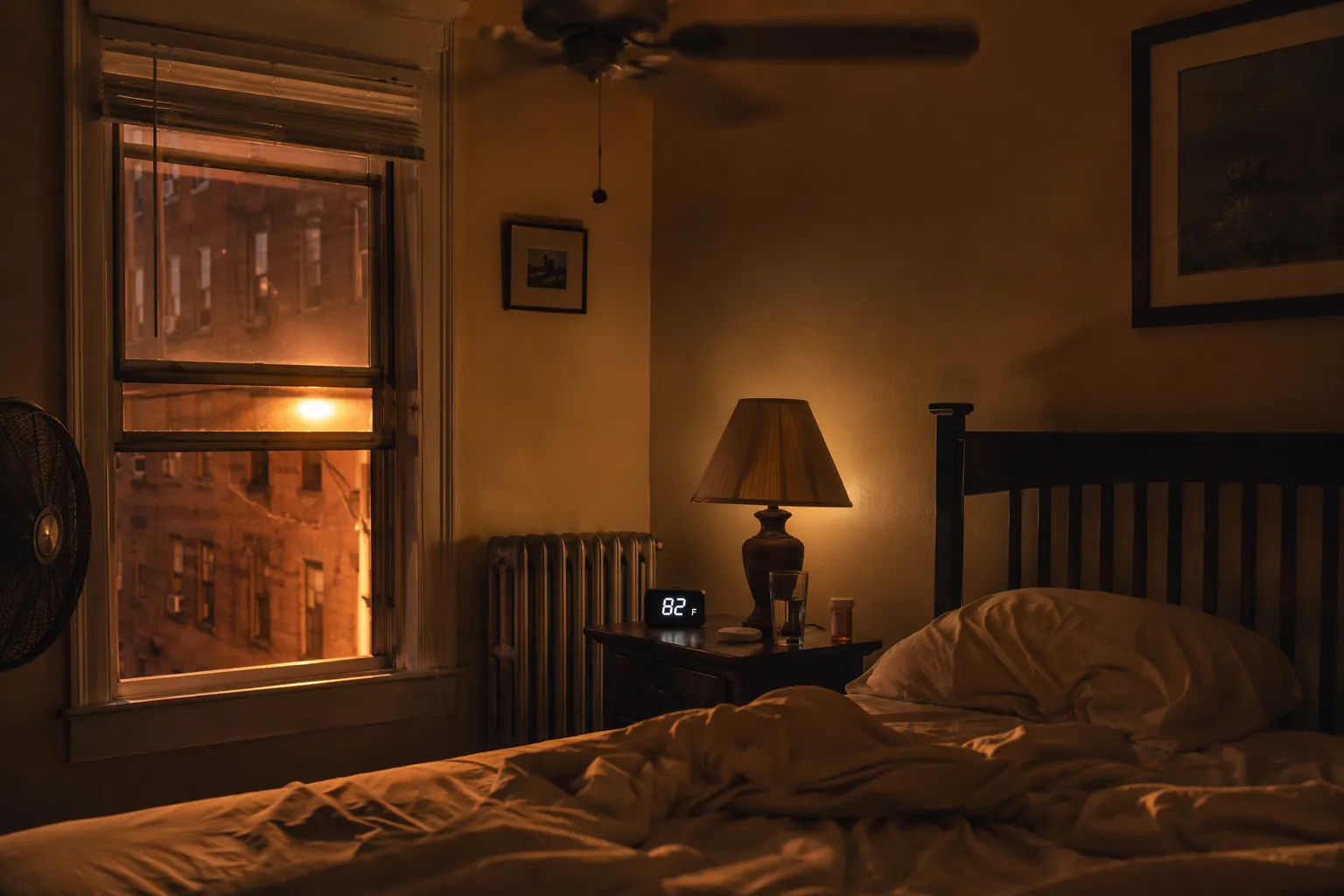
This is why advice on how to sleep during a St. Louis heat wave has to start in the actual room where the person is sleeping. A cool shower, cotton sheets, and a glass of water may help at the margins. They do not solve the central problem if the room stays above the upper 70s for hours and the person sleeping there is older, taking heat-relevant medications, or reluctant to leave home after dark.
The body is supposed to cool down before sleep
Sleep onset depends partly on a small drop in core body temperature. The body sends more blood toward the skin and extremities, releasing heat so the internal temperature can fall by about 1°C as sleep begins.[2] A hot, humid bedroom fights that process. Heat has fewer places to go. Sweat evaporates less efficiently. The body keeps working when it should be settling.
That mechanism matters more with age. The National Institute on Aging notes that older adults can have more trouble adjusting to sudden temperature changes and are at higher risk for heat-related illness, especially when chronic conditions or medications are involved.[3] The result is a bad match: an older person needs a reliable pre-sleep cooling drop, while the room keeps supplying heat back to the body.
The Boston study by Baniassadi and colleagues is not a St. Louis field study, so it should not be treated as a perfect local map. But Boston and St. Louis share the same broad humid continental climate classification, which makes the bedroom-temperature finding relevant. If anything, St. Louis humidity can make the lived experience feel harder, because moisture in the air blunts evaporative cooling. The safe takeaway is narrow and useful: for older adults, the upper 70s are not an innocent sleep environment during a heat wave.

The medication list belongs in the heat plan
Many people who would never ignore a heat warning still do not think of their prescriptions as part of the bedroom-temperature problem. They should. CDC clinical guidance identifies several medication classes that can interfere with thermoregulation or fluid balance during heat, including diuretics, beta-blockers, anticholinergics, and some antidepressants.[4]
That does not mean stopping or changing a medication on a hot day. It means the heat-wave plan should include a prescriber or pharmacist review, especially for someone with heart disease, high blood pressure, kidney disease, diabetes, cognitive changes, or a history of dehydration. A daughter checking on her father’s upstairs bedroom should not have to guess whether his diuretic changes the overnight risk. That question belongs with the clinician who knows the medication list.
The most useful version of the question is specific: “During a St. Louis heat wave, are any of these medicines likely to affect sweating, fluid balance, blood pressure, or heat tolerance, and what should we watch for overnight?” That keeps the conversation practical without turning a sleep article into prescribing advice.
A heat-wave sleep protocol for an older adult in St. Louis
The goal is not to create a perfect sleep sanctuary. The goal is to keep the person in an air-conditioned, lower-risk sleeping environment long enough for the body to cool and sleep to occur. On a dangerous night, the order of operations matters.
| When | What to do | Why it matters |
|---|---|---|
| Late afternoon or early evening | Check the actual sleeping-room temperature, not just the thermostat downstairs. | An upstairs bedroom can stay hot long after the rest of the house seems tolerable. |
| Before bedtime | Move sleep to the coolest air-conditioned room available, even if that means a recliner, guest room, or living room for the night. | Air-conditioned space is the primary protection when heat risk is high. |
| If the bedroom remains above the upper 70s | Treat the room as a risk factor, not merely a comfort problem. | Older-adult sleep efficiency measurably declines as bedroom temperature rises from 77°F to 86°F.[1] |
| If the heat index is above 90°F | Do not rely on a fan alone for an adult 65 or older. | CDC warns that fans alone are not enough for older adults under those conditions.[5] |
| If home cannot be cooled safely | Call 211 for current cooling-center information before traveling. | Cooling-center availability and activation can change, so the location should be verified that day. |
| During the season, not just that night | Ask about local AC assistance if the home lacks reliable cooling. | A one-night plan helps tonight; working air conditioning changes the risk for the next heat wave. |
1. Measure the bedroom, not the hallway
Put a simple thermometer where the person actually sleeps: on the nightstand, dresser, or a shelf near the bed. If the room reads 80°F at 9 p.m., it may still be too warm at midnight. In St. Louis homes, especially older two-story houses, the upstairs bedroom can lag behind the thermostat and hold heat well into the night.
This step is also a tactful way to talk about risk. “Your room is 82°F” is less insulting than “You are not taking this seriously.” It gives the older adult a fact to react to, not a lecture to resist.
2. Make air conditioning the first sleep intervention
For an older adult during extreme heat, air conditioning is not a luxury sleep upgrade. CDC guidance for adults 65 and older puts air-conditioned space at the center of prevention and specifically warns that fans alone are not sufficient when the heat index is above 90°F.[5]
That may mean sleeping somewhere that feels temporary or inelegant: a couch near the window unit, a recliner in the coolest room, a mattress on the first floor, or a family member’s home. The right question is not “Where does Dad usually sleep?” It is “Where can his body cool tonight?”
If the air conditioner is weak, close off rooms that do not need cooling overnight. Keep the sleeping space small, shaded, and prioritized. A cool living room beats a familiar bedroom that stays in the 80s.
3. Use fans only inside their limits
A fan can make a mildly warm room more comfortable. It can help circulate air from a working air conditioner. It can move cooler evening air if the outside temperature has truly dropped. But for adults 65 and older during extreme heat, a fan blowing across a hot room should not be treated as protection.
This distinction matters because “I’ve got the fan on” is one of the most common ways people reassure themselves. The fan may reduce the sensation of stillness while the room remains physiologically hostile to sleep. If the heat index is above 90°F, CDC’s warning is plain: fans alone are not enough for older adults.[5]
4. Keep fluids and cooling practical, not heroic
An older adult should not have to choose between dehydration and a night of repeated bathroom trips. Keep water nearby, encourage steady drinking earlier in the day, and ask a clinician for individualized guidance if fluid intake is restricted for heart, kidney, or other medical reasons. A person taking a diuretic or managing heart failure needs advice that fits the chart, not a generic “drink more water” instruction.
Light bedding, loose sleepwear, and a cool cloth can help the person feel more comfortable while the room cools. They are supports, not substitutes for a safer room temperature. If those small measures are the entire plan, the plan is too thin.
5. Know the exit plan before bedtime
The hardest time to negotiate a cooling center is 9:30 p.m., when the person is tired, proud, and convinced they can “make it one more night.” Decide earlier what would trigger leaving: the bedroom remains above the upper 70s, the air conditioner fails, the person feels dizzy or confused, or the caregiver cannot cool the sleeping space.
In Missouri, 211 can be used to find cooling-center information, and state heat-wave guidance also points residents toward local cooling resources.[6] Do not assume last year’s location, hours, or activation status still applies. Cooling-center availability changes, and the practical move is to call before driving.
For longer-term cooling, St. Louis residents should also check current eligibility for local assistance. In June 2026, First Alert 4 reported on Cool Down STL’s work with St. Louis organizations, including free air-conditioner installation for qualifying seniors during heat-wave conditions.[7] Program details can change, so eligibility and availability should be confirmed directly before counting on it.
When the person says they are fine
Many older adults minimize heat because they have lived through plenty of St. Louis summers. That history deserves respect. It is also not a reason to ignore the thermometer, the medication list, or a room that will not cool.
A caregiver does not need to win an argument about whether the night “feels dangerous.” Use thresholds and choices instead:
- “Your bedroom is 82°F. Let’s sleep downstairs tonight.”
- “The fan can stay on, but it cannot be the only cooling when the heat index is this high.”
- “Let’s call 211 now so we know the cooling-center option before it gets late.”
- “Tomorrow, we’ll ask the pharmacist whether any of these medicines change your heat risk.”
Those sentences preserve independence better than panic does. They also move the night forward.
What to watch for overnight
Heat-related illness is not always announced dramatically. The National Institute on Aging advises older adults and caregivers to take hot-weather symptoms seriously, including dizziness, headache, confusion, rapid pulse, nausea, fainting, and body temperature changes.[3] A person who is confused, faint, or worsening should not be managed with another damp washcloth and a promise to check again later.
During a heat wave, nighttime checks should be simple: Is the room cooler than it was an hour ago? Is the person drinking appropriately for their medical situation? Are they thinking clearly? Are they sweating normally or suddenly not sweating despite heat? Are they able to sleep, or are they restless and flushed in a room that remains hot?
If the answer points toward danger, the next step is cooling the person in an air-conditioned space and seeking medical help when symptoms suggest heat illness. The bedroom plan is not meant to replace emergency judgment.
The overnight plan, in plain order
- Check the temperature in the actual sleeping room by early evening.
- Move sleep to the coolest air-conditioned space before the person is exhausted.
- Do not rely on a fan alone for an adult 65 or older when the heat index is above 90°F.
- Keep water nearby, but follow individualized fluid guidance for heart, kidney, or other medical conditions.
- Review diuretics, beta-blockers, anticholinergics, and some antidepressants with a prescriber or pharmacist before or during heat-wave season.
- Call 211 for current cooling-center information if home cooling is not adequate.
- Check current 2026 availability for local AC assistance programs such as Cool Down STL before assuming help is available on demand.
During a St. Louis heat wave, older adults do not need prettier versions of common cooling tips. They need a bedroom-temperature, medication-aware, AC-first plan built around the physiology of aging sleep.
References
- “Nighttime ambient temperature and sleep in community-dwelling older adults,” Science of The Total Environment, 2023.
- “Thermoregulation as a Sleep Signaling System,” Frontiers in Neuroscience, 2019.
- “Hot Weather Safety for Older Adults,” National Institute on Aging.
- “Heat and Medications – Guidance for Clinicians,” Centers for Disease Control and Prevention.
- “Heat and Older Adults Aged 65+,” Centers for Disease Control and Prevention.
- “Heat Wave,” Missouri State Emergency Management Agency.
- “Heat can beat you: St. Louis organizations help those in need during heat wave,” First Alert 4, June 10, 2026.
Explore the mechanism
Next step
Spot an error or have clinical feedback?
Because this article covers clinical, medication, or safety information, we use a moderated correction channel instead of open public comments. Let us know if something about “How Older Adults in St. Louis Can Sleep Through a Heat Wave” needs a closer look.
Send feedback on this article