Perimenopause Thunderstorm Sleep Tips That Actually Help
Thunderstorms disrupt perimenopausal sleep more severely than generic storm anxiety advice acknowledges because hormonal changes heighten stress reactivity, auditory sensitivity, and the anxiety-sleep feedback loop. This article explains those mechanisms and provides layered strategies that address each vulnerability.
If thunderstorms used to be background weather and now they feel like a nervous-system ambush, the usual advice can sound almost insulting. Earplugs, a rain app, a few deep breaths — useful for some people, yes. But they mostly address the storm. They do not address the perimenopausal body receiving the storm: more reactive to stress, more easily startled by sound, and often already short on stable sleep before the first thunderclap hits.
That distinction matters. The problem is not that you suddenly became fragile, dramatic, or “bad at storms.” It may be that a stimulus your body once filtered has started arriving through a changed hormonal, sensory, and sleep system. The practical answer is not one heroic calming trick at 2 a.m. It is a storm-night setup that lowers arousal before the weather arrives, reduces the sensory load while it is happening, and prevents one bad night from turning into a learned insomnia pattern.
Why thunder can feel different in perimenopause
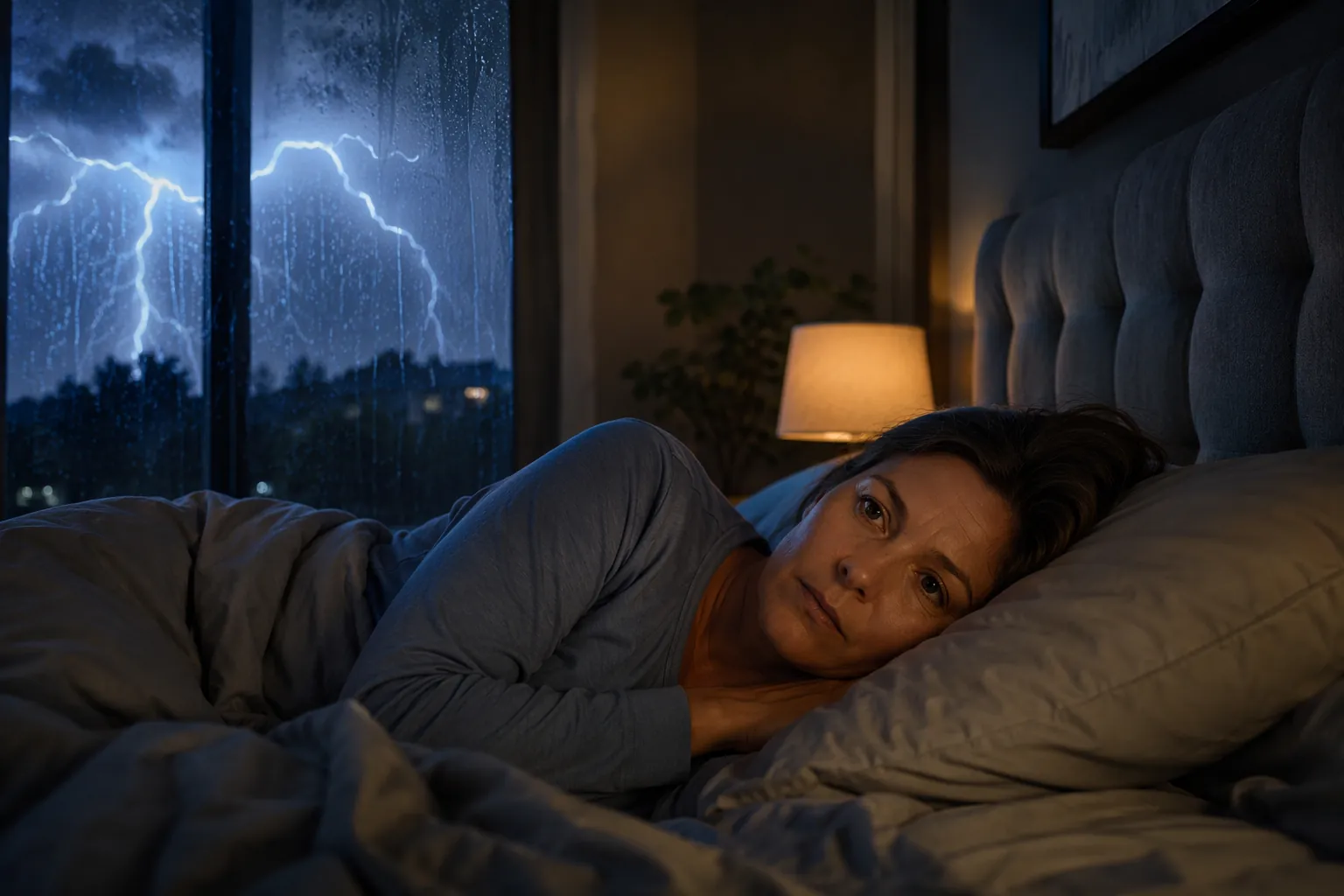
Perimenopause is not just irregular periods moving toward menopause. For many women, it is also a period of more volatile sleep and stress regulation. Johns Hopkins Medicine notes that up to 55% of perimenopausal women experience new or increased anxiety, and about 23% of women ages 42 to 52 experience persistent insomnia symptoms.[1] Those figures do not prove that a storm-wakeful night is a disorder. They do explain why thunder may land in a body whose baseline arousal is already higher than it used to be.
The first layer is stress reactivity. Progesterone does more than participate in the menstrual cycle. It is also connected to allopregnanolone, a neurosteroid that supports GABAergic calming in the brain. As progesterone becomes more erratic and often declines through perimenopause, that calming pathway may become less reliable; Lara Briden describes this as one reason stress can hit harder in the 40s.[2] In practical terms, a thunderclap may not merely wake you. It may set off a full-body jolt: heart racing, heat rising, muscles braced, mind scanning for the next strike.
The second layer is sound processing. Some women report that ordinary noises — dishes, television, traffic, a partner breathing — become harder to tolerate in perimenopause. ScienceWorks Health describes perimenopausal sensory overload as a pattern in which noise, heat, clothing, and touch can feel newly intrusive.[3] The National Sensory Network also discusses menopause-related changes in sensory processing.[4] The evidence does not give us a direct clinical trial saying “perimenopause makes thunder louder.” The more careful conclusion is that if auditory filtering is more strained, thunder has a better chance of feeling sharp, enormous, or physically invasive rather than merely loud.
Hyperacusis gives a useful comparison point, though not every storm-sensitive sleeper has it. Holtorf Medical Group reports that hyperacusis affects an estimated 9% to 15% of the general population and lists post-menopause among associated conditions.[5] Thunder is a special kind of sound problem because it is sudden, low-frequency, and unpredictable. Your brain cannot fully habituate when the next boom may arrive in three seconds or twenty minutes.
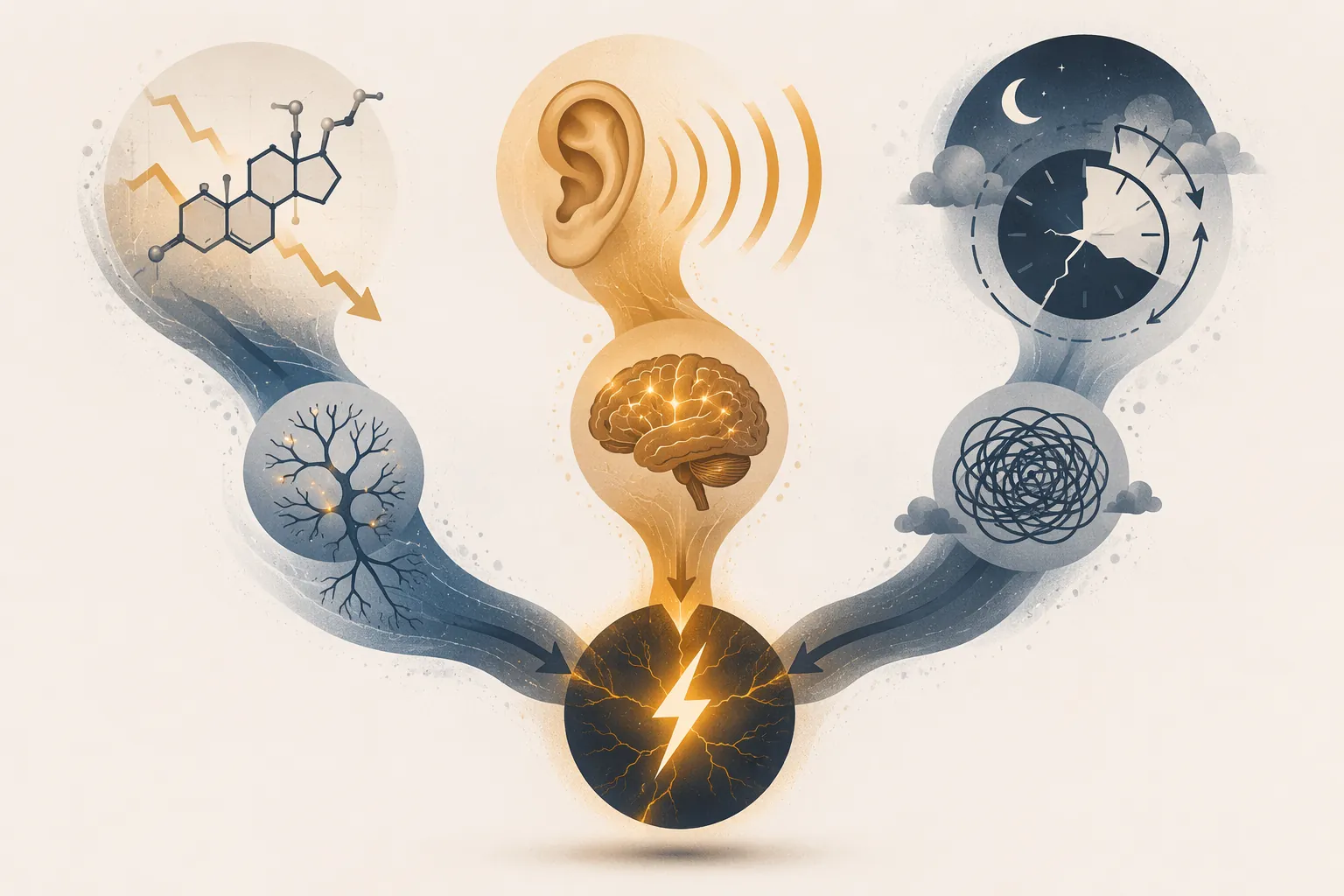
The third layer is the sleep-anxiety loop. A storm wakes you. The adrenaline surge makes returning to sleep harder. Being awake makes every sound more noticeable. Then the thought arrives: “If I don’t sleep now, tomorrow is ruined.” That thought is not irrational when you have work, caregiving, or a body that already struggles after a short night. But it can train the bed to become a monitoring station. Now you are not only listening for thunder; you are listening for whether sleep is coming back.
Build the storm plan before the storm
General storm-anxiety guidance from the Anxiety and Depression Association of America and Baylor College of Medicine leans on sensible basics: prepare ahead, limit overchecking, use calming skills, and keep weather information reliable rather than compulsive.[6][7] For perimenopause, the “ahead” part becomes especially important. Once the body is startled awake, the person making decisions is not your calm daytime self. It is your hot, wired, sleep-deprived self, possibly counting how many hours are left before the alarm.
| What changed | What the storm plan should target |
|---|---|
| Stress reactivity rises faster | Do setup tasks before bed, not during panic |
| Sound feels harder to filter | Mask low-frequency thunder rather than only blocking the ears |
| Heat or night sweats fragment sleep | Cool the sleep environment before the storm line arrives |
| Startle keeps the body braced | Use grounding or pressure tools that do not require much thinking |
| Insomnia learns patterns quickly | Avoid turning storm nights into elaborate nightly rituals |
The goal is not to become unbothered by storms. The goal is to reduce the number of systems that get activated at once. A storm plus sound sensitivity is hard. A storm plus sound sensitivity plus night sweats plus clock-watching plus a frantic search for the right app is harder.
Before bed: remove decisions
If storms are forecast, make the bedroom storm-ready while you are still regulated. Put water by the bed. Charge the sound machine or speaker. Set the cooling fan or air conditioner before the room gets warm. Place any grounding tool where your hand can find it in the dark. Check weather alerts once from a reliable source, then stop grazing radar loops unless there is an active safety reason.
This is not fussy. It is the same logic behind preparing for wildfire-smoke nights or other environmental sleep stressors: reduce the number of tasks your nervous system has to perform after arousal has already spiked. If that pattern is familiar, the same integrated approach applies to sleep disrupted by wildfire anxiety and smoke.
For sound: think masking, not just blocking
Earplugs can help, but they are a blunt tool. They may soften rain, household noise, and distant thunder, yet sudden low-frequency booms can still arrive through walls, windows, and the body. For some people, earplugs also make internal sounds — heartbeat, breath, swallowing — more noticeable, which is not ideal when anxiety is already looking for signs of danger.
A better experiment is to combine moderate ear protection with a low, steady masking sound. Brown-noise-style audio is often a better acoustic match for thunder than bright white noise because thunder carries more low-frequency energy. That is an acoustic rationale, not proof from a perimenopause thunderstorm trial. Still, it is a reasonable, low-effort test: set the sound before sleep, keep the volume comfortable, and avoid making it so loud that it becomes another stressor.
- Try brown noise, low fan noise, or steady rain audio before a storm night so the sound is familiar.
- Place the speaker between you and the window if thunder from that direction feels most startling.
- Use earplugs only if they reduce arousal rather than making your heartbeat or breathing feel louder.
- Skip sudden-volume apps or tracks with dramatic thunder sounds; the point is predictability.
For heat: treat temperature as part of storm anxiety
Perimenopausal storm wakefulness often gets mislabeled as purely emotional because the obvious trigger is thunder. But if you wake after a clap already sweating, with sheets too warm and the room humid from rain, the body reads that as more threat. Heat is arousing. Night sweats are arousing. A damp T-shirt at 3 a.m. is not a mindset problem.
Prepare for the thermal part as deliberately as the sound part. Use breathable layers instead of one heavy comforter. Keep a dry sleep shirt nearby if night sweats are common. Pre-cool the room before the storm if weather allows. If you use a weighted blanket, consider whether it helps enough to justify the warmth; some people do better with a weighted lap pad or a lighter pressure layer during humid storm season.
This is also where broader perimenopause sleep care matters. If hot flashes, night sweats, alcohol sensitivity, or late-evening overheating are already breaking sleep several nights a week, thunder is piling onto an unstable base. For related context, see how alcohol disrupts sleep in perimenopause and temperature and cortisol strategies during menopause travel.
For the body jolt: use pressure and orientation
When the main problem is the startle — the instant bolt upright, the pulse in the throat, the braced shoulders — cognitive reassurance may arrive too late. The body has already moved. This is where low-thinking tools are useful: pressure, contact, and orientation.
- Rest one hand on the sternum or abdomen and lengthen the exhale without counting perfectly.
- Use a weighted blanket, weighted lap pad, or firm pillow pressure if it feels settling rather than hot or restrictive.
- Name three neutral objects in the room to move attention from the next thunderclap back to present surroundings.
- Keep lights low; bright light can make a short awakening feel like the night is officially over.
Magnesium glycinate sits in the “possibly useful, not magic” category. Some people find it calming as part of a bedtime routine, and it is often discussed in relation to relaxation and sleep. It should not be treated as a storm-night sedative, and it is worth checking with a clinician or pharmacist if you take medications, have kidney disease, or are already using other sleep aids.
For the after-storm wakefulness: protect the bed from becoming a watchtower
The storm may pass at 2:40 a.m. and the real problem may still be there at 3:15: you, awake, monitoring whether sleep has returned. This is where generic calming rituals can backfire if they become longer, brighter, more effortful, and more desperate each time.
CBT-I-style principles are useful here because they target the learned insomnia loop rather than the weather. If you are awake and increasingly activated, leave the bed for a quiet, dim, boring activity until sleepiness returns. Do not turn the phone into a storm command center. Do not calculate exact remaining sleep in a way that raises the stakes. If you need a weather check for safety, make it brief and purposeful, then return to the sleep plan.
If insomnia has become frequent outside storms, it deserves its own treatment plan. CBT-I has a stronger evidence position than most supplements or sound hacks, and hormone-related options belong in a clinician conversation rather than in a 2 a.m. improvisation. For a broader comparison, see perimenopause insomnia treatments ranked by evidence.
When storm fear is bigger than sleep disruption
There is a line between storm-wakefulness and a phobia that is running the household. Cleveland Clinic describes astraphobia as an intense fear of thunder and lightning and reports that about 8% of adults experience it, with women affected about twice as often as men.[8] That number is a context marker, not a reason to diagnose yourself because a July storm ruined your sleep.
Escalation is worth considering if you avoid normal activities because storms might occur, repeatedly seek reassurance even when you are safe, panic before forecasts materialize, or cannot sleep on storm nights despite a prepared environment. In that situation, cognitive behavioral therapy, exposure-based treatment, or anxiety-focused care may be more appropriate than another sound machine.
Where hormones fit, and where they do not
Hormone therapy is not a thunderstorm sleep tip. It is not something to start, stop, or adjust because a storm is coming through tonight. But if storm nights are revealing a larger pattern — worsening insomnia, night sweats, anxiety spikes, or new sound sensitivity — hormones may be part of the medical discussion. Sleep Foundation notes that hormone therapy and other treatments may be considered for perimenopause-related sleep disruption depending on symptoms and individual risk.[9]
Oral micronized progesterone sometimes comes up because of its relationship to sleep and the progesterone-allopregnanolone-GABA pathway. That does not make it universally appropriate, and it does not make it a substitute for CBT-I when insomnia has become conditioned. A menopause-informed clinician can help separate vasomotor symptoms, anxiety, medication effects, sleep apnea risk, and primary insomnia instead of treating every stormy night as the same problem.
A perimenopause-specific storm-night setup
The most useful thunderstorm sleep tips for perimenopause anxiety are not exotic. They are better matched. Prepare before the storm because stress reactivity may rise fast. Use low, steady masking because thunder is not just “noise” but sudden low-frequency sound. Keep the body cool because heat can turn a startle into a longer awakening. Add pressure or grounding when the body jolt is the main event. Treat repeated after-storm wakefulness as insomnia conditioning, not as a personal failure.
A realistic plan might look like this: check the forecast once, set brown-noise-style masking before bed, cool the room early, place a dry shirt and water nearby, choose one pressure tool, and decide in advance what you will do if you are awake for a while after the storm. That last part matters. The middle of the night is a terrible time to invent a nervous-system strategy.
Perfect storm sleep may not be a fair promise. A better goal is fewer spikes, shorter awakenings, and less dread the next time lightning appears in the forecast. If thunderstorms now feel louder, more alarming, and harder to recover from, the answer is not “try harder to relax.” It is a plan that lowers stress reactivity, reduces sensory load, protects temperature stability, and interrupts the anxiety-sleep loop before it owns the whole night.
References
- Perimenopause and Anxiety — Johns Hopkins Medicine
- The Great Progesterone Crash of Perimenopause — Lara Briden
- Perimenopause Sensory Overload — ScienceWorks Health
- Understanding Sensory Processing and Menopause — National Sensory Network
- Hyperacusis: Noise Hypersensitivity and Estrogen — Holtorf Medical Group
- Severe Storms: How to Reduce Your Anxiety — ADAA
- Navigating Pre-Storm Anxiety — Baylor College of Medicine
- Astraphobia — Cleveland Clinic
- Perimenopause and Sleep — Sleep Foundation
Explore the mechanism
Next step
Spot an error or have clinical feedback?
Because this article covers clinical, medication, or safety information, we use a moderated correction channel instead of open public comments. Let us know if something about “Perimenopause Thunderstorm Sleep Tips That Actually Help” needs a closer look.
Send feedback on this article