
How Mounjaro Affects Sleep in Perimenopause
Perimenopause and Mounjaro (tirzepatide) both affect sleep, but through different mechanisms. Learn how three indirect pathways can compound sleep issues and how to tell whether the drug, the life stage, or both are disrupting your rest.
If your sleep changed after starting Mounjaro and you are also in perimenopause, the most honest answer is not a clean yes or no. Mounjaro is not known to directly cause insomnia in the way people usually mean it: insomnia is not listed as a tirzepatide adverse event in FDA labeling or as a primary signal across the major SURPASS and SURMOUNT trial programs. But that does not make your 3 a.m. waking imaginary. Tirzepatide can change digestion, appetite, glucose patterns, and sometimes mood-related symptoms, and those changes can land on a sleep system that perimenopause has already made easier to disturb.
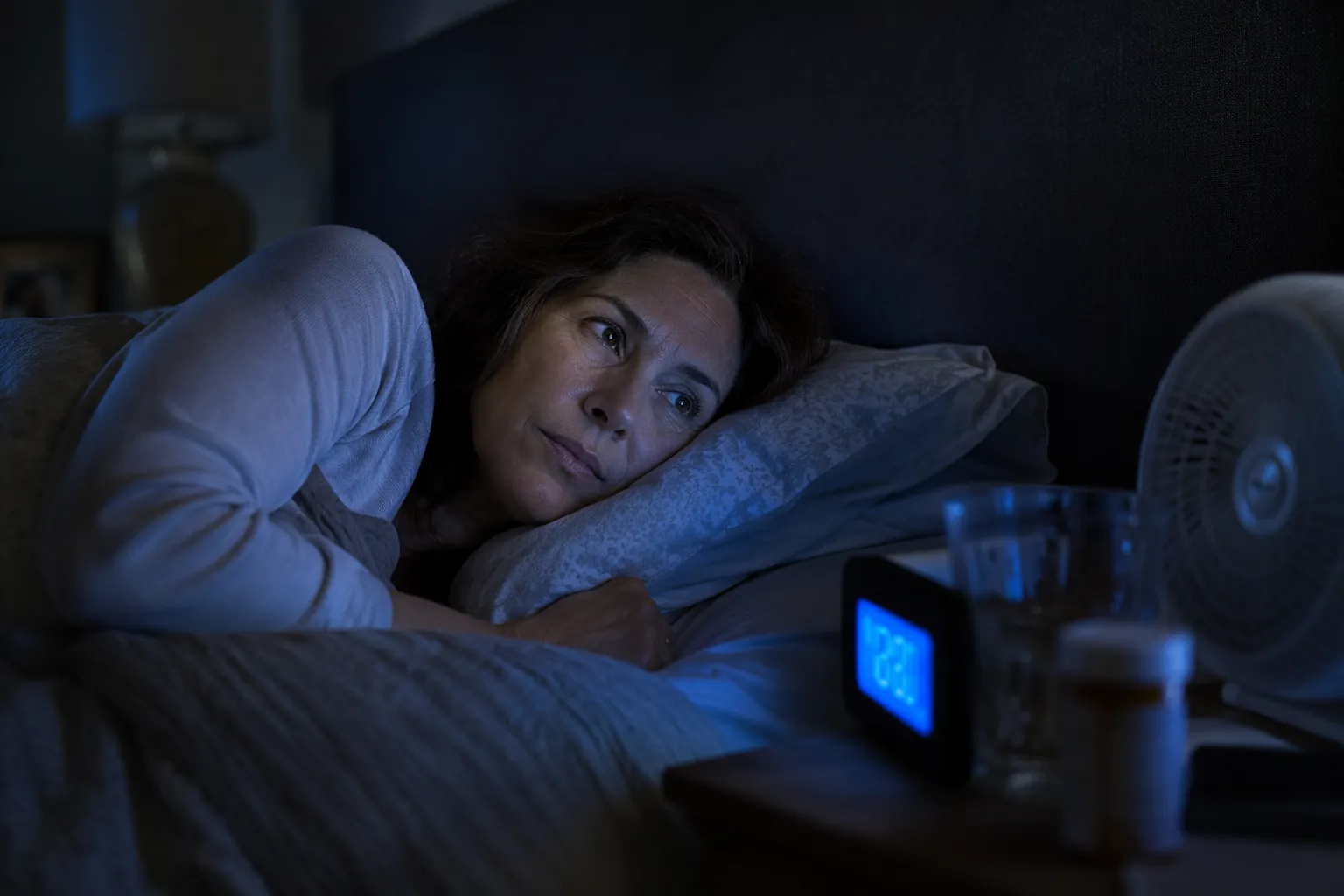
That distinction matters. The practical question is not simply, “Does Mounjaro affect sleep in perimenopause?” It is, “What changed first, what changed next, and which symptoms travel together?” A night disrupted by reflux after a late meal is a different problem from a night disrupted by hot flashes, a glucose dip, anxiety, or untreated sleep apnea.
Start with the sleep baseline perimenopause already creates
Perimenopause is not a quiet background condition for sleep. A 2025 narrative review reported sleep disturbance in 16–47% of women during perimenopause, rising to 35–60% after menopause. The review links that disruption to fluctuating estrogen and progesterone, vasomotor symptoms such as hot flashes and night sweats, mood changes, and increasing obstructive sleep apnea risk.[1]
That means a woman can start Mounjaro during a period when sleep was already becoming unstable, even if she had not yet named it as perimenopause. The timing can be misleading: a new medication is visible, while hormonal fluctuation, hotter nights, heavier bleeding, skipped periods, stress sensitivity, and subtle breathing changes may have been accumulating for months.
There is also an evidence gap right where many readers need certainty. RAND noted in 2025 that women aged 50–64 were the highest GLP-1-using demographic, with 20% use, while arguing that this population is still “largely ignored” in GLP-1 research.[2] As of now, no published study has directly examined Mounjaro’s sleep effects in a specifically perimenopausal cohort. The best answer has to be built from adjacent evidence, not from a perfect trial.
What the drug evidence does—and does not—show
The strongest direct drug evidence does not support calling insomnia a common or established Mounjaro side effect. In the available FDA labeling and major tirzepatide trial evidence summarized in the research literature, insomnia is not the standout sleep-related adverse event; fatigue is the more relevant sleep-adjacent finding. A 2023 analysis of GLP-1-related mental health discussions across social-media platforms found that roughly 1% of posts mentioning GLP-1s referenced insomnia, but that signal applied to GLP-1s broadly and came from social-media data, not a controlled tirzepatide sleep study.[3]
That kind of signal is worth noticing for pattern-finding, not for declaring causation. People post when symptoms are confusing, clustered, or frightening. They do not post in a way that separates perimenopause, dose escalation, meal timing, anxiety, glucose-lowering co-medications, sleep apnea, and ordinary bad luck with the precision a sleep study would require.
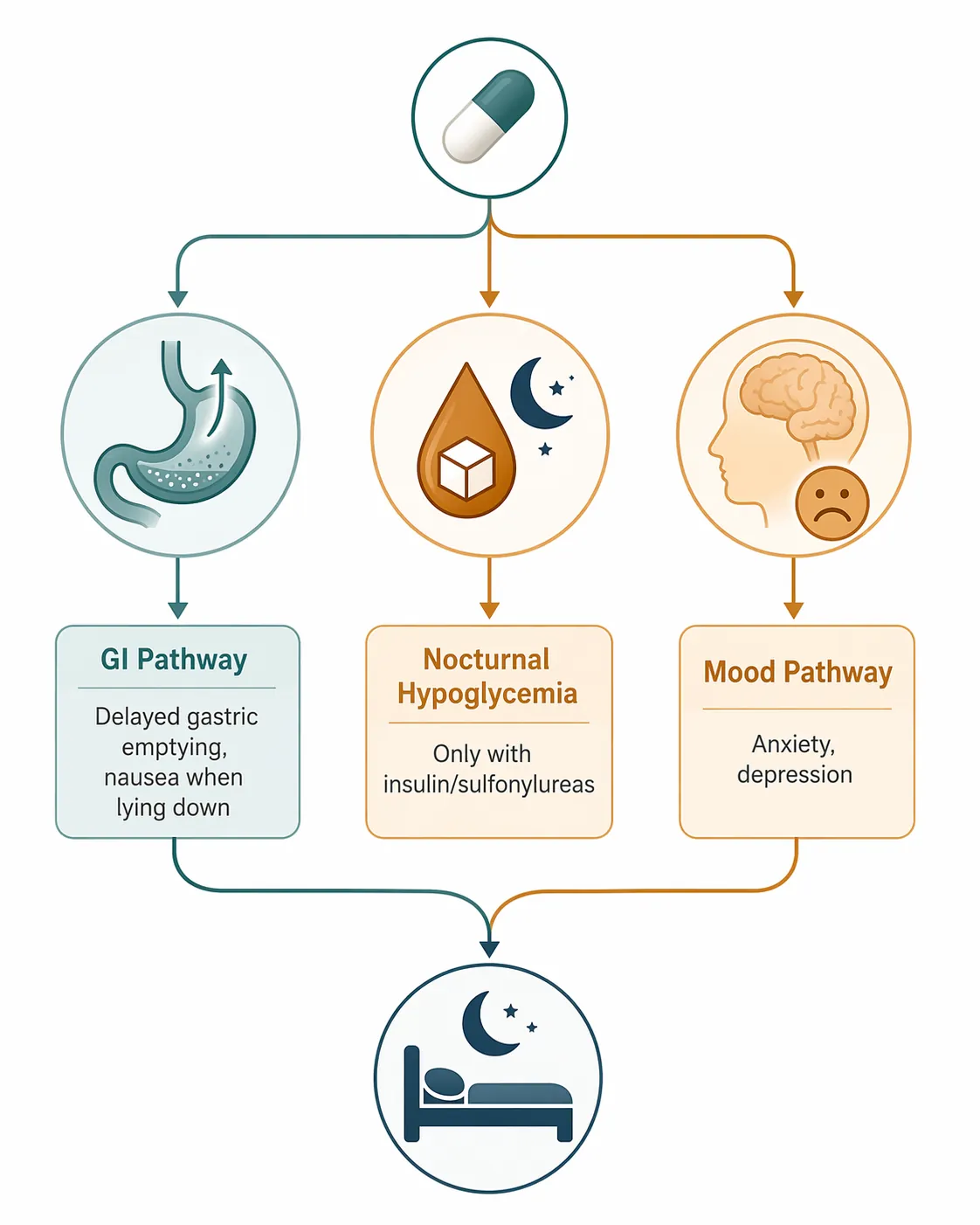
The three indirect ways Mounjaro can make a fragile night worse
The more useful way to think about Mounjaro and perimenopause sleep is through indirect pathways. These are not proof that tirzepatide directly causes insomnia. They are plausible routes by which a medication can change the conditions around sleep enough that a perimenopausal woman notices more waking, lighter sleep, or a harder time getting back to sleep.
1. Delayed gastric emptying can turn bedtime into reflux time
This is the pathway many people can actually recognize without a lab test. Tirzepatide slows gastric emptying. That effect is part of how the drug helps with appetite and glucose control, but it can also mean food sits in the stomach longer. If the last meal is large, rich, late, or followed quickly by lying down, the night may bring nausea, fullness, burping, reflux, or a sour taste that wakes you up.
Perimenopause can make this feel more confusing because the awakening may not announce itself as “stomach trouble.” You may wake hot, uncomfortable, vaguely anxious, or unable to settle. Then you notice the reflux only after sitting up. Or the sequence runs the other way: a hot flash wakes you, and once awake, the delayed digestion becomes impossible to ignore.
The timing clues are usually concrete. Sleep worsens after a dose increase. The first few nights after injection are rougher than the end of the week. Dinner sits heavily. Lying flat makes symptoms worse. Propping up or shifting the last meal earlier helps. Those clues do not prove Mounjaro is the only cause, but they make the GI pathway more likely than a vague “hormones or medication” guess.
2. Nocturnal hypoglycemia is a narrower concern than many people fear
Low blood glucose can disrupt sleep. It can cause sweating, shaking, a racing heart, vivid dreams, headache, or abrupt waking. In a perimenopausal woman, that can be mistaken for a hot flash or panic-like waking, especially if it happens in the early morning hours.
But this pathway needs a boundary. It matters mainly when Mounjaro is combined with medications that can push glucose down, especially insulin or sulfonylureas. It is not the default explanation for every person using Mounjaro alone for weight loss. Treating nocturnal hypoglycemia as a general fear can make people chase the wrong problem and miss the more likely drivers: reflux, hot flashes, alcohol, stress, dose escalation, or sleep apnea.
The pattern to take seriously is sleep disruption that appears alongside glucose-risk treatment: insulin, sulfonylureas, reduced food intake, missed meals, or symptoms that improve with appropriately managed glucose correction. That is a clinician conversation, not a reason to improvise medication changes at 2 a.m.
3. Mood shifts can fragment sleep without proving a direct insomnia effect
Anxiety and depression can make sleep shallower, shorten the first stretch of sleep, increase early-morning waking, and make normal awakenings feel harder to recover from. Mood symptoms also overlap with perimenopause, which can bring new irritability, premenstrual worsening, worry, and stress reactivity even in women who have not previously thought of themselves as anxious sleepers.
This is where anecdote can be both useful and treacherous. The social-media analysis showing an approximately 1% insomnia signal around GLP-1 discussions tells us that some people connect these drugs with sleeplessness in real-world conversation, but it does not tell us whether tirzepatide caused the insomnia, whether the users were perimenopausal, or whether the symptom followed weight change, appetite change, nausea, dose escalation, or preexisting mood symptoms.[3]
A more grounded question is whether mood changed in the same window as sleep. Did worry intensify after the dose increased? Did early-morning waking arrive with low appetite, nausea, or feeling keyed up? Did the sleep problem begin during a stressful life period that also happened to overlap with starting treatment? The answers help separate a medication-timing pattern from a perimenopause or mood-driven pattern that needs its own attention.
Mounjaro can also improve sleep when sleep apnea is part of the problem
A one-sided suspicion of Mounjaro misses an important possibility: for some people, tirzepatide may improve sleep by improving obesity-related obstructive sleep apnea. In the SURMOUNT-OSA trials published in 2024, tirzepatide reduced the apnea-hypopnea index by up to 63%, and 40–50% of participants achieved remission of obstructive sleep apnea.[4]
That does not mean Mounjaro is a sleep medication, and it does not mean it replaces evaluation or treatment for sleep apnea. The SURMOUNT-OSA population was not a perimenopause-specific cohort. Still, the finding matters because obstructive sleep apnea risk rises during the menopausal transition, and in women it can look less stereotypical than the classic picture of loud snoring and obvious daytime sleepiness.[1][4]
If your sleep becomes worse right after starting or increasing Mounjaro, the drug’s indirect effects deserve attention. If your sleep gradually improves as weight changes and breathing symptoms ease, sleep apnea may have been a larger part of the original problem than you realized. Both patterns can be true in different people, and sometimes in the same person at different stages of treatment.
How to sort the likely culprit
A sleep diary does not need to be elaborate to be useful. For two to three weeks, track the details that separate mechanisms from each other: injection day, dose changes, dinner timing, nausea or reflux, hot flashes or night sweats, alcohol, glucose-risk medications, mood shifts, snoring, witnessed breathing pauses, and the time of each major awakening.
| Pattern you notice | What it points toward | Why it matters |
|---|---|---|
| Worse sleep in the first nights after injection or after a dose increase, especially with nausea, fullness, or reflux | Mounjaro-related GI pathway | Meal timing, dose timing, and lying-down symptoms become the first clues to review |
| Abrupt waking with sweating, shaking, racing heart, or morning headache while also using insulin or a sulfonylurea | Possible nocturnal hypoglycemia | This belongs with a clinician because medication combinations may need review |
| Sleep worsens alongside new anxiety, low mood, early-morning rumination, or feeling keyed up | Mood-related sleep fragmentation | The sleep issue may be secondary to mood changes rather than a direct insomnia effect |
| Night sweats, cycle irregularity, hot flashes, or premenstrual worsening began before Mounjaro | Perimenopause-driven sleep disruption | The medication may be landing on an already unstable sleep baseline |
| Snoring, gasping, dry mouth, morning headaches, or persistent daytime fatigue | Possible obstructive sleep apnea | Mounjaro may help apnea risk over time, but symptoms still warrant evaluation |
The point of this sorting is not to self-diagnose with certainty. It is to make the next clinical conversation better. “I cannot sleep on Mounjaro” is hard to act on. “Sleep worsened after the 7.5 mg dose, mostly on injection nights, with reflux when I eat after 8 p.m.” gives a prescriber something specific to work with.
The same is true for perimenopause. “My hormones are ruining my sleep” may be emotionally accurate, but it does not separate hot flashes from apnea, anxiety, reflux, or glucose risk. If awakenings cluster with night sweats and cycle changes rather than injection timing, the center of the problem may be the menopausal transition, with Mounjaro playing only a minor role or no role at all.
When the pattern should not wait
Some sleep changes are annoying but not urgent; others should be reviewed promptly. Do not adjust or stop prescribed medication on your own if Mounjaro is being used for diabetes, if you take insulin or a sulfonylurea, if you have symptoms suggestive of low blood glucose at night, or if sleep disruption comes with severe mood changes. Those are safety questions, not lifestyle puzzles.
It is also worth asking about sleep apnea if poor sleep comes with snoring, gasping, morning headaches, dry mouth, high blood pressure, or daytime sleepiness. Perimenopause can make apnea easier to miss, and weight loss medication does not remove the need to identify breathing-related sleep disruption when the symptoms are already there.
So the cautious answer is this: Mounjaro does not appear to be a direct, established insomnia trigger, but it can affect the conditions that decide whether a perimenopausal night holds together. The likely culprit is usually found in timing and clustering—dose changes, meals, reflux, glucose-risk medications, mood shifts, hot flashes, and apnea signs—not in a single label line or a single online story.
References
- Sleep Disturbance and Perimenopause: A Narrative Review, PMC, Feb 2025.
- GLP-1 Agonists in Perimenopause: Unique Risks and Potential Opportunities, RAND, Aug 2025.
- GLP-1 Receptor Agonists And Related Mental Health Issues; Insights From A Range Of Social Media Platforms, PMC.
- Tirzepatide for the Treatment of Obstructive Sleep Apnea and Obesity, PubMed, 2024.
Safety & eligibility read
Cross-check against other interventionsExplore the mechanism
Next step
Spot an error or have clinical feedback?
Because this article covers clinical, medication, or safety information, we use a moderated correction channel instead of open public comments. Let us know if something about “How Mounjaro Affects Sleep in Perimenopause” needs a closer look.
Send feedback on this article