
How Poor Sleep Affects Aging Enzymes in Perimenopause
Poor sleep during perimenopause may accelerate biological aging through telomere shortening, disrupted sirtuin activity, and increased inflammation. This article explains the enzyme-level mechanisms and why the menopausal transition compounds the risk.
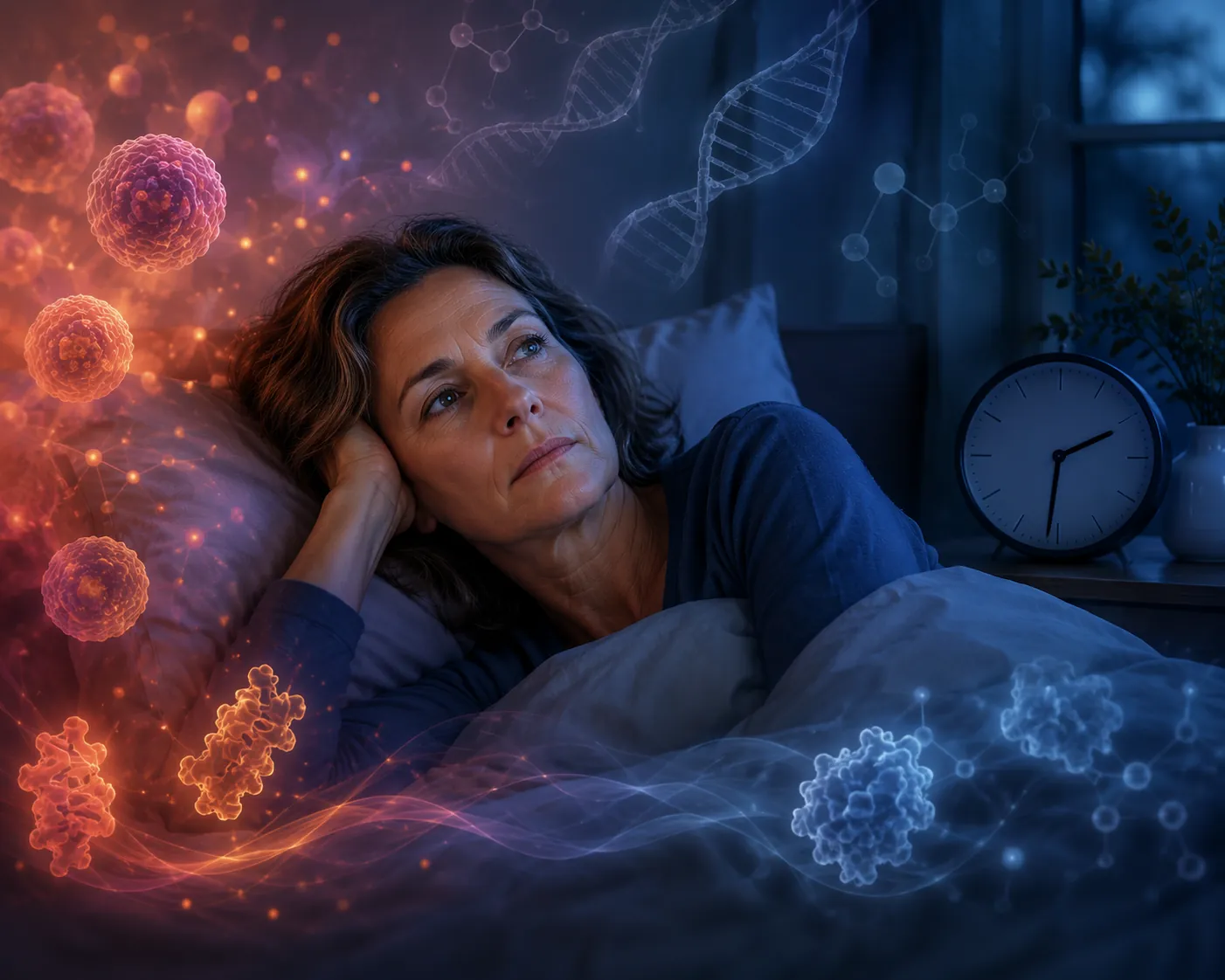
When sleep falls apart in perimenopause, the worry is often larger than fatigue. Many women describe a new kind of non-recovery: one broken night seems to linger in their joints, mood, skin, appetite, and ability to think. The cellular question underneath is reasonable: could this kind of sleep disruption affect biological aging pathways?
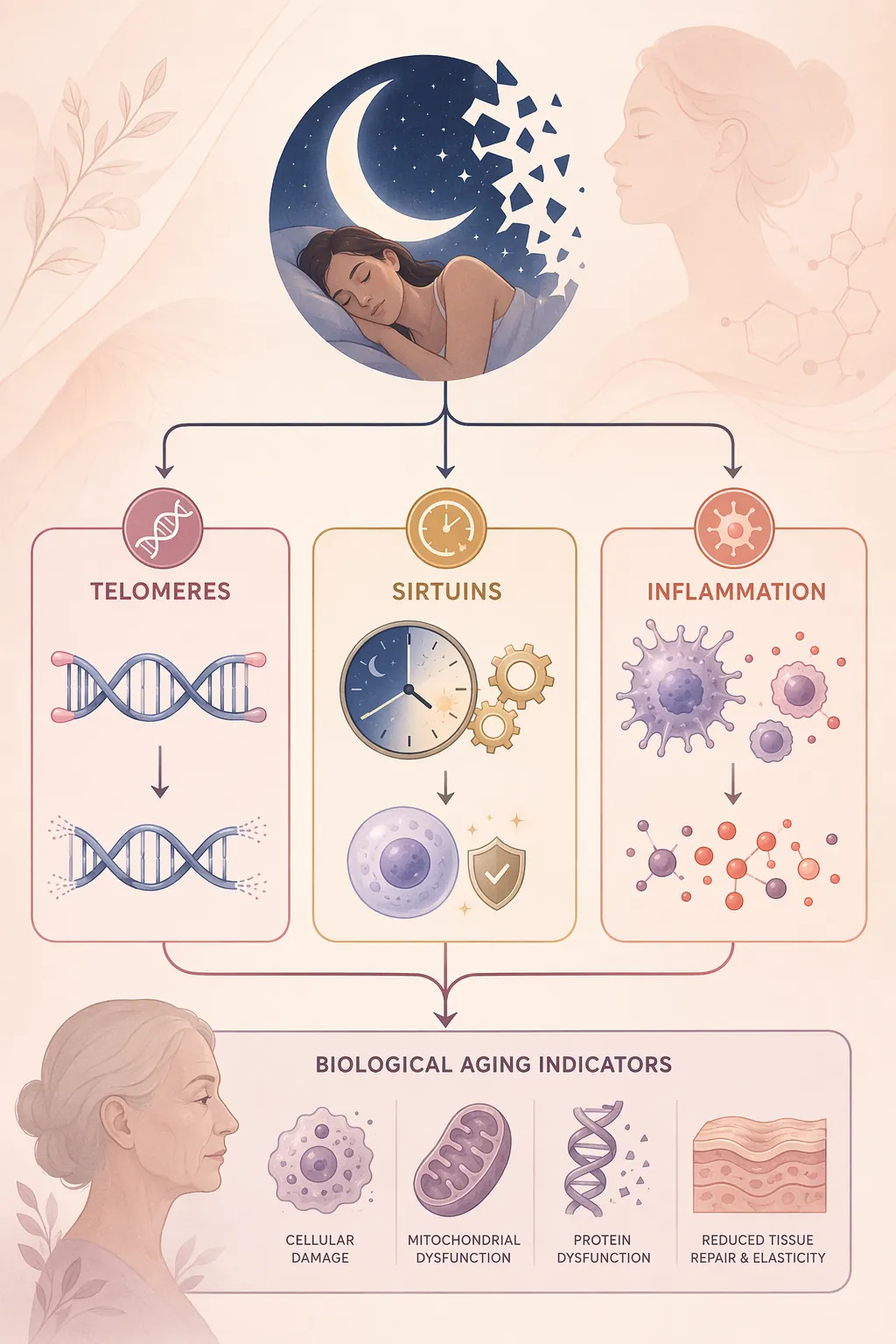
The careful answer is yes, possibly — but not through one neat switch called an “aging enzyme.” No single study measures “aging enzymes” as a unified category in perimenopausal women with poor sleep. The better way to read the science is through three adjacent pathways: telomere and telomerase biology, sirtuin activity tied to circadian repair, and inflammatory signaling.
This is not a niche complaint. SWAN, the Study of Women’s Health Across the Nation, reports that about 40% to 60% of women experience sleep disruption during the menopausal transition.[1] That baseline matters because perimenopausal sleep loss is often treated as if it were ordinary stress with a hormonal accent. It is more specific than that: hot flashes, night sweats, shifting estrogen and progesterone, mood vulnerability, and circadian disruption can all land in the same night.
The aging concern is not invented by wellness marketing, either. In UCLA reporting on work using Steve Horvath’s DNA methylation epigenetic clock, menopause was associated with an average 6% acceleration in cellular aging in an analysis of more than 3,100 women. The same UCLA release reported that postmenopausal women with five insomnia symptoms were nearly two years older biologically than same-age women without insomnia symptoms.[2] Those findings do not prove that a bad stretch of sleep will make an individual woman “age faster” in a simple, predictable way. They do show why menopause, insomnia, and biological aging belong in the same conversation.
What “aging enzymes” usually points to
In everyday language, “aging enzymes” usually means the molecular systems that repair damage, regulate inflammation, maintain chromosome ends, and coordinate cellular timing. Two names come up often: telomerase, which helps maintain telomeres, and sirtuins, especially SIRT1, which are involved in metabolism, DNA repair, stress response, and circadian regulation.
But aging biology is not governed by one enzyme rising or falling in isolation. Sleep fragmentation can increase oxidative stress and inflammatory pressure; circadian disruption can disturb repair timing; hormonal change can reduce some of the anti-inflammatory buffering that premenopausal physiology used to provide. The enzyme-level story is therefore a network story, not a supplement-label story.
| Pathway | What poor sleep may disturb | How strong the evidence is for perimenopause |
|---|---|---|
| Telomeres and telomerase | Chromosome-end maintenance under oxidative and inflammatory stress | Moderate human evidence in midlife and postmenopausal women; perimenopause-specific isolation is limited |
| SIRT1 and circadian repair | Clock-gene regulation, DNA repair timing, metabolic stress response | Biologically plausible but less directly tested in perimenopausal humans |
| Inflammatory signaling | Immune activation, oxidative stress, stress-system load | Strong mechanistic fit with menopause biology; direct aging-marker trials are still limited |
Telomeres: where the sleep-aging signal is easiest to see, and still not simple
Telomeres are protective caps at the ends of chromosomes. They shorten naturally with cell division and age, but the rate of shortening is influenced by stress biology, inflammation, and oxidative damage. Telomerase is the enzyme complex that helps maintain telomere length in certain cells. That makes telomere biology one of the clearest places to look when asking how poor sleep could become biologically visible.
In a study of midlife women, poor sleep quality was significantly associated with shorter leukocyte telomere length.[3] This does not mean poor sleep alone caused the telomeres to shorten; cross-sectional human studies cannot carry that much certainty. It does mean that among women in the age range where perimenopause often begins to reshape sleep, the association showed up in immune-cell aging markers.
A larger Women’s Health Initiative analysis of more than 3,000 postmenopausal women found that women sleeping less than seven hours had telomere length equivalent to women two years older.[4] The “equivalent to” wording is important. It is not the same as saying a woman biologically aged two years because she slept less. It compares telomere length patterns across groups, not the destiny of one person’s cells after a run of bad nights.
Another study, often referred to by its “tired telomeres” framing, connected poorer perceived sleep quality, perceived stress, and telomere length in immune-cell subsets.[5] That combination is especially relevant to perimenopause because the sleep problem is rarely only duration. A woman may spend enough hours in bed while still waking drenched, overheated, alert, anxious, or unrested. The body is not just counting hours; it is also responding to fragmentation and stress arousal.
The proposed mechanism is biologically coherent. Fragmented or insufficient sleep can raise inflammatory signaling and oxidative stress. Oxidative stress is hard on telomeric DNA because telomere regions are vulnerable to damage. Inflammation increases immune-cell turnover and stress signaling, which can add pressure to telomere maintenance systems. Telomerase may be part of the compensatory response, but a stressed system does not automatically mean a successfully repaired system.
The field is not settled. A 2023 systematic review of 22 studies concluded that evidence was insufficient overall for a significant association between sleep quality and telomere length.[6] That finding should not be brushed aside. It suggests that “sleep quality” may be too broad a bucket, that study methods differ too much, or that the strongest signal may come from specific sleep features such as insomnia symptoms, short duration, non-restorative sleep, or chronic stress rather than from a global sleep score.
For a perimenopausal reader, the most honest interpretation is not “your telomeres are shrinking every time you wake at 3 a.m.” It is that repeated, biologically stressful sleep disruption may interact with inflammatory and oxidative pathways that are already relevant to telomere maintenance. Telomeres give the strongest human clue in this story, but they still do not give a simple personal calculator.
SIRT1: the circadian repair bridge, not a proven perimenopause answer
Sirtuins are a family of enzymes involved in cellular stress response, metabolism, DNA repair, and aging-related pathways. SIRT1 is the one most often discussed in relation to circadian rhythm because it helps regulate clock-gene activity and interacts with repair and metabolic systems. If sleep timing becomes erratic, SIRT1 is a plausible place to look for downstream cellular consequences.
A review on circadian disruption, SIRT1, and telomeres describes SIRT1 as a regulator connected to both telomere integrity and clock-gene expression.[7] That connection matters because perimenopausal sleep disruption is often rhythmic disruption, not merely sleep deprivation. Night sweats can break the first half of the night; early-morning awakenings can shorten the second half; irregular recovery sleep can shift light exposure, meals, and activity timing.
Still, this is the pathway that needs the most restraint. The SIRT1-perimenopause-sleep evidence is mostly indirect, drawn from circadian biology, reviews, and experimental models rather than human trials showing that perimenopausal insomnia changes SIRT1 activity and then measurably accelerates biological aging. It is a credible bridge between disrupted sleep timing and cellular repair, but it is not yet a clinical claim.
That distinction protects the useful part of the science. SIRT1 helps explain why sleep regularity may matter at the cellular level: repair, metabolism, and clock timing are coordinated processes. But it does not justify confident claims that a specific product, fasting schedule, or sleep hack will “activate anti-aging enzymes” in a perimenopausal woman.
Inflammation is where perimenopause changes the sleep equation
Inflammation is the pathway that makes perimenopause feel biologically different from an ordinary busy season. Estrogen has anti-inflammatory effects, and as estrogen fluctuates and declines, that buffer can weaken. Progesterone also has sleep-supportive effects, and its decline can make sleep lighter or more fragile. Stanford Lifestyle Medicine describes perimenopausal sleep disruption in the context of changing estrogen and progesterone, hot flashes, and night sweats.[8]
This matters because fragmented sleep and inflammation can reinforce each other. A hot flash wakes the brain and body. The awakening increases sympathetic arousal. Repeated arousal can make the next night more vulnerable. Poor sleep can raise inflammatory signaling, while inflammatory activity can worsen fatigue, pain sensitivity, mood, and sleep continuity. By morning, the woman may not be reacting only to lost sleep; she may be feeling the aftereffects of a stress loop.
At the cellular level, inflammation also connects back to the other two pathways. Inflammatory signaling can increase oxidative stress, placing more pressure on telomere maintenance. It can alter immune-cell turnover, which is one reason leukocyte telomere length is often studied in stress and aging research. Circadian disruption can further dysregulate immune timing, because immune activity follows daily rhythms rather than running at a flat level all day.
That is the “triple threat” of perimenopausal poor sleep: the sleep is more likely to fragment, the hormonal environment is less protective than it used to be, and inflammation has more room to amplify the damage signal. None of this means cellular aging is inevitable or irreversible. It means the body may be carrying a higher biological load from the same number of wake-ups than it did ten years earlier.
What the evidence can and cannot say right now
The strongest human evidence in this topic is not a perfect perimenopause trial. It is a convergence: many women report sleep disruption during the menopausal transition; menopause and insomnia have been studied in relation to biological age markers; and several telomere studies in midlife or postmenopausal women suggest that poor sleep, short sleep, or non-restorative sleep can correlate with shorter telomeres.[1][2][3][4][5]
The weaker evidence is also important. SIRT1 is relevant to circadian repair biology, but perimenopause-specific human evidence is sparse.[7] Telomere findings are mixed when reviewed across the broader sleep-quality literature.[6] And no clinical trial has shown that improving sleep during perimenopause measurably slows, stops, or reverses biological aging.
So the practical scientific answer to “how sleep affects aging enzymes in perimenopause” is this: poor sleep may increase the cellular conditions that make aging pathways work harder. Telomerase-related maintenance may be challenged by oxidative and inflammatory stress. SIRT1-linked repair timing may be disturbed when circadian rhythm fragments. Inflammatory signaling may rise as estrogen’s anti-inflammatory buffering declines and night-sweat awakenings keep activating the stress system.
That is enough to take perimenopausal sleep seriously without pretending the science can read an individual woman’s aging clock from her worst week of insomnia. The evidence supports risk awareness and mechanism understanding more strongly than it supports claims of measurable age reversal. Poor sleep in perimenopause is not a personal failure, and it is not just a cosmetic aging concern. It is a biologically meaningful stressor arriving during a life stage when the body’s sleep, hormone, immune, and repair systems are already being renegotiated.
References
- Effects of Sleep Problems During Menopause — SWAN Study
- Menopause, sleepless nights may make women age faster — UCLA Health
- Shorter leukocyte telomere length in midlife women with poor sleep quality — 2011
- A cross-sectional analysis of telomere length and sleep in the Women's Health Initiative — 2019
- Tired telomeres: poor global sleep quality, perceived stress, and telomere length in immune cell subsets — 2015
- The association between sleep quality and telomere length: A systematic literature review — 2023
- Impact of circadian disruption on health; SIRT1 and Telomeres — ScienceDirect, 2020
- How Perimenopause Affects Sleep — Stanford Lifestyle Medicine
Explore the mechanism
Next step
Spot an error or have clinical feedback?
Because this article covers clinical, medication, or safety information, we use a moderated correction channel instead of open public comments. Let us know if something about “How Poor Sleep Affects Aging Enzymes in Perimenopause” needs a closer look.
Send feedback on this article