
How Poor Sleep Drives Alzheimer's Pathology
This article explains the three biological mechanisms linking poor sleep to Alzheimer's disease — glymphatic clearance failure, microglial overactivation, and tau buildup — and why treating sleep problems is a modifiable risk factor for older adults.
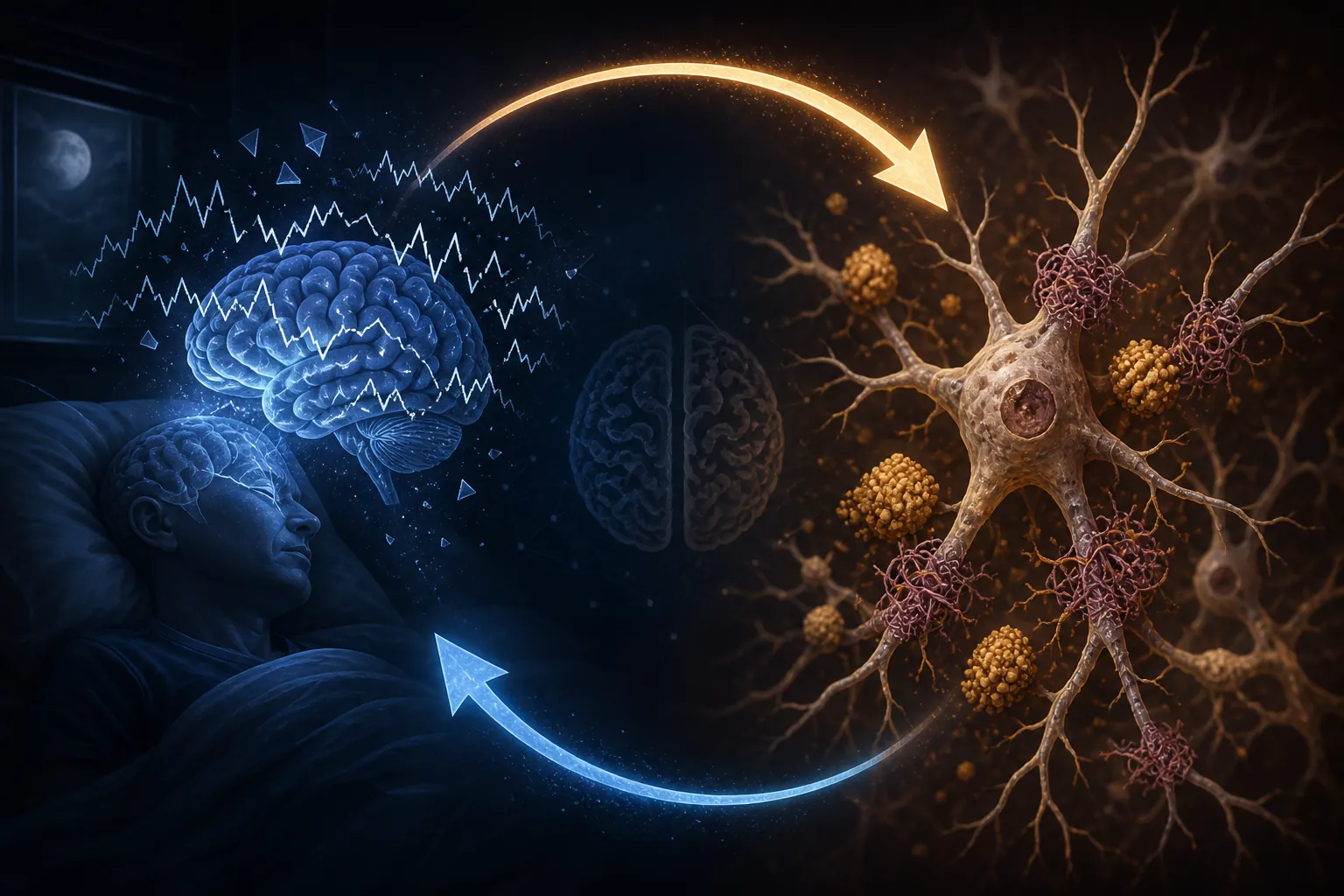
The Alzheimer's memory loss and sleep connection is often described backward. It is true that Alzheimer's disease can disturb sleep. People may wake more often, spend less time in restorative stages, or drift into irregular day-night rhythms as the disease advances. But that is only half of the biology. Poor and fragmented sleep may also help push forward the same Alzheimer's-related changes that later make sleep worse.
That bidirectional loop is the part worth taking seriously. During good sleep, the brain is not simply offline. It is changing fluid movement, immune activity, electrical rhythm, and protein handling. When sleep becomes chronically shallow or broken, three Alzheimer's-linked pathways become especially important: reduced glymphatic clearance of beta-amyloid, overactive microglia that may fragment restorative NREM sleep, and tau changes tied to sleep deprivation and loss of slow-wave sleep.[1][2]
None of this means a bad month of sleep diagnoses Alzheimer's disease. Older adults sleep poorly for many reasons: pain, medications, obstructive sleep apnea, nocturia, anxiety, restless legs, depression, alcohol use, caregiving schedules, and ordinary circadian changes with age. The point is narrower and more useful: persistent sleep disruption is biologically relevant enough that it should not be waved away as a harmless inconvenience.
The Loop Starts Before Memory Loss Is Obvious
Alzheimer's pathology can begin years before a person has noticeable memory loss. Beta-amyloid plaques and tau-related changes are not the same thing as a clinical diagnosis, and their presence does not tell a family exactly what will happen to one individual. Still, they are central pieces of the disease process, and sleep appears to interact with both.
The most practical way to think about the loop is this: sleep loss leaves more Alzheimer's-linked material behind; Alzheimer's-linked changes disturb the sleep stages that would normally help the brain recover; and the cycle can become self-reinforcing. Researchers still debate how much of sleep disruption is cause, how much is early symptom, and how much is shared vulnerability. But the evidence no longer supports treating sleep as a pleasant add-on to brain health.
| Pathway | What poor sleep changes | Why it matters for Alzheimer's biology |
|---|---|---|
| Glymphatic clearance | Less deep sleep means less efficient waste clearance | Beta-amyloid may be left behind more readily |
| Microglial activation | Brain immune cells may become overactive and disrupt NREM sleep | Restorative sleep can fragment even without reducing plaque burden |
| Tau biology | Sleep deprivation and reduced slow-wave sleep are linked to tau increases | Tau burden is closely tied to neurodegeneration and cognitive decline |
Deep Sleep Gives the Brain a Clearance Window
The glymphatic system is the brain's fluid-clearance network. It helps move cerebrospinal fluid through brain tissue and remove metabolic waste, including beta-amyloid. The system appears to work much more actively during sleep than during wakefulness, especially during deeper stages when brain rhythms slow and the space around brain cells changes in ways that support fluid movement.[1][2]
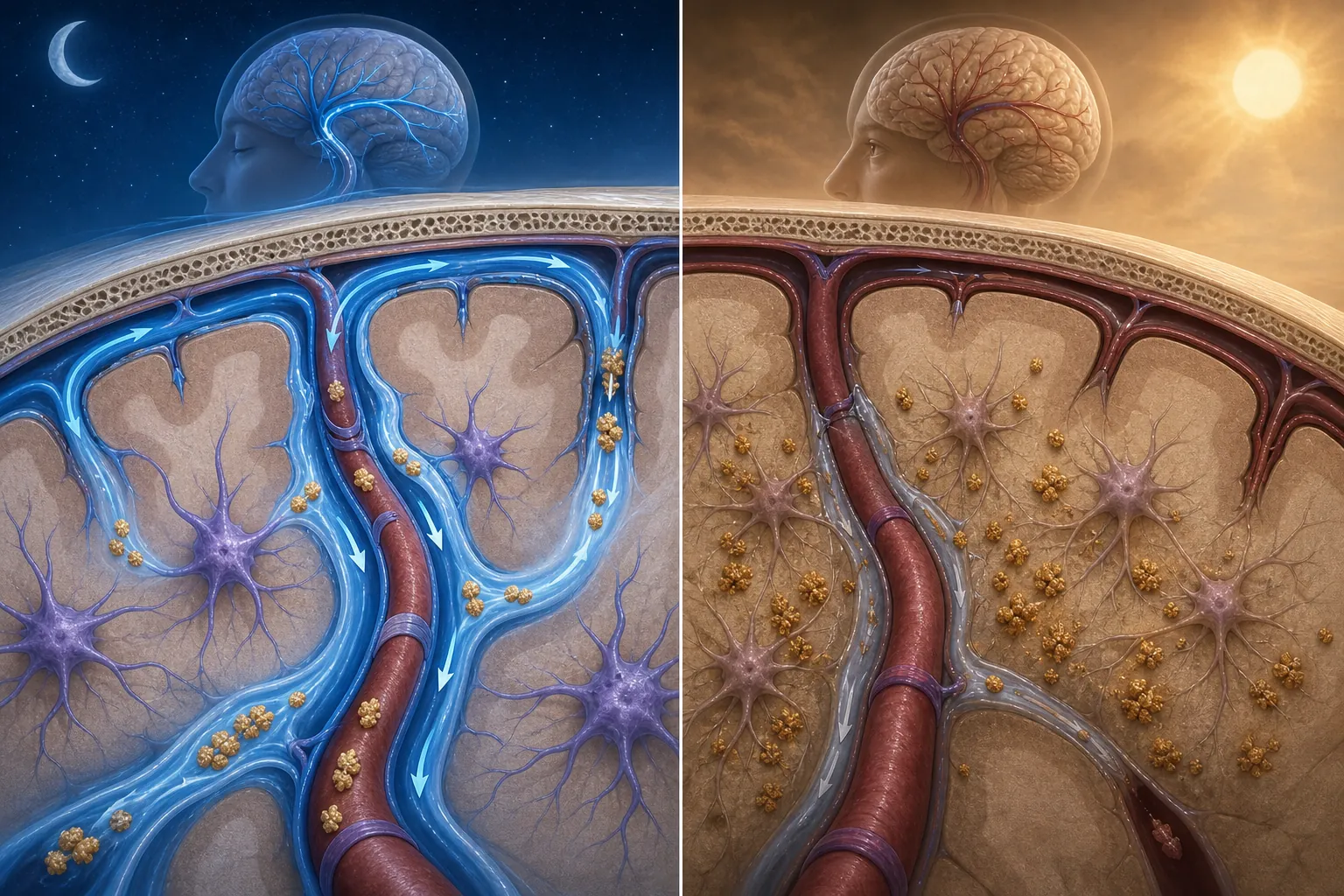
Peer-reviewed reviews describe a striking gap: glymphatic clearance of beta-amyloid is reported as about 90% lower during wakefulness than during sleep, and the brain clears roughly double the protein during deep sleep.[1][2] That figure is memorable, but it needs a guardrail. Much of the most precise clearance work behind these estimates comes from animal research, especially rodent studies. It should not be presented as a clean, directly measured human percentage for every older adult.
Even with that caveat, the direction is hard to ignore. Deep sleep is not just the part of the night that feels satisfying in the morning. It is a biological state in which the brain appears better able to move waste products away from neural tissue. If sleep becomes fragmented before the brain reaches or sustains those stages, the clearance window narrows.
This helps explain why older-adult sleep problems deserve more respect than they often get in exam rooms and family conversations. A person who wakes every hour is not simply losing comfort. They may be losing repeated access to the sleep architecture that supports amyloid handling. That does not prove that their insomnia will cause Alzheimer's disease, but it makes persistent sleep disruption worth evaluating.
Tau Makes the Sleep Problem Feel Less Abstract
Beta-amyloid often gets the public attention, but tau is where the sleep connection becomes especially concrete. Tau is a protein normally involved in stabilizing structures inside neurons. In Alzheimer's disease, abnormal tau changes are linked to tangles and neurodegeneration. For the person trying to understand why one bad night matters biologically, the key point is that tau appears responsive to sleep loss.
In research described by Washington University School of Medicine, one night of sleep deprivation raised cerebrospinal fluid tau by more than 50%.[3] That does not mean one sleepless night causes Alzheimer's disease. It means tau is not sealed off from short-term sleep-wake biology. The brain's protein environment changes measurably when sleep is withheld.
The older-adult evidence matters even more. Washington University researchers also studied 119 people age 60 and older who were cognitively normal or only very mildly impaired. Reduced slow-wave sleep was linked to higher tau burden, even after controlling for age, sex, and movement during sleep.[3] This is the bridge many readers need: the association was not limited to young lab volunteers staying awake under artificial conditions. It appeared in the age group where Alzheimer's risk becomes a real concern.
Slow-wave sleep is deep NREM sleep, marked by large, slow brain waves. It is easy to flatten that into the phrase "sleep quality," but that phrase is too vague. A person can spend enough hours in bed and still lose the stage of sleep most tied to amyloid clearance, tau regulation, and neural restoration. That is why sleep duration alone can be misleading. Seven or eight hours of fractured sleep is not biologically identical to consolidated sleep with adequate slow-wave activity.
This also helps explain why families sometimes notice a parent is "sleeping enough" but still seems unrefreshed, foggy, or increasingly irregular. The right question is not only how long the person is in bed. It is whether their sleep is repeatedly interrupted by breathing pauses, pain, bathroom trips, medication timing, alcohol, anxiety, or other treatable factors that prevent deeper NREM sleep from stabilizing.
Microglia Add a New Piece to the Cycle
The newest piece of this story is not another simple claim that plaques ruin sleep. A July 2026 report on University of Kentucky research points to microglia, the brain's resident immune cells, as a possible driver of sleep disruption in Alzheimer's models. In that study, researchers removed about 87% of overactive microglia and restored more than two hours of restorative NREM sleep per day, without changing amyloid plaque burden.[4]
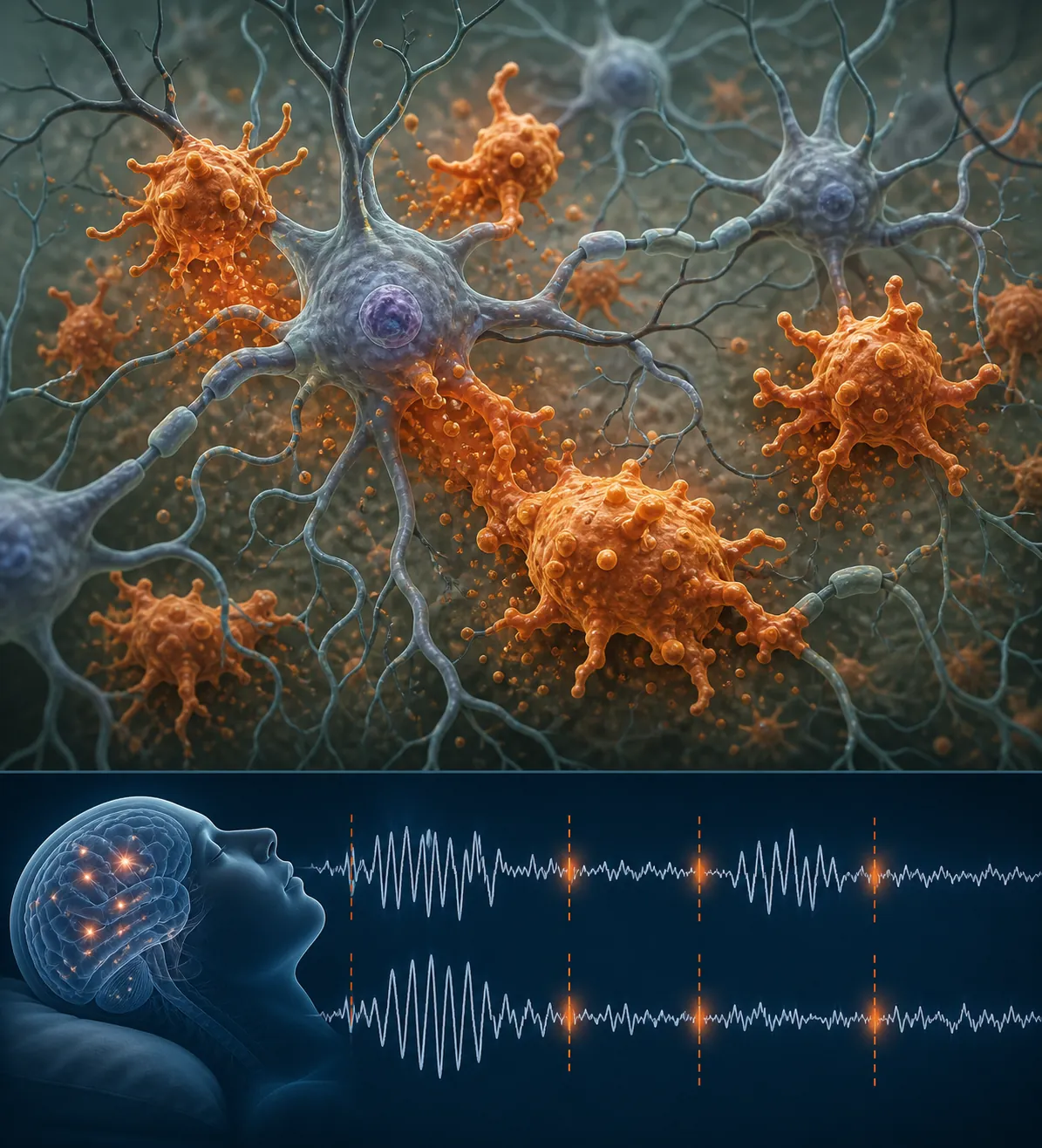
The caveat belongs in the same breath as the excitement: this was a mouse-model study, not a proven human treatment. It does not show that removing or suppressing microglia would safely improve sleep in people with Alzheimer's disease. Microglia also perform necessary immune and housekeeping functions, so the biology is not as simple as "less microglia is better."
Still, the finding changes the mental model. If restorative NREM sleep can improve while plaques remain unchanged, then plaques may not be the only sleep-disrupting actor. Immune activation itself may help fracture the very sleep stage the brain needs for recovery. That makes the loop more plausible: Alzheimer's-linked pathology activates immune responses; immune responses disrupt sleep architecture; disrupted sleep may then worsen amyloid and tau handling.
For older adults, this matters because sleep can look like a surface symptom while the underlying biology is deeper. Someone may say, "I just wake up too much now," and the family may chalk it up to age. Sometimes that is partly true. But if fragmented sleep reflects treatable apnea, inflammation, medication effects, pain, or another driver of repeated arousals, then ignoring it leaves a modifiable pressure on the system.
Why the Pathways Should Be Read Together
The three pathways are often easier to explain separately, but they probably do not behave separately in a living brain. Reduced deep sleep can weaken beta-amyloid clearance. Beta-amyloid and related pathology can activate microglia. Overactive microglia may fragment NREM sleep. Sleep deprivation and loss of slow-wave sleep are linked to higher tau. Tau pathology can then affect brain networks involved in sleep-wake regulation. The result is not a straight line. It is a loop with several entry points.
That loop is why the language around sleep and Alzheimer's needs to be careful. If sleep disruption appears years before diagnosis, one interpretation is that it is an early symptom of preclinical disease. Another is that sleep loss helps accelerate disease biology. The better answer may be both, depending on the person, timing, and underlying cause. The evidence supports bidirectionality, but it does not let anyone look at a sleep diary and calculate an individual's Alzheimer's future.
Large clinical summaries from Harvard Health and Cedars-Sinai also frame sleep as part of dementia-risk reduction, while avoiding the claim that sleep alone prevents Alzheimer's disease.[5][6] That distinction is important. Better sleep habits, diagnosis of sleep disorders, or treatment of insomnia may be sensible risk-reduction steps. They are not guarantees, and they are not substitutes for medical evaluation when cognition, mood, breathing, or safety changes.
What This Means for a 50- or 60-Something Who Sleeps Poorly
The practical implication is not to panic after a stretch of bad sleep. It is to stop treating chronic sleep fragmentation as a normal price of aging. If poor sleep continues for weeks or months, or if it comes with loud snoring, witnessed breathing pauses, morning headaches, daytime sleepiness, falls, confusion at night, worsening mood, or new memory concerns, it deserves a medical conversation.
The most useful first step is often not a supplement or a stricter bedtime routine. It is identifying the reason sleep is breaking apart. Obstructive sleep apnea can repeatedly interrupt oxygen and sleep depth. Pain can keep the nervous system on alert. Nocturia can carve the night into pieces. Some medications can worsen insomnia, vivid dreams, nighttime urination, or daytime sedation. Depression and anxiety can shift both sleep timing and sleep depth. These problems are common enough in older adulthood that they should be investigated before anyone assumes the explanation is brain degeneration.
- Ask whether sleep is short, fragmented, mistimed, or unrefreshing; each pattern points toward different causes.
- Screen for obstructive sleep apnea when snoring, pauses in breathing, morning headaches, or daytime sleepiness are present.
- Review medications and alcohol use, especially when awakenings or confusion worsened after a change.
- Treat pain, nocturia, mood symptoms, and restless legs as sleep problems, not only as separate complaints.
- Mention new memory changes to a clinician rather than using sleep quality alone to guess at Alzheimer's risk.
This is where the science becomes useful rather than frightening. If sleep affects amyloid clearance, microglial activity, and tau biology, then treating sleep problems is not cosmetic. It is a reasonable part of protecting brain health in the years when Alzheimer's risk begins to matter more.
The Disciplined Bottom Line
Poor sleep is not just a symptom that appears after Alzheimer's disease has already damaged the brain. It can participate in a feed-forward pathway: less deep sleep may reduce beta-amyloid clearance; immune activation may fragment NREM sleep; sleep deprivation and reduced slow-wave sleep are linked to tau increases and tau burden. The strongest human-relevant signal is the connection between deep NREM sleep and tau in older adults, while the microglia findings are promising but still limited to mouse models.
Sleep quality alone cannot diagnose Alzheimer's disease, and it cannot prove an individual's future risk. But persistent sleep disruption in midlife and older adulthood is biologically serious enough to evaluate and treat. That is the useful conclusion: not fear, not certainty, but a modifiable pressure point in a disease pathway that no one should dismiss as merely being tired.
References
- Sleep deficiency promotes Alzheimer's disease development and progression — PMC/NIH
- Sleep and Alzheimer: The Link — PMC/NIH
- Decreased deep sleep linked to early signs of Alzheimer's disease — WashU Medicine
- Alzheimer's breakthrough: Scientists restore two hours of sleep without clearing brain plaques — ScienceDaily, 2026-07-19
- Sleep well — and reduce your risk of dementia and death — Harvard Health
- Can Sleep Lower Alzheimer's and Dementia Risk? — Cedars-Sinai
Explore the mechanism
Next step
Spot an error or have clinical feedback?
Because this article covers clinical, medication, or safety information, we use a moderated correction channel instead of open public comments. Let us know if something about “How Poor Sleep Drives Alzheimer's Pathology” needs a closer look.
Send feedback on this article