
How Poor Sleep Affects Cholesterol in Perimenopause
Poor sleep during perimenopause triggers a physiological cascade that alters cholesterol metabolism through circadian disruption, estrogen withdrawal, and inflammation, explaining why worsening sleep and rising cholesterol often appear together in midlife.
If your sleep started breaking apart in perimenopause and your cholesterol panel changed soon after, that timing is not strange. It is also not proof that you “let yourself go.” Sleep disturbance is reported by roughly 43% to 69% of women during the menopausal transition, although studies define sleep disturbance in different ways across countries and research designs.[1] Perimenopausal women have also been reported to be about 1.5 times more likely to have poor sleep than premenopausal women.[2]
On the cholesterol side, LDL often rises around the same life-stage window. Research from menopause-transition lipid trajectories describes an LDL increase of about 10% to 15%, or roughly 10 to 20 mg/dL, in the year surrounding the final menstrual period, with estrogen withdrawal affecting hepatic lipid handling.[3] That does not mean every LDL change in midlife is caused by sleep. It does mean the overlap deserves a better explanation than “age happens.”

The useful question is not simply whether poor sleep affects cholesterol in perimenopause. The more physical question is: what pipeline could connect a disrupted night to a changing lipid panel? Three pathways matter most here: the liver’s circadian clock, estrogen-sensitive lipid metabolism, and inflammation.
| Pathway | What changes | Why it matters for a lipid panel |
|---|---|---|
| Circadian liver signaling | Sleep loss can disturb clock-gene control of cholesterol-to-bile-acid conversion | Cholesterol clearance may become less efficient |
| Estrogen withdrawal | The liver receives a different hormonal signal during the menopausal transition | LDL can rise, HDL can become harder to interpret, and LDL particle type may shift |
| Inflammation | Sleep restriction can raise inflammatory cytokine signaling | Measured LDL may not always move in a simple risk-reflecting direction |
The liver clock is not a metaphor
Cholesterol is not only something that enters the body through food or leaves the bloodstream after a statin prescription. The liver is constantly making, packaging, recycling, and clearing cholesterol. One of its major clearance routes is conversion into bile acids, which then move through the bile system and intestine.
That process is timed. The liver has clock machinery that helps coordinate metabolism with the sleep-wake cycle, feeding cycle, and light-dark cycle. One part of that machinery is NR1D1, also known as REV-ERBα. In mechanistic research, sleep deprivation disrupted NR1D1 and reduced CYP7A1, the liver enzyme that converts cholesterol into bile acids; the effect was detectable within 24 hours.[4]
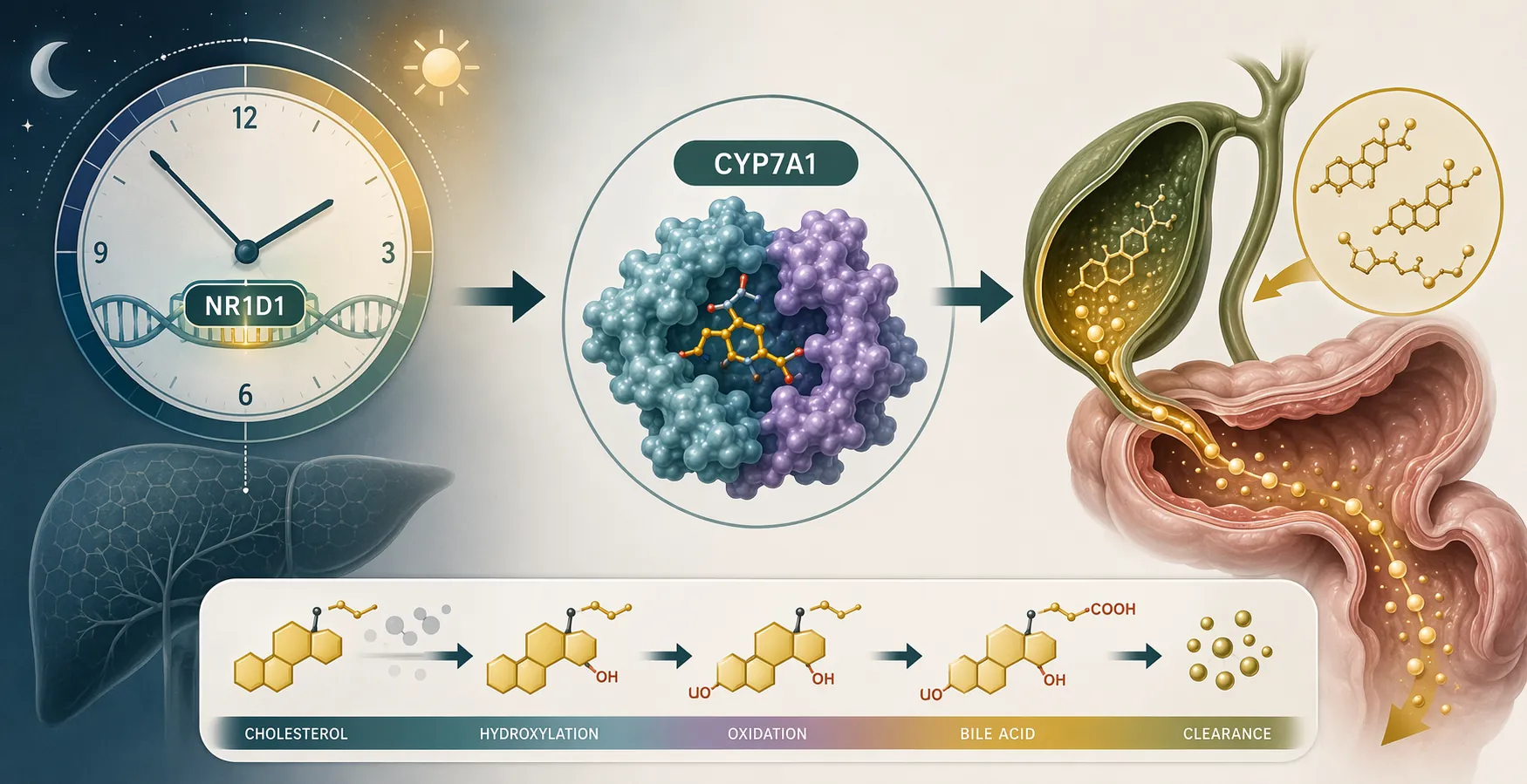
The sequence is important. NR1D1 helps regulate the timing of metabolic genes. CYP7A1 performs a rate-limiting step in bile acid synthesis. Bile acid synthesis is one way the body removes cholesterol from the hepatic cholesterol pool. When that rhythm is disturbed, the problem is not just that a person feels tired and eats differently the next day. The liver’s own cholesterol-disposal machinery may be receiving the wrong time signal.
This is the cleanest biological route from broken sleep to cholesterol handling, but it needs a boundary. The NR1D1-to-CYP7A1 evidence cited here comes from animal and mechanistic work, not a human trial in perimenopausal women showing that one night of insomnia directly raises LDL on a lab report.[4] It is strong as a plausible mechanism. It is not a completed clinical guarantee.
Perimenopause adds a second pressure on the same organ
Poor sleep can disturb liver timing in any adult. Perimenopause is different because the liver is also adapting to a changing estrogen environment. Estrogen affects hepatic receptors and lipid-metabolism pathways, so the menopausal transition is not just insomnia with a birthday attached to it.
Around the final menstrual period, LDL commonly rises by about 10% to 15%, or roughly 10 to 20 mg/dL.[3] For the person reading the lab report, that may look like a sudden personal failure. Biologically, it can reflect a liver receiving less estrogenic signaling at the same time sleep is becoming more fragmented. Two signals that normally help regulate metabolism are changing together: hormonal state and circadian timing.
HDL also becomes less straightforward. Before menopause, higher HDL-C has been associated with less carotid atherosclerosis; after menopause, higher HDL-C has been associated with greater carotid atherosclerosis in the cited research.[5] That does not mean HDL suddenly becomes “bad cholesterol.” It means HDL-C, the amount of cholesterol carried inside HDL particles, may not fully describe HDL particle function during and after the transition.
This distinction matters because standard lipid panels are blunt instruments. They usually report total cholesterol, LDL-C, HDL-C, triglycerides, and sometimes calculated ratios. They do not tell you whether LDL particles have become smaller, denser, or more numerous unless additional testing is ordered.
Small dense LDL deserves attention here because it is considered a more atherogenic LDL subtype. Research cited from LDL-subclass work reported a 213% increase in small dense LDL during perimenopause, a change that would not necessarily be visible on a standard lipid panel.[6] That number should not be stretched into a universal claim about every woman’s particle profile. It does explain why a familiar LDL-C number can hide a deeper remodeling of lipoproteins during the menopausal transition.
Inflammation can make the panel look less logical
Once the liver-clock and estrogen pieces are in place, inflammation adds a less intuitive layer. People often expect poor sleep to push LDL upward in a clean, linear way. Sometimes risk biology is messier than that.
In a trial of prolonged mild sleep restriction, participants reduced sleep by 1.5 hours for 6 weeks. In premenopausal women, LDL-C decreased by 6.3 mg/dL while inflammatory markers IL-6 and TNF-α rose, a pattern the authors discussed in relation to the lipid paradox seen in chronic inflammatory disease.[7] The perimenopausal and postmenopausal subgroup in that study was small, including only 12 postmenopausal women, so it should not be used to make a broad perimenopause-specific claim.[7]
Still, the finding is useful because it interrupts an oversimplified reading of cholesterol. A lower LDL-C number is not always a complete reassurance if inflammatory signaling is rising at the same time. Inflammation can alter lipid metabolism, lipoprotein behavior, vascular biology, and the meaning of a single measured cholesterol value.
Observational data in perimenopausal women also support the idea that sleep problems carry cardiometabolic information beyond exercise habits alone. In women ages 45 to 55, sleep problems were associated with higher dyslipidemia risk regardless of physical activity level.[8] That does not prove sleep problems caused the dyslipidemia. It does make it harder to dismiss sleep as merely a marker for inactivity.
What this means when your LDL rises during bad sleep
A changing cholesterol panel in perimenopause still deserves ordinary medical attention: family history, blood pressure, glucose status, thyroid function when relevant, medications, diet pattern, alcohol, movement, and overall cardiovascular risk all matter. None of the sleep biology cancels conventional lipid care.
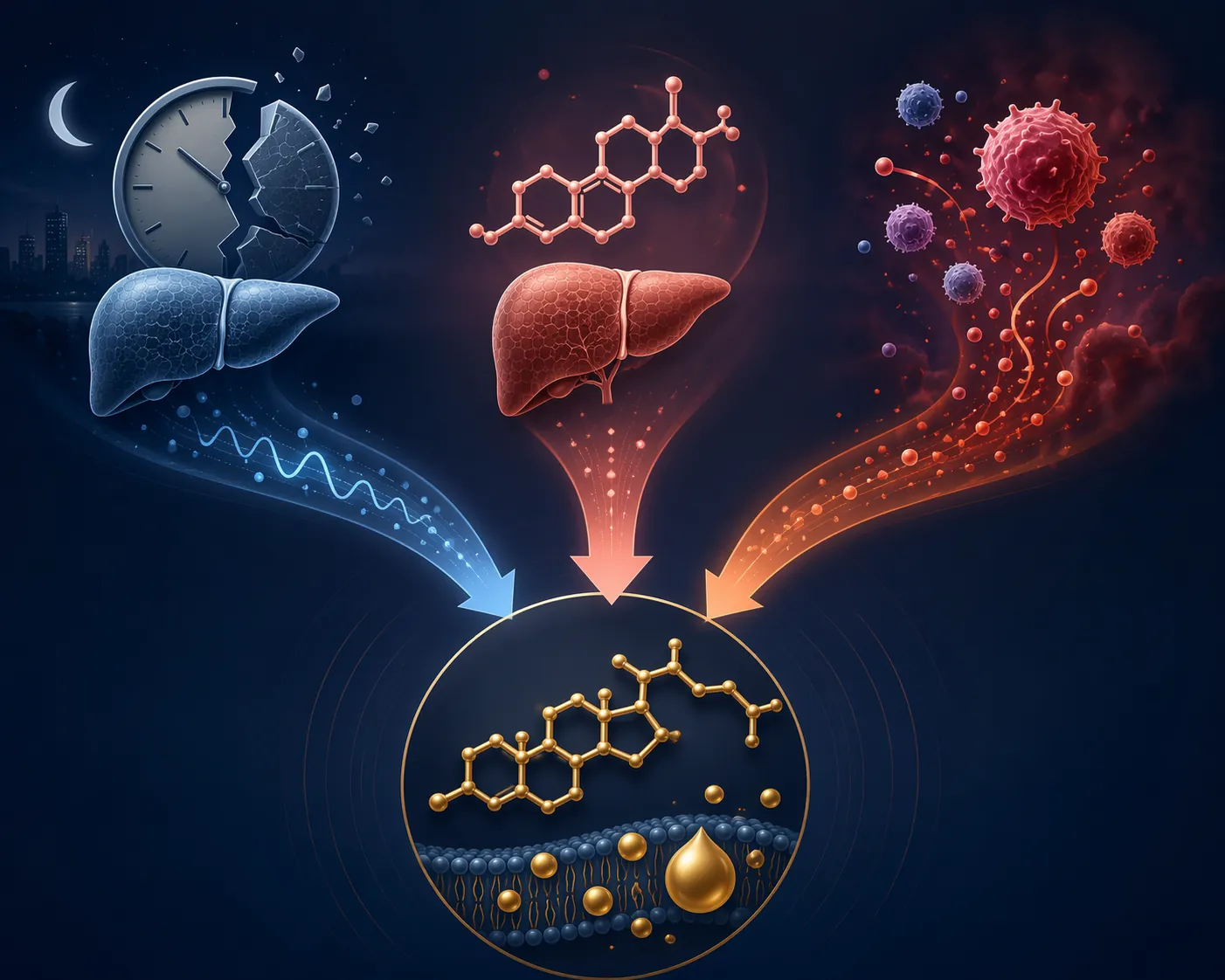
But the sleep piece changes the interpretation. If the LDL rise arrived during months of 3 a.m. waking, night sweats, shortened sleep, or wired-but-exhausted insomnia, the body is not presenting two unrelated complaints. It is presenting a life-stage shift in which the liver’s clock, estrogen-sensitive lipid pathways, and inflammatory signaling may be moving at the same time.
That is also why “just improve sleep” is too thin as advice. Sleep support may be important, especially when insomnia is entrenched, but current evidence is stronger for a converging physiological model than for a promise that better sleep alone will reliably lower cholesterol in every perimenopausal woman. Reviews of menopausal-transition sleep and cardiometabolic health note that fewer randomized trials have tested whether sleep improvement specifically reduces cholesterol in perimenopause.[1]
The calibrated takeaway is this: poor sleep in perimenopause is not merely coincidental with cholesterol changes, and it is not merely a lifestyle proxy. It can plausibly feed cholesterol remodeling through circadian liver disruption, estrogen-related hepatic changes, and inflammatory signaling. The lab report is real. So is the sleep collapse. The biology gives them a shared route, even where the clinical trial evidence is still incomplete.
References
- Sparks & Wang 2025 narrative review on sleep disturbance during the menopausal transition, PMC, 2025.
- Hwang et al. 2021 study on poor sleep likelihood in perimenopausal women, 2021.
- Dai et al. 2023 SWAN trajectories study on LDL changes around the final menstrual period, PMC, 2023.
- Xing et al. 2020 study on sleep deprivation, NR1D1, CYP7A1, and bile acid synthesis, Frontiers in Genetics, 2020.
- El Khoudary et al. 2016 study on HDL-C and carotid atherosclerosis before and after menopause, 2016.
- LDL subclasses paper on small dense LDL changes during perimenopause, PMC.
- Barragán et al. 2023 trial on prolonged mild sleep restriction, LDL-C, IL-6, and TNF-α, Journal of the American Heart Association, 2023.
- Du et al. 2022 study on sleep problems, physical activity, and dyslipidemia risk in perimenopausal women, BMJ Open, 2022.
Explore the mechanism
Next step
Spot an error or have clinical feedback?
Because this article covers clinical, medication, or safety information, we use a moderated correction channel instead of open public comments. Let us know if something about “How Poor Sleep Affects Cholesterol in Perimenopause” needs a closer look.
Send feedback on this article