
How to Layer IKEA Cooling Bedding for Menopause Night Sweats
This article maps IKEA's four-level cooling bedding system to the predictable hot-then-cold cycle of a vasomotor episode, explaining which products to layer and why to reduce sweat severity and prevent the chills phase. It helps perimenopausal and menopausal readers choose and combine sheets, duvets, pillows, and mattress toppers based on physiology, not marketing.
Evidence layer: physiology and behavioral sleep-management guidance, last reviewed July 29, 2026. This is informational only; IKEA cooling bedding for menopause night sweats can help manage heat, sweat, and damp bedding, but it does not treat the hormonal trigger behind vasomotor symptoms.
The part that gets underreported is not just waking hot. It is the whole little disaster: heat surges, sweat hits the sheet, the duvet traps or releases warmth at the wrong moment, and then the damp fabric turns cold against the body. Menopause night sweats are tied to estrogen fluctuation and a narrowed thermoneutral zone in the hypothalamus, which helps explain why the body can move from overheated to chilled so abruptly during a vasomotor episode.[1]
That sequence is why bedding has to be layered by job, not by the vague promise of being “cooling.” The sheet has to take sweat first. The duvet has to avoid trapping too much heat while still preventing the cold-after-wet phase. A pillow can help when heat concentrates around the head and neck. A topper belongs last because it changes the whole sleep surface and costs more.
If this is happening often, it is not a niche annoyance. Midi Health summarizes 2025 AASM data showing that 75% of women experience vasomotor symptoms during menopause, and 35% of women ages 45–64 say night sweats disrupt their sleep.[2] The numbers do not make the laundry easier, but they do confirm that this is a common sleep problem, not personal fussiness.
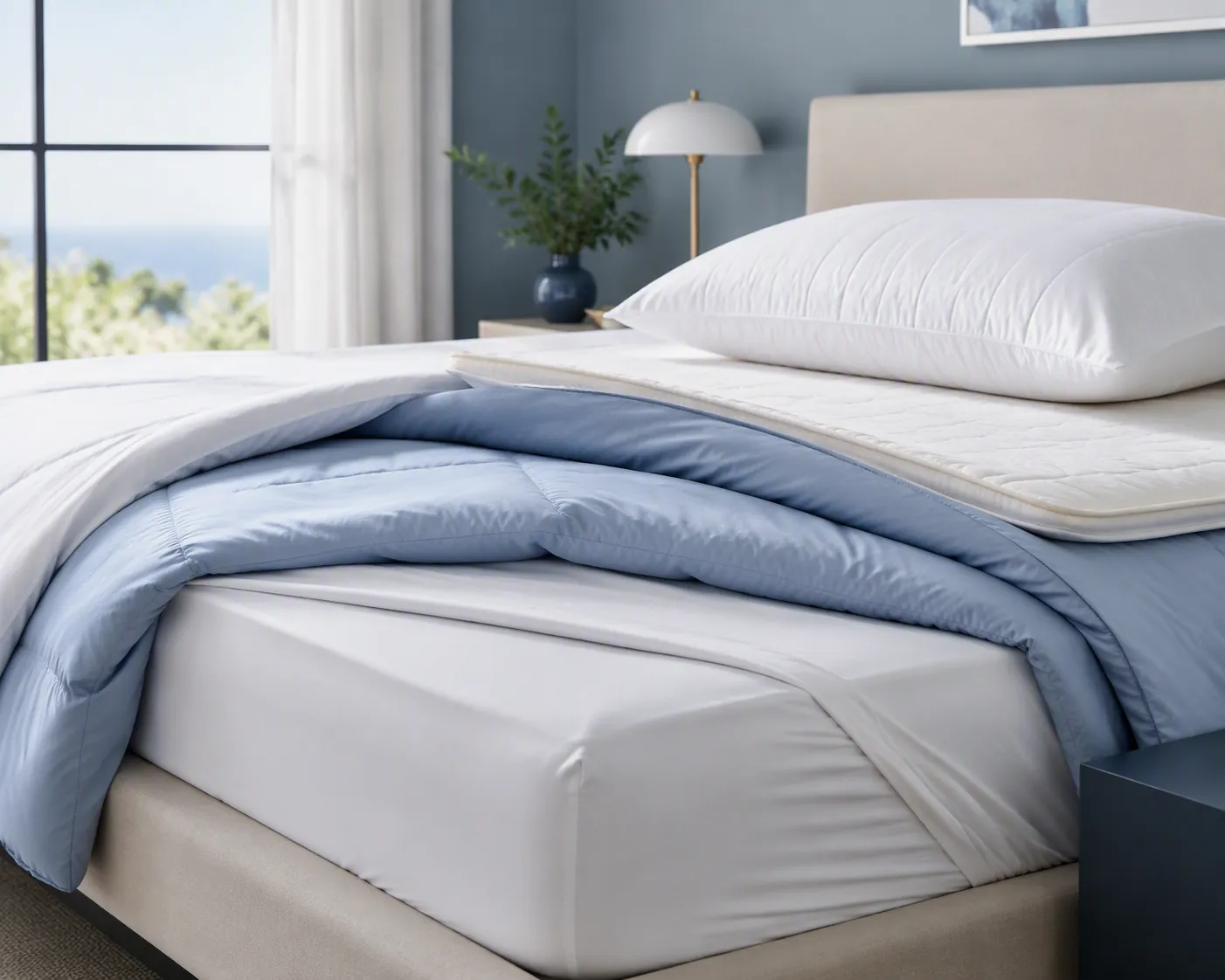
The four-layer order that actually matches the episode
IKEA’s cooling bedding approach is most useful when treated as a sequence. Start where the sweat lands, then work outward. Sleep Foundation’s cooling-sheet guidance also puts fabric breathability and moisture handling at the center, which is exactly where menopause night sweats become a bedding problem rather than just a room-temperature problem.[3]
| Layer | Main job during a night sweat | IKEA direction |
|---|---|---|
| 1. Sheet | Touches skin, takes sweat first, reduces clammy contact | Breathable lyocell/cotton sheets |
| 2. Duvet insert | Manages trapped warmth without leaving the sleeper chilled | BLÅNEPETA or GRÄSROTSFLY cooling duvet insert |
| 3. Pillow | Targets head and neck heat that can wake you fast | KVARNVEN, KLUBBSPORRE, or SENAPSMOTT |
| 4. Mattress topper | Adds active sleep-surface cooling, mainly at sleep onset | NÄSTABERG PCM-gel memory-foam topper |
IKEA’s own cooling-bed essentials place bedding components in a similar practical hierarchy: sheets, duvet, pillow, and mattress surface all matter, but they do not matter in the same way.[4] For menopause, that distinction is the whole point. A cold pillow cannot fix a damp cotton sheet. A fancy topper cannot rescue a duvet that keeps heat parked over the torso.
Level 1: start with the sheet, because sweat does
The first layer should be boringly competent. It sits against the skin during the hot phase, takes the first hit of moisture, and decides whether the next half hour feels merely uncomfortable or like lying in a cold washcloth. For this job, breathable lyocell/cotton sheets make more sense than chasing a dramatic cool-to-the-touch claim.
Lyocell matters because it is usually smooth, breathable, and moisture-managing; cotton adds familiar washability and structure. Sleep Foundation’s cooling-sheet guidance emphasizes breathable materials and moisture wicking rather than one magic fabric, which is the right standard here.[3] During a vasomotor episode, the sheet is not being asked to stop sweating. It is being asked to keep the sweat from sitting hot, then cold, against the skin.
This is also the place to be careful with “cool-touch” language. A fabric can feel cool for the first second and still perform poorly once the sleeper is damp. Qmax values measure initial contact coolness, not sustained temperature regulation through a night sweat; one brand-owned comparison reports Qmax 0.46 for its fabric versus 0.11 for cotton and 0.15 for bamboo rayon, but that kind of number is best treated as a narrow contact-cooling metric, not proof that a whole bedding system will work through the hot-then-cold cycle.[5]
If the budget only allows one change, change the sheet first. Not because it is glamorous, but because it is the layer that has the least room for error at 3 a.m.
Level 2: choose the duvet for the chill after the sweat
The duvet has a harder job than most product pages admit. During the heat surge, too much insulation makes sweating worse. After the sweat, too little cover leaves the sleeper chilled. This is where IKEA’s cooling duvet inserts become more interesting than an ordinary lightweight comforter.
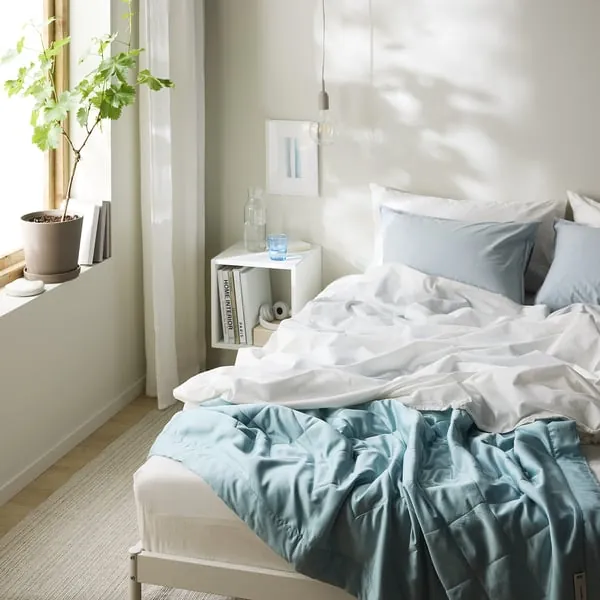
BLÅNEPETA is the stronger first duvet candidate for this specific problem. As of July 29, 2026, IKEA lists the Full/Queen BLÅNEPETA cooling duvet insert at $69.99, with a 4.4-star rating from 85 reviews, and the review signal is unusually relevant: multiple users specifically mention hot flashes or night sweats rather than generic warm sleeping.[6] That matters because menopause night sweats are not the same as preferring a crisp hotel-bed feel.
The drawback is plain: BLÅNEPETA is light blue. If the color does not work in the room, it needs a duvet cover, and the cover should not undo the cooling work underneath. A dense decorative cover may look better and sleep worse.
GRÄSROTSFLY is more complicated. Its appeal is the wax-infused viscose technology: IKEA says that, in its cooling range, a higher viscose content corresponds to a higher cooling effect.[7] Homes & Gardens tested GRÄSROTSFLY and reported “no sweating or chills” and that the reviewer “fell asleep quickly without waking drenched,” which is exactly the result a night-sweat sleeper wants to hear.[8]
But GRÄSROTSFLY should not be treated as a sure thing. As of July 29, 2026, the Twin size is listed at $49.99, and IKEA’s U.S. review signal is mixed at 3.8 stars from 151 reviews; some sleepers say it helped with night sweats, while others still find it warm. That split is not a reason to dismiss it. It is a reason to avoid pretending that wax-infused viscose behaves the same on every body, in every room, under every cover.
PopSugar’s review of the discontinued Stjärnstarr comforter is useful only in a limited way. The reviewer described “dramatically improved sleep” from a hot-sleeper perspective, and the product used the same broad wax-infused viscose idea.[9] Since Stjärnstarr is no longer the product on the shelf, that review supports the technology concept, not a current buying recommendation.
BLÅNEPETA or GRÄSROTSFLY?
For menopause night sweats, BLÅNEPETA gets the edge because the available user feedback names hot flashes and night sweats directly.[6] GRÄSROTSFLY remains appealing if you want the lower entry price or are curious about the wax-infused viscose behavior, but its mixed rating deserves respect. A product that solves one sleeper’s drenched wake-up can still feel too warm to another.
Level 3: add a pillow if the heat starts at the head and neck
A cooling pillow is not the foundation of the system. It is a targeted add-on for the sleeper who wakes because the neck, scalp, or face feels hot before the rest of the bedding has even become the problem. IKEA’s cooling pillow options, including KVARNVEN, KLUBBSPORRE, and SENAPSMOTT, make the most sense in that narrow role.
This is where a small product can feel disproportionately helpful. Cooling the head and neck may reduce the discomfort that makes a vasomotor episode feel urgent, even though it does not stop the episode itself. If the main complaint is a soaked torso and cold sheets, spend the money below the pillow first. If the main complaint is flipping the pillow over six times before sleep, the pillow layer earns its place.
Level 4: the topper is for a specific pattern, not everyone
NÄSTABERG is the tempting escalation: a mattress topper with a paraffin-based phase-change-material gel coating on memory foam. IKEA lists it from $199 to $289, with the Queen at $249 as of July 29, 2026, and describes cooling that works for roughly the first 20 minutes as the sleeper settles in.[10]
That 20-minute window is not nothing. Sleep onset can be a vulnerable time for temperature swings, and a cooler surface may help a sleeper get through the wake-to-sleep transition with less heat buildup. But it is not the same as all-night active cooling. If your worst episodes happen at 2 a.m. or 4 a.m., the topper may still improve the feel of the bed, but the published cooling claim is strongest at the beginning of the night.[10]
The other tradeoff is memory foam. Some people like the pressure relief; others dislike the contouring, the slower response, or the possibility that foam changes how warm the bed feels after the initial cooling phase. Since NÄSTABERG costs several times more than the duvet inserts, it belongs after the sheet-and-duvet experiment, not before it.
A buying sequence that does not overbuild the bed
The simplest approach is to buy in the same order the episode reaches the bed. That keeps the system affordable and makes it easier to tell which layer helped.
- If you wake damp but not drenched, start with breathable lyocell/cotton sheets and reassess before adding more.
- If you sweat through the sheet and then get chilled, add BLÅNEPETA first; consider GRÄSROTSFLY if price or the wax-infused viscose design matters more to you than the mixed review signal.
- If head and neck heat wake you before the sweat does, add a cooling pillow rather than replacing the whole bed setup.
- If sleep-onset heat is the stubborn pattern, or if the first two layers help but not enough, then consider NÄSTABERG.
One useful test is to change only one layer at a time for several nights. Menopause sleep is already variable enough; changing the sheet, duvet, pillow, pajamas, and fan setting all at once makes it impossible to know what helped. Washability matters, too. A cooling layer that cannot handle frequent laundering is not much of a menopause layer.
What bedding can and cannot do
Good layering can reduce the severity of the sweat phase, move moisture away from the skin, and soften the cold rebound that follows. It can make the bed less adversarial. That is a real gain.
It cannot widen the thermoneutral zone, regulate estrogen fluctuation, or diagnose why night sweats are happening. If night sweats are severe, escalating, newly unusual for you, or accompanied by other concerning symptoms, bedding should not be the whole plan. That is the point to bring the pattern to a clinician.
For a practical IKEA setup, the calibrated answer is straightforward: start with breathable lyocell/cotton sheets, pair them with the more menopause-relevant BLÅNEPETA duvet insert if the chill-after-sweat phase is the problem, add a cooling pillow only when head and neck heat are part of the wake-up, and reserve NÄSTABERG for sleep-onset heat or persistent episodes that justify the higher cost.
References
- Night Sweats in Women, Sleep Foundation
- Menopause Statistics, Facts & Latest Research for 2026, Midi Health
- Best Cooling Sheets of 2026, Sleep Foundation
- How to keep cool at night: the essentials for quality sleep, IKEA
- Cooling Bedding for Menopause Night Sweats: The Full System from Sheets to Comforter to Eye Mask, Breescape
- BLÅNEPETA duvet insert, cool, light blue, IKEA
- Bed textiles cooling range, IKEA
- I tried IKEA's cooling duvet insert and finally stopped waking up drenched in sweat, Homes & Gardens
- I Tried Ikea's Cool Comforter, and I Haven't Woken Up Hot Since, PopSugar
- NÄSTABERG mattress topper, white, IKEA
Explore the mechanism
Next step
Spot an error or have clinical feedback?
Because this article covers clinical, medication, or safety information, we use a moderated correction channel instead of open public comments. Let us know if something about “How to Layer IKEA Cooling Bedding for Menopause Night Sweats” needs a closer look.
Send feedback on this article